
Key takeaways
- A headcount plan answers the question of how many people each department needs, and it should be calculated from measured workload rather than from the current number of staff plus whatever the head of department proposes.
- Businesses usually combine three methods, namely calculating by volume and standard time for repetitive work, by standard ratios for management and support positions, and by the number of shifts and posts for staffed-post work.
- The hours used in the calculation must be effective hours after deducting public holidays, annual leave, meetings, training and reasonable interruptions, and must not rely on the assumption that employees regularly work overtime.
- The headcount plan is an internal plan approved by the competent person, whereas labour norms used to assign work and pay wages must be piloted, consulted on and publicly announced in accordance with the Labour Code.
- The headcount plan should be approved each year together with the payroll budget and reviewed each quarter or whenever workload changes significantly.
During the annual planning season, the board of directors of a distribution company received two recruitment proposals. The warehouse and logistics unit asked for five more people because orders had increased, and the accounting department asked for two more because it had more invoicing and reconciliation to do. With no data to compare, the board approved the requests on instinct and according to how persuasive each head of department was. Six months later, the warehouse was still working overtime continuously at the end of every month, while some people in the accounting department did not have enough work and the payroll budget had been exceeded.
A headcount plan is a tool for answering the question of how many people each department needs on the basis of data rather than instinct. This article covers the concept of a headcount plan and when one is needed, three common calculation methods, a six-step process, how to determine effective working hours within the statutory limits on working time, a worked example and how to link the headcount plan to labour norms, the payroll budget and recruitment. The content suits businesses with around 30 or more employees, and it is written mainly for directors, heads of HR, finance directors and heads of departments.
What a headcount plan is and when a business needs one
A headcount plan sets the number of people a department or job title needs to complete the expected workload in a planning period, usually one year. A headcount plan is different from a labour norm. A labour norm is the quantity of output or the standard time for one person to complete one unit of work, whereas the headcount plan is the result of multiplying the total workload by the norm and dividing it by the working hours of one person. In terms of sequence, a business must first have norms or standard times before it can calculate a headcount plan on a sound basis.
A headcount plan does not need to be redone every month, but a business should build or update it when it faces one of the following situations:
- The business is preparing its annual budget and needs a well-founded estimate of the payroll budget.
- Departments keep proposing to recruit more people, but the board has no yardstick for approving or rejecting the requests.
- The business opens a branch, adds a production line or a product line, or scales back an area of activity.
- One department regularly works overtime while another shows signs of having too many people.
In all four situations, the headcount plan shifts the discussion from who needs more people to how much work there really is and how many working hours are needed to complete it. When workload falls, the same calculation also shows which departments have too many people, which is the input for reorganising the business.
Three methods for determining headcount
No single method can be applied to every position. Repetitive, measurable work should be calculated by volume, management and support work that is hard to measure should be calculated by ratio, and work that must be staffed regardless of volume should be calculated by shift. The table below summarises the three methods.
| Method | Suitable for | Main calculation |
|---|---|---|
| By volume | Customer service, accounts payable and receivable, warehousing and logistics, production and other measurable repetitive work. | Total working hours needed in the period divided by the effective working hours of one person. |
| By standard ratio | Team leaders, middle managers and support positions such as HR and administration. | Apply an internal or industry reference ratio, for example one team leader for every six to ten staff. |
| By shift and post | Security, system operations, warehouse duty, reception and other posts that must be staffed continuously. | Number of posts per shift multiplied by the number of shifts, plus cover for weekly rest days and annual leave. |
Most businesses combine all three methods in a single headcount plan. Production and service units are calculated by volume, management by ratio and staffed posts by shift. Standard ratios should be taken from the business’s own data over several years or from businesses of similar size in the same industry, and adjusted for the level of automation, because an HR department using automated timekeeping and payroll software can serve considerably more employees than one that works manually.
Calculating headcount for shift-based posts
For posts that must be staffed continuously, the number of people depends not on volume but on the number of hours that must be covered. For example, if a warehouse operates two shifts a day, each of 8 hours, seven days a week, and needs one security guard per shift, the total number of hours to be covered in a week is 112. If each person works 48 hours a week, around 2.3 people are needed, but after allowing cover for weekly rest days, annual leave and public holidays, the actual headcount is usually 3 people. The business should not fill the gap by scheduling one person for two consecutive shifts, because this easily exceeds the limits on working hours and overtime.
A six-step process for building the headcount plan
A reliable headcount plan requires the participation of the heads of departments, the HR department and the finance function, and it must be approved by the competent person. The flowchart below describes the six steps in sequence, from listing tasks to approval.
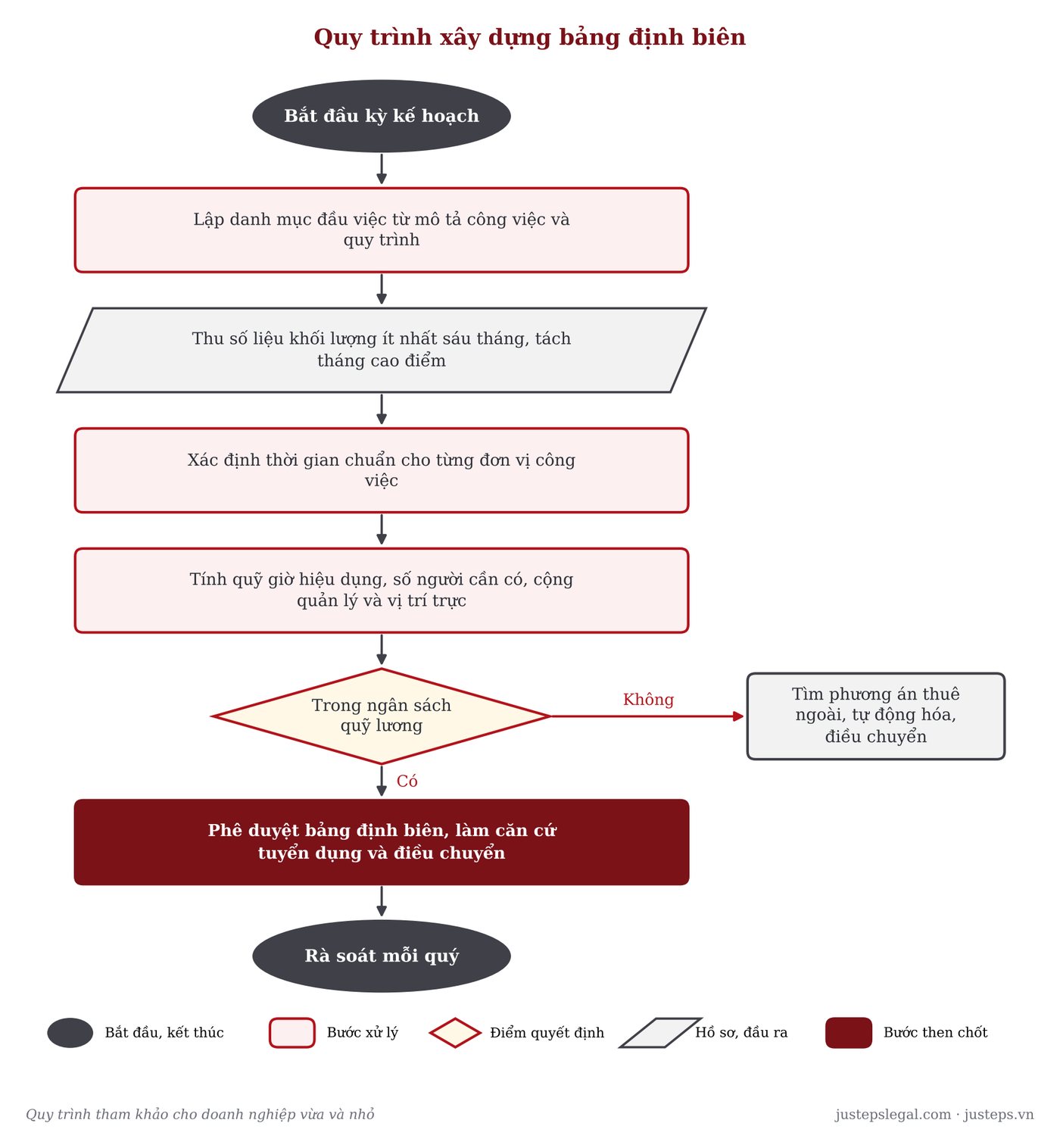
Six-step process for building a headcount plan
The first step is to list the tasks of each department, based on the job descriptions and current processes. Next, the head of department provides workload data for at least the last six months, separating out the peak months, and the HR department determines the standard time for each unit of work by timing tasks, observing a working day or taking data from software. The HR department then calculates the effective working hours and the number of people needed, adds management positions by ratio and staffed posts by shift, and compares the result with the current headcount. Finally, the finance function checks the result against the payroll budget before submitting it for approval, and if the budget is exceeded the plan goes back to the calculation step to look for options such as outsourcing, automation or internal transfers.
Roles in the process need to be clear so that the headcount plan does not become a matter for the HR department alone. The head of each department is responsible for the task list and the workload data of their department, the HR department is responsible for the calculation method, standard times and working hours, the finance function is responsible for checking against the budget, and the General Director gives final approval. When a head of department disagrees with the result, they need to point out which workload data or standard times are incorrect, instead of simply proposing the number of people they would like.
Calculating effective working hours within the limits on working time
The working hours of one person are the denominator of the headcount calculation, so an error here makes the whole headcount plan wrong. Under the Labour Code, normal working hours must not exceed 08 hours a day or 48 hours a week[1]. An employee who has worked for 12 full months under normal conditions is entitled to 12 working days of annual leave with full pay[2], as well as public holidays and Tet holidays as prescribed[3]. The labour legislation amended in 2026 adds paid public holidays, so when preparing the headcount plan for 2027, businesses need to update their holiday calendar according to the official text.
From the nominal working hours, the business deducts public holidays and annual leave averaged on a monthly basis, and then multiplies the result by an effectiveness factor to reflect time spent in meetings, training, switching between tasks and other reasonable interruptions. The effectiveness factor usually ranges from 80% to 90% depending on the nature of the work. The chart below illustrates how the nominal 176 hours per month of an employee working 22 days of 8 hours each are allocated.
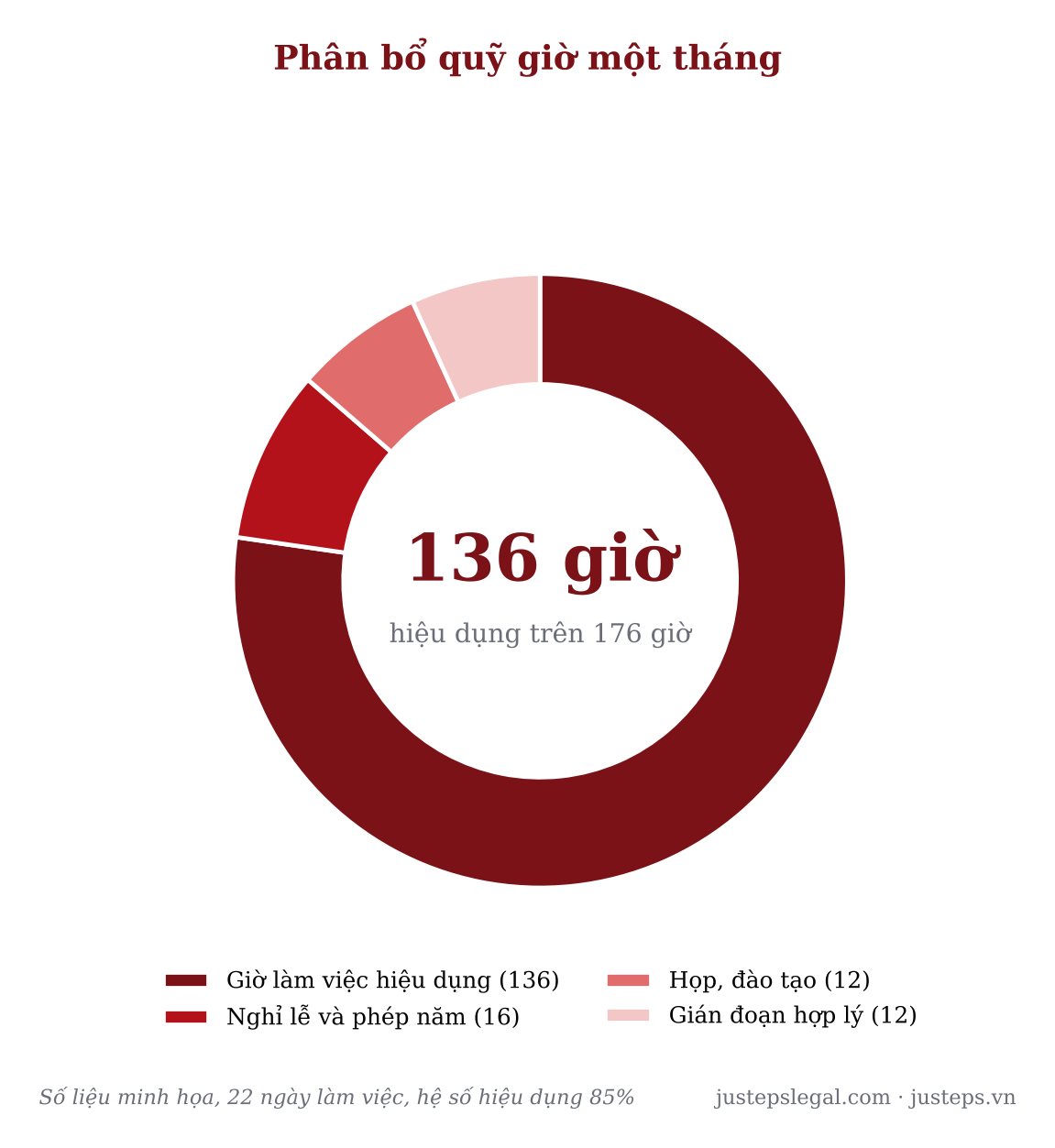
Allocation of an employee’s nominal monthly working hours
In the example, after deducting around 16 hours of public holidays and annual leave averaged on a monthly basis, 160 hours of attendance remain; multiplied by an effectiveness factor of 85%, the effective working hours come to 136. If the full 176 hours were used as the divisor, the headcount plan would be short by around one fifth of the people needed and the department would have to work overtime regularly. Overtime should be used only for short-term peaks, because overtime is limited in hours per day, month and year and requires the employee’s consent[4], so a headcount plan based on the assumption of regular overtime is both unsustainable and at risk of breaching the law.
Worked example of a headcount plan for the warehouse and logistics unit
Suppose that the warehouse and logistics unit of a distribution company has average data for the last six months as shown in the table below. The standard times were determined by timing several different employees over two weeks and taking the average, not the time of the fastest worker.
| Task | Volume and standard time | Working hours per month |
|---|---|---|
| Picking and dispatching orders | Around 4,800 orders per month, at 12 minutes per order. | 960 hours. |
| Receiving incoming goods | Around 600 consignments per month, at 30 minutes per consignment. | 300 hours. |
| Counting and arranging stock | A fixed workload based on the number of shelf locations in the warehouse. | 160 hours. |
| Reporting, meetings and training | A fixed workload for the whole unit. | 60 hours. |
| Total | Total working hours needed in a normal month. | 1,480 hours. |
With effective working hours of 136 per person, the number of staff needed is 1,480 divided by 136, which is approximately 10.9 and is rounded up to 11 people. Adding one warehouse manager at a ratio of one manager for around ten to twelve staff, the headcount for the unit is 12 people. The unit currently has 9 people, so it is short of 3 people, rather than the 5 originally requested. During the year-end peak months, the workload may rise by around 30%, but this increase should be met through seasonal workers or overtime within the permitted limits, and should not be built into the permanent headcount.
By applying the same calculation to the other departments, the business obtains a consolidated headcount plan to compare with its current staffing. The chart below illustrates the results for five departments of the company in the example.
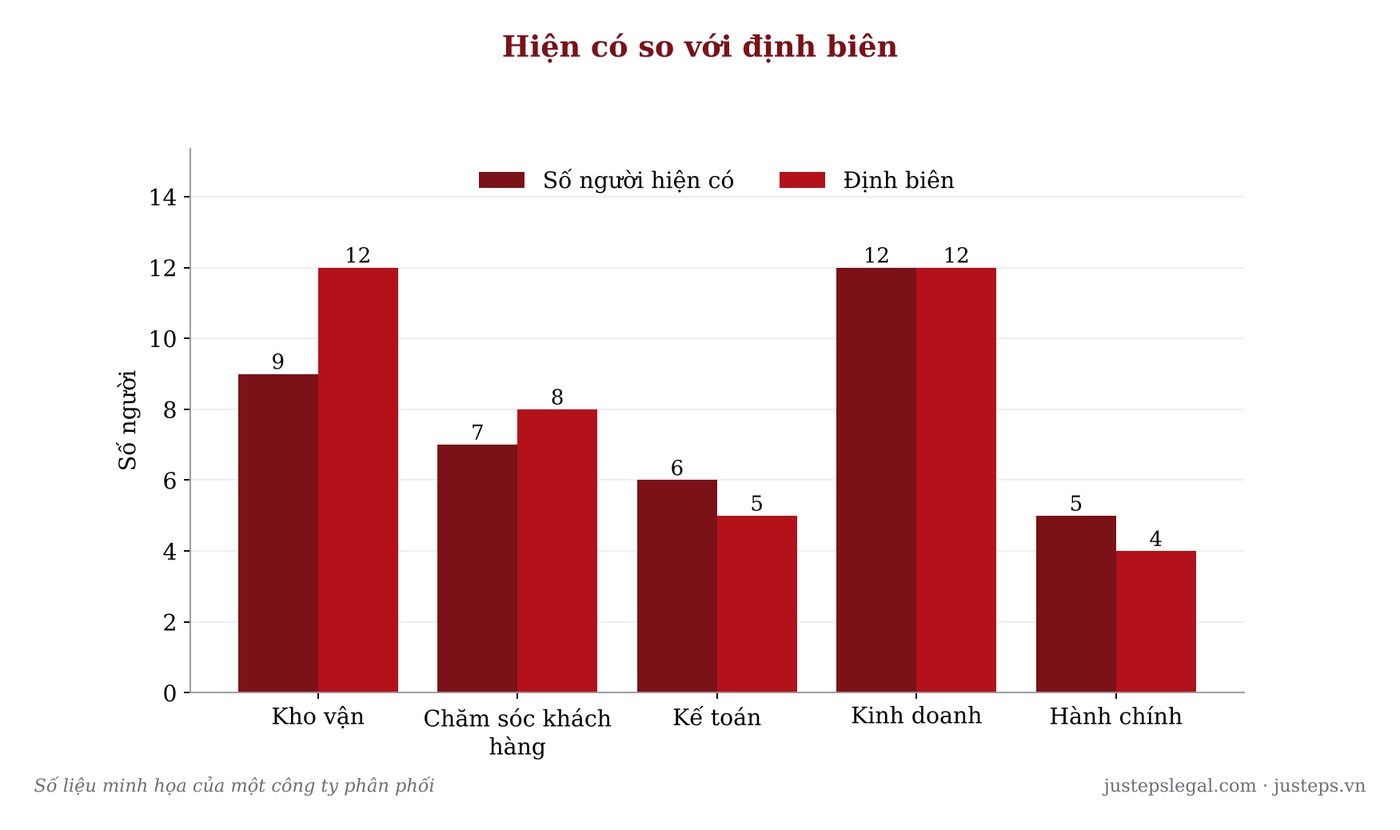
Current staff compared with the headcount plan for five departments
The results show that warehouse and logistics and customer care are short-staffed, sales has the right number of people, while accounting and administration each have around one person too many. Instead of recruiting for every short-staffed department, the business can transfer a suitable person from a department with surplus staff, with retraining, and recruit only for the remaining shortfall. The consolidated headcount plan should have columns for job title, current staff, planned headcount, difference, estimated payroll and the proposed action, namely new recruitment, transfer, outsourcing or no change.
Linking headcount to labour norms, the payroll budget and recruitment
The Labour Code requires the employer to develop wage scales, payrolls and labour norms as a basis for recruiting and using employees and for agreeing wage levels[5]. A labour norm must be an average level that ensures most employees can meet it without extending their normal working hours, and it must be piloted before being officially issued[6]. When developing labour norms, the business must consult the grassroots employee representative organisation, where one exists, and the norms must be publicly announced at the workplace before implementation[7]. This is also one of the cases in which the business must hold dialogue at the workplace[8].
In light of these provisions, the business should keep two types of document separate. The headcount plan is an internal plan for the number of people, approved by the General Director or the competent level under the internal regulations, and it is not subject to a procedure for consulting employees. Labour norms and standard times, when used to assign work, assess performance or pay wages, must go through all the steps of piloting, consultation and public announcement. Using the standard times in the headcount plan to deduct wages or to assess an employee as failing to complete their work before these steps have been taken is a mistake that easily leads to complaints.
The headcount plan must also go hand in hand with the payroll budget. Each position in the headcount plan needs to be linked to a pay grade in the wage scale so that the finance function can calculate the estimated payroll, including the employer’s social insurance contributions. When the headcount plan increases or reduces the number of employees, the business must also update the labour management register and report changes in the workforce as required[9]. If the headcount plan shows that positions must be cut because of structural change, the business must follow the procedure for preparing a labour utilisation plan under the Labour Code[10], and may not let employees go solely on the basis of the headcount plan. Businesses that need to align their headcount plan with their wage scales may refer to Justeps’ service for developing salary scales and pay and bonus regulations.
Common mistakes and periodic review
The most common mistake is to take the current number of staff as the headcount plan and then add to it according to proposals, without measuring workload. The second mistake is to take standard times from the fastest worker, so that most employees cannot meet them and have to work overtime. The third mistake is to use nominal working hours without deducting public holidays, annual leave, training and interruptions. In addition, many businesses do not link the headcount plan to the payroll budget and only discover that the budget has been exceeded after recruitment has been completed.
The headcount plan should be approved each year together with the budget and reviewed each quarter, or immediately when the workload of a department changes by more than around 15%. At each review, the HR department updates the workload data, rechecks the standard times for tasks whose processes or tools have changed, and reports the difference between the planned headcount and the actual number of staff. For businesses with fewer than 30 people, the approach can be simpler and cover only the main departments, but it still helps control the payroll budget and give a clear answer to each recruitment proposal. Businesses that need to build task lists, job descriptions and a headcount plan may refer to Justeps’ service for organisational structure, functions and duties, and job descriptions.
How Justeps can help
Justeps supports businesses in building and operating a headcount plan through the following services:
- Organisational structure, functions and duties, and job descriptions. Justeps lists tasks, measures workload and builds the headcount plan for each department.
- Salary scales and pay and bonus regulations. Justeps links each planned position to a pay grade and prepares the payroll budget estimate for the planning period.
- Working hours, overtime and timekeeping. Justeps drafts the labour norm regulation, the records for piloting, consultation and announcement, and the rules on overtime.
- Organisational restructuring and workforce streamlining. Justeps prepares the plan for rearranging employees when the headcount plan shows that positions need to be transferred or cut.
Frequently asked questions
How does a headcount plan differ from a labour norm?
A labour norm is the quantity of work or the standard time for one person to complete one unit of work. A headcount plan is the number of people a department needs, calculated from the norms and the total workload.
Does a business with fewer than 30 people need a headcount plan?
It is not mandatory, but a simple version for the main departments is advisable. A headcount plan helps control the payroll budget and gives a well-founded answer to requests for more staff.
Must employees be consulted on the headcount plan?
The headcount plan is an internal plan, so consultation is not mandatory. Labour norms used to assign work and pay wages, however, must be piloted, consulted on with the employee representative organisation where one exists, and publicly announced before implementation[7].
May the headcount plan assume that staff regularly work overtime?
This is not advisable, because overtime is limited in hours and requires the employee’s consent[4]. The headcount plan should be based on normal working hours, with overtime used only for short-term peaks.
What effectiveness factor should be used?
Usually between 80% and 90%, depending on how often the work is interrupted. Work involving many meetings, coordination or waiting time should use a lower factor.
If the headcount plan shows a surplus, can employees be let go immediately?
No. Where cuts result from structural change and affect many employees, the business must prepare a labour utilisation plan, consult and announce it in accordance with the Labour Code[10]. The business should give priority to transfers and retraining first.
How often should the headcount plan be reviewed?
The business should approve it each year together with the budget and review it each quarter. When the workload of a department changes significantly, for example by more than 15%, that department should be reviewed immediately.
Related articles
- Streamlining the organisation by merging or dissolving departments in the order required by labour law
- Building a job title and grade framework so that pay scales have a sound basis and employees can see their career path
- A guide to preparing the annual payroll budget for businesses
- How to write department functions and duties so that every task in a business has someone accountable for it
Notes
[1] Clause 1 of Article 105 of the Labour Code No. 45/2019/QH14 dated 20 November 2019.
[2] Clause 1 of Article 113 of the Labour Code No. 45/2019/QH14.
[3] Article 112 of the Labour Code No. 45/2019/QH14, as amended and supplemented.
[4] Article 107 of the Labour Code No. 45/2019/QH14.
[5] Clause 1 of Article 93 of the Labour Code No. 45/2019/QH14.
[6] Clause 2 of Article 93 of the Labour Code No. 45/2019/QH14.
[7] Clause 3 of Article 93 of the Labour Code No. 45/2019/QH14.
[8] Point c, Clause 2 of Article 63 of the Labour Code No. 45/2019/QH14.
[9] Article 12 of the Labour Code No. 45/2019/QH14.
[10] Articles 42 and 44 of the Labour Code No. 45/2019/QH14.
This article is for reference and reflects the regulations in force at the time of publication. Please consult Justeps for advice tailored to your company’s records and situation.
For further information, please contact:
📩 Email: info@justeps.vn
🌐 Website: https://justepslegal.com · https://justeps.vn
🌐 Page: Justeps
☎️ Hotline (Zalo): 096 172 2607
📍 Thanh Xuan Office: 12th Floor, Licogi 13 Tower, 164 Khuat Duy Tien Street, Thanh Xuan Ward, Hanoi, Vietnam
📍 Ha Dong Office: LK06B, No.10, Dong Dua Area, Ha Dong Ward, Hanoi, Vietnam
📍 Ho Chi Minh City Branch: 528 Le Van Sy, Ho Chi Minh City, Vietnam
📍 Hai Phong Office: Truong Thinh Village, Ha Dong Commune, Hai Phong, Vietnam
📍 Quang Ninh Office: Van Don Special Zone, Quang Ninh Province, Vietnam





