
Key takeaways
- KPIs for support departments should measure the quality of the internal services the department provides to other units, rather than merely counting the volume of work done.
- Before choosing indicators, the support department and the units using its services should agree on commitments regarding turnaround times and the inputs the requesting unit must supply, so that no one is assessed for a fault that belongs to another stage.
- Each department should have only four to six indicators across four groups, namely timeliness, accuracy, cost efficiency and internal satisfaction, and each indicator should have a clear formula and data source.
- KPI results should only be used to calculate bonuses after a one-quarter pilot and after the bonus regulation has been subject to consultation with the employee representative organisation, where one exists, and publicly announced.
- A business must not use low KPI scores to deduct wages in place of labour discipline; the variable part of income must be designed as a bonus or a conditional allowance from the outset.
In sales and production, assessing work performance is relatively easy because there are revenue, output and defect rates to measure. The accounting department, the HR department and the administration unit are different, because their products are reports, records and support for other people, and these are mostly noticed only when something goes wrong. As a result, many businesses either copy wholesale the way targets are set for the sales department, or let the head of department score staff on impressions at the end of the year. Both approaches lead to familiar situations, such as the HR department being criticised for slow recruitment when the recruitment request was sent only two days before the person was needed, or an administrative employee who works the most overtime being rated the same as colleagues who do less.
This article analyses how to build key performance indicators (KPIs) for support departments, covering why these departments are hard to measure, how to draw up a catalogue of internal services, a framework of four indicator groups, reference indicator sets for each department, the pilot process and the requirements of the Labour Code when results are linked to wages and bonuses. The content suits businesses with around 30 or more employees that already have separate support departments, and it can also be scaled down for small businesses that have only one accountant and one administrative employee. It is written mainly for chief executives, heads of HR and heads of support departments who have been tasked with building an appraisal system.
Why support departments are hard to measure by output targets
Support departments do not generate revenue directly, and their customers are the other units within the business. The results of the accounting department depend on the sales department submitting invoices and contracts on time, while the recruitment results of the HR department depend on line managers sending recruitment requests early and interviewing candidates as scheduled. If an indicator cannot separate the work that falls within the support department’s responsibility from the inputs supplied by other units, the person who receives a low score may be the one who did the job properly.
The second difficulty is that much of the work of support departments is preventive in nature. A complete set of labour records, a tax return filed on time or an office lease renewed in good time does not produce any visible result, but if any of them is missing the business may be penalised or its operations may be disrupted. Accordingly, indicators for support departments need to capture the absence of errors as well, instead of counting only the work that is easy to see.
The third difficulty is that the workload fluctuates with the season. The accounting department is busiest during tax finalisation and the preparation of annual financial statements, and the HR department is busiest during pay reviews, seasonal recruitment and personal income tax finalisation, while the remaining months are quieter. Indicators measured in absolute numbers will fluctuate with the season and will not reflect real effort, so businesses should prefer ratio-based indicators such as the proportion of tasks completed on time or the error rate as a share of total tasks.
Drawing up a catalogue of internal services before choosing indicators
The foundational step is to treat the support department as a unit that provides services to other units and to list all of those services. The catalogue is drawn up from the approved job descriptions and the regulations on functions and duties; for example, the HR department provides services in recruitment, preparing employment contracts, calculating payroll, registering social insurance and handling resignation procedures. For each service, the catalogue states clearly what the requesting unit must supply, through which channel, and how long the support department commits to take to complete the work from the time it receives complete inputs.
An internal service commitment is a document that helps allocate responsibility when work is delayed. For example, the time taken to recruit an employee is counted only from the date on which the HR department receives an approved recruitment request together with the job description, and the clock is paused while waiting for the line manager to interview candidates. Similarly, the deadline for the accounting department to prepare the monthly management report is meaningful only if the sales department and the warehouse have handed over all source documents before the agreed closing date. Once the commitment is put in writing and approved by the director, both sides know how the indicator is measured and there is no longer any argument about the cause of a delay.
Businesses should record the date on which complete inputs were received and the date of completion for each request on an internal request form or in task management software. This is the sole data source for calculating timeliness indicators, so if requests are still made verbally or through scattered messages, the KPI system will have to rely on the memory of whoever is scoring. Standardising the request form usually takes a few weeks, but it is a precondition for the later steps to have any value.
A framework of four indicator groups and how to allocate weightings
Once the service catalogue is in place, each department chooses indicators within four groups. The timeliness group measures the proportion of work completed within the committed deadline, including statutory deadlines such as the deadline for filing tax returns and internal deadlines such as the date for sending the management report. The accuracy group measures the number of errors discovered after handover, the number of times work has to be redone or the number of reminders received from state authorities. The efficiency group measures the average cost or time per unit of work, while the internal satisfaction group measures the assessments of the units that use the services.
Each group should have only one or two indicators, and the total number of indicators for a department should not exceed six. Beyond this level, the head of department spends a great deal of time collecting data, the weighting of each indicator becomes too small and employees no longer know what the priorities are. The weighting structure below is a reference starting point for a typical support department.
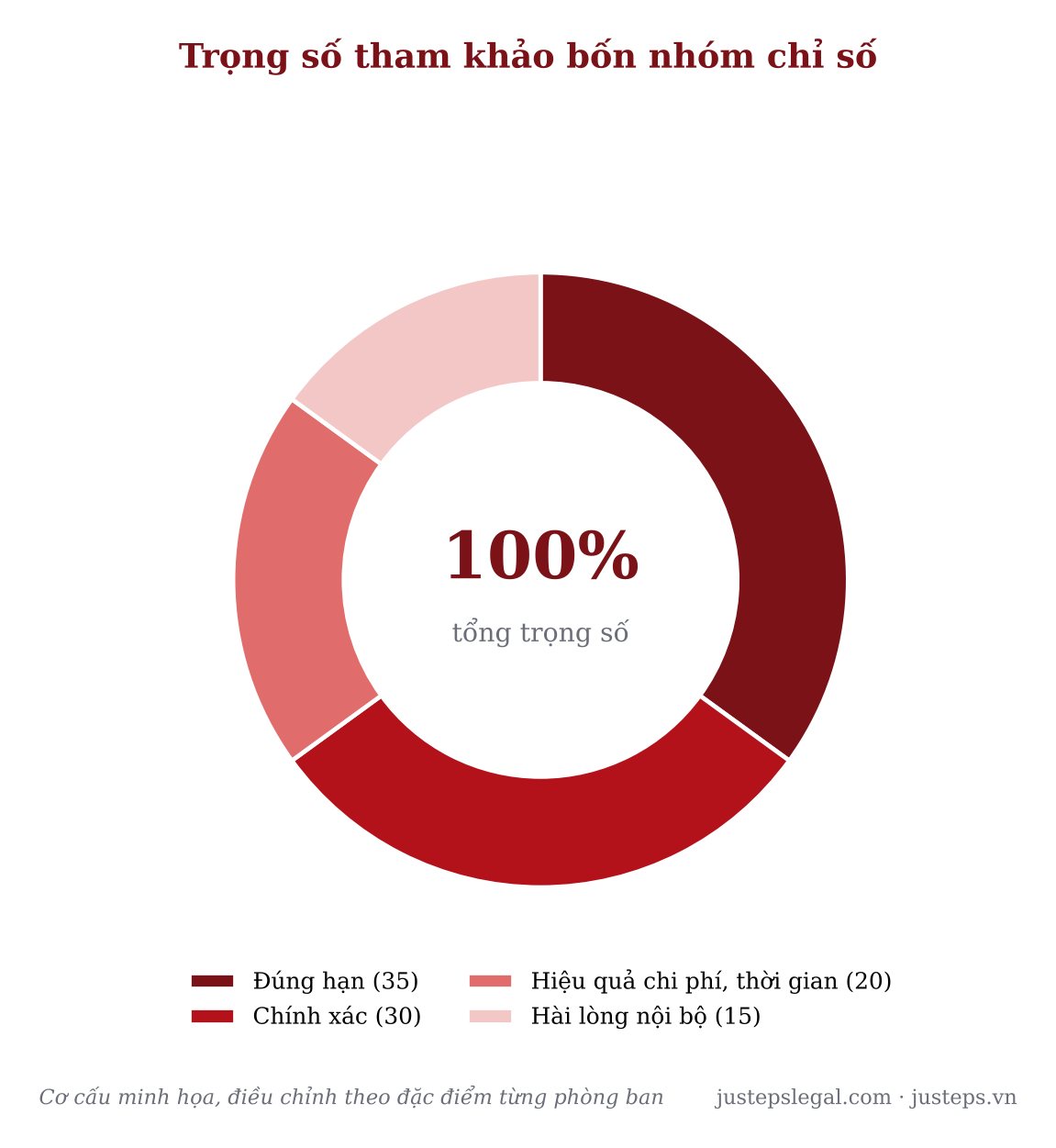
Reference weighting structure of the four indicator groups for support departments
Under the reference structure, the timeliness group accounts for 35% and the accuracy group for 30%, because these are the two factors that other units and state authorities notice most clearly. The efficiency group accounts for 20% to encourage better ways of working, while the internal satisfaction group accounts for 15% because survey results are easily influenced by personal relationships. The weightings should be adjusted to the characteristics of each department; for instance, an accounting department bound by many statutory deadlines may increase the timeliness and accuracy groups, while an administration unit serving many small requests may increase the internal satisfaction group.
The matrix below suggests the priority level of each indicator group for three common support departments, as a basis for heads of department to propose weightings before submitting them to the director for approval.
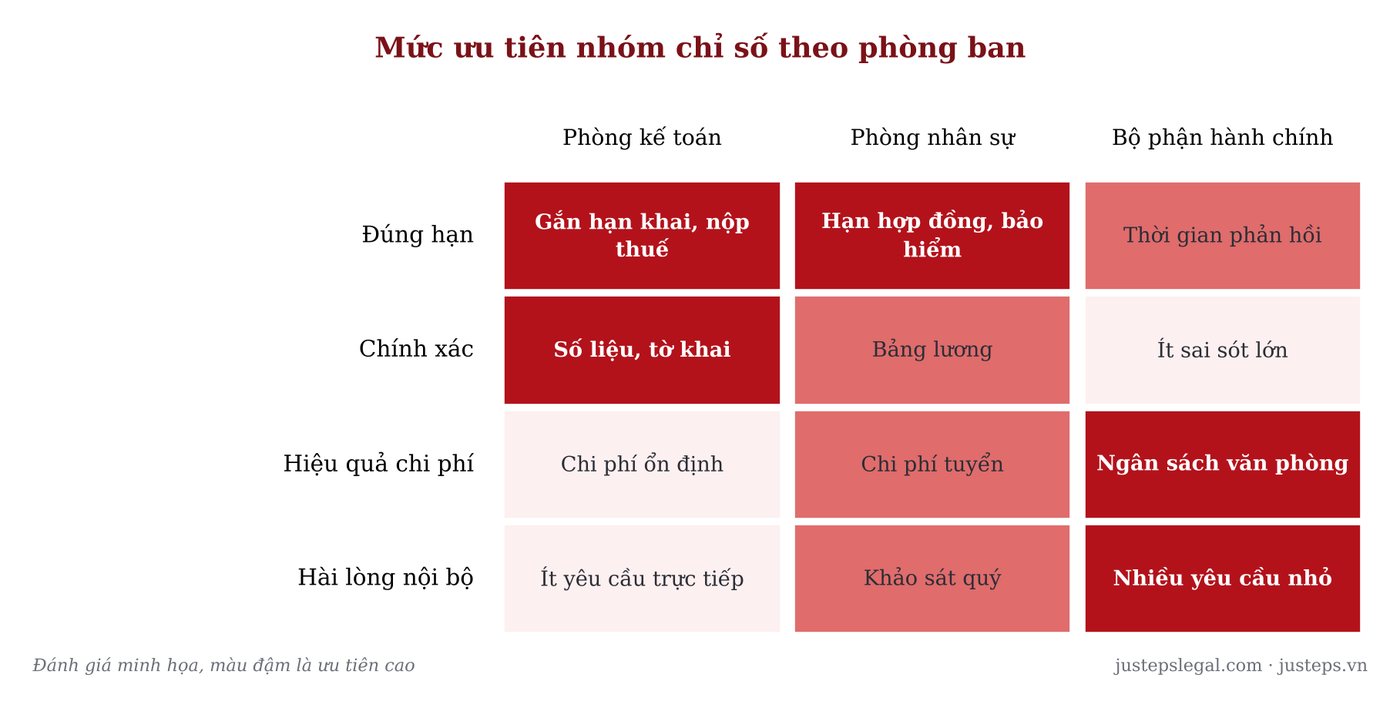
Priority level of each indicator group by support department
For the accounting department, the timeliness and accuracy groups have high priority because they are directly linked to the obligations to declare and pay tax and to prepare financial statements. For the HR department, the timeliness group has high priority because it is linked to the deadlines for signing contracts, paying insurance contributions and recruiting staff, while the internal satisfaction group is of medium priority. For the administration unit, the internal satisfaction group and the cost efficiency group have higher priority, because its work consists mainly of responding to daily requests and managing the office budget.
Reference indicator sets for accounting, HR and administration
Accounting department
The accounting department is bound by many statutory deadlines, so the timeliness and accuracy groups make up most of its indicator set. The Law on Tax Administration requires taxpayers to file tax returns and pay tax on time, and late payment gives rise to late payment interest calculated by the day[1]. Accordingly, the proportion of tax returns filed on time should have an absolute target of 100%, while the number of journal entries that have to be adjusted after closing because of internal errors reflects the quality of record keeping. The three core indicators commonly used are the monthly management report sent on time, tax returns filed on time and the proportion of customer receivables reconciled and confirmed during the period.
HR department
The indicators of the HR department should follow the employee life cycle, from recruitment, contract signing, payroll and insurance contributions to handling resignations. Tasks with statutory deadlines should take priority; for example, an employment contract must be concluded before the employee is taken on to work[2], and employees subject to compulsory social insurance must be registered within the prescribed time[3]. In addition, time to hire and payroll accuracy are the two indicators that other units notice most clearly, so they are usually chosen as the main indicators.
Administration unit
The administration unit handles many small requests such as issuing stationery, booking meeting rooms, repairing equipment, managing vehicles and handling office leases. Suitable indicators are the average response time from receipt of a request, the proportion of requests completed within the committed time and actual office costs compared with the approved budget. In addition, the administration unit usually keeps the list of licences and contracts with fixed terms, so the number of late renewals is also a meaningful accuracy indicator.
The table below summarises a number of reference indicators for the three departments, together with the calculation method and the starting targets that businesses may use in their first pilot quarter:
| Indicator | Calculation | Starting target |
|---|---|---|
| Monthly management report | Number of months in which the report was sent before the committed date, divided by the number of months in the quarter. | Three out of three months each quarter. |
| Tax returns on time | Number of returns filed on time divided by the total number of returns due in the period. | 100%, with no exceptions. |
| Adjusting entries | Number of entries corrected after closing because of internal errors during the quarter. | No more than five entries per quarter. |
| Time to hire | Number of days from receipt of an approved request until the candidate accepts the job offer. | No more than 30 days for staff-level positions. |
| Payroll accuracy | Number of pay complaints confirmed as valid during the month. | No more than one case per month. |
| Administrative response | Average number of working hours from receipt of a request until a response is given. | Within four working hours. |
| Internal satisfaction | Average score of a quarterly anonymous survey on a five-point scale. | Four points or higher. |
The targets in the table are only a starting point. A more prudent approach is to take the actual results of the two most recent quarters as the baseline and then set an improvement target of around 10% to 20%, instead of applying a single figure to every business. Businesses that need help designing scorecards and measurement forms may refer to Justeps’ service for building a KPI and performance appraisal system.
The process for building and piloting
A KPI system for support departments should be built in a fixed sequence, with a pilot phase before it is linked to bonuses. The sequence below brings together the steps that small and medium-sized businesses can carry out over about two quarters.
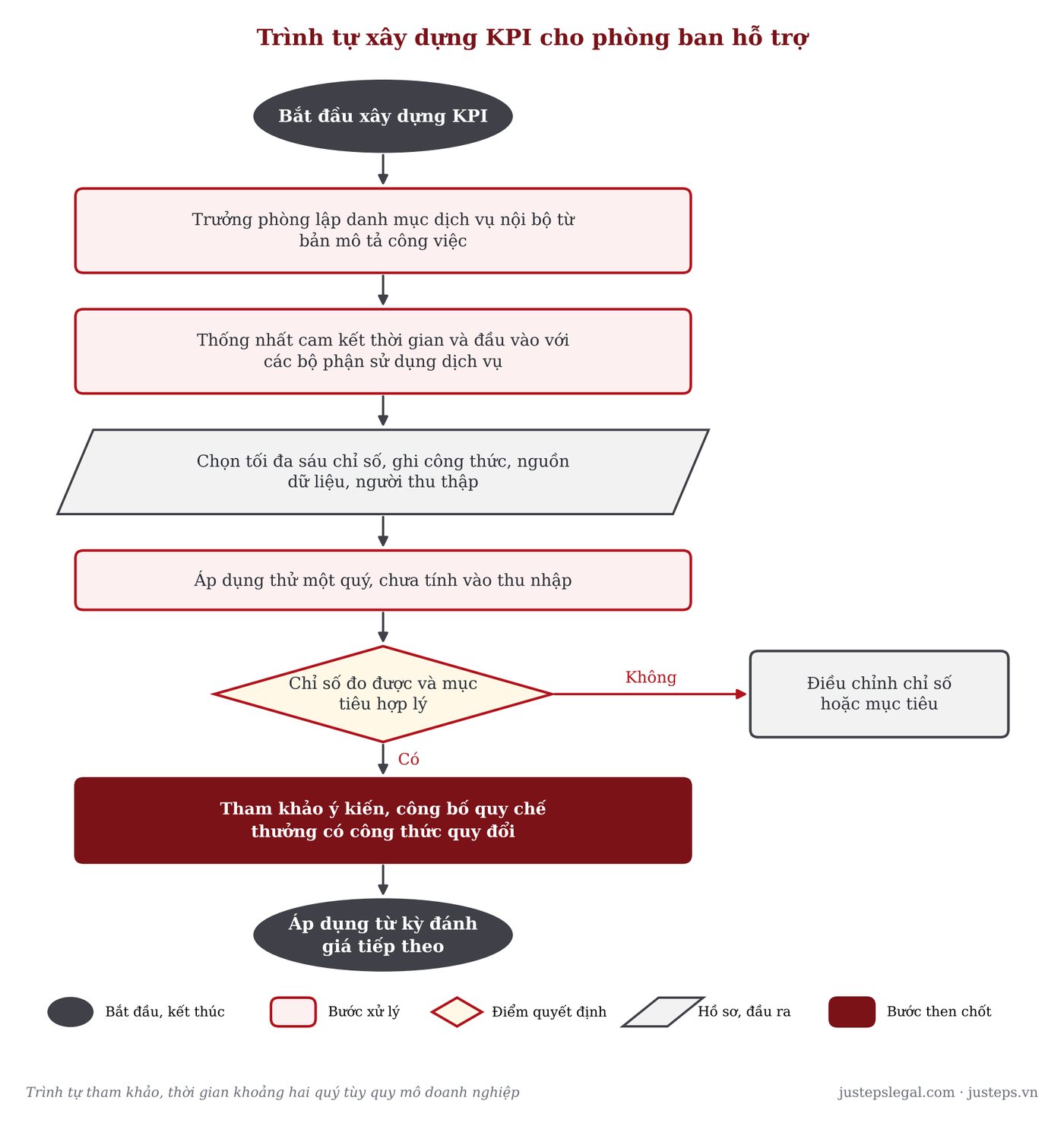
Sequence for building, piloting and issuing KPIs for support departments
The sequence begins when the head of department draws up the catalogue of internal services based on the job descriptions, and then agrees commitments on turnaround times and inputs with the units that use those services. On the basis of that commitment, the head of department chooses no more than six indicators, each with a formula, a data source and a person responsible for collecting the data. The business pilots the indicators for one quarter, measuring and announcing results but not yet counting them towards income; if the pilot data show that an indicator cannot be measured or a target is unrealistic, the business goes back and adjusts it. The decisive step is to issue the bonus formula formally in the bonus regulation after completing the consultation and announcement procedures, and only then to apply it from the next appraisal period.
The pilot phase is often skipped because businesses want immediate results, but it is the phase that reveals indicators for which there are no data, targets that are too easy or too hard, and service commitments that are not yet reasonable. The pilot results also serve as a basis for explaining matters to employees when the bonus regulation is issued, because everyone has already seen the indicators working on real data. For new employees, the business should allow one to two months of familiarisation, during which results are only fed back and not yet counted towards bonuses.
Linking KPI results to wages and bonuses through the proper procedures
KPIs motivate only when results are reflected in income, but linking results to wages and bonuses must follow the procedures of the Labour Code. When developing wage scales, payrolls and labour norms, the employer must consult the grassroots employee representative organisation, where one exists, and must publicly announce them at the workplace before implementation[4]. As for bonuses, the bonus regulation is decided by the employer and publicly announced at the workplace after consultation with the grassroots employee representative organisation, where one exists[5]. The Labour Code also requires dialogue at the workplace to be held when issues arise concerning wage scales, payrolls, labour norms and bonus regulations[6].
A point to note is how the part of income linked to KPIs is designed. If the employment contract states a fixed wage and the business then deducts from it when the KPI score is low, the deduction may be regarded as a fine or wage cut in place of labour discipline, which is prohibited[7]. Accordingly, the variable part of income should be designed from the outset as a bonus or a conditional allowance, with the formula converting KPI scores into an amount of money set out in the regulation. This design also affects the wage used as the basis for social insurance contributions, because amounts agreed to be paid regularly and consistently in each pay period are included in the contribution basis, whereas bonuses paid under the bonus regulation are not[8].
As for proportion, the part of income linked to KPIs in support departments is usually lower than in the sales department, commonly at 10% to 20% of total income, because their results depend heavily on external factors. Businesses should divide bonuses into two tiers, one tier based on the department-wide KPIs to encourage cooperation and one tier based on individual KPIs to recognise individual contributions. Bonuses are income from wages and salaries subject to personal income tax, so the accounting department needs to calculate and withhold tax when paying them[9]. Businesses that need to standardise their wage scales and bonus regulation may refer to Justeps’ service for developing wage scales and pay and bonus regulations.
KPIs and assessment of the level of job completion
KPI results may also be used as a basis for assessing the level of job completion. The Labour Code allows the employer to terminate the contract unilaterally when an employee regularly fails to complete the work under the contract, as determined by the assessment criteria in a regulation issued by the employer after consultation with the grassroots employee representative organisation, where one exists[10]. To use KPI results for this purpose, the business must include the criteria in a validly issued assessment regulation and must have records proving that measurement was objective and consistent over several periods. The KPI results of a single quarter, without a regulation as their foundation, are usually not sufficient to prove that an employee regularly fails to complete the work.
In addition, the Law amending and supplementing the Labour Code, passed by the National Assembly on 21 November 2026 and effective from 1 March 2027, adds 27 July and 24 November as days off with full pay[11]. The HR and accounting departments need to update working calendars, the method for calculating pay on public holidays and internal deadlines during 2027, and to adjust internal service commitments where turnaround times fall on the new days off.
Common mistakes and records to keep
The most common mistake is having too many indicators; some businesses assign as many as fifteen indicators to a single administration department, so the head of department spends more time measuring than managing the work. The second mistake is counting volume only, such as the number of files processed or the number of candidates interviewed, which leads employees to pick the easy tasks and neglect the difficult ones. The third mistake is failing to separate errors caused by inputs from other units, so the support department is rated low for delays that are not its responsibility.
Two other mistakes relate to procedure. Internal satisfaction surveys in which respondents give their names tend to produce scores higher than reality, so the survey should be anonymous and aggregated by unit only; if the business also collects comments about specific individuals, those data are personal data and must be protected under the law on personal data protection[12]. The remaining mistake is using KPI results to reduce income before the bonus regulation has been announced, which easily leads to complaints and wage disputes.
For the system to operate steadily and to have a basis whenever the business needs to explain matters to employees, the representative organisation or the labour authority, the business should keep the following records:
- The catalogue of internal services and the turnaround commitments of each support department, approved by the director.
- The scorecard of each department showing the name of each indicator, its formula, data source, weighting, target and the person responsible.
- Internal request forms or software data recording the date complete inputs were received and the completion date of each request.
- The results of the quarterly anonymous internal satisfaction surveys and the summary of KPI scores for each period.
- The bonus regulation with an appendix converting KPI scores into bonus amounts, together with the minutes of consultation and evidence of public announcement.
This set of records also helps the management team look back after each year to decide whether to keep, drop or replace indicators. An indicator that has met its target for four consecutive quarters has usually lost its motivating effect and should have its target raised or be replaced with another indicator. Conversely, an indicator that no department has achieved over several periods may reflect an unrealistic target or a problem in cross-departmental processes, which should be addressed by changing the process instead of continuing to give low scores.
How Justeps can help
Justeps supports businesses in building KPIs for support departments and linking the results to remuneration in compliance with the law through the following services:
- Building a KPI and performance appraisal system. Justeps draws up the catalogue of internal services and designs scorecards and measurement forms for each support department.
- Developing wage scales and pay and bonus regulations. Justeps drafts the bonus regulation with a formula for converting KPI scores and the consultation records, announced in line with the Labour Code.
- Organisational structure, functions, duties and job descriptions. Justeps reviews the functions and duties of support departments and the job descriptions that form the basis of the internal service catalogue.
- Training on KPIs and performance management. Justeps trains heads of department in choosing indicators, setting targets and giving employees feedback on appraisal results.
Frequently asked questions
How many KPIs should each support department have?
Each department should have four to six indicators covering the four groups of timeliness, accuracy, efficiency and internal satisfaction. More than six indicators usually increases the measurement effort without improving the quality of the appraisal.
Should KPIs be applied to new employees immediately?
The business should give new employees one to two months to settle in, during which results are only fed back and not yet counted towards bonuses. After this period, new employees are assessed in the same way as other members of the department.
Does changing the KPI-based bonus formula require the procedure to be repeated?
Yes, because the bonus formula is part of the bonus regulation. The business needs to amend the regulation, consult the grassroots employee representative organisation where one exists, and publicly announce it before applying it[5].
May a business deduct wages when an employee fails to meet KPIs?
A business must not impose fines or wage cuts in place of labour discipline[7]. The part of income that depends on results should be designed from the outset as a bonus or a conditional allowance, with the formula set out in the regulation.
How can a small business with only one accountant measure KPIs?
The business can use three indicators, namely the monthly report sent on time, tax returns filed on time and the number of entries adjusted after closing. The director reviews the results each quarter and discusses them directly with the accountant instead of setting up a complex system.
Can KPI results be used to terminate an employment contract?
Only where the KPI criteria have been included in a validly issued regulation on assessing the level of job completion and there are records of objective measurement over several periods[10]. Short-term appraisal results without a regulation as their foundation are usually not a sufficient basis.
Does the internal satisfaction survey need to be anonymous?
It should be anonymous, because named surveys tend to produce scores higher than reality. Results should be aggregated by unit only, and comments about individuals need to be protected as personal data[12].
Related articles
- How businesses should organise periodic performance appraisals that can be relied on for pay, bonuses and people management
- How to write department functions and duties so that every task in a business has someone accountable for it
- Building KPIs for production workshops on productivity, quality and safety, linked to piece-rate pay
- Applying OKRs in small and medium-sized enterprises, from the annual business plan to a weekly tracking rhythm
Notes
[1] Law on Tax Administration No. 108/2025/QH15 dated 10 December 2025, effective from 1 July 2026, governing deadlines for tax declaration and payment and late payment interest.
[2] Clause 1 of Article 13 and Article 14 of the Labour Code No. 45/2019/QH14 dated 20 November 2019.
[3] Law on Social Insurance No. 41/2024/QH15 dated 29 June 2024, governing the persons subject to compulsory social insurance and the employer’s responsibility to register them.
[4] Article 93 of the Labour Code No. 45/2019/QH14.
[5] Clause 2 of Article 104 of the Labour Code No. 45/2019/QH14.
[6] Point c, Clause 2 of Article 63 of the Labour Code No. 45/2019/QH14.
[7] Clause 2 of Article 127 of the Labour Code No. 45/2019/QH14.
[8] Clause 1 of Article 31 of the Law on Social Insurance No. 41/2024/QH15 on the wage used as the basis for compulsory social insurance contributions.
[9] Law on Personal Income Tax No. 109/2025/QH15, under which income from wages and salaries, including bonuses, is taxable income.
[10] Point a, Clause 1 of Article 36 of the Labour Code No. 45/2019/QH14.
[11] The Law amending and supplementing a number of articles of the Labour Code, passed by the National Assembly on 21 November 2026 and effective from 1 March 2027.
[12] Law on Personal Data Protection No. 91/2025/QH15 and Government Decree No. 363/2026/ND-CP.
This article is for reference and reflects the regulations in force at the time of publication. Please consult Justeps for advice tailored to your company’s records and situation.
For further information, please contact:
📩 Email: info@justeps.vn
🌐 Website: https://justepslegal.com · https://justeps.vn
🌐 Page: Justeps
☎️ Hotline (Zalo): 096 172 2607
📍 Thanh Xuan Office: 12th Floor, Licogi 13 Tower, 164 Khuat Duy Tien Street, Thanh Xuan Ward, Hanoi, Vietnam
📍 Ha Dong Office: LK06B, No.10, Dong Dua Area, Ha Dong Ward, Hanoi, Vietnam
📍 Ho Chi Minh City Branch: 528 Le Van Sy, Ho Chi Minh City, Vietnam
📍 Hai Phong Office: Truong Thinh Village, Ha Dong Commune, Hai Phong, Vietnam
📍 Quang Ninh Office: Van Don Special Zone, Quang Ninh Province, Vietnam





