
Key takeaways
- The structure of a technology start-up should be reviewed every time headcount doubles or after each funding round, because an organisation that suits ten people usually becomes a bottleneck at thirty.
- If the founders plan to raise capital or reward key staff with shares, they should consider a joint stock company from the outset, because a limited liability company may not issue shares except for the purpose of converting its type.
- Source code, domain names, server accounts and trade marks must belong to the company before it hires more people or works with investors, because these are the first assets examined in due diligence.
- Once it has ten or more employees, the company must have written internal labour regulations that are registered, and it should sign a confidentiality agreement and an assignment of rights in work products with every engineer.
- The rights of the founders, the management team and investors should be written into the Charter, the shareholders’ agreement and an authority matrix rather than resting on personal trust.
A software company has twenty-five people, yet every employee still reports directly to the general director, who is also the founder. Developers receive work from three founders at the same time, each prioritising a different client, while the books are kept by an outside accounting service on the basis of documents sent at the end of the month. When an investment fund asks to carry out due diligence before investing, the company discovers that the source code and the cloud server accounts are registered in the personal name of a technical lead who has already left, and that three key engineers were promised shares verbally while the company is still a limited liability company. These problems do not stem from the capability of the team but from the fact that the organisational structure was not adjusted as the company grew.
This article analyses how to build the organisational structure of a technology start-up across four stages of growth, from a founding team of a few people to a company with several product lines. Besides the organisational model for each stage, it sets out the legal tasks that go with it, including the choice of company type, the founders’ shareholding structure, transferring intellectual property to the company, the allocation of authority with investors, internal labour regulations and personal data. The main readers are founders, general directors, heads of operations and HR staff of software, digital platform, e-commerce or financial technology businesses at an early stage.
Why the structure must change with scale
Technology companies often grow their headcount very quickly, sometimes doubling within a year after a funding round or after winning a large contract. Each time people are added, the number of working relationships in the team grows much faster than the number of people, because in a team of n members the number of pairs that must coordinate equals n multiplied by n minus one, divided by two. A team of five has only ten pairs, but a team of thirty already has four hundred and thirty-five, so the habit of everyone following everything through one shared chat group no longer works. The chart below shows the number of communication pairs by size for a team with no layers.
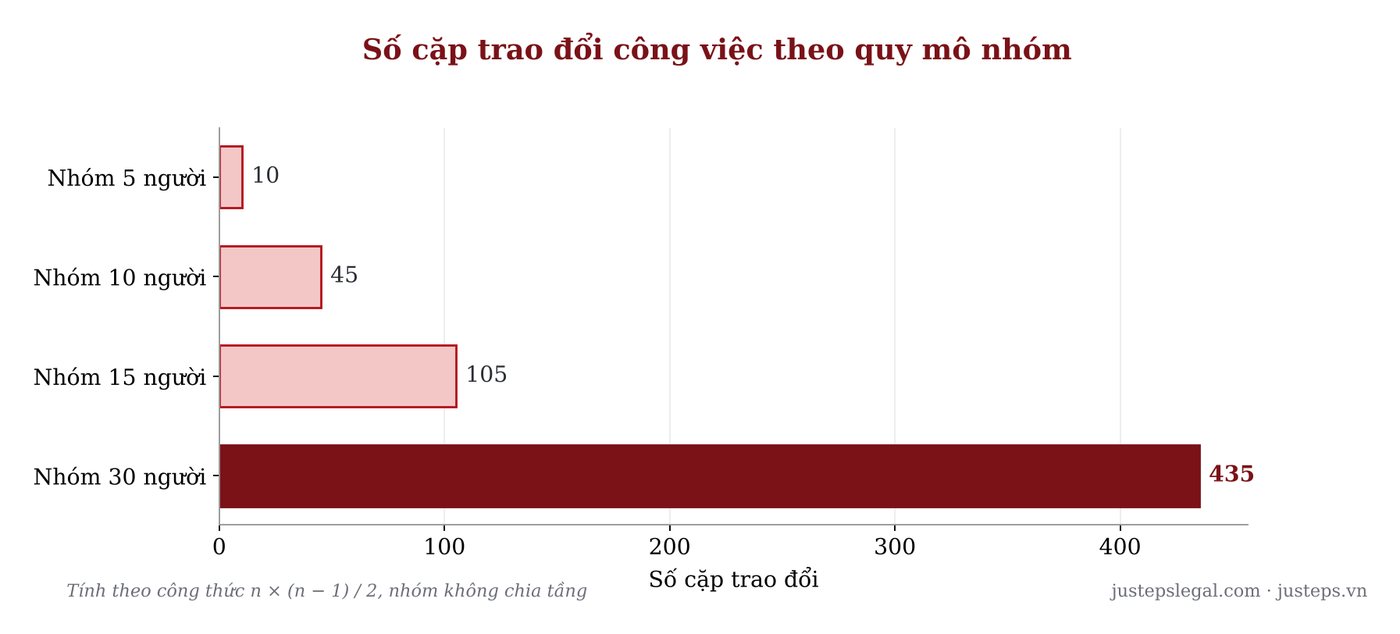
The number of working communication pairs grows with the size of a team without layers
According to the chart, when a team grows from ten to fifteen people, the number of communication pairs rises from forty-five to one hundred and five, more than doubling while headcount grows by only half. This is why product teams in technology companies are usually kept at five to nine people, and once they exceed about twelve to fifteen they need to be split into teams with their own leads. An organisational structure reduces the number of mandatory communication channels by giving each team a clear scope and one person accountable for results.
In its advisory practice, Justeps often finds that the structure of a technology company has become outdated and needs to be redesigned when one or more of the following signs appear in the company:
- Every decision, even small matters such as buying a software tool or approving leave, still has to wait for a founder.
- Two teams work on the same feature or contact the same client without knowing about each other.
- Good engineers leave because they see no development path, while the company keeps hiring more people into the same positions.
- The pace of releasing new features slows down even though the number of engineers has risen significantly.
- Investors ask who is responsible for finance, security or customer data, but the company has no clear answer.
Choosing the company type and the ownership foundation from the start
Limited liability company or joint stock company
The choice of company type directly affects the later organisational structure, because the type determines the governing bodies, how voting rights are allocated and which tools are available to reward staff. The Law on Enterprises provides that a limited liability company may not issue shares, except for the purpose of converting into a joint stock company[1]. Therefore, if the founders expect to raise capital from investment funds within the next one to two years, or wish to set aside part of the shares to reward key engineers, incorporating a joint stock company at once is usually easier than converting later. Conversely, a founding team of only two or three people with no plans to raise capital and wanting the leanest possible structure may choose a limited liability company and accept the conversion procedure when needed.
A joint stock company allows more flexibility in its capital structure, as in addition to ordinary shares it may have dividend preference shares, redeemable preference shares, voting preference shares and other preference shares provided for in the Charter[2]. Voting preference shares may only be held by organisations authorised by the Government and by founding shareholders, and the voting preference of founding shareholders is effective only for three years from the date the company is granted its Enterprise Registration Certificate[3]. Founders who wish to retain control in the long term should therefore not rely solely on voting preference shares, but should combine their ownership percentage, the Charter and a shareholders’ agreement.
The agreement between founders
Ordinary shares of founding shareholders are subject to transfer restrictions for three years from the date the company is granted its Enterprise Registration Certificate, whereby founding shareholders may transfer them to persons who are not founding shareholders only with the approval of the General Meeting of Shareholders[4]. This rule restricts transfers but does not resolve the most common question in a start-up, namely what happens when a founder leaves early while still holding a large number of shares. The founders should sign an agreement stating their roles, the period of working commitment, a mechanism under which shares vest gradually over the period of service, and the price and method by which the company or the other founders buy back unvested shares when someone leaves. This agreement must be drafted so that it does not conflict with the Charter, and any provisions that need to bind the company itself should be included in the Charter.
Bringing intellectual property and system accounts into the company
For a technology company, the most valuable assets are usually the source code, databases, domain names, accounts on cloud platforms, code repositories and trade marks. Intellectual property law recognises that an organisation that assigns a task to, or enters into a contract with, an author is the owner of the copyright in the work created under that task or contract, unless otherwise agreed[5]. However, source code written before the company was established, or written by a founder without a contract, does not automatically belong to the company, so an assignment document or a capital contribution in the form of intellectual property rights is needed. Cloud accounts, domain names and code repositories should be registered with the company’s email address and payment method, have at least two administrators and be recorded in a register of technology assets. Product trade marks should be filed for registration in the company’s name as early as possible, because rights in trade marks are established mainly on a first-to-file basis.
Four stages and the corresponding organisational models
There is no single correct organisational chart for every technology company, but most businesses pass through four stages with fairly similar management requirements. The headcount thresholds below are only reference points, and a business should identify its stage by the stability of its product and revenue sources, not only by the number of staff.
The product discovery stage, from three to ten people
At this stage the company is testing its product and looking for its first group of customers, so a flat structure is appropriate. The founders divide two broad areas between them, with one in charge of product and customers and one in charge of technology, while accounting, legal procedures and payroll are usually outsourced. What needs to be done early is to record in writing who may decide on the product, who may hire and who may sign contracts on behalf of the company, because these are the three types of decision that most easily cause disagreement among founders. The company does not yet need middle management, but each area of work must have one person with final responsibility.
The product–market fit stage, from ten to thirty people
Once the product has customers paying regularly, the company begins to split into small product teams, each consisting of a product manager, engineers and an interface designer pursuing a common goal. The positions usually added are a technical lead, a head of operations who also covers HR, and a head of sales or user growth. The general director should reduce the number of direct reports to about five to seven so as to have time for major clients, fundraising and hiring key people. This is also the stage at which the company passes the threshold of ten employees and incurs the obligation regarding internal labour regulations analysed later in this article.
The scale-up stage, from thirty to one hundred people
At this size, the company usually moves to a model combining functions and product teams, in which an engineer belongs both to a product team day to day and to a professional unit for appraisal and career development. The technology division has a chief technology officer, engineering managers and separate infrastructure and security teams, while the business division has a head of sales, customer success and marketing. The support functions need dedicated heads, including a chief accountant or chief financial officer, a head of HR and a person in charge of legal affairs, compliance and data protection. A salary scale by engineering level should be standardised at this stage, because paying salaries through case-by-case negotiation causes income gaps within the same level to widen and leads to staff losses.
The multi-product stage, over one hundred people
When the company has two or more product lines or two clearly distinct customer groups, a structure based on business units or product lines begins to deliver results. Each unit has a director responsible for revenue, costs and product results, while infrastructure, security, finance, HR and legal affairs sit at company level as shared services. The executive team, made up of the general director and the division directors, meets regularly around a common set of indicators, and the Board of Directors begins to need members with independent governance experience. This stage also usually requires an internal control function, because the number of transactions and the number of people with spending authority have exceeded the management team’s capacity for direct supervision.
The table below summarises the organisational model, the positions to be added and the key legal and governance tasks of each stage, so that founders can compare it with the current state of their own company.
| Stage | Model and positions to add | Key legal and governance tasks |
|---|---|---|
| Three to ten people | A flat structure run by the founders, with support functions outsourced. | Choose the company type, sign the founders’ agreement, transfer intellectual property and accounts to the company. |
| Ten to thirty people | Small product teams, adding a technical lead, product manager and head of operations. | Issue and register internal labour regulations, sign a confidentiality agreement with each person. |
| Thirty to one hundred people | Functions combined with product teams, adding a CTO, finance, HR and legal heads. | Authority matrix, salary scale by level, employee share programme. |
| Over one hundred people | Business units or product lines, with shared functions at company level. | Complete joint stock company governance, internal control, investor reporting. |
A business does not necessarily have to go through all four steps in strict order, and a company selling solutions to corporate clients may need a legal and contracts function earlier than a consumer application. What should be avoided is creating too many management layers while the company is still small, because each added layer slows decisions and increases fixed costs while revenue is not yet stable. When the organisation needs to be redesigned for the next stage, the business may consider Justeps’ service of organisational structure design for innovative start-ups.
Allocating authority between founders, management and investors
When receiving capital from an investment fund, the company usually has to accept a list of matters requiring the investor’s prior consent, such as issuing additional shares, borrowing above a threshold, replacing the general director, selling or licensing core intellectual property and changing the main line of business. These rights must be included in the Charter or the shareholders’ agreement and reflected in the internal regulations, so that managers know clearly which matters they may decide themselves and which must wait for the Board of Directors or the shareholders. If veto rights sit only in an agreement that the management team is not aware of, the company can easily breach its commitments to investors inadvertently in the course of day-to-day operations.
A joint stock company may choose one of two management models, namely a model with a General Meeting of Shareholders, a Board of Directors, a Supervisory Board and a Director or General Director, or a model with a General Meeting of Shareholders, a Board of Directors and a Director or General Director, in which the Board of Directors has independent members and an Audit Committee[6]. Start-ups after their first funding round usually choose the model with a Supervisory Board because it is simpler, while the model with an Audit Committee suits companies whose Board already has independent members and which aim for the governance standards of institutional investors. A business preparing to receive capital should review its Charter, shareholders’ agreement and governance structure at the same time, and may consider Justeps’ service of investment fundraising and private share issuance.
At operational level, the authority matrix should set value thresholds and approvers for decisions specific to a technology company, such as hiring outside the headcount plan, cloud infrastructure costs exceeding the monthly budget, contracts with corporate clients containing unlimited liability clauses and decisions to release versions involving major changes to user data. Each line of the matrix states who proposes, who checks and who approves, with specific value thresholds based on the budget approved by the Board of Directors. This matrix helps founders delegate work while keeping control, and it is also a document that investors often request when assessing governance capability.
Labour and data obligations that arise as the team grows
Internal labour regulations and confidentiality agreements
Under the Labour Code, an employer with ten or more employees must issue written internal labour regulations and register them with the specialised labour agency under the provincial People’s Committee[7]. For a technology company, the regulations should cover the protection of business secrets, the use of work accounts and devices, remote working and the handling of copying or taking source code outside the company. The Labour Code also allows the employer to agree in writing with the employee on the content and duration of protection of business secrets and technology secrets, and on the benefits and method of compensation in case of breach[7]. An engineer’s employment contract should therefore be accompanied by a confidentiality agreement and a clause confirming the company’s rights in the products created in the course of employment. The Labour Code has just been amended and supplemented by a law passed by the National Assembly on 21 November 2026, so businesses need to review their regulations and contract templates when the amending law takes effect.
Personal data of users and employees
Almost every technology product processes users’ personal data, and the company also processes the data of its own employees, such as identification details, bank accounts and images. The Law on Personal Data Protection, effective from 1 January 2026, imposes obligations on data controllers and data processors, while allowing small businesses and start-ups to choose not yet to perform certain obligations, such as appointing a data protection person or department, for five years from the effective date of the law, except where they provide data processing services or process sensitive data[8]. This option does not exempt the company from basic obligations such as notifying data subjects and obtaining their consent, so even at an early stage the company still needs a person assigned to monitor data processing. When the company enters the scale-up stage or its product processes financial, health or location data, there should be a dedicated data protection unit or staff member in the formal structure.
Shares as rewards for employees
Technology companies often use an employee stock ownership plan (ESOP) or bonus shares to retain key people when they cannot yet pay salaries comparable to large companies. This tool can only be implemented in a joint stock company, must be approved by the competent body under the Charter, and requires regulations stating the eligible persons, the vesting conditions based on length of service, the purchase price, the transfer restriction period and how matters are handled when the employee leaves. Income from bonus shares or share options may give rise to personal income tax obligations under the Decree guiding the Law on Personal Income Tax issued in 2026[9], so the regulations should be checked against the tax rules before being announced to employees. Promising shares verbally while the company is still a limited liability company is a common mistake that easily leads to disputes when the company raises capital or when the person who was promised shares leaves.
The process for reviewing and adjusting the structure
The structure should be adjusted following a fixed sequence every time headcount doubles, after each funding round or when the company opens a new product line. The flowchart below describes the reference sequence that Justeps usually applies when helping technology businesses review their organisation.
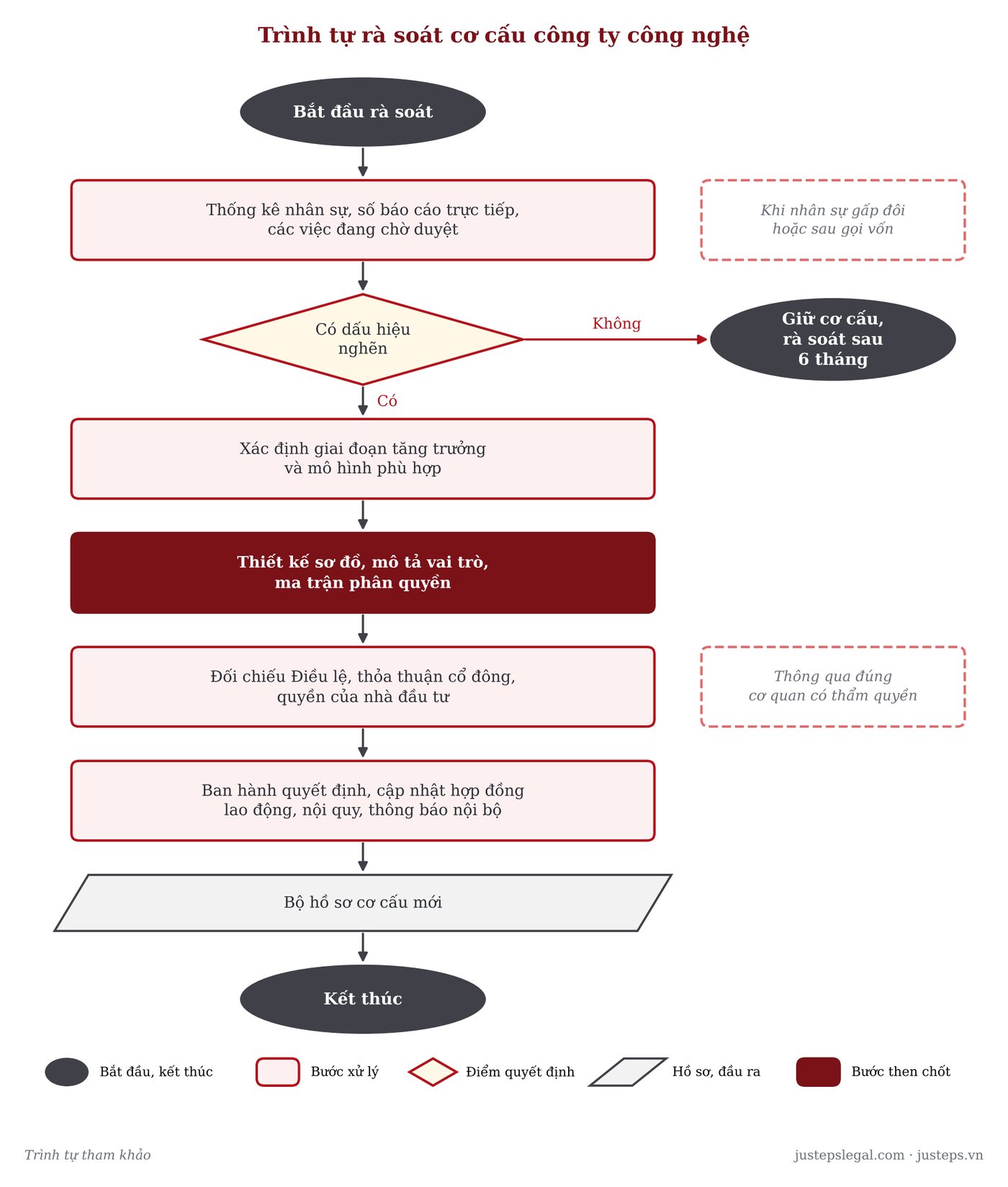
Sequence for reviewing and adjusting the organisational structure of a technology company
According to the flowchart, the first step is to take stock of headcount, the number of direct reports of each manager and the matters awaiting approval, and then assess whether the organisation shows signs of congestion. If there are no signs of congestion, the company keeps its current structure and schedules another review in six months, because changing the structure too often also leaves employees disoriented. Where there are signs of congestion, the company identifies its stage, designs the chart, the role descriptions and the authority matrix, and then checks them against the Charter, the shareholders’ agreement and investors’ rights before issuing them. The final step is to update employment contracts and the internal regulations and to inform the whole company, because a new chart without accompanying role descriptions and authorities usually fails to change how people actually work.
Where a change of structure entails transferring employees to other positions or changing titles or salaries, the company must act in accordance with the employment contract or sign an amending annex following the procedure of the Labour Code[7]. If the change affects the jobs of many employees, the company must also prepare a labour utilisation plan and consult the grassroots employee representative organisation, if any. For enterprise managers such as the general director, appointment and dismissal must be decided by the competent body under the Law on Enterprises and the Charter, and if the legal representative is replaced, the company must register the change with the business registration authority.
Common mistakes and the records required
Each stage has different legal and governance priorities, and acting too early wastes resources just as acting too late does. The matrix below suggests the priority of seven groups of tasks across the four growth stages, based on Justeps’ experience in supporting technology businesses.
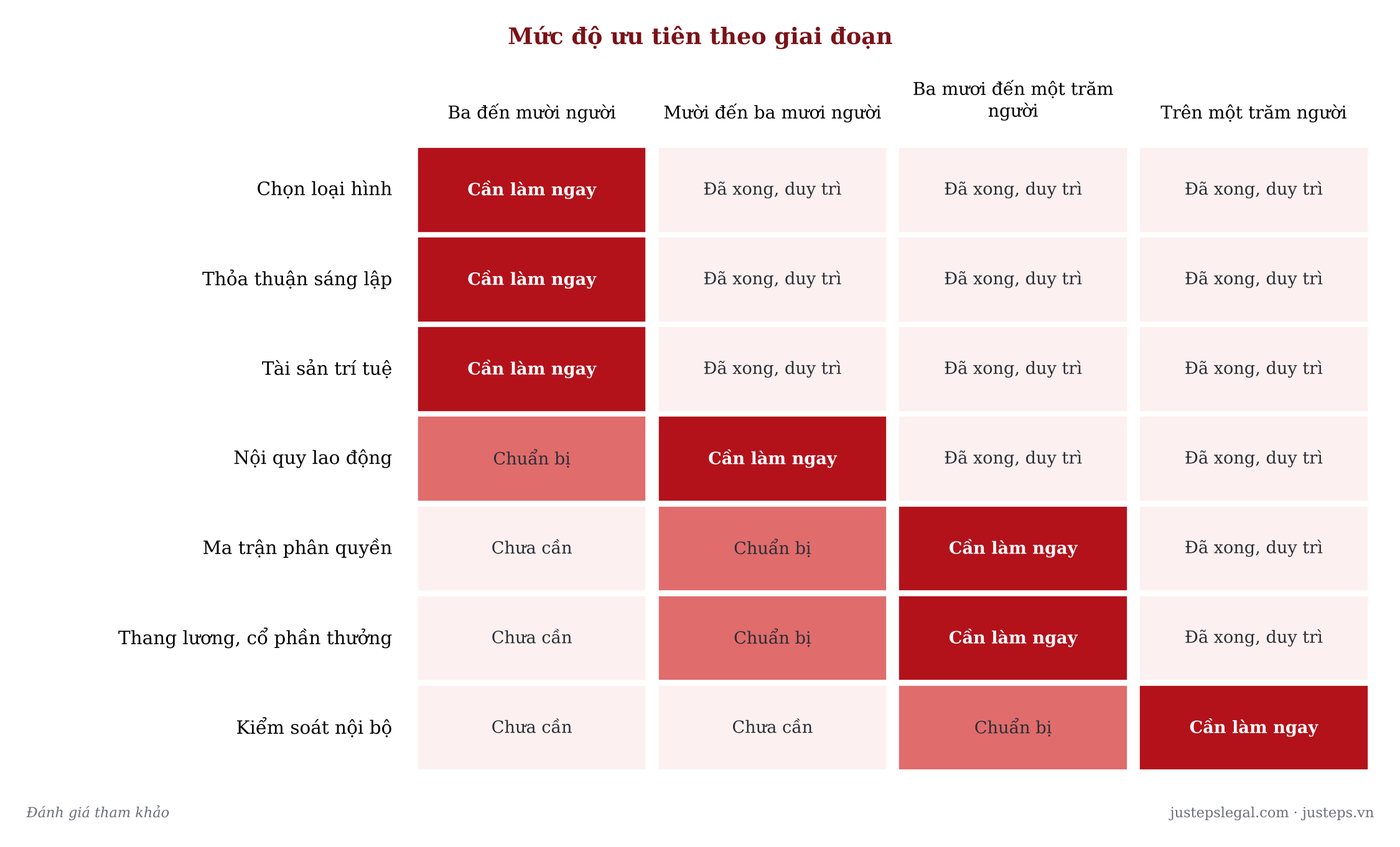
Priority of legal and governance tasks by stage
According to the matrix, three tasks must be done right from incorporation, namely choosing the company type, signing the founders’ agreement and bringing intellectual property into the company, because the later they are left the harder they are to resolve once more people have contributed capital. Internal labour regulations become an obligation once the company has ten or more employees, while the authority matrix, salary scale and employee share pool are the focus of the scale-up stage. Internal control only really needs a separate unit once the company has more than one hundred people, but the principle of separating the person who proposes spending from the person who approves it should be applied early.
Across the technology businesses that Justeps has helped review their organisation, the following mistakes recur quite frequently and usually only come to light when the company raises capital or a key person leaves:
- Source code, domain names and cloud accounts are registered in the personal name of a founder or engineer, so the company loses control when that person leaves.
- Engineers’ employment contracts contain no confidentiality agreement and do not confirm the company’s rights in the products they create.
- The best engineer is appointed as a manager without training, so the company loses a good engineer and gains an inexperienced manager.
- Shares are promised verbally while the company is still a limited liability company, with no regulations setting the vesting conditions.
- The company creates several management layers when it has only a few dozen people, slowing decisions and making fixed costs grow faster than revenue.
The minimum set of organisational records for a technology company at the scale-up stage comprises the founders’ agreement, the Charter and the shareholders’ agreement, the organisational chart with role descriptions for each position, the approval authority matrix, employment contracts with confidentiality and assignment of rights in work products, registered internal labour regulations, a competency framework and salary scale, employee share regulations, and a register of intellectual property and system accounts. These documents should use a common numbering system, have a custodian of the originals and be reviewed every year or after each funding round. A concise and consistent set of records helps the company shorten due diligence when working with investors and reduces internal disputes when the team changes.
How Justeps can help
Justeps helps technology start-ups build and adjust their organisation at each stage through the following services:
- Organisational structure design for start-ups and innovative businesses. Justeps surveys the current organisation and designs the chart, role descriptions and authority matrix suited to the growth stage.
- Internal procedures and regulations for start-ups and innovative businesses. Justeps drafts internal labour regulations, confidentiality rules, technology asset management rules and employee share regulations.
- Investment fundraising and private share issuance. Justeps reviews the Charter, the shareholders’ agreement and the governance structure so that the company is ready to work with investors.
- Labour, wages and social insurance for start-ups and innovative businesses. Justeps builds salary scales by engineering level, employment contract templates with confidentiality agreements and insurance procedures.
- Ongoing legal advisory for start-ups and innovative businesses. Justeps accompanies founders in decisions on contracts, intellectual property, data and labour as the company grows.
Frequently asked questions
Does a start-up with fewer than ten people need an organisational chart?
The company does not yet need a multi-layer chart, but it should have a role table stating who is responsible for each area and who may decide on the product, hiring and signing contracts. This table helps avoid disagreement among founders and serves as the basis for designing the structure when the company grows.
Can a limited liability company reward employees with shares?
No, because a limited liability company may not issue shares except for the purpose of converting into a joint stock company[1]. A company wishing to introduce bonus shares should convert its type first and then issue regulations in accordance with the Charter.
When should a technology company hire a chief financial officer?
Usually when preparing for a large funding round or when the company has more than about fifty people and several revenue streams. Before that, the company can rely on a chief accountant combined with a part-time financial adviser.
Can a founder who leaves early sell their shares immediately?
Within three years from the date of the Enterprise Registration Certificate, founding shareholders may transfer ordinary shares to persons who are not founding shareholders only with the approval of the General Meeting of Shareholders[4]. Founders should agree in advance on a mechanism for buying back unvested shares when one of them leaves.
Does source code written by employees automatically belong to the company?
Intellectual property law recognises the organisation that assigns the task as the owner of the copyright in works created under that task, unless otherwise agreed[5]. The company should still state this clearly in the employment contract and prepare an assignment document for source code that existed before incorporation.
Should the company be organised into product teams from the start?
This should only be done once the company has two products or two clearly distinct customer groups. When the company has a single product and fewer than fifteen people, one common team led by a technical lead is usually more effective.
Must a start-up appoint a personal data protection person immediately?
Start-ups may choose not yet to perform certain obligations for five years from the effective date of the Law on Personal Data Protection, unless they provide data processing services or process sensitive data[8]. Even so, the company should assign someone to monitor data processing from an early stage.
Related articles
- Setting up a technology start-up, capital structure, ESOP and ownership of source code
- Adjusting the governance model after fundraising, from the charter and the Board of Directors to the reporting regime
- Setting up the organisation of a newly incorporated company with fewer than 10 staff so that roles, authority and cash flow are under control
- Restructuring a fast-growing business so that its organisation keeps pace with its new scale
Notes
[1] Clause 3, Article 46 and Clause 3, Article 74 of the Law on Enterprises No. 59/2020/QH14 dated 17 June 2020, as amended and supplemented by Law No. 76/2025/QH15.
[2] Clause 2, Article 114 of the Law on Enterprises No. 59/2020/QH14 dated 17 June 2020, as amended and supplemented by Law No. 76/2025/QH15.
[3] Clauses 1 and 3, Article 116 of the Law on Enterprises No. 59/2020/QH14 dated 17 June 2020, as amended and supplemented by Law No. 76/2025/QH15.
[4] Clause 3, Article 120 of the Law on Enterprises No. 59/2020/QH14 dated 17 June 2020, as amended and supplemented by Law No. 76/2025/QH15.
[5] The Law on Intellectual Property No. 50/2005/QH11, as amended and supplemented several times (provisions on copyright owners).
[6] Clause 1, Article 137 of the Law on Enterprises No. 59/2020/QH14 dated 17 June 2020, as amended and supplemented by Law No. 76/2025/QH15.
[7] Labour Code No. 45/2019/QH14 dated 20 November 2019 (provisions on internal labour regulations, protection of business secrets and amendment of employment contracts), as amended and supplemented by the Law amending and supplementing a number of articles of the Labour Code and certain laws passed by the National Assembly on 21 November 2026.
[8] The Law on Personal Data Protection No. 91/2025/QH15, effective from 1 January 2026.
[9] Government Decree No. 253/2026/ND-CP dated 30 June 2026 detailing a number of articles of the Law on Personal Income Tax.
This article is for reference and reflects the regulations in force at the time of publication. Please consult Justeps for advice tailored to your company’s records and situation.
For further information, please contact:
📩 Email: info@justeps.vn
🌐 Website: https://justepslegal.com · https://justeps.vn
🌐 Page: Justeps
☎️ Hotline (Zalo): 096 172 2607
📍 Thanh Xuan Office: 12th Floor, Licogi 13 Tower, 164 Khuat Duy Tien Street, Thanh Xuan Ward, Hanoi, Vietnam
📍 Ha Dong Office: LK06B, No.10, Dong Dua Area, Ha Dong Ward, Hanoi, Vietnam
📍 Ho Chi Minh City Branch: 528 Le Van Sy, Ho Chi Minh City, Vietnam
📍 Hai Phong Office: Truong Thinh Village, Ha Dong Commune, Hai Phong, Vietnam
📍 Quang Ninh Office: Van Don Special Zone, Quang Ninh Province, Vietnam





