
Key takeaways
- The Labour Code recognises only three forms of pay, namely time-based, piece-rate and job-based lump-sum pay; 3P pay and base salary plus commission are ways in which businesses combine these forms with bonuses[2].
- The right model depends on whether work results can be measured and on how far the business has developed its work norms, job descriptions and appraisal system, not on which model other businesses are using.
- The larger the variable part of pay, the more the business must be able to show that its norms are reasonable, that the calculation is transparent and that earnings for normal working hours are not below the regional minimum wage.
- Changing the pay model amends the employment contract, so the business needs to simulate earnings, run a pilot, publish its wage scales and pay tables and sign an appendix with each employee before applying the new model.
As a business grows, the question of how to pay fairly and in a way that motivates staff usually arises at the same time as pressure to control costs. Many businesses choose a pay model on the advice of acquaintances or copy other businesses in the same sector, only to find a few months later that high performers are leaving, payroll costs are rising faster than revenue, or employees are complaining about unit rates, work norms and how lump-sum payments are shared. Most of these problems lie not in the model itself but in applying it to the wrong group of jobs, or in introducing it before the business has the data needed to measure results.
This article analyses five pay models commonly used in Vietnam, namely fixed time-based pay, piece-rate pay, job-based lump-sum pay, 3P pay and base salary plus commission, against the legal framework of the 2019 Labour Code and the guiding documents currently in force. Each model is examined in terms of how it is calculated, the groups of positions it suits, the minimum conditions it requires and the risks commonly encountered, after which the article suggests a sequence for changing pay model. It is written for business owners, HR directors, payroll accountants and the heads of sales and production departments in small and medium-sized businesses.
The common legal framework that every pay model must respect
In principle, wages are the amount the employer pays under the agreement for the employee to perform the work, comprising the wage for the job or title, wage allowances and other additional amounts[1]. The Labour Code allows the parties to agree on time-based, piece-rate or job-based lump-sum pay, and Decree No. 145/2020/ND-CP explains each of these forms by reference to working time, the extent to which output meets the norm and the unit rate, or the volume and quality of work to be completed[2]. Accordingly, when a business speaks of 3P pay or base salary plus commission, from a legal point of view it is still a combination of time-based pay with additional amounts or bonuses, and the employment contract must state clearly the form of pay applied[3].
Whichever model is chosen, the wage for the job or title must not be lower than the minimum wage, and the business must pay equal wages to employees doing work of equal value[1]. From 1 January 2027, the monthly minimum wage is VND 5,700,000 in Region I, VND 5,080,000 in Region II, VND 4,450,000 in Region III and VND 4,040,000 in Region IV[4]. For employees on piece-rate or lump-sum pay, the wage converted for normal working hours must also reach this level, so a business cannot set a low unit rate and then argue that the employee bears the risk of output.
The Labour Code also requires the business to develop wage scales, pay tables and labour norms as the basis for recruitment, agreeing wages and paying wages. A norm must be an average level that most employees can achieve without extending normal working hours, must be piloted before it is officially issued, and the business must consult the grassroots employee representative organisation where one exists and then publish the norm at the workplace before applying it[5]. Bonus rules are likewise decided by the business and published after consulting the employee representative organisation[6]. A business that fails to develop or publish its wage scales, pay tables and labour norms may face administrative penalties, with the fine for an organisation being twice that for an individual[7].
The way wages are paid is also subject to its own constraints. Monthly wages are paid once a month or once every half month, while piece-rate and lump-sum pay is paid as agreed, but where the work lasts several months the employee is entitled to a monthly advance in proportion to the work done[8]. Each time wages are paid, the business must provide a pay statement showing the wages, overtime pay, night work pay and any deductions[9]. This statement is the most important basis for resolving complaints about commission, unit rates or lump-sum payments, because the employee can check the figures in each pay period.
Fixed time-based pay suits work where individual results are hard to measure
Time-based pay is paid by the month, week, day or hour on the basis of the time actually worked and does not depend on output or sales. Its advantages are that it is easy to calculate, makes the wage bill easy to forecast and gives rise to few disputes over calculation, so it suits positions such as administration, accounting, legal affairs, customer service or technical operations, where the results of each individual are difficult to separate. It is also a sensible model for businesses with fewer than about 20 staff, where the owner can still observe each employee’s work directly.
The greatest limitation of time-based pay is that it does not distinguish between those who do more and those who do less. As the business expands, its top performers notice that they earn almost the same as weaker colleagues and start looking for employers who pay according to ability. Businesses therefore often add quarterly or annual bonuses linked to appraisal results, but a bonus motivates only when the criteria are announced before the period begins and the grading method is transparent.
A common error is to split time-based pay into a basic wage close to the regional minimum and a number of fixed allowances in order to reduce social insurance contributions. Under the 2024 Law on Social Insurance, the wage used as the contribution base includes the wage, wage allowances and other additional amounts agreed to be paid regularly and consistently in each pay period[10], so this split does not reduce the contribution obligation but merely creates an insurance debt that may be recovered. The business should clearly distinguish which amounts are paid consistently every month and which genuinely depend on results, and describe the true nature of each amount correctly in the contract and in the pay regulations.
Piece-rate pay and job-based lump-sum pay link earnings to output
Piece-rate pay
Under this model, the employee’s earnings equal the unit rate multiplied by the number of products that meet quality standards. The model suits production organised in measurable stages, such as garment sewing, component assembly, packing or mechanical processing, because the labour cost per product is almost fixed and those who work quickly and accurately earn more. The conditions for applying it are that the business has norms and unit rates developed through the proper procedure, a system for recording output by individual or by team, and a quality check before wages are calculated.
For example, a workshop sets a norm of 1,000 products a month and a unit rate of VND 9,000 per product. A worker who exactly meets the norm receives VND 9,000,000, one who makes 1,200 products receives VND 10,800,000, and one who makes only 800 products receives VND 7,200,000. This gap creates a clear incentive, but where output is low because of a shortage of materials, a machine breakdown or a power cut, the employee is not at fault, and the Labour Code requires the business to pay wages for work stoppage according to the degree of fault of each party[11]. Piece-rate pay rules should therefore specify how stoppage time is recorded and the guaranteed pay for that time, rather than allowing earnings to fall with output.
Excessively high norms are the most common cause of disputes. When most workers cannot meet the norm within normal working hours, they stay on after their shift to make up output without the time being recorded, and that time may be found to be unpaid overtime. The business should pilot a new norm in a few teams, record the proportion of workers who meet it and adjust it before issuing it for the whole workshop.
Job-based lump-sum pay
Lump-sum pay assigns a complete volume of work to an individual or team for a total amount and completion deadline fixed in advance. This model suits construction, installation, maintenance or projects with clearly defined outputs, because the business knows its labour cost in advance and the employees can organise their own time. Its risks centre on how the lump sum is shared among team members and on quality control when those doing the work want to finish quickly in order to take on another job.
To limit disputes, each assignment should be recorded in minutes stating the volume of work, quality standards, deadline, total lump sum, acceptance method and the rules for sharing the money within the team. Where the work lasts several months, the business must still pay monthly advances in proportion to the work done[8], so it cannot withhold the entire lump sum until acceptance. The business must also distinguish between assigning lump-sum work to its employees and engaging an outside team, because where there is payment of wages and management, direction and supervision by the business, the relationship is treated as an employment relationship even if the contract bears a different name[12].
3P pay and base salary plus commission for businesses that can already measure ability and results
3P pay
3P pay divides earnings into three parts, namely pay for the position (P1), pay for individual competence (P2) and pay for work performance (P3). P1 is determined by evaluating the value of the work of each job title, P2 is based on a competency framework, and P3 depends on the extent to which targets are met in the period. This model enables the business to explain why two people with the same job title earn different amounts and creates a clear path for pay rises, so it usually suits businesses with around 50 staff or more, many job titles and existing job descriptions.
The weakness of 3P pay is the high cost of developing and maintaining it. If the business has no competency framework, P2 will be decided by the line manager on impression, and if it has no reliable system of targets, P3 becomes an almost fixed bonus. Legally, P1 and P2 form the wage for the job title and must be shown in the wage scales and pay tables, while P3 should be governed by the bonus rules or the pay regulations with a published method of calculation. Businesses may consider Justeps’ service on KPI and performance management systems when they need to design the targets on which P3 is based.
Base salary plus sales commission
This model consists of a fixed salary that guarantees minimum earnings and a commission calculated as a percentage of sales or gross profit. It suits sales, retail, brokerage and other positions where sales are directly attributable to each individual. Because payroll costs vary with revenue, the business is safer when the market declines, but employees’ earnings fluctuate sharply and there is a tendency to chase sales with customers who cannot pay.
The base salary must still be no lower than the regional minimum wage, even in a month in which the employee makes no sales. Commission should be calculated on money actually collected or paid in two instalments, one when the contract with the customer is signed and the rest when payment is received in full. The reason is that the business may deduct from an employee’s wages only to compensate for damage to tools, equipment or property, and by no more than 30% of the monthly wage actually paid[13], so commission already paid on a contract that is later cancelled is very difficult to recover unless the rules specify from the outset when entitlement arises.
To see the differences between the models clearly, consider the example of a sales employee with a target of VND 500 million a month under three ways of paying. The first pays a fixed VND 15 million, the second pays a base salary of VND 7 million plus commission of 2% of sales, and the third uses 3P pay with P1 of VND 8 million, P2 of VND 2 million and P3 of up to VND 5 million multiplied by the target achievement rate, with no P3 paid below 70% and a cap at 150%.
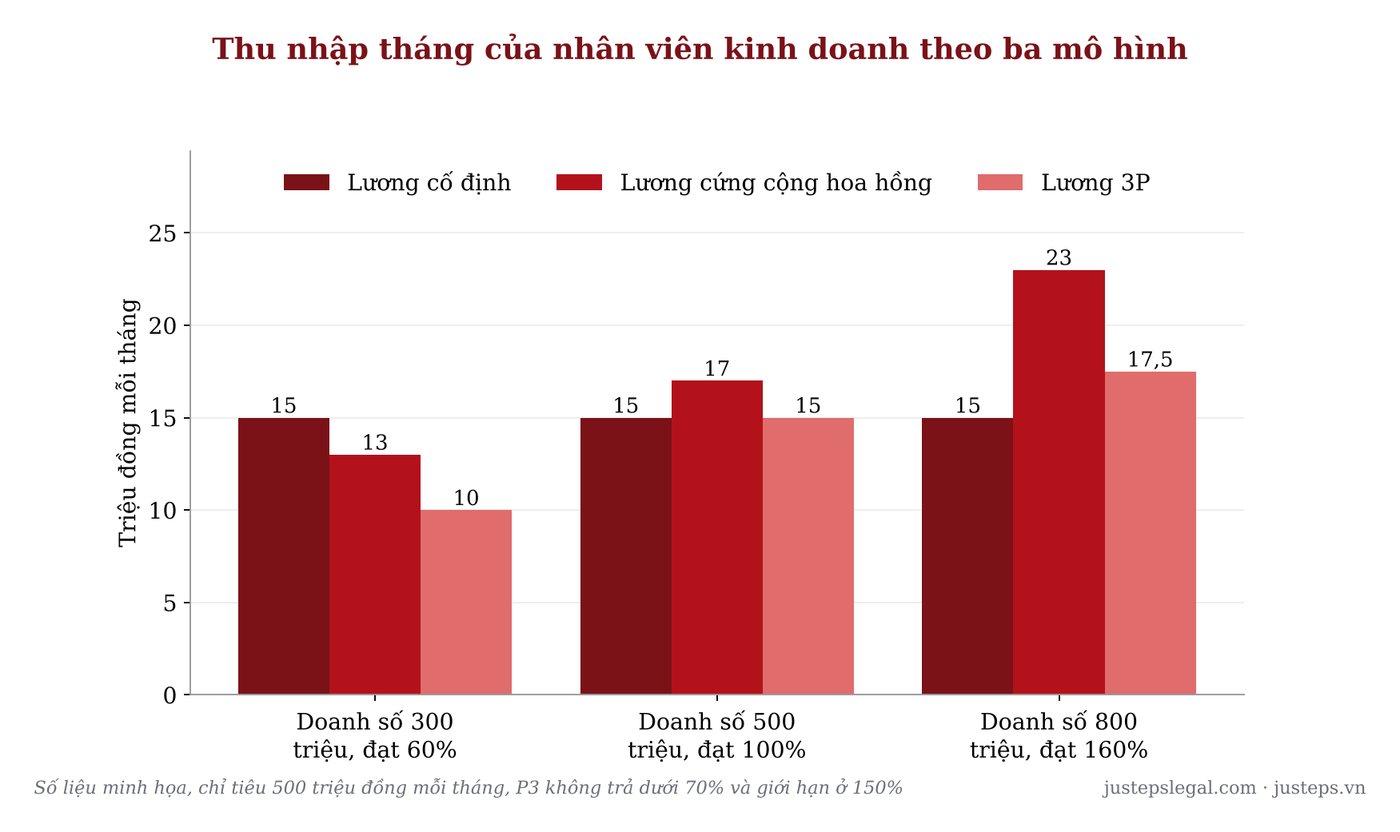
Monthly earnings of a sales employee under three pay models at three levels of sales
When sales reach only VND 300 million, the fixed model makes the business pay the most for the weakest result, while 3P pay costs only VND 10 million because no performance pay arises. When the employee exceeds the target and reaches VND 800 million, base salary plus commission pays VND 23 million, the highest of the three models, and so gives the strongest incentive to good sellers, while 3P pay stops at VND 17.5 million because of its cap. The example shows that no model is the cheapest in every case, and the business must decide in advance whether its priority is stable costs, strong rewards for good sellers or cost control at both low and high levels of sales.
Choosing a model by group of positions and by the readiness of the business
A sensible approach is to choose a model for each group of positions rather than apply a single model to the whole company. A manufacturing business may pay time-based wages to office staff, piece-rate pay to production workers and base salary plus commission to its sales team, provided that the pay regulations state clearly which model applies to each group and each person’s contract reflects the correct form of pay. The matrix below summarises how well the five models suit four common groups of positions.
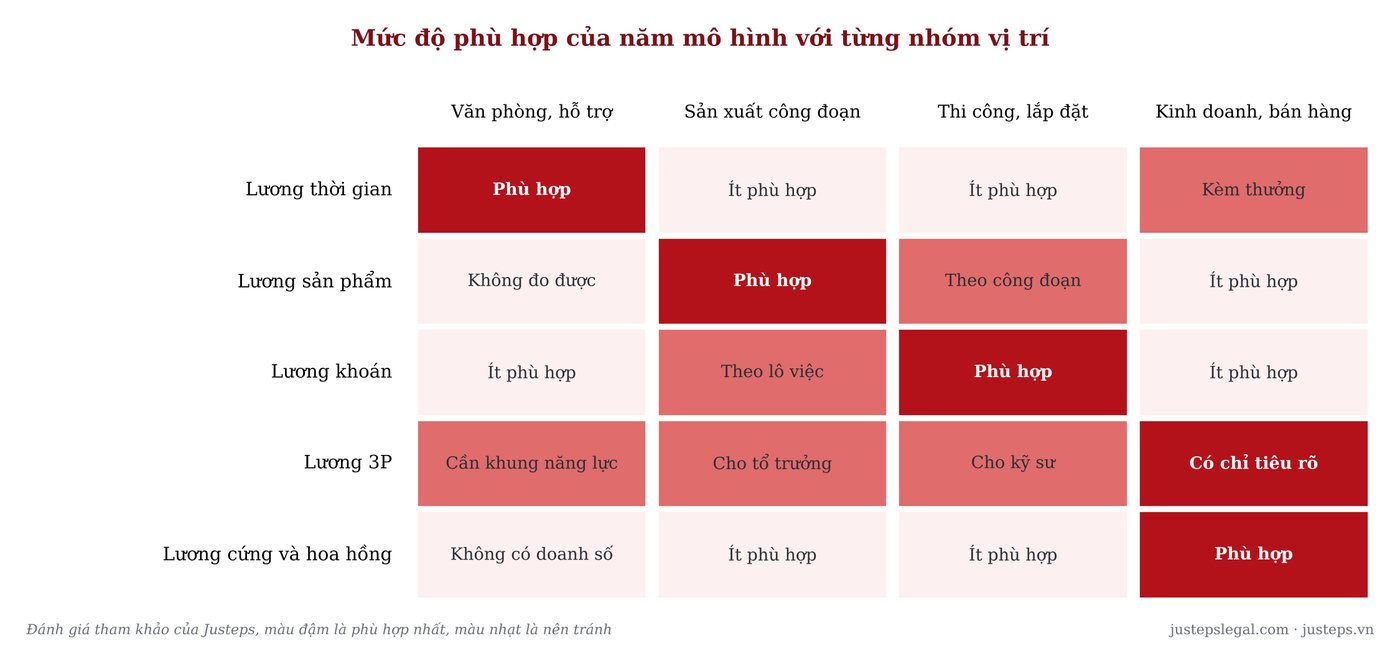
How well the five pay models suit four common groups of positions
A cell rated high means that the model can be used as the main way of paying the corresponding group of positions, a medium rating means it should be used only in combination with bonuses or where the business meets additional conditions, and a low rating indicates a case to avoid. Time-based pay remains a safe choice for support functions, whereas piece-rate and lump-sum pay are effective only where output can be counted. 3P pay is rated medium or high for most groups, but only where the business already has job descriptions and an appraisal system.
Apart from the type of work, the business needs to assess its own readiness before choosing. The table below sets out the minimum conditions for each model:
| Model | Suitable groups of positions | Minimum conditions required |
|---|---|---|
| Time-based pay | Office and support services, and businesses with fewer than about 20 staff. | Wage scales and pay tables by job title and bonus rules with criteria announced in advance. |
| Piece-rate pay | Staged production, processing and packing where output can be counted. | Piloted norms, unit rates, an output recording system and quality checks. |
| Job-based lump-sum pay | Construction, installation, maintenance and projects with separable volumes of work. | Assignment minutes, an acceptance procedure and rules for sharing the money within the team. |
| 3P pay | Businesses with around 50 staff or more and many job titles and grades. | Job descriptions, a competency framework and a reliable system of performance targets. |
| Base salary plus commission | Sales, retail and brokerage where sales are attributable to each individual. | Rules on recognising sales, the time when commission is earned and the allocation of customers. |
Common legal risks when designing the variable part of pay
The first risk is confusing bonuses with wages. An amount called a bonus but paid at a fixed level every month regardless of results will be treated as an additional amount paid regularly and must be included in the wage on which social insurance is contributed[10]. Conversely, a genuine bonus linked to business results or work performance is paid only under published bonus rules[6], so the business must set out the conditions, method of calculation and timing of payment clearly in those rules.
The second risk is using the variable part of pay as a disciplinary tool. Deducting commission when an employee arrives late, cutting the unit rate when a worker breaches the internal rules or reducing a lump sum because of attitude may all be regarded as imposing fines or wage cuts in place of labour discipline, which is prohibited[14]. The variable part of pay should depend only on measured work results, while breaches of discipline must be dealt with under the internal labour regulations and the statutory procedure.
The third risk concerns personal income tax and supporting documents. Commission, bonuses and lump-sum payments made to employees with employment contracts are all income from salaries and wages, so the business must withhold tax under the progressive tariff together with the monthly wage[15]. Where commission is calculated quarterly but paid in a single instalment, income paid in that month rises sharply and so does the tax withheld, so employees should be told in advance to avoid misunderstandings.
Finally, every model must respect the principle of equal pay. Where two employees with the same job title and the same results earn different amounts because they negotiated individually, the business will find the difference hard to justify if a complaint is made, particularly where the difference coincides with gender[1]. To manage all of these risks in one consistent set of rules, businesses may use Justeps’ service on salary scales and pay and bonus regulations.
Changing the pay model in the correct sequence
A business should consider changing its model when signs appear such as productivity flattening while orders increase, a wide gap in results between high and average performers despite almost equal earnings, payroll costs rising as a share of revenue for several consecutive quarters, or rising turnover among staff rated highly. However, the form and level of pay are terms of the employment contract, so the business cannot change them unilaterally by an internal decision. The party wishing to make an amendment must notify the other party of the proposed changes at least 3 working days in advance, and the amendment is made by a contract appendix or a new contract once the two parties have agreed[16].
The sequence below allows the business to make the change without reducing the earnings of employees who meet requirements, while keeping sufficient records to justify its position if a complaint arises.
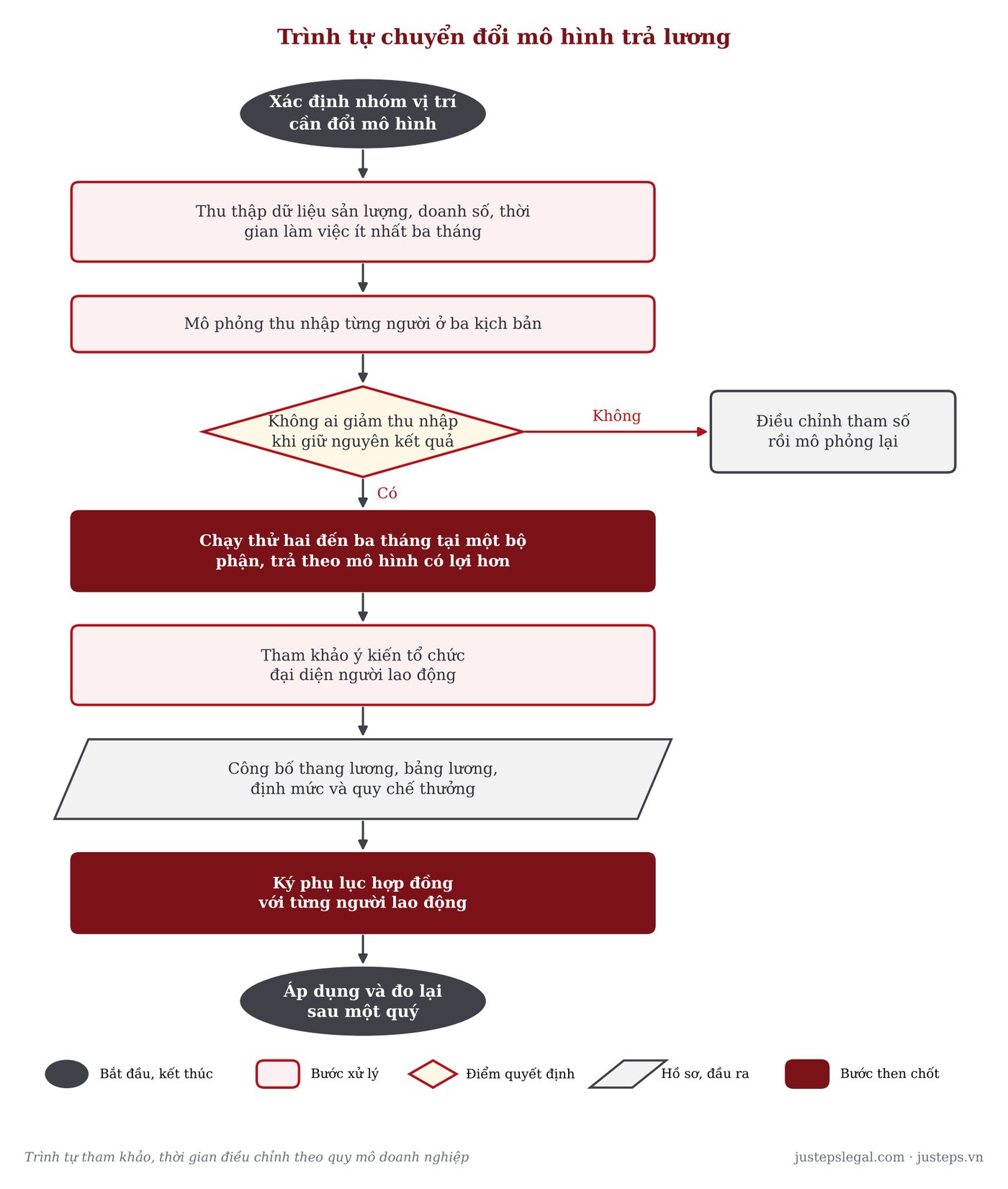
Sequence for changing pay model, from measuring data to signing contract appendices
The business begins by collecting at least three months of data on each person’s output, sales and working time, then uses that data to simulate earnings under the new model in low, medium and high scenarios. If anyone’s earnings would fall even though their results stay the same, the parameters should be adjusted rather than the model being introduced immediately. The new model is then piloted in one department for two to three months, during which employees are paid under whichever model is more favourable to them. Only when the pilot results are stable should the business consult the employee representative organisation, publish the wage scales, pay tables, norms or bonus rules and sign an appendix with each person.
Two common errors at the final stage are issuing only a decision without signing contract appendices, and using the change of model as an opportunity to lower the fixed part of pay to near the minimum in order to reduce insurance contributions. The first error entitles employees to demand payment under their old contracts, while the second creates an insurance debt where the variable part is in substance paid consistently. The complete set of documents after the change comprises pay regulations stating the model for each group of positions, wage scales and pay tables, a table of norms and unit rates, template assignment and acceptance minutes, the earnings simulation and the signed contract appendices.
How Justeps can help
Justeps helps businesses choose, design and change their pay model through the following services:
- Salary scales and pay and bonus regulations. Justeps designs wage scales, pay tables, pay regulations and bonus rules suited to the pay model of each group of positions.
- KPI and performance management systems. Justeps develops the targets, competency framework and appraisal method on which performance-based and competence-based pay rely.
- Labour and payroll compliance management. Justeps reviews norms, unit rates, contracts and pay statements to identify risks before the pay model is changed.
- Compulsory social insurance advisory. Justeps determines the correct contribution base when a business separates fixed pay from variable pay.
Frequently asked questions
Should a small business adopt 3P pay?
Businesses with fewer than about 30 staff usually do not yet need 3P pay, because the cost of building a competency framework and a target system outweighs the benefits. Time-based pay with quarterly performance bonuses is a simpler approach that still achieves most of the motivational aims.
Are employees on piece-rate pay guaranteed the regional minimum wage?
Yes. The unit rate must be set so that an employee who meets the norm within normal working hours earns no less than the regional minimum wage[4]. The norm must also be a level that most employees can achieve[5].
Should commission be calculated on contracted sales or on money collected?
The business should calculate it on money collected, or pay it in two instalments, when the contract is signed and when payment is received in full. This limits the chasing of sales with customers who do not pay, because commission already paid is very difficult to deduct from wages later[13].
May one company apply several pay models at the same time?
Yes. The pay regulations must state the model applied to each group of positions, and each person’s employment contract must reflect the form of pay that applies[3].
May a business switch on its own from fixed pay to base salary plus commission?
The business may not make the change unilaterally, because the form and level of pay are terms of the employment contract. The change must be notified at least 3 working days in advance and made by a contract appendix once the two parties have agreed[16].
Is a bonus paid regularly every month subject to social insurance contributions?
An amount called a bonus but paid at a fixed and consistent level in each pay period may be treated as an additional amount forming part of the contribution base[10]. A bonus that genuinely depends on business results and is governed by the bonus rules is treated differently.
May commission or lump-sum pay be deducted when an employee breaches the internal rules?
No. The law prohibits fines or wage cuts in place of labour discipline[14]. Breaches of the internal rules must be dealt with through the disciplinary procedure, while the variable part of pay depends only on work results.
Related articles
- Designing KPIs for production workshops and linking assessment results to workers’ piece-rate pay
- Developing commission rules for spa therapists linked to wages, employment contracts and service quality
- A monthly labour and payroll compliance checklist for HR departments
- How businesses should organise periodic performance appraisals that can be relied on for pay, bonuses and people management
Notes
[1] Article 90 of the Labour Code No. 45/2019/QH14.
[2] Clause 1 of Article 96 of the Labour Code No. 45/2019/QH14 dated 20 November 2019; Article 54 of Government Decree No. 145/2020/ND-CP dated 14 December 2020.
[3] Point (dd) of Clause 1 of Article 21 of the Labour Code No. 45/2019/QH14.
[4] Government Decree No. 399/2026/ND-CP on minimum wages for employees working under employment contracts, applicable from 1 January 2027.
[5] Article 93 of the Labour Code No. 45/2019/QH14.
[6] Article 104 of the Labour Code No. 45/2019/QH14.
[7] Government Decree No. 283/2026/ND-CP on administrative penalties for violations in the fields of labour and social insurance, effective from 10 September 2026.
[8] Article 97 of the Labour Code No. 45/2019/QH14.
[9] Clause 3 of Article 95 of the Labour Code No. 45/2019/QH14.
[10] Article 31 of the Law on Social Insurance No. 41/2024/QH15 dated 29 June 2024.
[11] Article 99 of the Labour Code No. 45/2019/QH14.
[12] Clause 1 of Article 13 of the Labour Code No. 45/2019/QH14.
[13] Article 102 of the Labour Code No. 45/2019/QH14.
[14] Clause 2 of Article 127 of the Labour Code No. 45/2019/QH14.
[15] The Law on Personal Income Tax No. 109/2025/QH15 and its guiding documents on income from salaries and wages.
[16] Article 33 of the Labour Code No. 45/2019/QH14.
This article is for reference and reflects the regulations in force at the time of publication. Please consult Justeps for advice tailored to your company’s records and situation.
For further information, please contact:
📩 Email: info@justeps.vn
🌐 Website: https://justepslegal.com · https://justeps.vn
🌐 Page: Justeps
☎️ Hotline (Zalo): 096 172 2607
📍 Thanh Xuan Office: 12th Floor, Licogi 13 Tower, 164 Khuat Duy Tien Street, Thanh Xuan Ward, Hanoi, Vietnam
📍 Ha Dong Office: LK06B, No.10, Dong Dua Area, Ha Dong Ward, Hanoi, Vietnam
📍 Ho Chi Minh City Branch: 528 Le Van Sy, Ho Chi Minh City, Vietnam
📍 Hai Phong Office: Truong Thinh Village, Ha Dong Commune, Hai Phong, Vietnam
📍 Quang Ninh Office: Van Don Special Zone, Quang Ninh Province, Vietnam





