
Key takeaways
- A founders’ shareholders agreement is a civil contract that binds only its signatories, so provisions on voting, transfer restrictions and share buy-backs should be incorporated into the company’s charter to take effect against the company and third parties.
- Vietnamese law requires shareholders to pay in full for the shares they subscribe for within 90 days, so vesting must be structured through buy-back rights between shareholders rather than through delayed capital contributions.
- Veto rights should be limited to a defined list of matters and tied to voting thresholds set out in the charter; veto rights that are drawn too widely can easily push the company into deadlock.
- The exit mechanism should fix the price, timing and procedure for each scenario in advance, from a founder leaving the company and prolonged deadlock to an investor wishing to acquire the entire company.
Most start-ups in Vietnam are founded by two to four people who know one another, contribute capital in proportions agreed orally and use an off-the-shelf charter template when registering the company. This approach works well enough in the first year, but problems tend to surface when one founder wants to leave, when the founders disagree on strategy or when the first investor asks to see the ownership structure. At that point, the founder who has left still holds all of his or her shares, those who remain have no means of buying them back, and every major decision can be blocked by one party with no way out.
This article analyses the core content of an agreement between founding shareholders (the Founders’ Shareholders Agreement), namely capital contributions, vesting, governance and veto rights, transfer restrictions, deadlock resolution and exit, by reference to the Law on Enterprises and the Civil Code currently in force. It focuses mainly on joint stock companies, the usual vehicle for start-ups that intend to raise capital, while noting the differences where founders choose a limited liability company with two or more members. It is written primarily for founders, chief executives and those responsible for legal matters at companies shortly before or immediately after registration.
Legal effect of a founders’ shareholders agreement compared with the company charter
The Law on Enterprises contains no specific provisions on shareholders agreements, so in principle such a document is a civil contract between shareholders, entered into voluntarily and on the basis of freedom of contract[1]. Accordingly, the agreement binds its signatories but does not automatically bind the company, the business registration authority or anyone who later acquires shares. By contrast, the charter is an internal document that is binding on the company, its shareholders and its managers, and the Law on Enterprises allows the charter to regulate many matters such as voting thresholds, quorum requirements and the procedure for transferring shares[2].
One concept to clarify before drafting the agreement is that of a founding shareholder, meaning a shareholder who owns at least one ordinary share and signs the list of founding shareholders when a joint stock company is registered[3]. A newly established joint stock company must have at least three founding shareholders, who together subscribe for at least 20% of the total ordinary shares authorised for offering. During the first three years, ordinary shares subscribed for by founding shareholders at incorporation may be transferred freely to other founding shareholders, but may be transferred to outsiders only with the approval of the General Meeting of Shareholders, and the shareholder proposing to transfer may not vote on that matter[3].
Where the agreement and the charter conflict, the company will apply the charter, and the party in breach of the agreement will only be liable to the other shareholders in contract. For example, if the agreement requires shareholders to offer their shares to one another before selling to outsiders but the charter contains no such restriction, a sale to an outsider after the three-year period may still be entered in the register of shareholders. The founders’ shareholders agreement and the charter should therefore be drafted together, with provisions that need to bind the company transferred into the charter, while personal undertakings such as non-competition, confidentiality and the allocation of roles may remain in the agreement alone.
Capital contributions, contributed assets and the founders’ intellectual property
Shareholders must pay in full for the shares they have subscribed for within 90 days of the date on which the company is issued its enterprise registration certificate, unless the charter or the subscription contract provides for a shorter period[4]. After that period, a person who has not paid ceases to be a shareholder, a person who has paid only in part has rights corresponding only to the amount contributed, and the company must register an adjustment of its charter capital to reflect the capital actually contributed. The founders’ shareholders agreement should state clearly how much each person contributes, in what form and by what date, together with specific consequences for late contributors, for example a right for the other shareholders to purchase the unpaid shares at par value.
Founders of technology companies often contribute source code, a brand, a domain name or trade secrets rather than cash. Non-cash assets contributed as capital must be valued by the founding shareholders on a consensus basis or by a valuation organisation, and title to them or the right to use them must be transferred to the company[5]. If an asset is valued above its actual worth, the founding shareholders are jointly liable to contribute the difference and jointly liable for any loss caused by the incorrect valuation. For software written by a founder before the company was established, the agreement should include a clause assigning the economic rights in the source code to the company, while subsequent development should be governed by an employment contract or a services contract so that the rights vest in the company from the outset.
One point that is often overlooked is nominee shareholding, where one person provides the funds but asks another to appear on the list of shareholders. Since Law No. 76/2025/QH15 amending the Law on Enterprises took effect, companies have been required to collect, retain and provide information on their beneficial owners to the state authorities[6]. A nominee arrangement therefore both creates a risk of dispute between the person who provided the funds and the registered holder, and may render the information the company declares to the state authorities inaccurate. The founders’ shareholders agreement should reflect only those who genuinely own shares, together with each person’s undertaking to provide information whenever the company requests it.
Vesting within the framework of Vietnamese law
Vesting is an arrangement under which a founder is entitled to retain all of his or her shares only after remaining with the company for a specified period, usually four years, with the first milestone after 12 months. Its purpose is to keep each founder’s ownership proportionate to the time actually committed, avoiding a situation in which a founder who leaves early retains a large stake while those who remain carry the entire workload for many years afterwards. Investors commonly require vesting even where the founders have already worked together for many years, because the value of the company depends heavily on the founding team continuing to run it.
Why the capital contribution period cannot be used in place of vesting
In some jurisdictions, founders’ shares are issued immediately but the company retains the right to buy back unvested shares at a very low price. In Vietnam, achieving a similar result by extending the contribution period over several years is not appropriate, because the 90-day payment period is mandatory and a person who does not pay in full loses shareholder status in respect of the unpaid portion[4]. Founders therefore usually pay in full at the outset and build vesting into the agreement through share buy-back rights, or through the issue of additional shares at each milestone.
Three common methods of implementation
The table below compares three ways of implementing vesting in a joint stock company, each with its own advantages and legal limitations:
| Method | Mechanism | Limitations to note |
|---|---|---|
| Buy-back between shareholders | The departing founder is obliged to sell unvested shares to the remaining founding shareholders at a pre-agreed price. | This is a contractual obligation; if the departing founder refuses to sign the transfer, the others must ask a court or arbitral tribunal to order performance. |
| Buy-back by the company | The company buys back the departing founder’s shares by resolution of the Board of Directors or the General Meeting of Shareholders. | Limited as to quantity, price and solvency; the company must reduce its charter capital after the buy-back. |
| Staged issue of shares | The founder receives part of the shares at incorporation and the remainder is offered as each time milestone is reached. | Each issue requires approval by the General Meeting of Shareholders and registration of the change in capital, which is burdensome and may dilute investors. |
The first method is the most widely used because it is flexible and does not change the charter capital. During the first three years, transfers between founding shareholders do not require the approval of the General Meeting of Shareholders, so this mechanism fits with the statutory transfer restriction[3]. Where the company is the buyer, the Board of Directors may only resolve to buy back up to 10% of the total shares of each class sold within 12 months, the price for ordinary shares may not exceed the market price, and the company may pay only if it remains able to pay its debts in full afterwards[7]. In addition, the mechanism for buy-backs by decision of the company is designed for purchases in proportion to shareholdings, so an arrangement under which the company buys back only one founder’s shares should be carefully assessed before it is included in the agreement.
The following chart illustrates a four-year vesting schedule with the first milestone after 12 months, applied to a founder holding 30% of the company’s shares.
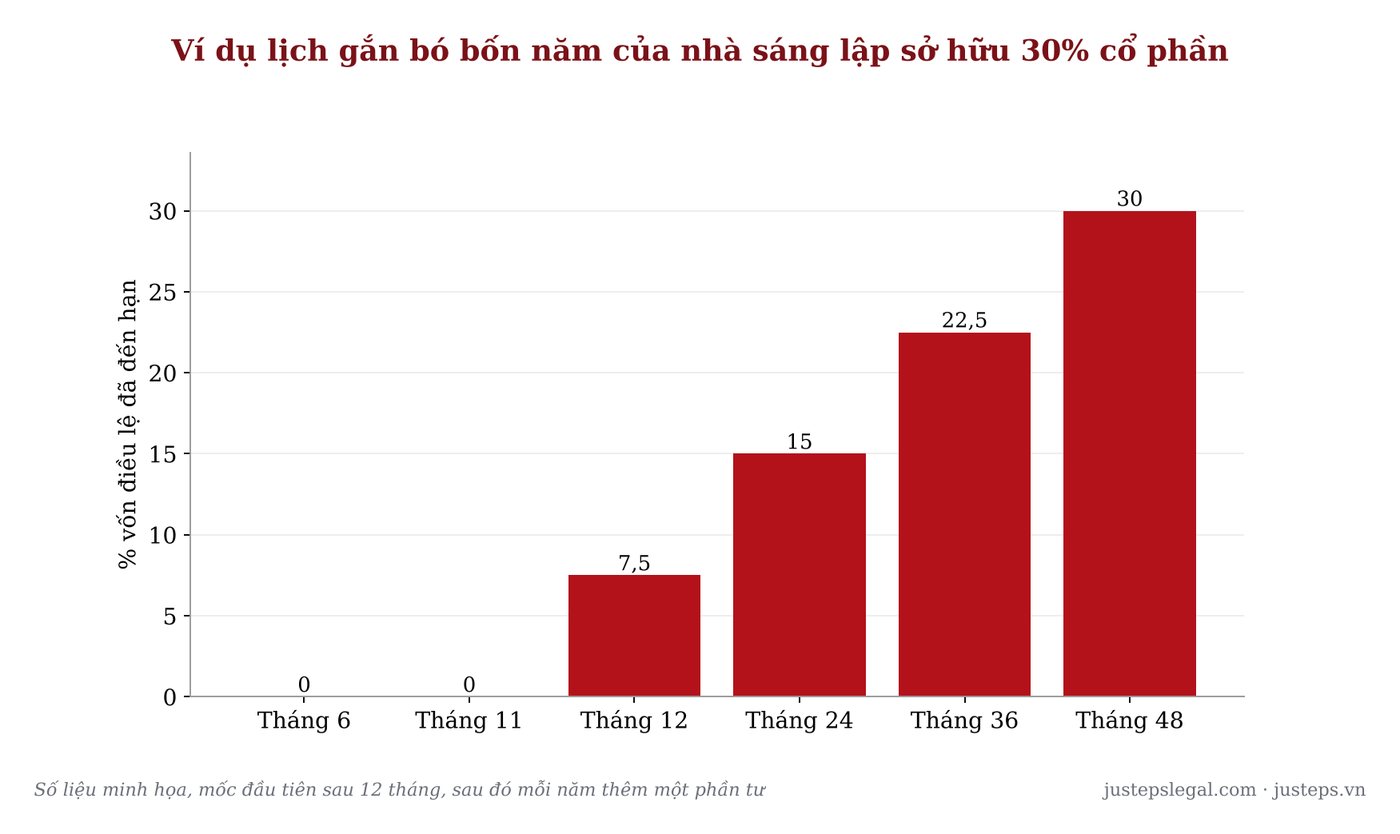
Example of the proportion of shares vested for a founder under a four-year vesting schedule
During the first 11 months, none of the founder’s 30% stake has vested, so if this founder leaves, the remaining shareholders are entitled to buy back the entire stake at the agreed price. At month 12, one quarter of the shares vests at once, equivalent to 7.5% of the company’s capital, and a further quarter vests in each following year until the full 30% has vested at the end of the fourth year. The agreement may also provide for quarterly or monthly vesting after the first year so that the proportion rises more evenly, provided that the calculation is set out clearly with a formula and a worked example.
Good leavers and bad leavers
The agreement should distinguish between a founder who leaves for legitimate reasons (a Good Leaver), such as illness, incapacity or departure agreed by the parties, and a founder who leaves as a result of breach (a Bad Leaver), such as leaving early without consent, breaching a non-compete undertaking or causing serious harm to the company. For a good leaver, vested shares are usually retained, while unvested shares are bought back at book value or market value. For a bad leaver, the parties may agree to buy back vested shares as well at par value or at the amount of capital actually contributed, but a price far below actual value may be challenged as disproportionate.
When a founder gives notice of departure, the remaining shareholders should proceed in the sequence below to avoid a prolonged dispute over the price and timing of the transfer.
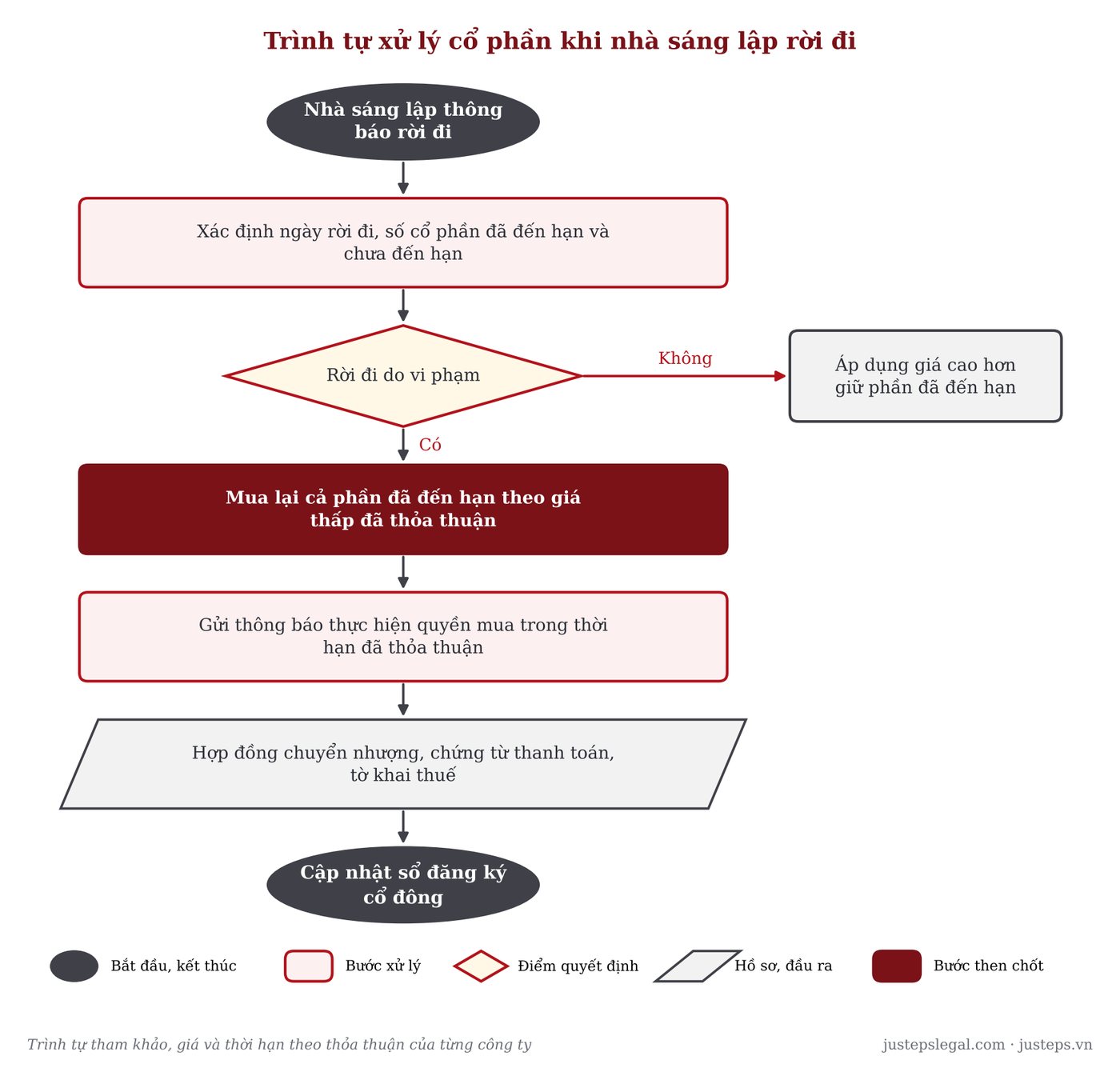
Sequence for dealing with shares when a founder leaves the company
The first step is to determine the date of departure and the reason for it according to the definitions in the agreement, because these two factors determine the number of unvested shares and the applicable price. If the departing founder is a bad leaver, the remaining shareholders buy back at the lower agreed price, whereas for a good leaver a higher price applies and the vested shares are retained. After notice of exercise of the purchase right is given, the parties sign the transfer contract, make payment, declare and pay personal income tax on income from the transfer of capital[8], and the company then updates its register of shareholders. Each step should have a specific time limit, for example 30 days for notice and 60 days to complete payment, so that the purchase right does not remain open indefinitely.
To improve enforceability, many agreements require each founder to sign a letter of authorisation in advance empowering another person to sign the transfer contract on his or her behalf. However, under the Civil Code the principal may unilaterally revoke an authorisation at any time, being liable to pay damages only in certain cases[9], so a letter of authorisation is not a reliable safeguard. A more effective approach is to combine a contractual penalty set at a sufficiently dissuasive level[10], the right to claim damages and a fast dispute resolution mechanism chosen in advance.
Corporate governance and founders’ veto rights
Voting thresholds and quorum requirements under the Law on Enterprises
A General Meeting of Shareholders may proceed when the shareholders attending represent more than 50% of the total votes, with the specific threshold being determined by the charter[11]. Resolutions on important matters such as classes of shares, business lines, the management structure, investment projects or sales of assets worth 35% or more of total assets, reorganisation and dissolution of the company must be approved by shareholders representing at least 65% of the votes of all shareholders attending, while other matters require more than 50%[11]. This means that a founder holding more than 35% of the shares already has a de facto veto over the group of important matters, even if the agreement says nothing on the point.
Because the Law on Enterprises allows the charter to set specific thresholds, founders may raise the approval threshold for certain matters in order to give minority shareholders a veto. Another tool is preferred voting shares, which carry more votes than ordinary shares, but only founding shareholders and organisations authorised by the Government may hold them, and the voting preference of founding shareholders is effective only for three years from the date on which the company is issued its enterprise registration certificate[12]. When raising capital, investors usually require these shares to be converted into ordinary shares, so preferred voting shares are suitable only for stabilising control in the early stage.
At Board level, the agreement usually allocates seats to each founder and contains an undertaking by the parties to vote to elect the persons nominated. Because members of the Board of Directors are elected by cumulative voting by default, unless the charter provides otherwise, the voting undertaking must be calculated against actual shareholdings so that the result of the election matches the agreement[13]. A Board meeting may proceed only when at least three quarters of all members attend[13], so a group of members can render a meeting inquorate simply by staying away. The law already allows a second meeting to be convened, which may proceed if more than half of the members attend, but the agreement should still bind the founders to attend and treat repeated deliberate absence as a breach.
Matters requiring unanimous or special approval
Veto rights should be set out as a list of specific matters (the Reserved Matters) rather than as a general clause covering every decision. The list usually includes amendments to the charter, the issue of new shares or the establishment of an employee share option plan (ESOP), the appointment or dismissal of the chief executive, approval of the annual budget, borrowing or guarantees above a value threshold, and related-party transactions. Transactions between the company and its shareholders, managers and their related persons must in any event be approved by the General Meeting of Shareholders or the Board of Directors under the law, and the interested person may not vote[14]. The longer the list, the harder it is for the company to take decisions, so day-to-day operational matters should be delegated to the chief executive within the approved budget.
The matrix below suggests the decision-making body under the law and the level of consent that founders should agree for each group of matters commonly encountered at start-ups.
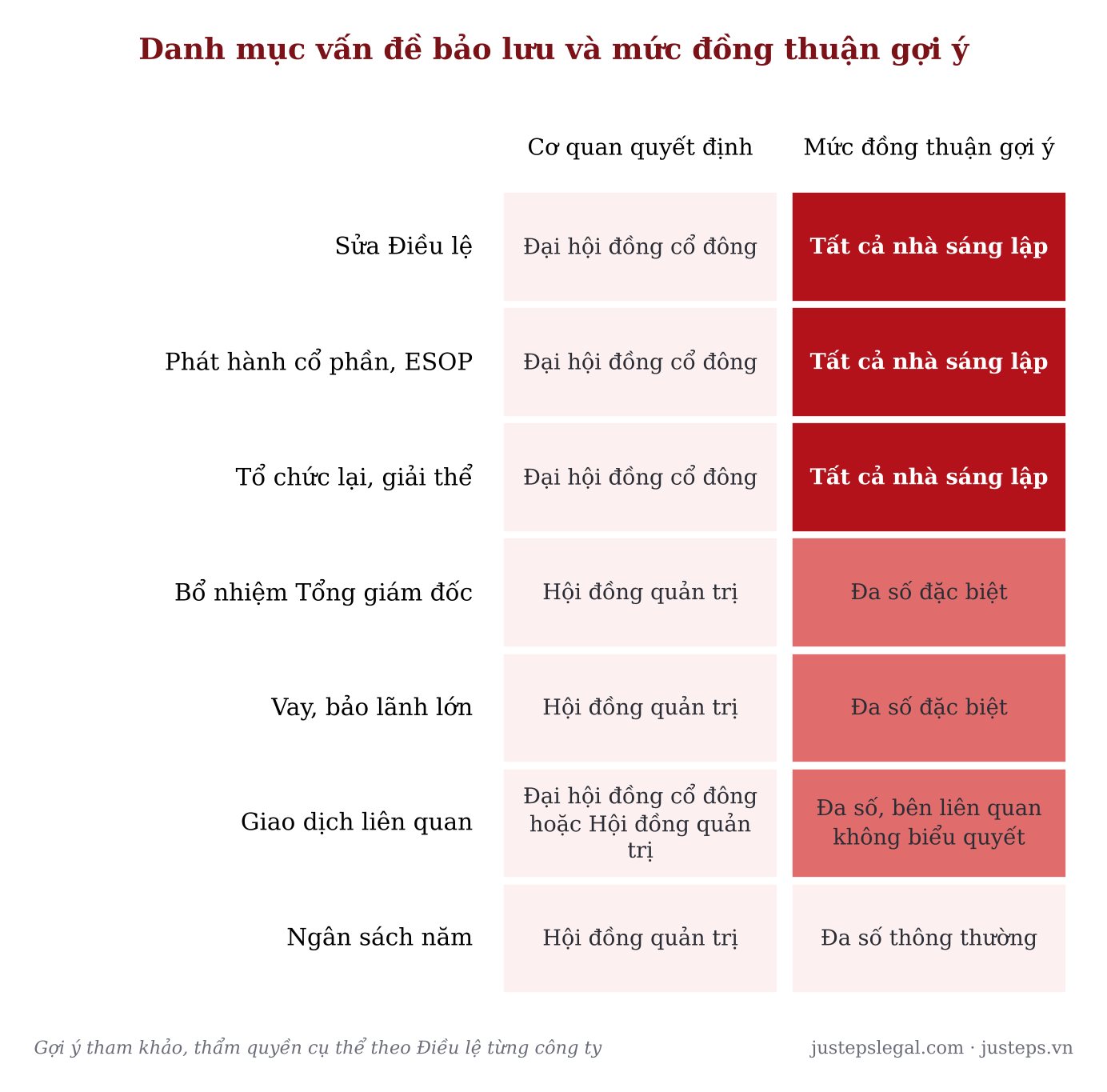
Suggested levels of consent for each group of matters on the reserved matters list
For each group of matters, the matrix identifies the body with decision-making authority under the Law on Enterprises and a typical charter, together with the level of consent that the founders should agree among themselves. The highest level, requiring the approval of all founders, is reserved for matters that change the ownership proportions or the nature of the company, such as amending the charter and issuing new shares. A special majority, for example 75% of the votes, is appropriate for senior appointments and large borrowings, while the recurring expenditure budget only needs a decision of the Board of Directors by simple majority. Each company should adjust the value thresholds and levels of consent to its size, but should keep to the principle that the less frequent and the less reversible a matter is, the higher the level of consent should be.
Transfer restrictions and rights attached to the sale of shares
Under the Law on Enterprises, shares are freely transferable, except for the three-year restriction on founding shareholders and any restrictions set out in the charter[15]. Where the charter restricts transfers, the restriction takes effect only if it is clearly stated on the share certificates for the relevant shares, so the company needs to issue share certificates or certificates of shareholding that record it. In a limited liability company with two or more members, a member wishing to transfer must first offer the interest to the other members and may sell to an outsider only if they do not purchase all of it within 30 days[16], so a right of first refusal is already built into the law.
Right of first refusal, tag-along and drag-along rights
A right of first refusal allows the remaining founding shareholders to buy first, at the same price and on the same terms, when one founder wishes to sell shares to an outsider. A tag-along right allows minority shareholders to sell their shares alongside a majority shareholder at the same price when the majority shareholder sells to a new buyer, so that the minority is not left behind with a new owner it did not choose. Conversely, a drag-along right allows a group of shareholders holding a pre-agreed majority, for example 75% of the shares or more, to require the remaining shareholders to sell as well when a buyer wishes to acquire the entire company. All three rights are undertakings between shareholders, so they should be recorded in both the charter and the share certificates to give the company a basis for refusing to register a transaction that contravenes the agreement.
The drag-along right requires the most careful design, because it compels a shareholder to sell his or her property against his or her will. The agreement should set a minimum price, a requirement for payment in cash, a cap on the warranties and indemnities borne by dragged shareholders in proportion to their shareholding, and a sufficiently long notice period. Where the buyer is a foreign investor, the transaction must also satisfy market access conditions and may require registration of the capital contribution or share purchase under the Law on Investment[17], so the agreement should identify who is responsible for preparing the application and the consequences if approval is not granted.
The statutory right to require the company to buy back shares
In addition to contractual rights, the Law on Enterprises allows a shareholder who voted against a resolution on the reorganisation of the company or on changes to shareholders’ rights and obligations in the charter to require the company to buy back his or her shares[18]. The buy-back price is the market price or a price calculated on the principles set out in the charter, and the company must complete the purchase within 90 days of receiving the request. This right is the minimum exit route for minority shareholders, so the founders’ shareholders agreement should determine the valuation method in advance to avoid disputes when the right is exercised.
Resolving deadlock and exit mechanisms
Deadlock arises when founders hold equal stakes or when one party repeatedly exercises a veto, leaving the company unable to approve its budget, financial statements or key appointments. The Law on Enterprises has no specific mechanism for breaking deadlock, so if the agreement does not provide for it in advance, the remaining options are usually dissolution of the company or a protracted dispute. The agreement should define clearly when deadlock is deemed to arise, for example where the same reserved matter fails to be approved at two consecutive meetings held at least 15 days apart.
Deadlock resolution mechanisms usually operate in several tiers, from conciliatory measures to the termination of the ownership relationship, as illustrated below.
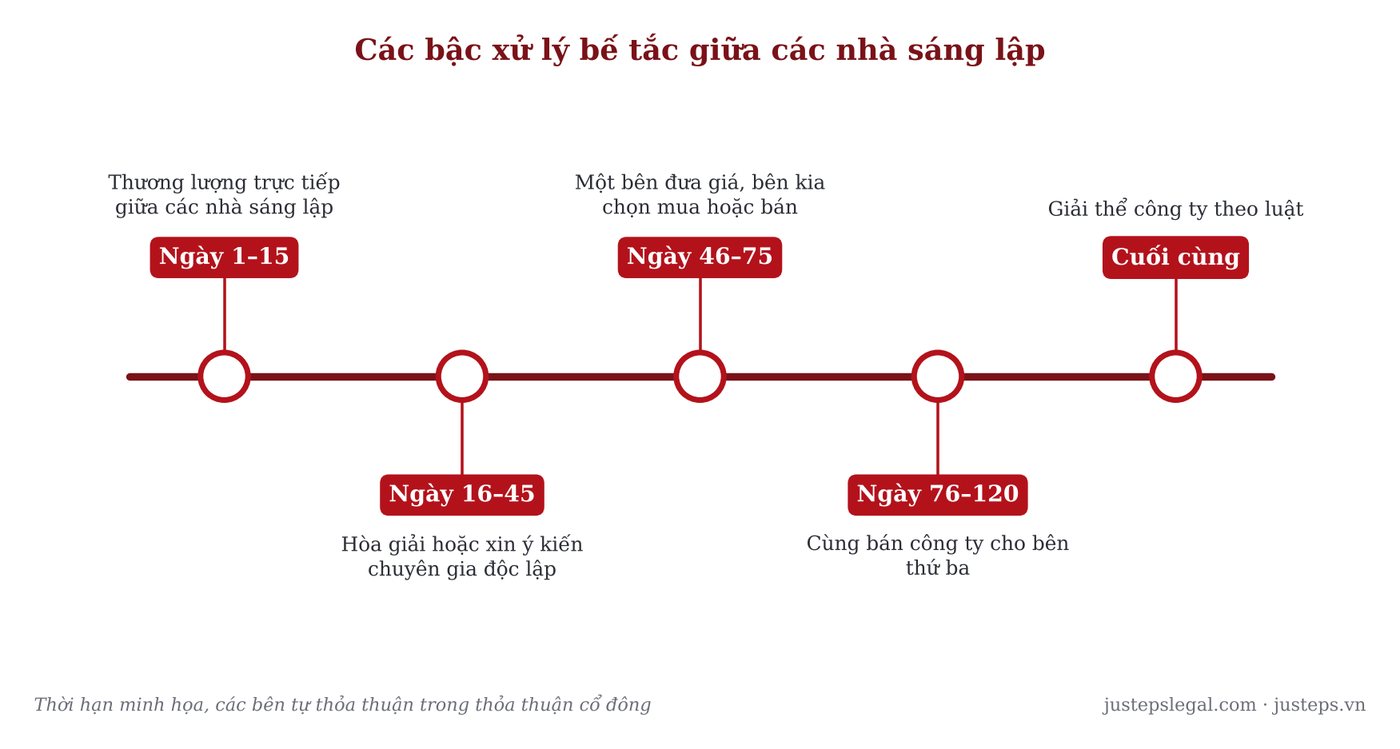
Tiers for resolving deadlock between founders in chronological order
At the first tier, the matter is escalated to the principals of each side for direct negotiation within a short period, after which an independent mediator or an industry expert may be invited to give an opinion. If deadlock persists, the agreement may allow one party to name a price for all of the other party’s shares, and the party receiving the offer must choose either to sell at that price or to buy the offering party’s shares at the same price. This mechanism compels the offering party to name a fair price, since it does not know whether it will end up as buyer or seller, but it disadvantages the party with less cash. The final measure is a joint sale of the company to a third party or dissolution, which should be used only when the earlier tiers have failed.
Beyond deadlock, the agreement should provide for other exit scenarios such as the death of a founder, loss of legal capacity, divorce involving a division of shares or criminal prosecution. For each scenario, the agreement should specify who has the right to buy, how the price is determined and whether the heir or the person receiving shares on division becomes a shareholder. Where a dispute arises, companies may consider Justeps’ shareholder and member dispute resolution services for an assessment of the matter and the preparation of a negotiation strategy and mediation documents.
Incorporating the agreement into the charter and internal records, and putting it into practice
The founders’ shareholders agreement should be signed before or at the same time as the application for enterprise registration is filed, as this is when the parties are most likely to agree and the contribution ratios have not yet been officially recorded. After signing, the person responsible for legal matters should check each provision against the charter and transfer the provisions on voting thresholds, transfer restrictions, rights of first refusal, drag-along rights and share valuation into the charter. Provisions on the allocation of roles, full-time commitment, non-competition and confidentiality should also be reflected in an employment contract or services contract between the company and each founder.
To ensure that the undertakings between founders can be proved and enforced if a dispute arises, the company should keep at least the following documents on file:
- The founders’ shareholders agreement signed by all shareholders, with the vesting schedule and the buy-back price calculation attached as schedules.
- The company charter, recording the agreed transfer restrictions and voting thresholds.
- The register of shareholders and the share certificates or certificates of shareholding recording the transfer restrictions.
- Evidence of capital contributions, valuation minutes and instruments transferring title to non-cash contributed assets.
- The employment contract or services contract of each founder, including a clause assigning intellectual property rights to the company.
The agreement should be reviewed at each event that changes the ownership structure, such as the first funding round, the establishment of an ESOP or the departure of a founder. In a funding round, investors usually propose a new shareholders agreement to replace the existing one, so founders need to be clear about which of their rights will be preserved and which will be shared with investors. Companies may use Justeps’ shareholders agreement and founder capital services to draft the agreement, align the charter and prepare documents for subsequent funding rounds.
How Justeps can help
Justeps supports founders in designing and implementing a founders’ shareholders agreement through the following services:
- Shareholders agreements and founder capital contributions. Justeps drafts the founders’ shareholders agreement, the vesting schedule and the share valuation mechanism, and aligns these provisions with the charter.
- Resolution of internal disputes between shareholders and members. Justeps assesses disputes between founders and prepares negotiation and mediation strategies and documents for the company to pursue itself or pass to a provider of its choice.
- Capital raising and private placement of shares. Justeps prepares private placement documents, establishes ESOPs and revises the shareholders agreement when new investors come in.
- Organisational design for innovative start-ups. Justeps designs the Board structure, the delegation of authority to the chief executive and a reserved matters list suited to the size of the company.
Frequently asked questions
Must a founders’ shareholders agreement be filed with the business registration authority?
A founders’ shareholders agreement does not form part of the enterprise registration application, so the parties are not required to file it. However, provisions that need to bind the company must be incorporated into the charter, which is part of the registration file[2].
May founders agree to contribute capital gradually over four years in place of vesting?
This approach is not advisable, because shareholders must pay in full for the shares they subscribe for within 90 days and a person who does not pay in full loses rights to the unpaid portion[4]. Founders should pay in full at the outset and build a right to buy back unvested shares into the agreement.
May a founder who leaves within the first three years sell shares to an outsider?
For three years from the date on which the company is issued its enterprise registration certificate, the sale of ordinary shares subscribed for at incorporation to a person who is not a founding shareholder requires the approval of the General Meeting of Shareholders[3]. A founders’ shareholders agreement usually adds a right of first refusal for the remaining founders.
Are minority shareholders’ veto rights lawful?
Veto rights can be created lawfully by raising the approval threshold for certain matters in the charter, since the Law on Enterprises allows the charter to set specific thresholds[11]. If the right exists only in the agreement, the company may still pass resolutions in accordance with the charter, and the party in breach is liable in contract.
Is the contractual penalty in a founders’ shareholders agreement subject to any cap?
The Civil Code allows the parties to agree the amount of a contractual penalty freely, unless the relevant law provides otherwise[10]. If the agreement is characterised as a commercial contract, the penalty may be capped under the Commercial Law, so the parties should assess the position carefully when setting the amount.
Does a limited liability company need an agreement between its founding members?
A limited liability company with two or more members should also have a similar agreement, even though the law already provides the other members with a right of first refusal over a member’s capital interest[16]. The agreement still needs to deal with vesting, the allocation of management roles, the valuation of capital interests and deadlock.
Does the existing founders’ shareholders agreement remain in effect after a funding round?
The existing agreement remains in effect between the founders until it is amended or replaced. In practice, the shareholders agreement signed with investors usually replaces the earlier one, so founders should review which rights will be preserved.
Related articles
- Setting up a technology start-up company, from capital structure and employee shares to ownership of source code
- The procedure for a private placement of shares and registration of a charter capital increase by a non-public joint stock company
- How to choose a business form between a household business, a limited liability company and a joint stock company
- The authority of the General Director and how to delegate executive powers within the limits of the charter and internal rules
Notes
[1] Articles 3 and 385 of the Civil Code No. 91/2015/QH13 dated 24 November 2015.
[2] Article 24 of the Law on Enterprises No. 59/2020/QH14 dated 17 June 2020, as amended and supplemented by Law No. 76/2025/QH15.
[3] Clause 4 of Article 4 and Article 120 of the Law on Enterprises No. 59/2020/QH14.
[4] Article 113 of the Law on Enterprises No. 59/2020/QH14.
[5] Articles 34, 35 and 36 of the Law on Enterprises No. 59/2020/QH14.
[6] Law No. 76/2025/QH15 amending and supplementing a number of articles of the Law on Enterprises, providing for information on the beneficial owners of enterprises; Decree No. 168/2025/ND-CP on enterprise registration.
[7] Articles 133, 134 and 135 of the Law on Enterprises No. 59/2020/QH14.
[8] Law on Personal Income Tax No. 109/2025/QH15, provisions on income from the transfer of capital.
[9] Article 569 of the Civil Code No. 91/2015/QH13.
[10] Article 418 of the Civil Code No. 91/2015/QH13.
[11] Articles 145 and 148 of the Law on Enterprises No. 59/2020/QH14.
[12] Article 116 of the Law on Enterprises No. 59/2020/QH14.
[13] Clause 3 of Article 148 and Article 157 of the Law on Enterprises No. 59/2020/QH14.
[14] Article 167 of the Law on Enterprises No. 59/2020/QH14.
[15] Article 127 of the Law on Enterprises No. 59/2020/QH14.
[16] Article 52 of the Law on Enterprises No. 59/2020/QH14.
[17] Law on Investment No. 143/2025/QH15, provisions on investment by foreign investors in the form of capital contributions and share purchases.
[18] Article 132 of the Law on Enterprises No. 59/2020/QH14.
This article is for reference and reflects the regulations in force at the time of publication. Please consult Justeps for advice tailored to your company’s records and situation.
For further information, please contact:
📩 Email: info@justeps.vn
🌐 Website: https://justepslegal.com · https://justeps.vn
🌐 Page: Justeps
☎️ Hotline (Zalo): 096 172 2607
📍 Thanh Xuan Office: 12th Floor, Licogi 13 Tower, 164 Khuat Duy Tien Street, Thanh Xuan Ward, Hanoi, Vietnam
📍 Ha Dong Office: LK06B, No.10, Dong Dua Area, Ha Dong Ward, Hanoi, Vietnam
📍 Ho Chi Minh City Branch: 528 Le Van Sy, Ho Chi Minh City, Vietnam
📍 Hai Phong Office: Truong Thinh Village, Ha Dong Commune, Hai Phong, Vietnam
📍 Quang Ninh Office: Van Don Special Zone, Quang Ninh Province, Vietnam





