
Key takeaways
- Job descriptions should follow a single company-wide template and be used throughout recruitment, employment contracts, appraisal, pay and delegation of authority, rather than only for job advertisements.
- Each line of responsibility should contain an action verb, the object of the work and a measurable output standard, since this is the direct source for building appraisal indicators.
- The criteria used to determine that an employee regularly fails to complete their work must be set out in the appraisal rules issued by the business, so job descriptions need to be consistent with those rules.
- A change to the work agreed in the employment contract requires the consent of both parties by way of an appendix or a new contract; a temporary transfer decision may be used only in the cases and for the duration permitted by law.
In many businesses, the job description is written once when a vacancy needs to be advertised and then sits untouched in the personnel file. The usual consequences are that employees are given many additional tasks not covered by the description, managers appraise staff on impression because there are no criteria, and when an employee asks for a pay rise, the business has no basis for comparing the value of that position with others. When a dispute arises over failure to complete work or a job transfer, a sketchy job description also makes it hard for the business to prove what work the employee was actually assigned.
This article explains how to build a job description that can be used for recruitment, entering into the employment contract, appraisal and pay, covering its structure, how to write each line of responsibility and the procedure for issuing it. It also analyses the provisions of the Labour Code on job content, assessment of work performance and changes of job, so that the business knows how far a job description can be relied on. It is written mainly for the HR department, heads of departments and the management team of businesses that are standardising their job title system, appraisal indicators or salary scales.
What job descriptions are used for
A job description (job description, often called a JD) is an internal document that sets out why a position exists, its main responsibilities, the results to be achieved, its authority and the competence requirements for the person holding it. Labour law does not prescribe a template for job descriptions, but an employment contract must contain provisions on the job and the place of work[1], where the job means the tasks the employee must perform[2]. The job description is therefore the most natural document for clarifying the job section of the contract and proving what has been agreed.
Before entering into the contract, the business is also obliged to provide the employee with truthful information on the job, the place of work, working hours, safety conditions and wages[3]. During employment, the job description feeds into the rules for assessing work performance, and the criteria used as a ground for terminating the contract because an employee regularly fails to complete their work must be set out in rules issued by the business[4]. When it comes to pay, the wage for a job or title must be based on the value of the position and may not be lower than the minimum wage[5]. The life cycle of a position and the points at which the job description is used can be illustrated as follows.
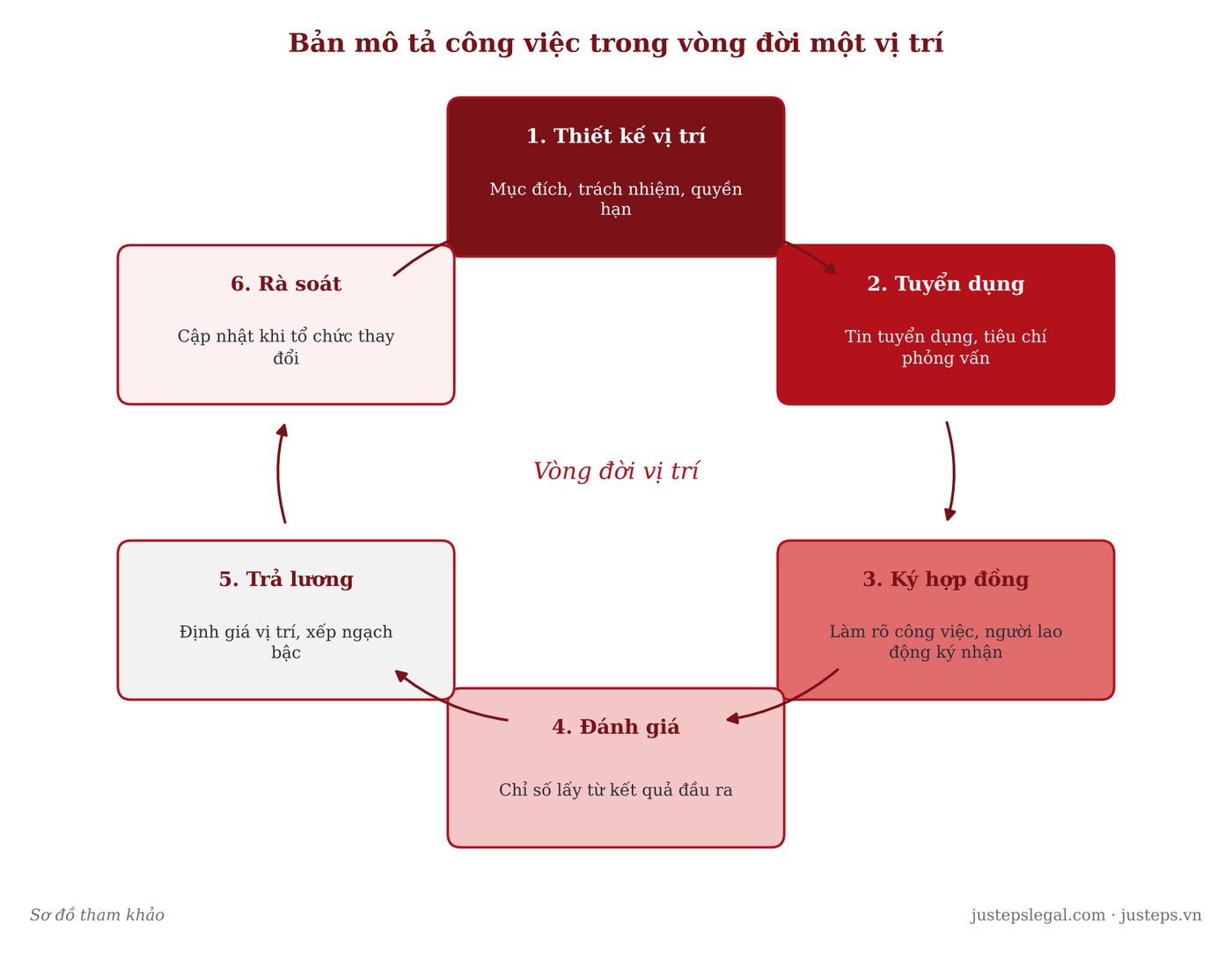
The life cycle of a position and the points at which the job description is used
The job description is created when the business designs the position and is then used in turn to write the job advertisement, clarify the job when the contract is signed, set appraisal indicators and value the position when assigning a pay grade. After each cycle, the business reviews the description, especially when the organisational structure changes, so that the next cycle uses information that reflects the actual work. If the description is used only at the recruitment stage, the later steps will have to rely on managers’ memories and disputes are more likely.
The structure of a usable job description
The business should use a single template for all positions so that departments write in the same way and the HR department can compare positions. The template usually has seven sections, namely position details, purpose of the position, main responsibilities, outputs and indicators, authority, competence requirements and working conditions. The position details section records the position code, title, department, line manager, subordinate positions and place of work, consistent with the organisation chart currently in force. A reasonable length is one to two pages; detailed operating steps should go into separate procedures or work instructions so that the description does not need amending every time software or forms change.
Purpose of the position
The purpose of the position answers the question of what result the business needs this position to achieve, and should be written in one or two sentences. For example, the purpose of an accounts receivable accountant might be to ensure that receivables data is accurate, updated daily and collected in line with the company’s credit policy. This section helps managers avoid assigning work outside the role, because a task that does not serve the purpose of the position should be considered for assignment to another position.
Main responsibilities and time allocation
Tasks should be grouped into five to eight areas of responsibility, each with an estimated share of working time adding up to 100%. The time allocation helps the business spot gaps between design and reality, for example an analyst who spends most of their time on data entry, and also serves as a basis for valuing the position and calculating staffing needs. The chart below illustrates how time is allocated for an accounts receivable accountant.
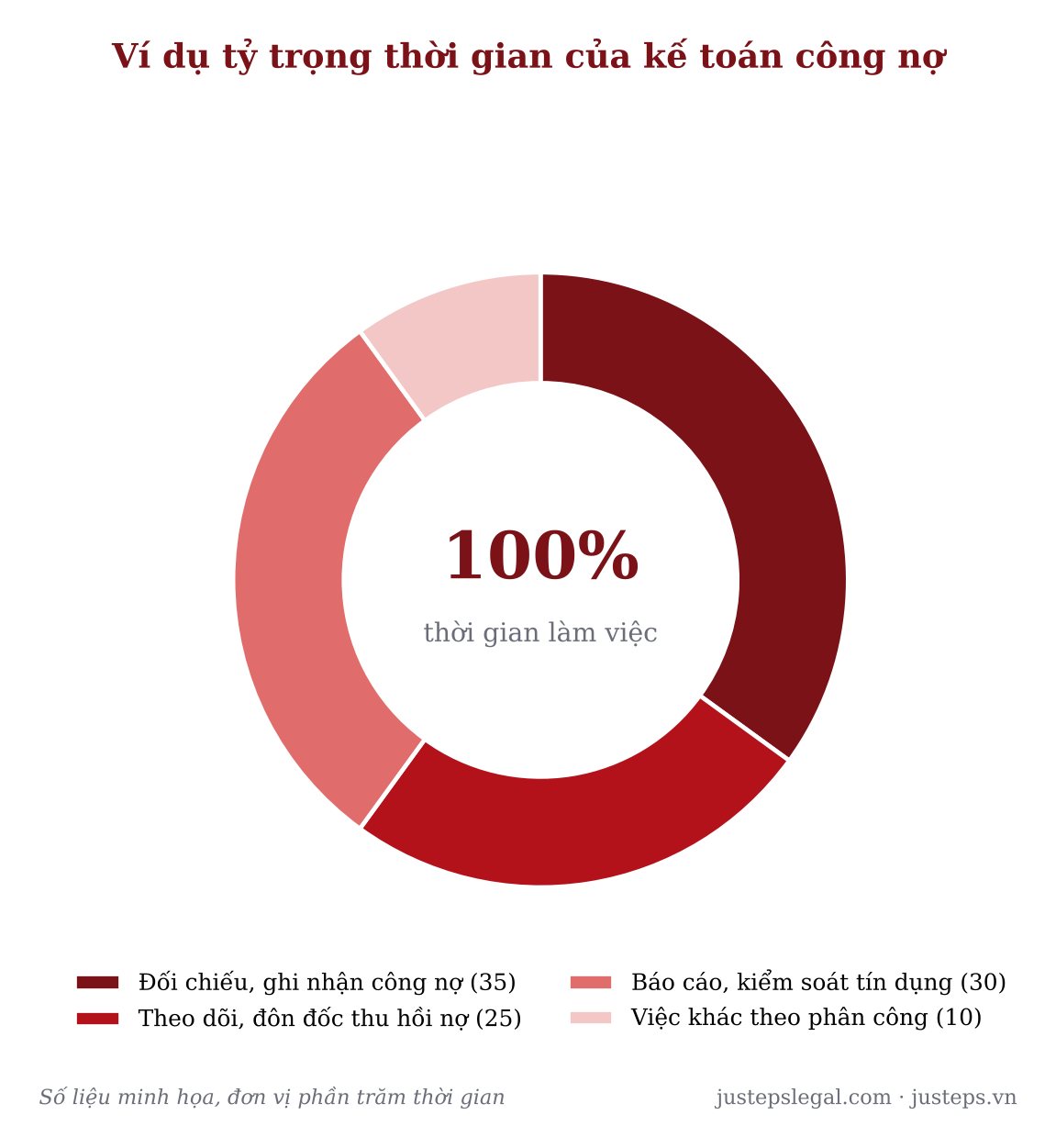
Example of time allocation across areas of responsibility for an accounts receivable accountant
In the example, reconciling and recording receivables takes about one third of the time, monitoring debt ageing and chasing collection takes a quarter, about 30% is spent on receivables reporting and supporting credit control, and 10% on other tasks. If, during a review, the jobholder reports that chasing collection actually takes only 5% of their time, the business needs to reallocate the work or adjust the purpose of the position. The group of other tasks as assigned should be capped at around 10% to keep flexibility without changing the nature of the job.
Outputs, authority and competence requirements
For each area of responsibility, the description should state the deliverable, the deadline and the quality standard, since this is the part that will be turned into appraisal indicators. Authority should be stated specifically in figures or scope, for example the power to approve expenditure up to a certain limit or to sign receivables reconciliation statements, and must match the delegation of authority rules or letter of authorisation in force. Competence requirements cover qualifications, experience, skills and any professional practising certificate required by sector-specific law, while working conditions record factors such as business travel, shift work or hazardous environments.
How to write each line of responsibility
A usable line of responsibility consists of three components, namely an action verb, the object of the work and an output standard. The verb should express a specific action such as prepare, reconcile, approve, check or negotiate, rather than hard-to-measure verbs such as support, participate in or be generally in charge of. The output standard answers the question of how the manager knows the task has been done well, for instance a deadline, an error rate or the satisfaction of the department receiving the output. The table below compares some common ways of writing with measurable versions:
| Area of work | Hard-to-use wording | Measurable wording |
|---|---|---|
| Receivables | Support the monitoring of customer receivables. | Reconcile receivables with each customer before the 10th of every month and resolve discrepancies within 5 working days. |
| Recruitment | Participate in the company’s recruitment activities. | Screen applications and organise first-round interviews, ensuring a suitable candidate is available within 30 days of receiving the request. |
| Sales | Be in charge of corporate customers. | Maintain and grow sales to the corporate customer group in line with the approved quarterly target. |
| Warehouse | Manage the warehouse. | Carry out a stocktake every month and ensure that the discrepancy between the books and physical stock does not exceed the permitted rate. |
A line for other tasks as assigned by the line manager should still be kept for flexibility, but it should state clearly that these are tasks suited to the expertise of the position and that they take up a limited share of time. This line cannot replace the procedure for changing an employee’s job under the Labour Code, so the business cannot rely on it to assign, on a long-term basis, work that is entirely different from the agreed position. Once finished, the author should reread each line and ask whether someone outside the department would understand what has to be done and how it will be assessed.
Linking job descriptions to recruitment and the employment contract
When used for recruitment, the competence requirements should be split into mandatory requirements used to screen applications and preferred requirements used to score candidates. The head of department can use the main areas of responsibility to draft three to five situational questions, helping interviewers assess candidates against the same criteria. Job advertisements and descriptions must not contain discriminatory requirements based on gender, age, marital status, religion or other characteristics prohibited by law, unless the requirement is linked to the particular nature of the job[6].
When entering into an employment contract, the business has two ways of setting out the job content. The first is to state the job title and main areas of work in the contract, while the detailed description is an internal document acknowledged by the employee in writing; this allows the business to update operating details without amending the contract. The second is to attach the description as an appendix to the contract, in which case every change to the description is a change to the contract and must be agreed by both parties. Whichever approach is chosen, the business should keep the copy signed by the employee, as this is important evidence if a dispute arises about the scope of work.
For foreign employees, the job title and position stated in the work permit application must match the work the person actually performs[7]. The job description helps the business explain its need and demonstrate that the position falls within the category of manager, executive director, expert or technical worker. Where a foreign employee is assigned work different from the licensed position, the business should check whether a new work permit or an amendment to the permit is required before making the change.
Using job descriptions for appraisal and pay
Turning outputs into appraisal indicators
Each output in the description can be turned into an appraisal indicator with a specific target for each period, for example the rate of receivables overdue by more than 90 days or the average time taken to fill a position. The job description for a position should remain stable, while each individual’s targets for each period are recorded in a target assignment form. This separation allows several people in the same position to share one description while still having their own targets suited to the area or customer group assigned to them.
If the business wishes to use appraisal results to deal with an employee who regularly fails to complete their work, the appraisal criteria must be set out in the rules on assessing work performance issued by the business, after consulting the grassroots employee representative organisation where one exists[4]. The indicators in the target assignment form are effective only when the rules refer to how those targets are set and scored. The business should therefore review the description, the target assignment form and the appraisal rules together, for example through Justeps’ service for building KPI systems and performance appraisal.
Job evaluation and pay grading
When building salary scales and pay tables, the business may score each position on factors such as scope of responsibility, impact on business results, number of people managed, required qualifications and working conditions, and use the total score to place the position in a pay grade. The Labour Code requires businesses to establish salary scales, pay tables and labour norms as the basis for recruitment, agreeing wages and paying wages, after consulting the employee representative organisation and publicising them at the workplace before implementation[8]. A good job description makes scoring transparent and helps the business ensure equal pay for people doing work of equal value[5].
The starting step of the lowest grades must be reviewed whenever the regional minimum wage changes. From 1 January 2027, the monthly minimum wage is VND 5,700,000 in Region I, VND 5,080,000 in Region II, VND 4,450,000 in Region III and VND 4,040,000 in Region IV[9], so positions whose starting step is close to the old level need adjusting before the January payroll. When adjusting, the business should also check the gaps between steps and between grades to avoid a position with greater responsibility having a starting wage almost equal to that of a lower position.
Changing job descriptions and the limits of the power to transfer
Not every change to a job description requires the employee’s consent. Updating methods, tools or forms within the scope of the agreed work falls within the business’s management and operational authority and requires only notification and the employee’s acknowledgement. Conversely, where a change alters the job, the place of work or the wage stated in the contract, the party proposing it must give at least three working days’ notice and the parties may proceed only if they agree by way of an appendix or a new contract[10].
The Labour Code allows a business to temporarily transfer an employee to work different from that in the contract in the event of sudden difficulties or production and business needs, provided those cases are specified in the internal labour regulations[11]. The temporary transfer may not exceed 60 cumulative working days in a year unless the employee agrees in writing, and the business must give at least three working days’ notice; if the new job pays less, the employee keeps their previous wage for 30 working days and is thereafter paid at least 85% of that wage[12]. The following table summarises how to handle each type of change:
| Type of change | Example | How to handle it |
|---|---|---|
| Working method | Switching accounting software, changing a report template or adding a check step within the same job. | Update the description or procedure, notify the employee and obtain their acknowledgement. |
| Job content | Moving a receivables accountant to tax accounting or adding team management responsibilities. | Give at least three working days’ notice, reach agreement and sign an appendix or a new contract. |
| Temporary transfer | Moving office staff to help with packing when there is an urgent order. | Applies only to cases specified in the internal labour regulations, for up to 60 working days a year without written consent. |
| Place of work | Moving an employee from head office to a branch in another province. | Agree an amendment to the contract, unless the contract already provides for multiple places of work. |
Issuing, updating and keeping records
Job descriptions should be issued under a uniform procedure to ensure that their content is consistent with the organisation chart, the delegation of authority rules and the salary scales. The content is written by the head of department, who understands the work best, while the HR department issues the template, checks consistency and keeps the records. The sequence below applies both to new descriptions and to amendments.
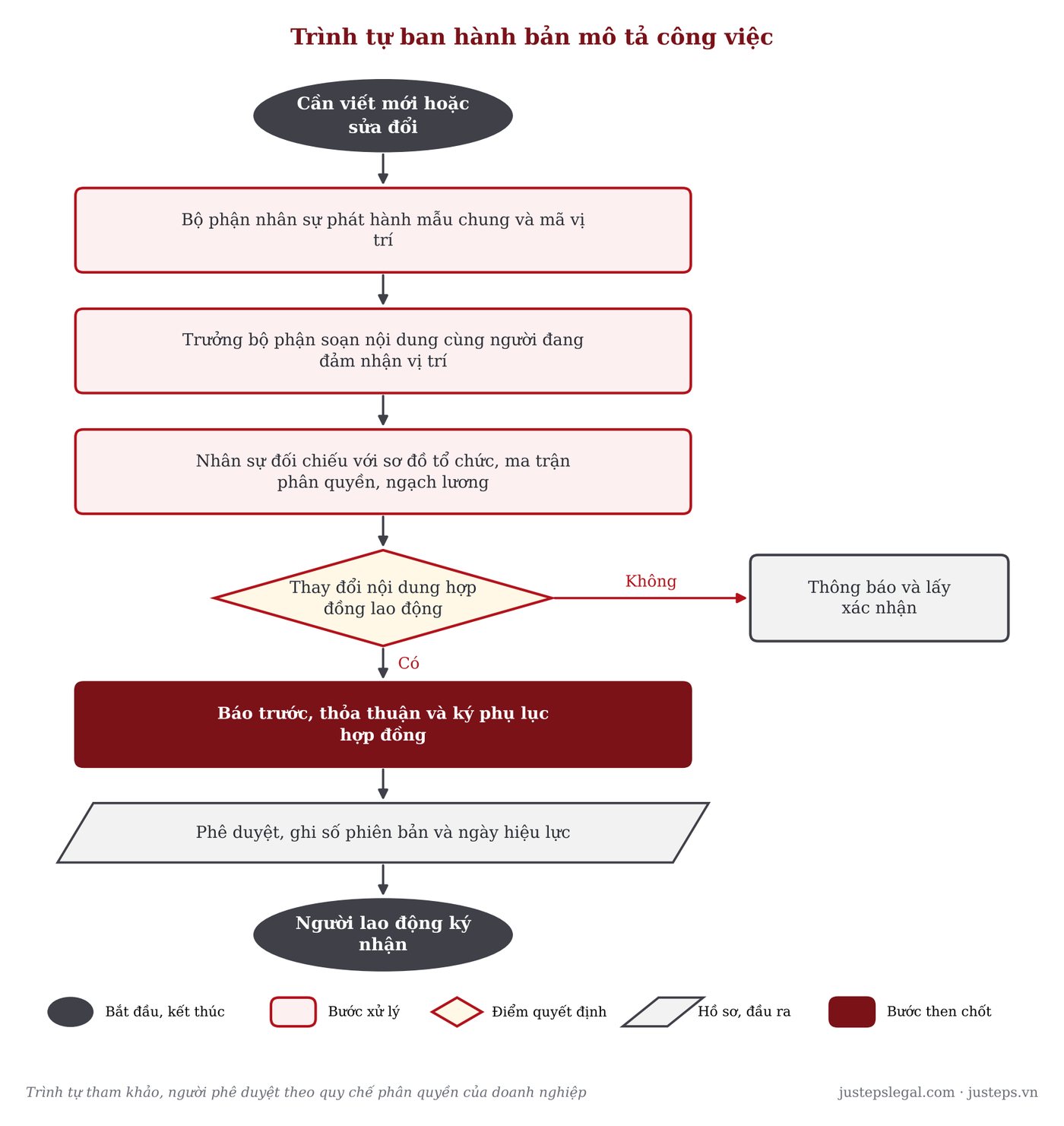
Sequence for writing or amending a job description
After the head of department drafts the content together with the current jobholder, the HR department checks it against the organisation chart, the delegation of authority matrix and the pay grades to avoid overlapping responsibilities or authority exceeding the rules. The key question at the next step is whether the change alters the content of the employment contract; if it does, the business must give notice and agree an appendix, and if not, notification and acknowledgement are sufficient. The description is then approved by the authorised person, given a version number and effective date, and handed to the employee to sign in acknowledgement.
The business should rewrite a description when the organisational structure changes, when an employee has been working outside the description continuously for more than three months, when new appraisal indicators or pay rules are about to be applied, or when there is a complaint about the scope of work. In addition, all descriptions should be reviewed every twelve months, at the same time as the annual appraisal. The minimum records comprise the common template, the list of positions with codes, the approved descriptions, the employees’ signed acknowledgements and a version change log.
Common mistakes include copying templates from the internet so that the description lists tasks nobody does and omits tasks that are actually performed, listing dozens of minor tasks so that nobody reads it, omitting output indicators so that appraisal reverts to impression, stating authority that differs from the delegation of authority rules or the letter of authorisation, and failing to obtain the employee’s signed acknowledgement. Businesses can standardise their entire job title system and job descriptions with Justeps’ service on organisational structure, functions and duties, and job descriptions.
How Justeps can help
Justeps helps businesses build and use job descriptions through the following services:
- Organisational structure, functions and duties, and job descriptions. Justeps designs the common template and list of positions and drafts job descriptions consistent with the organisation chart and the delegation of authority rules.
- Building KPI systems and performance appraisal. Justeps turns the outputs in job descriptions into appraisal indicators and drafts the rules on assessing work performance.
- Salary scales and pay and bonus regulations. Justeps values positions based on job descriptions, assigns grades and steps, and reviews wages against the 2027 regional minimum wage.
- Labour records and employment contracts. Justeps reviews how the job is set out in employment contracts and drafts appendices for changes of job and acknowledgement records.
- In-house training. Justeps trains heads of department to write lines of responsibility, set output indicators and assign work within the scope of the contract.
Frequently asked questions
Does the law require a business to have job descriptions?
The law does not prescribe a template for job descriptions, but an employment contract must contain provisions on the job and the place of work[1]. A job description is the most convenient way to clarify this content and to serve as a basis for appraisal.
How long should a job description be?
A description should be about one to two pages long, with five to eight areas of responsibility. Detailed operating steps should be placed in separate procedures or work instructions.
Does changing a job description require the employee’s consent?
If the change alters the work agreed in the contract, the parties must agree it by way of an appendix or a new contract[10]. If only the method of performing the same work changes, the business notifies the employee and obtains their acknowledgement.
Can several people in the same position share one job description?
The business should use a shared description, because the description describes the position rather than the individual. Each person’s own targets are recorded in the target assignment form for each period.
Should the job description be attached to the employment contract?
Attaching it as an appendix makes the job content clear, but every subsequent change must then be agreed by both parties. Many businesses choose to state the job title and main areas of work in the contract, with the detailed description acknowledged separately by the employee.
Can a job description be used to terminate a contract for failure to complete work?
The description is only part of the basis, because the appraisal criteria must be set out in the rules on assessing work performance issued by the business[4]. The business needs the rules, the appraisal results and complete target assignment records before considering termination.
Does the line on other tasks as assigned allow any work to be assigned?
This line should cover only work suited to the expertise of the position and taking up a limited share of time. To assign entirely different work on a long-term basis, the business must agree an amendment to the contract or properly apply the temporary transfer procedure[12].
Related articles
- How to choose an organisation chart model that fits the size of a business and the way it generates revenue
- Which documents make up the minimum set of internal governance rules for a company with 50 to 200 staff
- Designing KPIs for production workshops and linking assessment results to workers’ piece-rate pay
- A monthly labour and payroll compliance checklist for HR departments
Notes
[1] Point c, Clause 1 of Article 21 of the Labour Code No. 45/2019/QH14 dated 20 November 2019.
[2] Clause 3 of Article 3 of Circular No. 10/2020/TT-BLDTBXH dated 12 November 2020 guiding the contents of employment contracts.
[3] Clause 1 of Article 16 of the Labour Code No. 45/2019/QH14 dated 20 November 2019.
[4] Point a, Clause 1 of Article 36 of the Labour Code No. 45/2019/QH14 dated 20 November 2019.
[5] Article 90 of the Labour Code No. 45/2019/QH14 dated 20 November 2019.
[6] Clause 8 of Article 3 and Clause 1 of Article 8 of the Labour Code No. 45/2019/QH14 dated 20 November 2019.
[7] Government Decree No. 219/2025/ND-CP on foreign workers working in Vietnam.
[8] Article 93 of the Labour Code No. 45/2019/QH14 dated 20 November 2019.
[9] Decree No. 399/2026/ND-CP on minimum wages applicable from 1 January 2027.
[10] Articles 22 and 33 of the Labour Code No. 45/2019/QH14 dated 20 November 2019.
[11] Clause 2 of Article 118 of the Labour Code No. 45/2019/QH14; Article 69 of Government Decree No. 145/2020/ND-CP dated 14 December 2020.
[12] Article 29 of the Labour Code No. 45/2019/QH14 dated 20 November 2019.
This article is for reference and reflects the regulations in force at the time of publication. Please consult Justeps for advice tailored to your company’s records and situation.
For further information, please contact:
📩 Email: info@justeps.vn
🌐 Website: https://justepslegal.com · https://justeps.vn
🌐 Page: Justeps
☎️ Hotline (Zalo): 096 172 2607
📍 Thanh Xuan Office: 12th Floor, Licogi 13 Tower, 164 Khuat Duy Tien Street, Thanh Xuan Ward, Hanoi, Vietnam
📍 Ha Dong Office: LK06B, No.10, Dong Dua Area, Ha Dong Ward, Hanoi, Vietnam
📍 Ho Chi Minh City Branch: 528 Le Van Sy, Ho Chi Minh City, Vietnam
📍 Hai Phong Office: Truong Thinh Village, Ha Dong Commune, Hai Phong, Vietnam
📍 Quang Ninh Office: Van Don Special Zone, Quang Ninh Province, Vietnam





