
Decree No. 363/2026/ND-CP on administrative sanctions in the field of data took effect on 11 November 2026. For the first time, very ordinary gaps in data collection, such as missing consent, no collection procedure or no data quality checks, carry specific fines of up to VND 60 million for individuals and VND 120 million for organizations.
What businesses should note is that failing to issue a data collection procedure is itself a sanctionable act. Marketing running sign-up forms, sales entering data into the CRM and HR keeping candidate files are all collecting data, and now need a written procedure backed by evidence of how it works in practice.
Sanctionable acts related to data collection
Article 8 of Decree No. 363/2026/ND-CP divides the violations into two groups. Clause 1 imposes fines of VND 20–40 million for procedural failures; Clause 2 imposes fines of VND 40–60 million for more serious acts. These amounts apply to individuals; an organization committing the same violation is fined twice the amount applicable to individuals.
| Violation | Basis | Individual | Organization |
|---|---|---|---|
| Collecting or creating data without consent as required | Clause 1, Article 8 | VND 20–40 million | VND 40–80 million |
| Failing to issue a data collection procedure or to apply data protection measures | Clause 1, Article 8 | VND 20–40 million | VND 40–80 million |
| Failing to check data accuracy and quality | Clause 1, Article 8 | VND 20–40 million | VND 40–80 million |
| Intentionally creating false or forged data | Clause 2, Article 8 | VND 40–60 million | VND 80–120 million |
| Collecting data beyond the notified scope or purpose | Clause 2, Article 8 | VND 40–60 million | VND 80–120 million |
| Clause 1 violations involving core or important data | Clause 2, Article 8 | VND 40–60 million | VND 80–120 million |
| Clause 1 violations that disclose sensitive information | Clause 2, Article 8 | VND 40–60 million | VND 80–120 million |
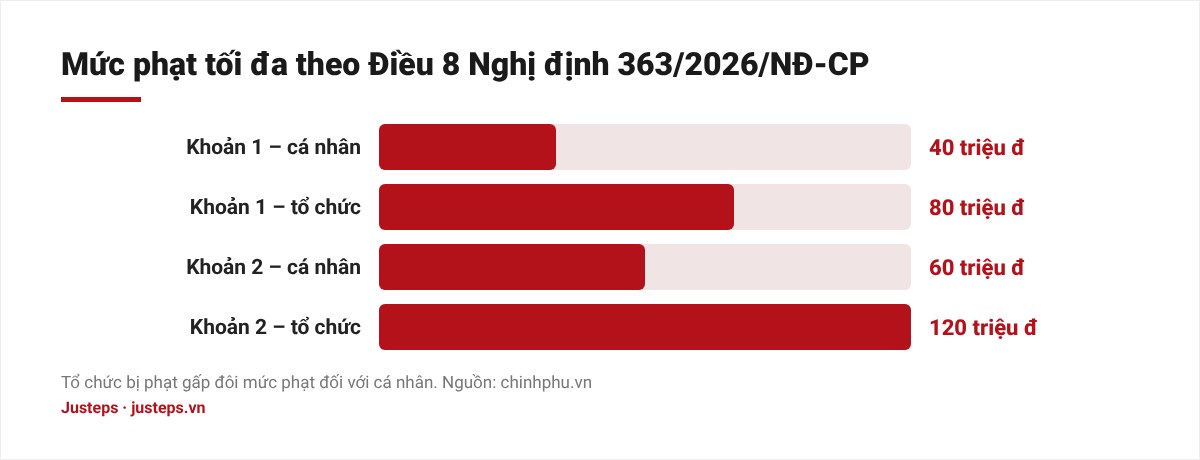
Maximum fines under Clauses 1 and 2, Article 8 of Decree No. 363/2026/ND-CP.
Beyond fines, a business may have the management and operation of its database suspended for 6 to 9 months in the cases under Points d and dd, Clause 2, have exhibits confiscated, be forced to delete or destroy data and be forced to return illegal gains. For marketing-driven businesses, being forced to delete a leads database often hurts more than the fine itself.
The decree does not apply to acts already covered by the decree on sanctions for cybersecurity and personal data protection. In practice, a CRM or HR database holds both personal data and other data such as transaction history, product data and operational data. The internal procedure should therefore be designed once to satisfy both the Law on Data No. 60/2024/QH15 and the Law on Personal Data Protection No. 91/2025/QH15, rather than maintaining two separate sets of documents.
Common risks in three data areas
Marketing
Landing page forms, events and content downloads are the largest data sources. Common mistakes include pre-ticked consent boxes, no record of when consent was given, or data collected to send a quotation being pushed into retargeting ads. The latter may be treated as collecting data beyond the notified scope or purpose under Clause 2, Article 8. Lists bought from third parties without evidence of consent are also a direct risk.
CRM and sales
Sales staff enter data by hand, each in their own way, and duplicates and errors pile up over the years. Failing to check data accuracy and quality is sanctionable under Point c, Clause 1, Article 8, so data cleansing is no longer only a sales efficiency issue.
Human resources
Candidate files, employee records, biometric attendance data and health information are sensitive information. If a Clause 1 violation leads to disclosure of sensitive information, the fine moves up to Clause 2, so HR needs tighter access control than other departments.
Building an internal data collection procedure
The procedure should be issued by decision of the Director or General Director and apply to every department that collects data. The six steps below track the sanctionable acts in Article 8.
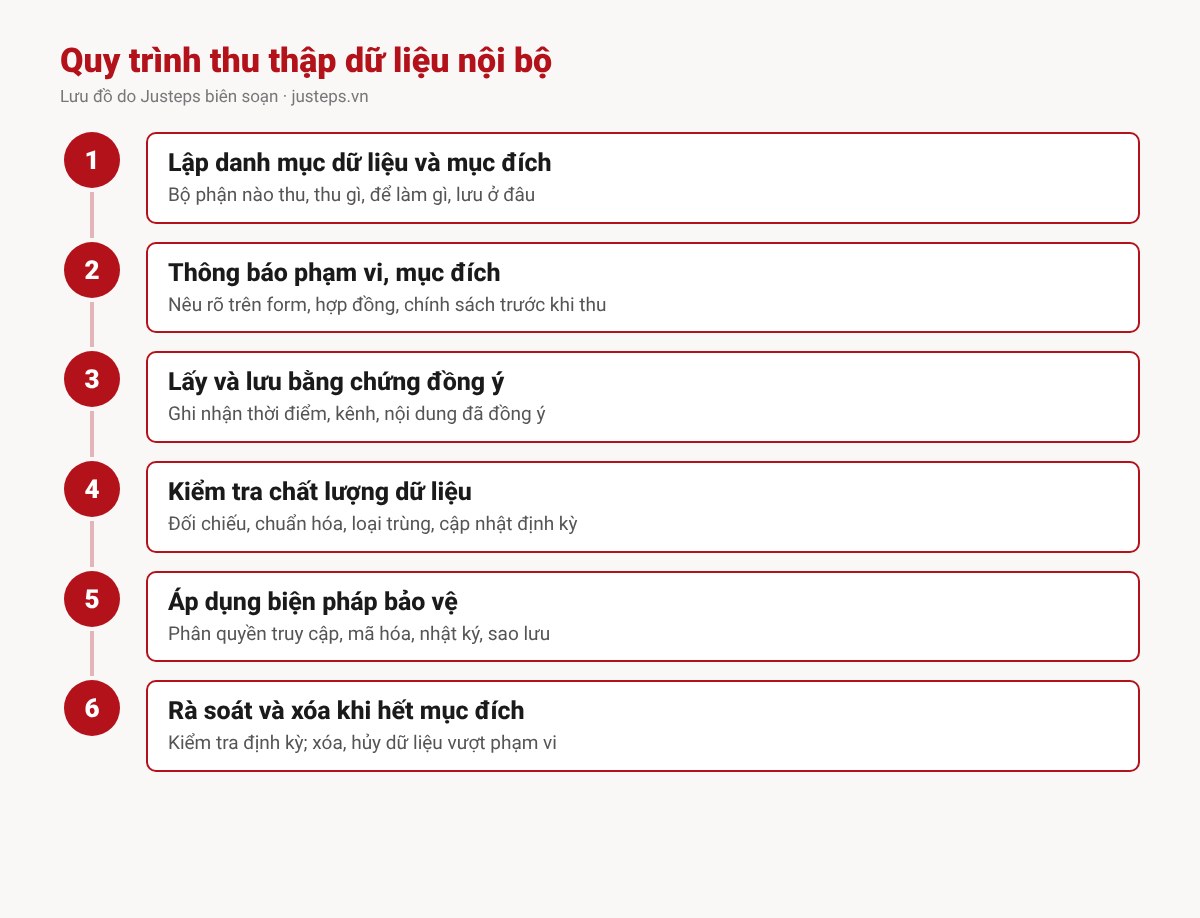
Six steps of an internal data collection procedure proposed by Justeps.
Build a data inventory and define purposes
Each department lists the data it collects: source, data type, purpose of use, storage location, who has access and retention period. This inventory is the reference for checking whether collection exceeds its purpose, so a data governance focal point should own and update it.
Notify scope and purpose before collection
Every collection point, such as a form, contract or job application, must state clearly what the data is collected for. To use data for a new purpose, the business notifies again and obtains additional consent before use.
Obtain and record evidence of consent
Consent boxes are unticked by default and separated by purpose. The system records the time, channel and version of the content the user agreed to. For data bought or received from partners, the contract must include the provider's undertaking on consent and the right to request evidence.
Check data accuracy and quality
Set mandatory input rules (phone number, email and tax code formats), run duplicate checks monthly and carry out periodic full reviews. Each check is recorded in minutes as evidence of compliance.
Apply protection measures
Use role-based access, encrypt sensitive data, keep access logs, back up data and lock bulk export functions. Access for departing employees must be revoked on their last day.
Review periodically and delete or destroy data
Data that has served its purpose, passed its retention period or was collected beyond scope should be deleted or destroyed, with a written record. This also reduces the volume of data that must be protected.
Responsibilities and records to keep
During an inspection, authorities will ask for evidence, not just the procedure document. The table below suggests responsibilities and records for each control area.
| Control area | Lead department | Evidence |
|---|---|---|
| Data inventory and collection purposes | Data governance focal point, data-owning departments | Data inventory register, updated every 6 months |
| Notice of scope and purpose | Marketing, HR, legal | Approved forms, policies and contract clauses |
| Consent | Marketing, sales, HR | Consent logs in the CRM, signed consent forms |
| Data quality | CRM operations, HR | Periodic check minutes, data cleansing reports |
| Protection measures | IT | Access rights matrix, access logs, backup plan |
| Deletion and destruction | Data-owning departments, IT | Signed deletion/destruction records |
A business starting from scratch can roll this out in about 30 days: week one for the data inventory, week two for drafting the procedure and forms, week three for updating forms, contracts and policies across collection channels, and the final week for issuing the decision and training staff who enter data. Data collected before 11 November 2026 should be reviewed: obtain additional consent where needed, cleanse it and delete what no longer has a purpose, because the obligations to check quality and protect data continue after the decree takes effect.
Legal basis
- Decree No. 363/2026/ND-CP on administrative sanctions in the field of data, issued on 19 September 2026, effective from 11 November 2026.
- Law on Data No. 60/2024/QH15.
- Law on Personal Data Protection No. 91/2025/QH15, effective from 1 January 2026.
How Justeps can help
- Drafting the internal data collection procedure, the issuing decision and supporting forms through the services of Justeps.
- Reviewing forms, policies and contract terms across marketing, CRM and recruitment channels.
- Reviewing data purchase and data sharing agreements with partners and service providers.
- Training marketing, sales and HR teams on data collection and protection.
- Ongoing advice on data and personal data compliance.
Frequently asked questions
When does Decree No. 363/2026/ND-CP take effect?
The decree was issued on 19 September 2026 and takes effect from 11 November 2026.
What is the maximum fine for a business that collects data unlawfully?
Organizations are fined twice the amount for individuals, i.e. up to VND 80 million for acts under Clause 1 and VND 120 million for acts under Clause 2, Article 8, in addition to supplementary sanctions and remedial measures.
We already have a privacy policy on our website. Do we still need a data collection procedure?
Yes. A website policy is a notice to users, while the collection procedure is an internal document setting out how departments collect, check and protect data. Failing to issue a collection procedure is sanctionable under Point b, Clause 1, Article 8.
What are the risks of buying customer lists from third parties?
If consent cannot be proven, the business may be considered to have collected data without consent as required. Data purchase contracts should include the provider's undertaking and evidence of consent; for personal data, the rules on personal data protection must also be checked.
Does data collected before 11 November 2026 need to be reprocessed?
It should be reviewed. The obligations to check quality and apply protection measures continue, so legacy data should be cleansed, supplemented with consent where needed and deleted where it no longer serves a purpose.
Related articles
- Controlling advertising content: a pre-publication approval process
- Fire safety records for business premises under the new law: annual tasks
- Organizational structure for private dental clinics with one to three locations
- Building KPIs for the B2B sales team of a small or medium software company
Contact Justeps
Email: info@justeps.vn · Hotline/Zalo: 096 172 2607 · Website: justeps.vn
Office network
- Thanh Xuan Office: 12th Floor, Licogi 13 Tower, 164 Khuat Duy Tien, Thanh Xuan Ward, Hanoi
- Ha Dong Office: LK06B, No.10, Dong Dua Area, Ha Dong Ward, Hanoi
- Ho Chi Minh City Branch: 528 Le Van Sy, Nhieu Loc Ward, HCMC (formerly Ward 14, District 3)
- Hai Phong Office: Truong Thinh Village, Ha Dong Commune, Hai Phong
- Quang Ninh Office: Van Don Special Zone, Quang Ninh





