
Key takeaways
- In a small factory, losses and accidents usually stem from the person who checks reporting to the very person being checked, and rarely from a shortage of staff.
- The person in charge of occupational safety and the head of quality control should report directly to the director, with the right to stop work or hold goods written into their appointment decisions.
- The number of people in charge of occupational safety and health and their working arrangements depend on the sector and the headcount, so a business needs to identify its sector group before setting its staffing plan.
- The storekeeper must be separated from the purchaser and from the person who keeps the materials accounts, and every stocktake needs the signatures of both accounting and production.
- Combining roles is a reasonable approach at small scale, provided that a business does not merge two roles where one is tasked with controlling the other.
A mechanical workshop of around eighty people may deliver on time for many years, until a major customer arrives to assess its suppliers and asks three very simple questions. Who has the power to hold back a non-conforming batch, to whom does the person in charge of occupational safety report, and why do the warehouse and accounting inventory figures differ every month. The answer is usually that the production manager decides everything, the safety role is held by a technician assigned verbally, and the storekeeper also places the orders for materials. The business is not short of people, but roles and reporting lines have not been defined, so when an incident occurs no one has sufficient authority or records to prove that they acted correctly.
This article sets out how to build the organisational structure of a manufacturing company with roughly thirty to two hundred employees, in order from dividing the functional blocks and recognising when a review is needed, to placing the three control positions that are most often put in the wrong place, namely occupational safety, quality control and the materials warehouse, and then to designing reporting lines, documenting authority and choosing how to combine roles. The content suits limited liability companies and joint stock companies in mechanical engineering, plastics, packaging, food processing, garments and assembly. The main readers are directors, production managers, HR officers and chief accountants of manufacturing businesses.
The five functional blocks of a small manufacturing workshop
In principle, the organisational structure of a small manufacturing company should be divided into five blocks, namely production, quality control, warehouse and materials, occupational safety, and a support block covering purchasing, sales, accounting and human resources. At small scale, a block may consist of only one or two people, or even a single person holding another role at the same time. What needs to be clarified is what each block is responsible for, to whom it is accountable and how far its decision-making power extends, because a chart with every box filled in but no allocation of authority still cannot resolve internal disputes when an incident occurs. The table below suggests an arrangement for a workshop with around eighty workers.
| Block | Main duties | Reports to |
|---|---|---|
| Production | Planning shifts, coordinating production teams, maintaining machinery and ensuring output in line with orders. | The director, through the production manager. |
| Quality control | Inspecting incoming materials, in-line work and goods before dispatch, keeping samples and deciding to hold non-conforming goods. | The director, bypassing the production manager. |
| Warehouse and materials | Receiving, issuing and storing raw materials and finished goods against approved slips. | The chief accountant or the person in charge of finance. |
| Occupational safety | Preparing the safety plan, organising training, inspecting the shop floor and monitoring incidents. | The director, with the right to propose stopping work when danger is detected. |
| Support | Purchasing, sales, accounting, human resources and administration serving the whole workshop. | The director or the deputy director in charge. |
This arrangement has two features worth noting. First, quality control and occupational safety sit on the same level as the production block rather than inside it, because these are the two positions whose task is to control production itself. Second, the warehouse is placed under the supervision of finance rather than of purchasing or production, so that the person issuing materials is not also the person who uses or buys them. The diagram below shows the five blocks and the common goal they all work towards.
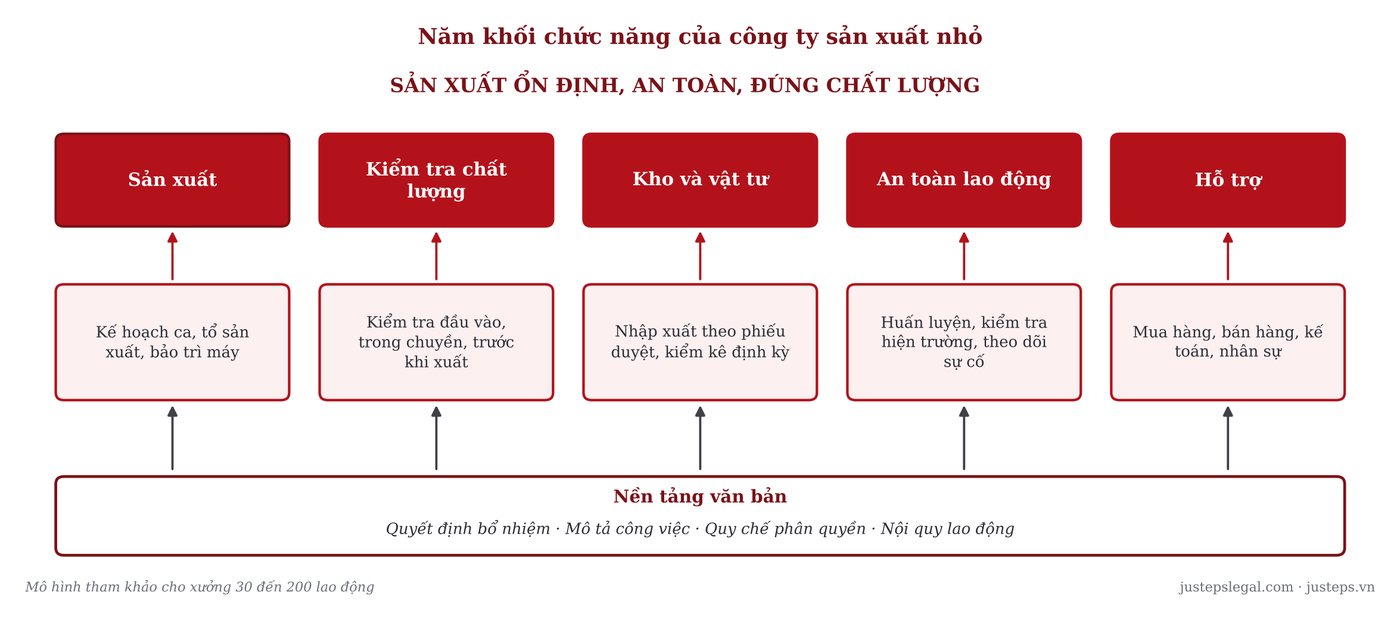
The five functional blocks in the organisational structure of a small manufacturing company
The diagram shows that each block is an independent pillar with its own person in charge, and that all of them rest on a common foundation of appointment decisions, job descriptions, regulations on delegation of authority and the internal labour rules. Without this documentary foundation, the pillars exist only on paper, because staff continue to work out of habit and follow whoever has the loudest voice in the workshop. A business should start by redrawing its current chart honestly, recording who actually reports to whom, and only then compare it with the desired chart.
Signs that the current structure needs to be reviewed
Many manufacturing businesses keep the structure they had when they employed fifteen or twenty people until they have grown fivefold. The old structure was not wrong at the outset, but as the number of shifts, lines and customers increases, overlapping responsibilities start to cause real losses. A business should review its structure when one or more of the following signs appear:
- The workshop starts running two or three shifts while the production manager remains the only person with power to decide everything on the shop floor.
- The headcount exceeds around fifty, especially in mechanical engineering, chemicals and metals, where the obligations regarding occupational safety staff change with scale.
- Major customers or supplier assessment teams raise questions about the independence of the quality control department.
- Inventory discrepancies recur for several consecutive months without anyone being identified as responsible.
- An accident or incident has occurred but the business cannot produce the assignment decision and training records of the persons involved.
These signs show that the risk is already embedded in the way the business is organised, and that the incidents arising are no longer isolated. When reviewing, a business should follow an order of priority with occupational safety first, quality control second and the materials warehouse last, because errors in the safety position affect the lives and health of workers and carry the heaviest legal liability. Each position should be examined against three questions, namely who is doing the job, to whom that person reports, and whether that person's authority has been put in writing.
The person in charge of occupational safety and health
The law on occupational safety and health requires employers to set up a unit or assign persons to occupational safety and health work, assign persons to health care work and organise a network of safety and health officers in production teams[1]. The number of persons in charge of safety and their working arrangements are set according to the sector group and the number of employees. For high-risk sector groups such as mining, chemicals, manufacture of metals and metal products, manufacture of non-metallic mineral products, construction, shipbuilding and power generation, a business with fewer than fifty employees needs at least one person working on a part-time basis, while a business with fifty to fewer than three hundred employees needs at least one full-time person[2]. For other sectors, a business with fewer than three hundred employees needs at least one person doing occupational safety and health work on a part-time basis[2].
The person assigned to this task must meet the requirements on professional qualifications and experience set by law, and must be trained for the correct group of trainees before taking up the task[3]. Where a business cannot find a qualified person, the law allows it to hire an organisation with the capacity to provide occupational safety and health services[1]. Outsourcing does not transfer the employer's responsibility to the service provider, so the business still needs an internal focal point to monitor the plan, the records and the remedying of shortcomings identified by the provider.
Reporting line and the right to request a stoppage
The person in charge of safety should report directly to the director, not through the production manager. The reason is that this person has the right to request the head of the production unit to order the suspension of work or the temporary stoppage of machinery and equipment when a risk of accident is detected[1], and that right is hard to exercise if the person asked to stop is the direct superior who appraises and sets the pay of the person making the request. The appointment decision should state clearly the scope of the right to propose a stoppage, who must be notified immediately when work is stopped and who has the authority to allow operations to resume, so as to avoid arguments on the shop floor.
The network of safety and health officers and training
Each production team should have at least one part-time safety and health officer, who is a direct worker, understands the work and is elected by the team, with the benefits provided for by the law on occupational safety and health[1]. In parallel, employees doing work with strict occupational safety requirements must be trained and issued with a safety card before being assigned to such work[3]. A new list of jobs with strict safety requirements has been issued by the Ministry of Home Affairs and applies from 1 January 2027[4], so a business needs to check the list of positions in its workshop against it before that date. In addition, the National Assembly passed a law amending the Law on Occupational Safety and Health on 21 November 2026, effective from 1 March 2027[1], so internal regulations on incident reporting and on the role of safety and health officers should be reviewed once the implementing documents are issued.
The quality control department
Quality control is the position most easily misplaced in a small workshop. In many businesses, quality inspectors are attached to individual production teams, receive piece-rate pay based on the team's output and take their assignments from the team leader. Under such an arrangement, the inspector benefits directly from letting goods pass, so it is very difficult to ask them to hold back a batch at the end of a shift when the team is running to meet its target. Export customers and supplier assessment teams usually spot this very quickly from the organisation chart and the payroll.
A more suitable arrangement is to have the head of quality control report directly to the director. The head of department has the right to hold back a non-conforming batch, and the production manager may not release that batch on their own initiative, but may only propose that the director consider conditional acceptance where the customer agrees in writing. The income of inspectors should be linked to the defect detection rate, the customer complaint rate and compliance with procedures, not to output. The quality control department is also where inspection records, retained samples and batch traceability records are kept, which are important evidence when a quality complaint arises with a customer.
The procedure for handling a non-conforming batch should be put in writing and communicated to the whole workshop. The flowchart below describes the sequence from the detection of a defect to the final handling of the batch, in which the decision on conditional acceptance belongs to the director and not to the production manager.
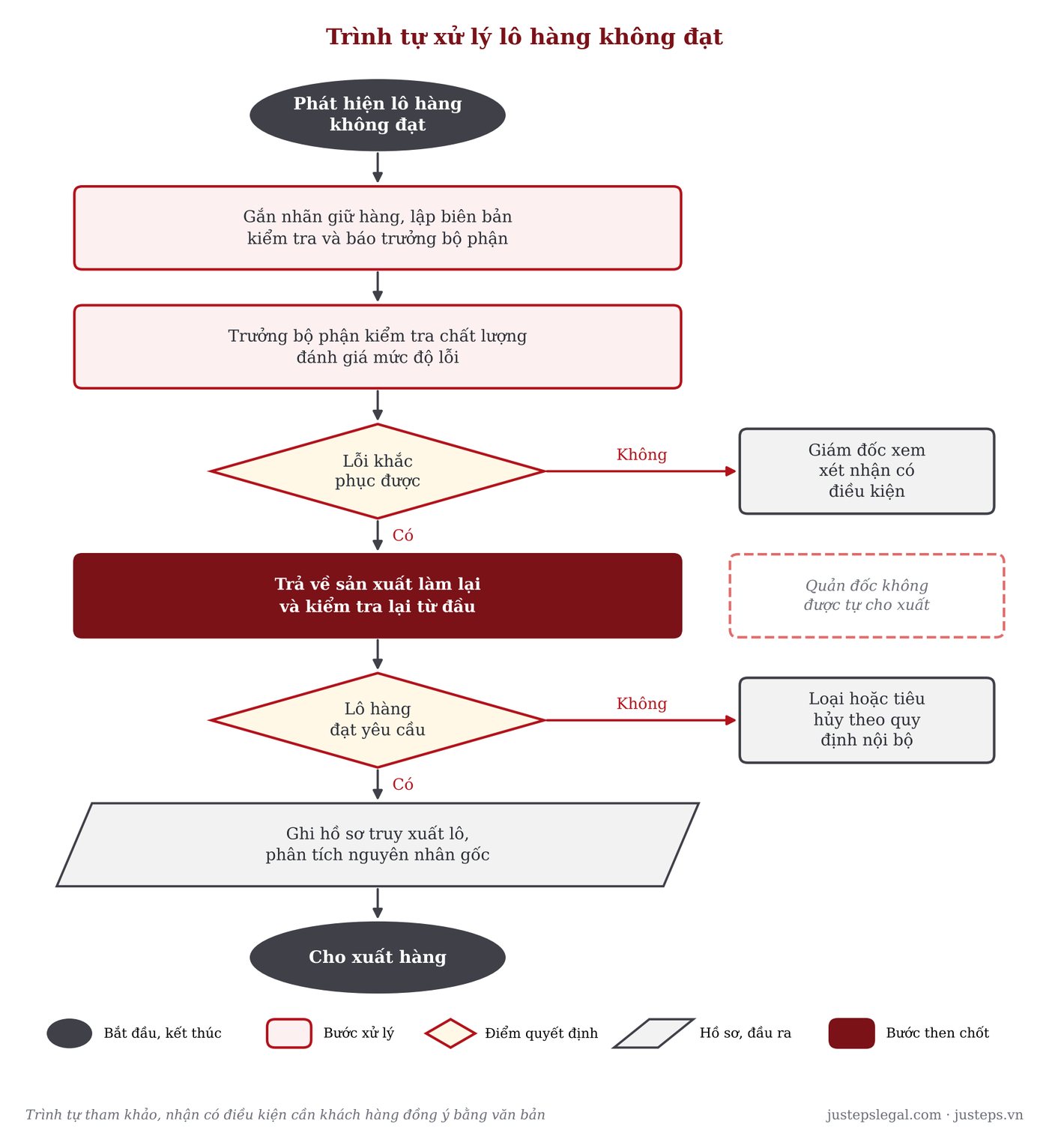
Sequence for handling a non-conforming batch and the role of the quality control department
According to the flowchart, when an inspector finds a non-conforming batch, the first step is to attach a hold label and prepare a record, after which the head of quality control assesses the severity of the defect. If the defect can be remedied, the batch is returned to production for rework and is inspected again from the start, and a reworked batch that still does not conform is rejected or destroyed under internal rules. If the defect cannot be remedied, only the director may consider conditional acceptance, on condition that the customer consents in writing, and where the customer does not consent the batch is also rejected. Every step leaves a record, which helps the business explain itself to the customer and find the root cause in order to take corrective action.
The materials warehouse and the principle of segregation of duties
The warehouse holds most of the current assets of a manufacturing business, so the basic principle is that the storekeeper is not at the same time the person who decides on purchases, the person who uses the materials or the person who keeps the materials accounts. The storekeeper issues materials only against request slips approved by an authorised person, receives goods only when there is an incoming inspection record from the quality control department, and reports to the finance block. Accounting law also provides that a person working as storekeeper, cashier or purchaser or seller of assets may not do accounting work, except in certain cases such as private enterprises, single-member limited liability companies owned by an individual and micro-enterprises without state capital[5][6].
Periodic stocktaking is the tool for detecting discrepancies between warehouse and accounting figures. For a small workshop, a monthly count of high-value or easily lost materials and a full count at year end is a reasonable level. The stocktake record should bear the signatures of the storekeeper, a representative of accounting and a representative of production, together with an explanation of the cause of each discrepancy that exceeds the permitted threshold. Stocktake documents belong to the group of accounting documents that must be kept for at least ten years[7], so the business needs to keep the signed originals or electronic copies of equivalent legal value.
Designing reporting lines and documenting authority
The core principle when designing reporting lines in a manufacturing business is that the person who checks does not report to the person being checked. From this principle, a business can apply three specific rules, namely that quality control and occupational safety report directly to the director, that the warehouse reports to the finance block, and that the right to stop work or hold goods is written into the appointment decision, together with the names of those who must be notified when that right is exercised. In limited liability companies and joint stock companies, the director or general director has the power to appoint and dismiss managerial positions in the company, except positions falling within the authority of the Members' Council or the Board of Directors[8], so decisions appointing heads of department are usually signed by the director.
A reporting line only has effect when it is recorded in official documents and not merely shown on a chart hanging on the wall. The minimum set of documents comprises appointment or assignment decisions, a job description for each position, regulations on delegation of authority stating clearly who approves what, and internal labour rules containing provisions on occupational safety and health at the workplace[9]. A business employing ten or more employees must put its internal labour rules in writing and complete the procedures required by labour law[9]. A business that needs to prepare these documents as a consistent set may refer to the Justeps service organisational structure, functions, duties and job descriptions.
Staffing of indirect blocks by size
A frequent question is how many people a workshop needs in the indirect blocks for a given number of workers. There is no single figure for all sectors, because the need depends on the complexity of the product, customer requirements and the degree of automation. The chart below illustrates one staffing option for a mechanical workshop at three different sizes.
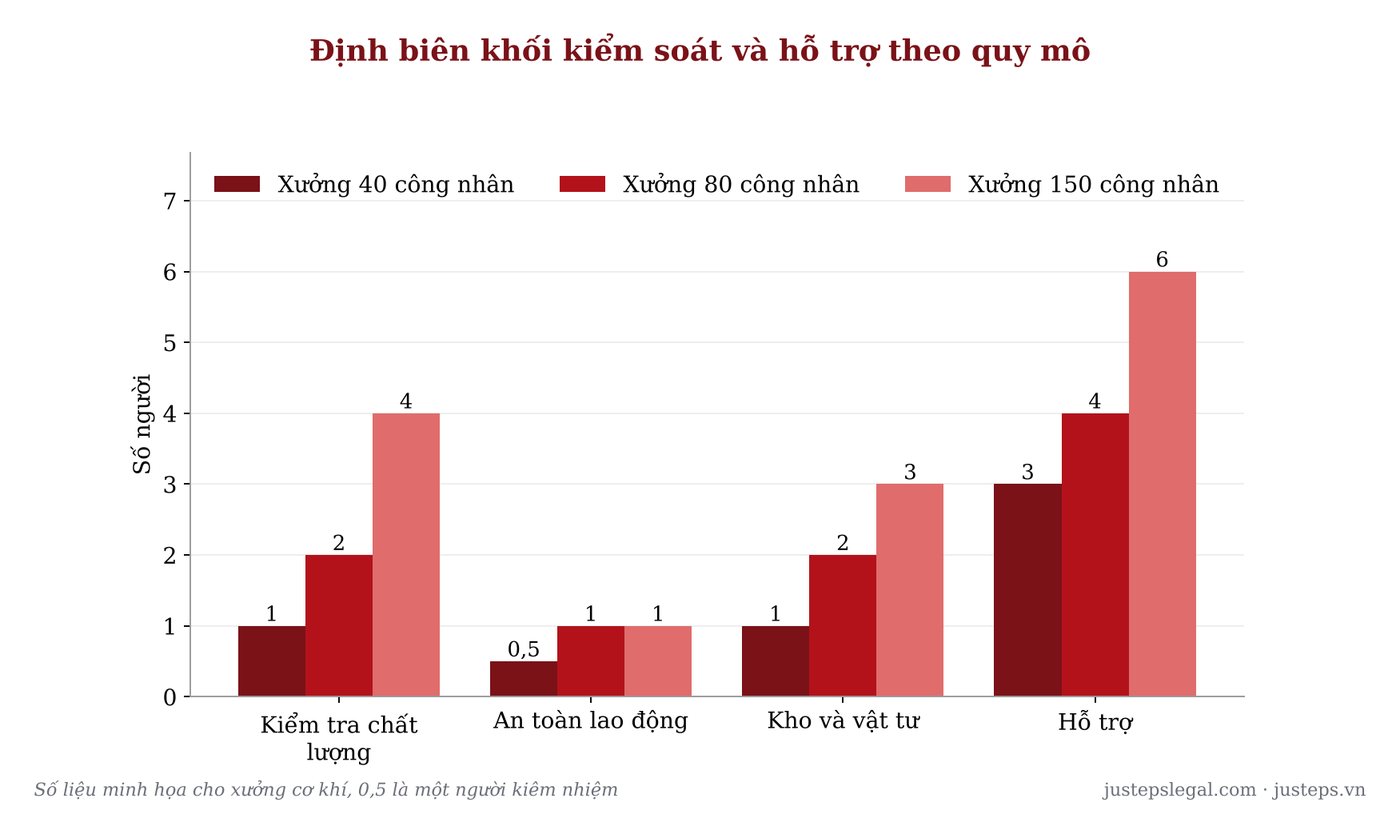
Number of people in the control and support blocks by headcount, illustrative figures
In this example, when the workshop grows from forty to one hundred and fifty workers, the quality control block grows from one to four people, the occupational safety block moves from one person holding the role alongside another job to one full-time person, while the warehouse and support blocks grow more slowly thanks to a clear division of work. The figures in the chart are illustrative examples and not legal norms, except for the minimum requirement on occupational safety staff set out above. A business should prepare its own staffing plan based on the number of shifts, lines and inspections that must be carried out each day, and then review it every six months.
Reasonable combinations of roles and common mistakes
At a scale of thirty to two hundred employees, combining roles is hard to avoid and is not wrong in itself if it is arranged correctly. The principle when giving two roles to one person is that the two roles must not control each other, and the person holding both must still meet the requirements of, and be trained for, each role. The table below lists some arrangements that should be adopted and some pairs of roles that should be avoided.
| Area | Recommended | To be avoided |
|---|---|---|
| Occupational safety | An equipment maintenance engineer also acting as the part-time occupational safety officer, if qualified and trained. | The production manager also acting as the person in charge of safety, as they would be checking work they direct. |
| Quality control | The head of quality control also maintaining the quality management system records. | A production manager or team leader also acting as head of quality control. |
| Materials warehouse | The storekeeper also maintaining stock cards and the receipts, issues and balances report sent to accounting. | The storekeeper also acting as purchaser or as materials accountant. |
| Production team | A team leader or skilled worker elected by the team also serving as its safety and health officer. | Appointing safety and health officers verbally, without a list or training records. |
From Justeps' experience supporting manufacturing businesses, the following mistakes occur frequently and are often only discovered when there is an accident, a complaint or a customer assessment:
- Occupational safety duties are assigned verbally, with no assignment decision and no training records for the person assigned.
- Quality inspectors are attached to production teams and paid according to the team's output.
- Production teams have no safety and health officers, or the list was drawn up many years ago and many of the people on it have since left.
- The storekeeper also places orders for materials, so inventory discrepancies persist without the cause being identified.
- The organisation chart has been updated, but the appointment decisions, job descriptions and regulations on delegation of authority are still the old versions.
To remedy these mistakes, a business should plan a review over about three months, starting by redrawing the actual chart and identifying its sector group and headcount in order to determine its obligations regarding occupational safety staff, then adjusting the reporting lines of the three control positions and reissuing the set of documents. Each document needs a specific person responsible for drafting it, a person who approves it and an effective date, and it must be communicated to team leaders and the employees concerned. A business wishing to standardise all of its quality control, warehouse receipt and issue and delegation of authority procedures may refer to the Justeps service development of internal governance regulations and procedures.
How Justeps can help
Justeps supports small manufacturing companies in building their organisational structure and the set of operating documents through the following services:
- Organisational structure, functions, duties and job descriptions. Justeps designs the five-block chart, reporting lines, functions and duties and the job description for each position in the workshop.
- Organisational structure design for mechanical engineering and metalworking businesses. Justeps develops a structure and staffing plan that fit the occupational safety obligations of the mechanical engineering and metals sector group.
- Development of internal governance regulations and procedures. Justeps drafts regulations on delegation of authority, the procedure for handling non-conforming goods, and procedures for warehouse receipts, issues and stocktaking.
- Internal labour rules and disciplinary handling. Justeps drafts internal labour rules with occupational safety and health provisions that reflect the reality of the workshop and supports the registration procedure.
- Salary scales and pay and bonus regulations. Justeps designs a separate income mechanism for quality inspectors and allowances for employees who hold more than one role.
Frequently asked questions
Must a garment workshop with forty employees have a full-time occupational safety officer?
Garment manufacturing is not among the separately listed high-risk sector groups, so a business with fewer than three hundred employees needs at least one person doing occupational safety and health work on a part-time basis[2]. That person must still meet the qualification requirements and be trained for the correct group of trainees.
Can occupational safety and health work be outsourced?
Yes. Where a business cannot assign a qualified person, it may hire an organisation with sufficient capacity to do the work[1]. The business still bears primary responsibility and should appoint an internal focal point to monitor the work.
To whom should the head of quality control report?
The head of quality control should report directly to the director, not through the production manager. This arrangement ensures that the decision to hold back a non-conforming batch is not swayed by pressure on output.
Are safety and health officers entitled to an allowance?
Safety and health officers are entitled to the benefits provided for by the law on occupational safety and health, including a responsibility allowance[1]. A business should set out the amount of the allowance in its pay regulations and update it when the documents implementing the 2026 amending law are issued.
Can the storekeeper also act as the materials accountant?
Generally not, because a storekeeper may not do accounting work, except in certain cases such as private enterprises, single-member limited liability companies owned by an individual and micro-enterprises without state capital[6]. Even where an exception applies, the business should still keep the two tasks separate to control losses.
Does the production manager have the power to release a batch held back by quality control?
Under the recommended arrangement, the production manager does not have this power. Only the director may decide on conditional acceptance after the customer agrees in writing, and this power should be written into the regulations on delegation of authority.
When should the list of jobs with strict safety requirements be updated?
A business should check its positions against the new list issued by the Ministry of Home Affairs, which applies from 1 January 2027[4], straight away and again whenever it puts new machinery, equipment or processes into use. Employees doing jobs on the list must be trained and issued with a safety card before being assigned to the work[3].
Related articles
- Building an occupational safety and health system for a factory, from the responsible unit to training and monitoring
- Building KPIs for a production workshop on productivity, quality and safety linked to piece-rate pay
- How to write department functions and duties so that every task in a business has someone accountable for it
- How to choose an organisation chart model that fits the size of a business and the way it generates revenue
Notes
[1] Law on Occupational Safety and Health No. 84/2015/QH13 dated 25 June 2015, as amended and supplemented, including by the Law amending and supplementing a number of articles of the Law on Occupational Safety and Health passed by the National Assembly on 21 November 2026 and effective from 1 March 2027.
[2] Article 36 of Decree No. 39/2016/ND-CP dated 15 May 2016 detailing the implementation of a number of articles of the Law on Occupational Safety and Health.
[3] Decree No. 44/2016/ND-CP dated 15 May 2016 detailing a number of articles of the Law on Occupational Safety and Health on technical safety inspection, occupational safety and health training and workplace environment monitoring, as amended and supplemented by Decree No. 140/2018/ND-CP and Decree No. 04/2023/ND-CP.
[4] Circular No. 27/2026/TT-BNV dated 20 October 2026 of the Ministry of Home Affairs promulgating the List of jobs with strict occupational safety and health requirements, effective from 1 January 2027.
[5] Law on Accounting No. 88/2015/QH13 dated 20 November 2015 and the documents amending and supplementing it.
[6] Clause 3, Article 19 of Decree No. 174/2016/ND-CP dated 30 December 2016 detailing a number of articles of the Law on Accounting.
[7] Article 13 of Decree No. 174/2016/ND-CP dated 30 December 2016.
[8] Clause 2, Article 63 and Clause 3, Article 162 of the Law on Enterprises No. 59/2020/QH14 dated 17 June 2020, as amended and supplemented by Law No. 76/2025/QH15.
[9] Labour Code No. 45/2019/QH14 dated 20 November 2019, as amended and supplemented, including by the Law amending and supplementing a number of articles of the Labour Code and certain other laws passed by the National Assembly on 21 November 2026.
This article is for reference and reflects the regulations in force at the time of publication. Please consult Justeps for advice tailored to your company’s records and situation.
For further information, please contact:
📩 Email: info@justeps.vn
🌐 Website: https://justepslegal.com · https://justeps.vn
🌐 Page: Justeps
☎️ Hotline (Zalo): 096 172 2607
📍 Thanh Xuan Office: 12th Floor, Licogi 13 Tower, 164 Khuat Duy Tien Street, Thanh Xuan Ward, Hanoi, Vietnam
📍 Ha Dong Office: LK06B, No.10, Dong Dua Area, Ha Dong Ward, Hanoi, Vietnam
📍 Ho Chi Minh City Branch: 528 Le Van Sy, Ho Chi Minh City, Vietnam
📍 Hai Phong Office: Truong Thinh Village, Ha Dong Commune, Hai Phong, Vietnam
📍 Quang Ninh Office: Van Don Special Zone, Quang Ninh Province, Vietnam





