
A coffee chain with outlets in inner-city Hanoi and one outlet in a Region III province often uses a single pay scale for convenience. This tends to cause one of two problems: either the province outlet pays more than the local market requires, or step 1 in Hanoi falls below the Region I minimum wage once the new levels take effect on 01/01/2027.
Decree No. 399/2026/ND-CP replaces Decree No. 293/2025/ND-CP and raises the minimum wage in all four regions. This article takes an operational angle: how an F&B chain should build pay scales by position and by region, who in the company does what, and what to check before the January 2027 payroll.
The new minimum wages and how to determine the region of each outlet
From 01/01/2027, the monthly minimum wage is VND 5,700,000 (Region I), VND 5,080,000 (Region II), VND 4,450,000 (Region III) and VND 4,040,000 (Region IV); the hourly minimum wage is VND 27,400, 24,400, 21,400 and 19,400 respectively (under Decree No. 399/2026/ND-CP).
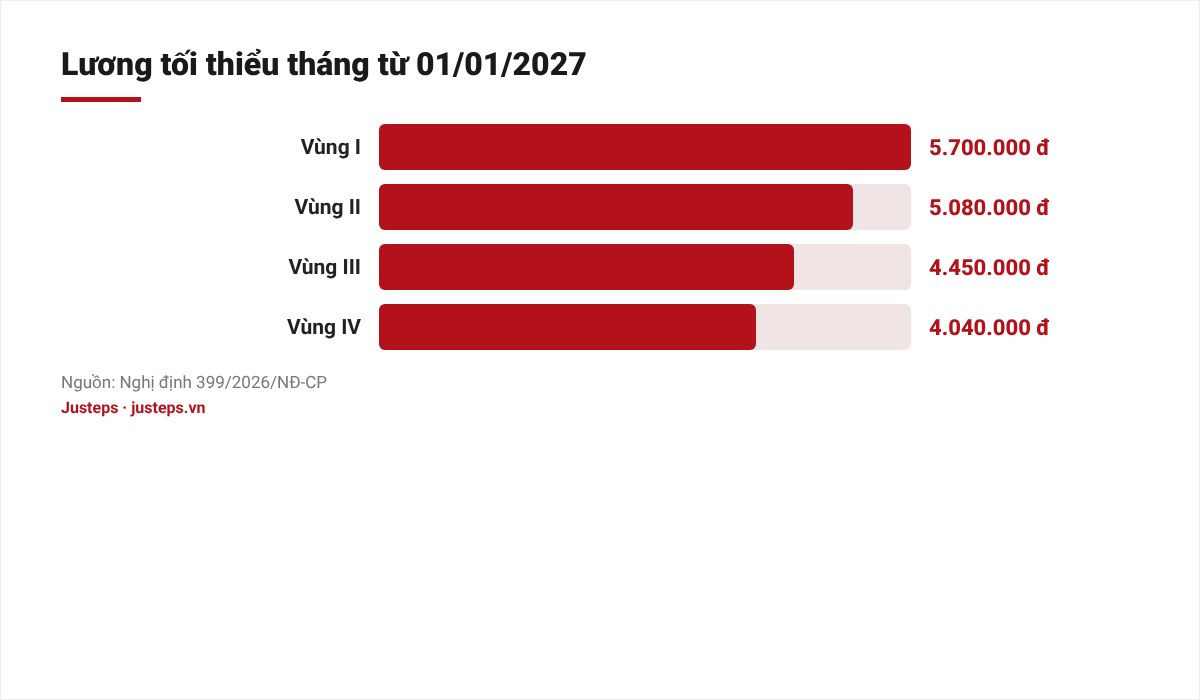
The four monthly minimum wage levels applicable from 01/01/2027 under Decree No. 399/2026/ND-CP.
For a multi-branch chain, the applicable level depends on where each outlet operates, not where the head office is. An inner-city Hanoi outlet applies Region I; an outlet in a commune classified as Region III applies Region III, even if the employee signs the contract with the Hanoi company. The list of localities has changed considerably after the reorganisation of administrative units, so HR should check the locality appendix attached to Decree No. 399/2026/ND-CP for each outlet address and keep the lookup on file, rather than relying on memory or old lists.
Build the job framework before filling in numbers
A mid-sized F&B chain usually needs only five in-store job groups: server (including cashier), barista, kitchen, shift leader and store manager. Each group needs a short job description stating skill requirements and responsibilities, since this is what explains why a barista is graded above a server, or why a shift leader receives a responsibility allowance.
The wage for a job or title must not be lower than the minimum wage (under Clause 2, Article 90 of Labor Code No. 45/2019/QH14). In practice, only step 1 of the lowest title needs to be controlled; all other steps and titles will be higher. The number of steps and the gap between them are for the employer to decide; for store staff, 3 to 5 steps with a 4–7% gap are enough to offer a pay progression without inflating the wage bill too fast.
Example pay table for two regions
The table below is an example for a chain with outlets in Region I and Region III, with a 5% gap per step. The figures only illustrate the method; actual levels should be based on local pay surveys and each outlet's ability to pay.
| Title | Step 1, Region I (VND/month) | Step 3, Region I (VND/month) | Step 1, Region III (VND/month) | Step 3, Region III (VND/month) |
|---|---|---|---|---|
| Server | 5.800.000 | 6.400.000 | 4.600.000 | 5.070.000 |
| Barista | 6.200.000 | 6.840.000 | 4.900.000 | 5.400.000 |
| Kitchen | 6.500.000 | 7.170.000 | 5.150.000 | 5.680.000 |
| Shift leader | 7.800.000 | 8.600.000 | 6.200.000 | 6.840.000 |
| Store manager | 11.000.000 | 12.130.000 | 8.800.000 | 9.700.000 |
Two points deserve attention. Step 1 for servers in Region I (VND 5,800,000) is only VND 100,000 above the minimum, so if the Government adjusts the minimum again next year, this is the first line to revise. The Region III table is not simply the Region I table multiplied by a fixed factor; the employer should refer to local pay levels, especially for kitchen and store manager roles, which are hard to fill in the provinces.
Part-time staff paid by the hour
F&B relies heavily on students working shifts. For employees paid by the hour, the hourly rate must not be lower than the hourly minimum wage of the region where the outlet operates: VND 27,400 in Region I and VND 21,400 in Region III from 01/01/2027. Many chains currently paying VND 25,000 per hour in Hanoi will need to raise the rate before the first timekeeping period of January 2027.
When comparing, use only the basic hourly wage, excluding overtime pay, night work pay or sales bonuses. Evening shifts running past 22:00 must also carry at least an extra 30% for the night-work portion (under Clause 2, Article 98 of Labor Code No. 45/2019/QH14). Part-time contracts should state the hourly rate, how clock-in time is rounded and the pay period.
Allowances and the social insurance contribution base
Common items in F&B chains include responsibility allowances for shift leaders and store managers, attendance allowances, seniority allowances, meal allowances and outlet sales bonuses. Employers need to separate wage allowances tied to the job from welfare items or performance-based bonuses, because the classification determines the social insurance contribution base.
Under Law on Social Insurance No. 41/2024/QH15, the monthly wage subject to compulsory social insurance includes the wage for the job or title, wage allowances and other supplementary amounts agreed to be paid regularly and stably in each pay period. An "attendance allowance" paid at a fixed amount every month regardless of days worked is very likely to be treated as contributable. The minimum contribution base also must not be lower than the regional minimum wage of the place of work, so a Region I outlet has a higher contribution floor than a Region III outlet.
Internal procedure: consultation and public disclosure
The employer must develop pay scales, pay tables and labor norms as a basis for recruitment, use of labor, wage agreement and payment; when doing so it must consult the grassroots employee representative organization (if any), and must publicly disclose them at the workplace before applying them (under Article 93 of Labor Code No. 45/2019/QH14). For a chain, the "workplace" is every outlet: the table must be posted or sent to employees both in Hanoi and at the provincial outlet.
A sensible division of work: HR drafts the tables and checks the regions; accounting calculates the impact on the wage bill and insurance; the grassroots trade union (if any) comments in writing; the director signs the issuing decision; store managers post the tables and confirm disclosure. Aim to finalize by 20/12/2026 to leave time to update timekeeping software and sign contract annexes for employees whose pay is below the new level.
Common operational risks
- Using one pay table for all outlets, leaving Region I step 1 below the new minimum wage.
- Forgetting to update hourly rates for part-time staff, who are often numerous in F&B chains.
- Folding fixed allowances into bonuses to reduce insurance contributions, creating a risk of back-payment upon inspection.
- Not keeping evidence of consultation and public disclosure at each outlet.
- Transferring an employee from a Region III outlet to Hanoi without adjusting pay to the Region I table.
Legal basis
- Labor Code No. 45/2019/QH14, effective from 01/01/2021.
- Law on Social Insurance No. 41/2024/QH15, effective from 01/7/2025.
- Decree No. 399/2026/ND-CP on minimum wages for employees working under labor contracts, applicable from 01/01/2027, replacing Decree No. 293/2025/ND-CP.
How Justeps can help
- Designing pay scales by title and by region for retail and F&B chains: Justeps.
- Drafting wage, bonus and allowance regulations and reviewing the social insurance contribution base.
- Reviewing part-time labor contracts and pay adjustment annexes from 01/01/2027.
- Ongoing labor law advice for multi-branch businesses.
Frequently asked questions
A Hanoi company has an outlet in a Region III province. Which minimum wage applies?
Each outlet applies the minimum wage of the locality where it operates. Staff working at the Region III outlet are covered by the Region III level, even if their contract is signed with the Hanoi head office.
Is a 5% gap between pay steps mandatory?
No. The number of steps and the gaps between them are for the employer to decide; the mandatory condition is that the lowest level is not below the regional minimum wage.
Must the pay scale be filed with the labor authority?
The 2019 Labor Code requires consultation with the employee representative organization (if any) and public disclosure at the workplace before application. Employers should keep the issuing file to present during inspections.
Are hourly workers measured against the monthly minimum wage?
Employees paid by the hour are measured against the hourly minimum wage (VND 27,400 in Region I and VND 21,400 in Region III from 01/01/2027), not the monthly level.
Is an attendance allowance subject to social insurance?
If it is agreed and paid regularly and stably each pay period, it is very likely to be included in the contribution base. Items that depend on results and are not fixed should be designed and stated clearly in the wage regulation.
Related articles
- Controlling advertising content: a pre-publication approval process
- Fire safety records for business premises under the new law: annual tasks
- Building a Tet Dinh Mui 2027 bonus policy for manufacturing companies
- Two new public holidays on 27 July and 24 November from 2027: what businesses need to update
Contact Justeps
Email: info@justeps.vn · Hotline/Zalo: 096 172 2607 · Website: justeps.vn
Office network
- Thanh Xuan Office: 12th Floor, Licogi 13 Tower, 164 Khuat Duy Tien, Thanh Xuan Ward, Hanoi
- Ha Dong Office: LK06B, No.10, Dong Dua Area, Ha Dong Ward, Hanoi
- Ho Chi Minh City Branch: 528 Le Van Sy, Nhieu Loc Ward, HCMC (formerly Ward 14, District 3)
- Hai Phong Office: Truong Thinh Village, Ha Dong Commune, Hai Phong
- Quang Ninh Office: Van Don Special Zone, Quang Ninh





