
Key takeaways
- A purchasing procedure should have five fixed steps, from purchase request, requesting quotations, approval and contracting, receipt and acceptance to matching of documents and payment, with approval limits set down in writing.
- Suppliers should be selected using a weighted multi-criteria scorecard, in which legal status and the ability to issue valid invoices are exclusion conditions rather than ordinary criteria that add points.
- The person who requests the purchase, the person who selects the supplier, the person who receives the goods and the person who makes the payment must be different people, to limit fraud and conflicts of interest.
- Purchases of VND 5 million or more per transaction must be supported by non-cash payment documents to be deductible and to qualify for input value added tax credit.
- Each purchase transaction should be filed as one set of records under the order code, from the purchase request to the bank transfer document, for tax finalisation, audit and handling complaints with suppliers.
In many businesses, purchasing develops out of the habits of each department. The workshop calls the suppliers it knows, the office buys on the first quotation it receives, and the accounting department learns of the transaction only when it receives the invoice and the payment request. The usual consequences are that the same item is bought at different prices, goods received are not checked for quality by anyone, invoices contain incorrect information or arrive late, and the expense is disallowed as a deductible expense at tax finalisation for lack of supporting documents.
This article analyses how to build a purchasing procedure and select suppliers in the order in which the work is carried out, covering the steps from purchase request to payment, the criteria for selecting and evaluating suppliers, how to allocate roles for control purposes, the conditions relating to contracts, invoices and payment documents, and the set of records to be kept. It applies to businesses using private capital to buy raw materials, goods, services and assets for their business operations. It is written mainly for directors, heads of purchasing, chief accountants and the people responsible for internal control.
When a business needs to standardise its purchasing procedure
The law does not require private businesses to issue a purchasing procedure in any fixed form. The Law on Bidding mainly governs the selection of contractors where state capital and certain other sources of funds specified by the law are used, so a business using its own capital is free to decide how it selects suppliers[1]. However, state-owned enterprises and businesses implementing projects with state capital need to check the scope of application carefully, because some of their procurement packages must follow the statutory bidding procedure.
For private businesses, the need to standardise arises when the number of purchase orders grows to the point where the director can no longer review every transaction personally. The clearest signs are that the purchase price of the same item differs between departments or between periods without explanation, purchase records are often incomplete after payment has been made, a supplier deals with only one employee, or the business opens a new branch, warehouse or site in a new location. Businesses preparing to raise capital, borrow from a bank or undergo their first audit should also standardise early, because purchasing controls are routinely examined during due diligence.
The purchasing procedure should be issued together with a table of approval limits setting out who may approve purchase requests and who may sign purchase orders or contracts at each level of value. These levels must be consistent with the authority that the charter and the financial regulations confer on the director, the Members’ Council or the Board of Directors. Businesses that do not yet have expense norms and spending authority can develop them at the same time through Justeps’ service on internal spending regulations and expense norms.
The steps of the purchasing procedure from request to payment
A controlled purchasing procedure usually consists of five consecutive steps, each with a person responsible, an output document and a condition for moving on to the next step. The flowchart below describes an illustrative sequence applicable to ordinary purchases.
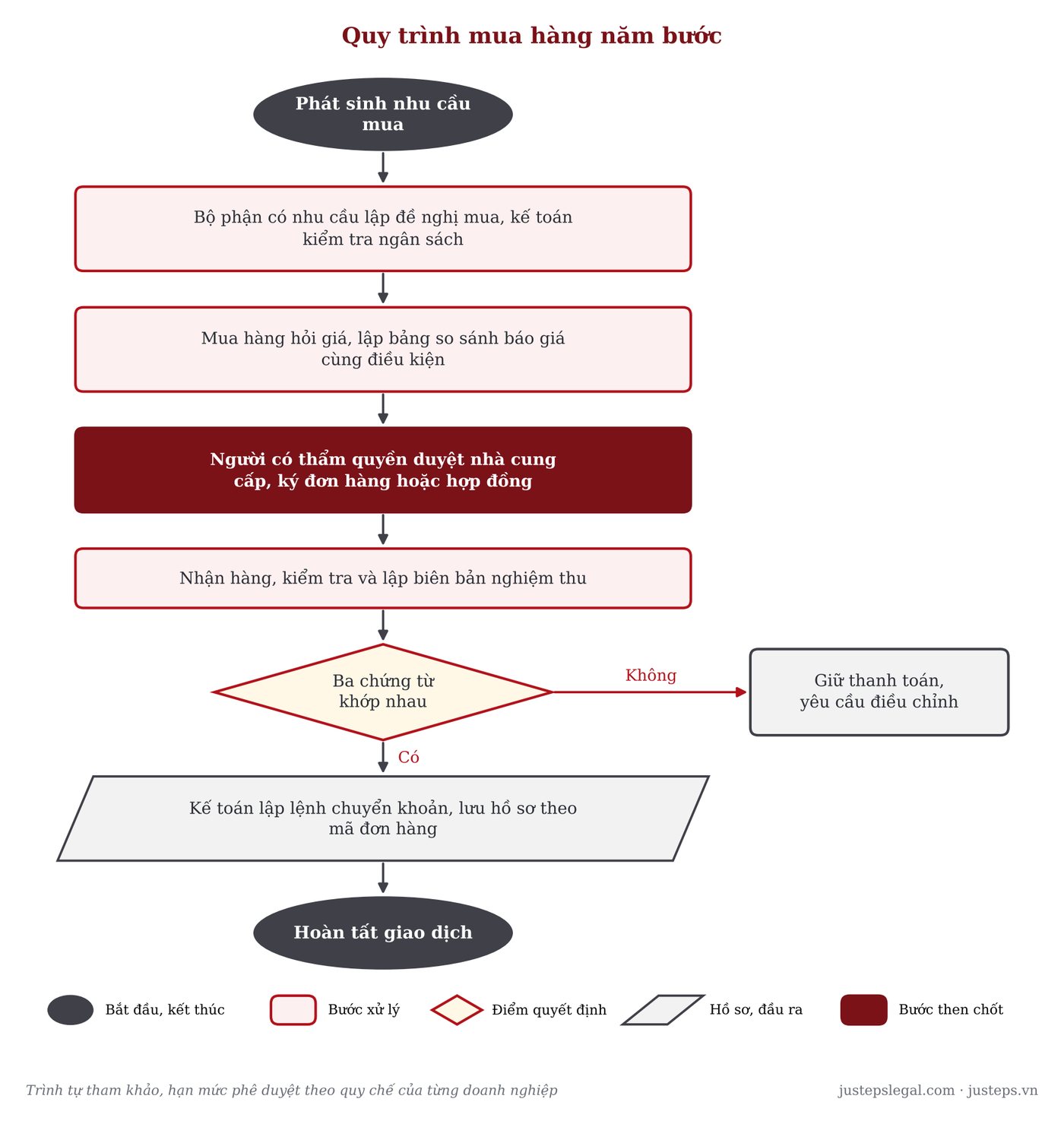
The five steps of the purchasing procedure from purchase request to payment
The procedure begins when the department with the need prepares a purchase request stating the item, specifications, quantity, date required and budget code. The purchasing department requests and compares quotations, after which a person with the relevant authority approves the supplier and signs the purchase order or contract. When the goods arrive, the receiving department inspects them and prepares an acceptance record, and the accounting department then matches the purchase order, the acceptance record and the invoice before preparing the transfer order. If the three documents do not agree as to quantity, unit price or specifications, payment is withheld until the supplier makes the correction.
Preparing the purchase request and checking the budget
The purchase request is the first document and also the basis for controlling expenditure, so it must be prepared before the supplier is contacted rather than added after the purchase has been made. The accounting or planning department checks whether the purchase falls within the approved budget, and if it exceeds the budget the request must be referred to a higher level in accordance with the table of approval limits. For goods bought regularly, such as raw materials, the business may use a monthly purchasing plan instead of individual requests, provided that the plan is approved in advance.
Requesting and comparing quotations
The business should set a minimum number of quotations according to the value of the purchase, for example one quotation for small purchases from an approved supplier, at least three quotations for medium-sized purchases and a competitive tender based on a written request document for large purchases. The comparison of quotations should convert all offers to the same terms, including the price inclusive of tax, transport costs, delivery time, payment terms and warranty, because comparing prices before tax or prices excluding transport often leads to the wrong choice. Where only one supplier can meet the technical requirements, the person making the proposal must state the reason clearly and the approver must be at a level higher than usual.
Approving and signing the purchase order or contract
A contract for the sale of goods may take the form of words, a written document or specific conduct, but the business should use a written document or an equivalent data message so that it has evidence in the event of a dispute[2]. With regular suppliers, an effective approach is to sign a framework agreement containing terms on quality, delivery and receipt, payment, warranty, penalties and dispute resolution, so that each subsequent purchase only requires a purchase order. In a commercial contract, the level of the contractual penalty is agreed by the parties, but the total penalty may not exceed 8% of the value of the part of the obligation breached, and a penalty applies only where the contract provides for it[3].
Where the supplier is a related person of a member, a major shareholder or a manager of the business, the contract may require the approval of the Members’ Council, the Board of Directors or the General Meeting of Shareholders under the Law on Enterprises[4]. The purchasing procedure should include a conflict of interest declaration, in which the person making the proposal and the approver confirm that they have no ownership or family relationship with the selected supplier. A contract signed without going through this approval procedure may be declared invalid on application, and the person who signed it must compensate the business for any loss.
Selecting and evaluating suppliers
Choosing suppliers solely on the lowest price often leads to hidden costs larger than the savings, such as defective goods that must be replaced, late deliveries that halt production or invalid invoices that cause the expense to be disallowed at tax finalisation. The business should score suppliers against several weighted criteria, with the weights reflecting how much each criterion affects its operations. The chart below shows an illustrative set of weights for a manufacturing business buying raw materials.
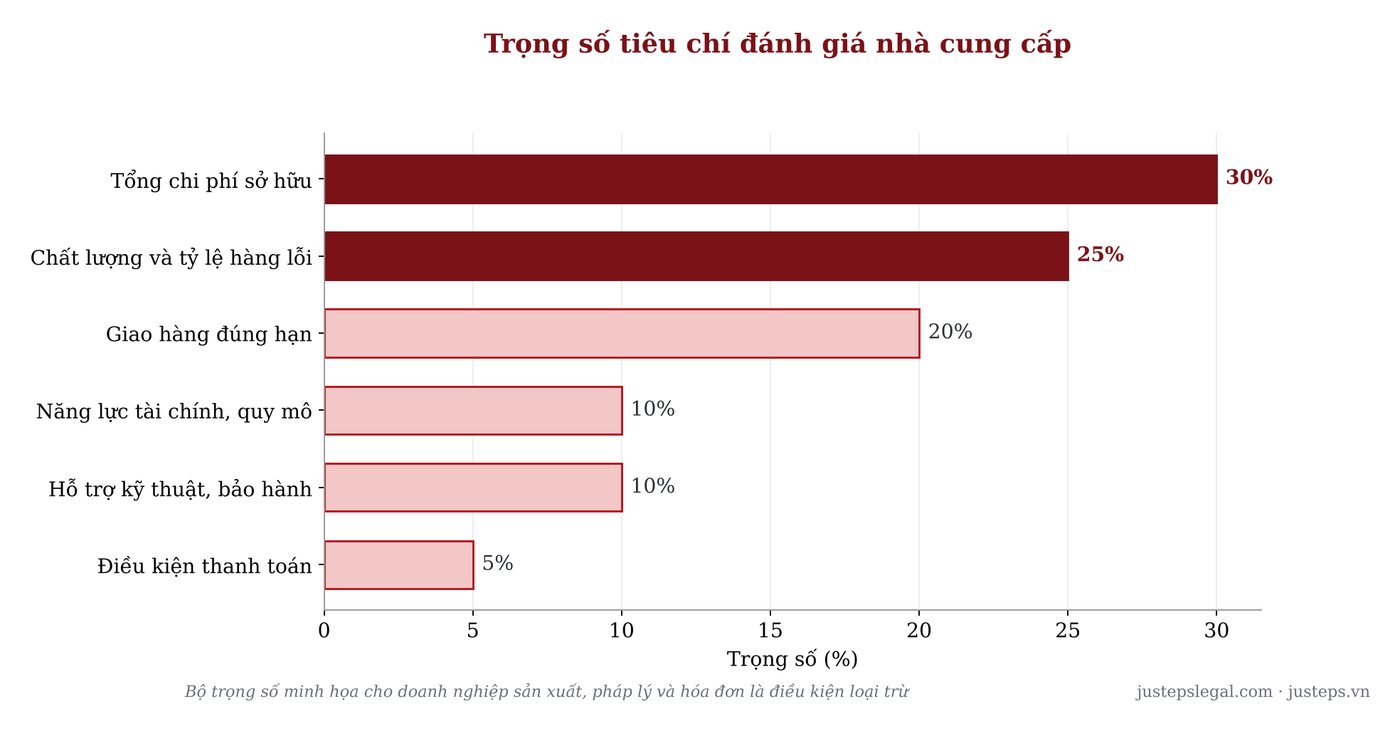
Illustrative weights of the criteria for evaluating raw material suppliers
In this example, total cost of ownership accounts for 30% and quality for 25%, because these are the two factors that directly affect production cost and the defect rate. On-time delivery accounts for 20%, while financial capacity, after-sales support and other criteria share the remainder. A trading business may increase the weight given to price and payment terms, whereas food and pharmaceutical businesses should increase the weight given to quality and traceability records. The set of weights should be issued together with the procedure so that all departments score against the same yardstick.
Legal status and the ability to issue valid invoices should be exclusion conditions, meaning that a supplier that fails them is not placed on the list however high its scores on other criteria. Before signing a contract for the first time, the purchasing or accounting department should look up the supplier’s enterprise registration details, the operating status of its tax code, its business lines and any sub-licences where the item belongs to a conditional business line. Buying from a business that has ceased operating or abandoned its business address may lead the tax authority to treat the invoice as unlawful, resulting in the expense being disallowed and the input value added tax already credited being recovered.
Once selected, the supplier is placed on the approved supplier list and is re-evaluated periodically, usually every six months or every year, on the basis of actual delivery data such as the on-time delivery rate, the defect rate and the number of invoice errors. A supplier with low scores in two consecutive periods should be placed under monitoring or removed from the list. The list also helps to prevent employees from adding new suppliers on their own without due vetting.
Receipt, acceptance and three-way matching
Receipt of goods is the point at which the business confirms that the supplier has properly performed its delivery obligation, so the inspection must be carried out immediately and recorded. Under the Commercial Law, the buyer may inspect the goods before receiving them if the parties have so agreed, and the seller is not liable for defects that the buyer knew or ought to have known of but did not notify within a reasonable time after inspection[5]. The delivery record should therefore state the quantity, specifications, condition of the packaging and any discrepancies found, rather than simply acknowledging in general terms that everything has been received.
Where the goods do not conform to the contract as to quantity, quality, specifications or packaging, the buyer has the right to refuse to accept them[6]. For services or goods that require installation or trial operation, acceptance should be divided into acceptance of quantity and acceptance of quality, with the final instalment paid only after the quality acceptance record has been signed. The person signing the acceptance record must have the relevant expertise and must not also be the person who selected the supplier, so that the result of the inspection is objective.
Before payment, the accounting department matches three documents, namely the purchase order or contract, the delivery or acceptance record and the supplier’s invoice. The three documents must agree as to the item, quantity, unit price and total amount, and the invoice must show the business’s name, tax code and address correctly. The supplier must issue the invoice at the time required by the rules on invoices, which in principle is the time when ownership or the right to use the goods is transferred, or when the provision of the service is completed[7]. An invoice issued at the wrong time or with incorrect information should be adjusted or replaced by the supplier before payment, because once the money has been transferred the business has almost no leverage left to insist on it.
Payment documents, tax conditions and purchase records
The conditions on payment documents directly affect the amount of tax the business must pay. From 15 December 2025, expenditure on goods and services and other payments of VND 5 million or more per transaction is deductible for corporate income tax purposes only if it is supported by non-cash payment documents[8]. For value added tax, the 2024 Law on Value Added Tax requires non-cash payment documents for input tax to be credited[9], and the implementing regulations apply this requirement to goods and services purchased for VND 5 million or more, inclusive of tax[10].
In practice, this means that the purchasing procedure should prohibit cash payment for any purchase of VND 5 million or more, even where an employee has received an advance to make an urgent purchase. The business should also not split a single purchase into several invoices below the threshold in order to pay in cash, because the tax authority looks at each actual purchase and splitting is easily regarded as manufacturing supporting documents. The supplier’s receiving account must match the account stated in the contract or notified in writing, and any change of account number must be verified again by telephone with the supplier’s representative to guard against fraud.
Each purchase transaction should be filed as one set of records under a single order code, so that a reviewer can trace the purchase from the request to the bank transfer document without having to search in several places. Accounting documents must be retained for the statutory period[11], so the set of purchase records should be kept together with the accounting documents or should clearly reference where they are stored. The following table lists the minimum documents in a set of purchase records:
| Document | Required content | Prepared and kept by |
|---|---|---|
| Purchase request | Item, specifications, quantity, date required, budget code and approval signature. | Prepared by the requesting department, with purchasing keeping the original. |
| Quotations and comparison | Quotations converted to the same terms and the reason for choosing the supplier. | Prepared and kept by the purchasing department. |
| Contract or purchase order | Price, quality, delivery and receipt, payment, warranty and penalties. | Drafted by purchasing, signed by the authorised person, original kept by the legal function. |
| Delivery and acceptance record | Quantity, specifications, condition of the goods and any discrepancies found. | Prepared by the receiving department and kept by the warehouse or technical team. |
| Invoice | Correct buyer details and issued at the time required by the rules. | Checked by accounting and kept with the bookkeeping documents. |
| Payment document | Payment order or bank document matching the account stated in the contract. | Prepared and kept by the payments accountant. |
Allocating roles and controlling conflicts of interest in purchasing
The core principle of purchasing control is that no single person handles a transaction from start to finish. The person who requests the purchase, the person who selects the supplier, the person who receives the goods and the person who makes the payment should be different people, and the approver should not negotiate prices directly with the supplier. The Law on Accounting also provides that a person who is a manager or executive, a storekeeper, a cashier or a person who buys and sells assets may not at the same time work as an accountant in the same entity, except in certain types of small business permitted by the law[12]. The matrix below shows an illustrative allocation of roles between departments at each step.
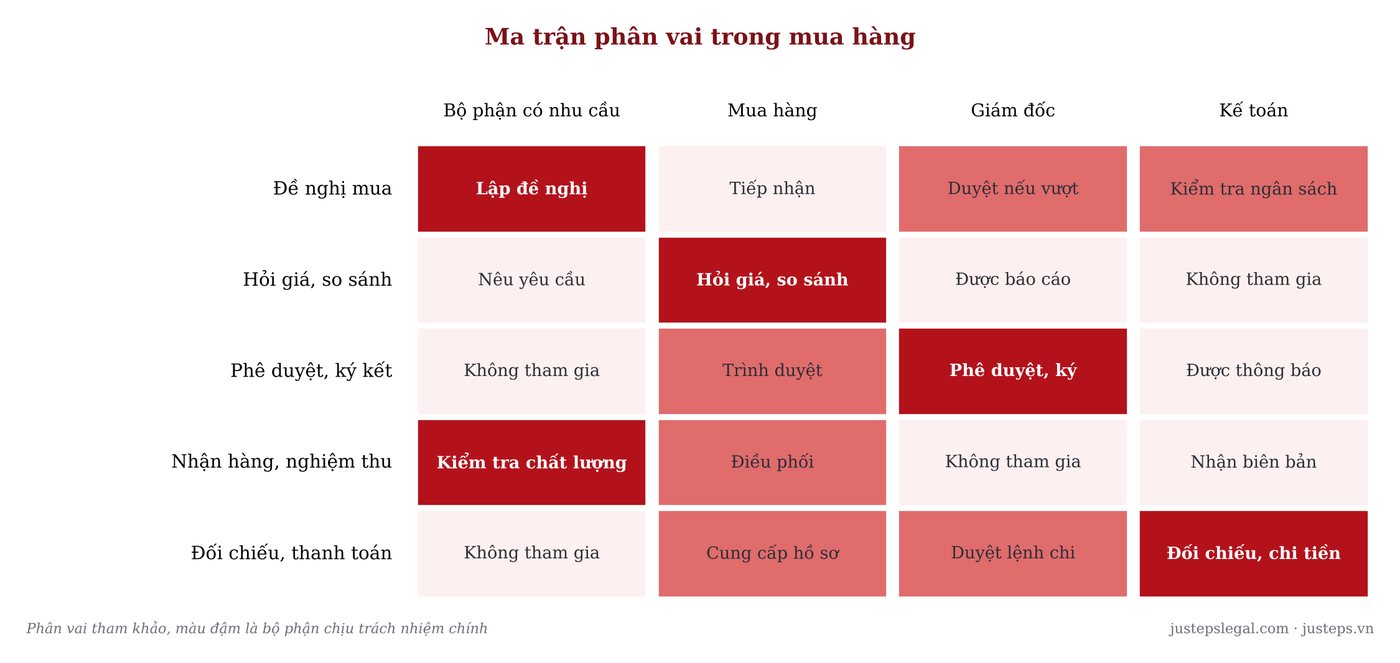
Matrix of roles between departments in the purchasing procedure
According to the matrix, the requesting department is primarily responsible at the request step and takes part in acceptance, but does not take part in selecting the supplier or in payment. The purchasing department plays the main role in requesting quotations and drafting the purchase order, while the authority to approve rests with the director or a person authorised within the approval limits. The accounting department is primarily responsible for matching documents and making payment, and also checks the budget at the first step. In a small business without enough staff for full separation, the director should personally approve every payment and periodically telephone a few randomly chosen suppliers to confirm prices.
The greatest risk in purchasing is that employees receive commissions or other benefits from suppliers in return for selecting them or accepting substandard goods. The Criminal Code applies the offences of receiving and giving bribes also to persons holding positions and powers in enterprises and organisations outside the state sector[13], and the Law on Anti-Corruption also contains provisions on preventing corruption in the non-state sector[14]. The business should include in its contracts with suppliers a clause prohibiting the giving of benefits to its employees and a right to terminate the contract for breach, and should require purchasing staff to sign an undertaking not to accept gifts above the permitted level. These measures should be integrated into a single financial internal control system, so that access rights in the software, online banking and the internal rules work together.
Common errors and how to measure the effectiveness of the purchasing procedure
The most common error is buying first and only then preparing the purchase request and contract to regularise the file, so that the procedure exists only on paper. The second error is acceptance in name only, where the person receiving the goods signs the record without inspecting them, causing the business to lose its right to complain about quality. The third error is paying on the basis of the invoice without matching it against the purchase order and the delivery record, resulting in payment for quantities not fully received or at unit prices higher than agreed. In addition, many businesses do not update their supplier list for years and so continue to order from suppliers whose quality has declined.
To find out whether the procedure is working in substance, the business should track a few simple indicators every month. The proportion of purchases with a request approved before the order was placed shows whether the procedure is being bypassed, while the proportion of invoices that pass three-way matching at the first attempt shows the quality of coordination between purchasing, the warehouse and the supplier. The average time from approval of the request to receipt of the goods shows whether the procedure is too cumbersome relative to the need, because a procedure that is too slow will lead departments to find ways of buying outside it. The difference between the actual purchase price and the market reference price helps to detect early any suppliers or employees showing signs of irregularity.
The purchasing procedure should be reviewed at least once a year or when the business changes in size, opens new locations or moves to new management software. When reviewing it, the business should select a number of purchase files at random and check them from start to finish, comparing them with the procedure that has been issued and recording the points that were skipped. The results of the review form the basis for adjusting the approval limits, the minimum number of quotations or the supplier evaluation criteria to fit actual operations.
How Justeps can help
Justeps helps businesses build a purchasing procedure and control their suppliers through the following services:
- Financial internal control systems. Justeps designs the purchasing procedure, the matrix of roles, the table of approval limits and the three-way matching mechanism.
- Internal spending regulations and expense norms. Justeps drafts expense norms, rules on advances and the document conditions needed for purchases to be deductible for tax purposes.
- Drafting and reviewing commercial contracts. Justeps drafts framework agreements with suppliers, including clauses on quality, acceptance, penalties and anti-bribery.
- Reviewing deductible expenses for corporate income tax finalisation. Justeps reviews purchase files, invoices and payment documents to reduce the risk of expenses being disallowed at finalisation.
Frequently asked questions
Must a private business apply the Law on Bidding when making purchases?
The Law on Bidding mainly applies to the selection of contractors using state capital and certain other sources of funds specified by the law[1]. A business using private capital is free to set its own way of selecting suppliers, but it should issue an internal procedure for control purposes.
Must purchases of VND 5 million or more be paid by bank transfer?
The law does not prohibit cash payment, but a purchase of VND 5 million or more per transaction without non-cash payment documents will not be deductible[8] and will not qualify for input value added tax credit[10]. The business should therefore require bank transfer for every purchase at or above this level.
How many quotations are needed for a single purchase?
The law does not prescribe a number of quotations for private businesses, so each business sets its own according to the value of the purchase. A common approach is one quotation for small purchases from an approved supplier, at least three for medium-sized purchases and a written competitive tender for large purchases.
What is the maximum contractual penalty in a purchase contract?
For commercial contracts, the total penalty may not exceed 8% of the value of the part of the contractual obligation breached[3]. In addition to the penalty, the aggrieved party may also claim compensation for actual loss if it can prove it.
May a purchasing employee also act as accountant?
A person who buys and sells assets may not work as an accountant in the same entity, except in certain cases permitted by the law, such as private enterprises or limited liability companies owned by one individual[12]. Even where the exception applies, the business should still separate the person selecting suppliers from the person making payments.
What should a business do when the goods delivered do not conform to the contract?
The business should record the discrepancies clearly in the delivery record and notify the supplier in writing within a reasonable time, because the buyer has the right to refuse goods that do not conform to the contract[6]. The corresponding payment should be withheld until the supplier replaces the goods or adjusts the invoice.
May a business sign a purchase contract with a company owned by a relative of the director?
The business may sign it, but a contract with a related person may require the approval of the Members’ Council, the Board of Directors or the General Meeting of Shareholders under the Law on Enterprises[4]. The director must declare the relationship and must not personally approve that transaction.
Related articles
- Building internal financial regulations for a limited liability company, from approval authority to advances and their settlement
- How construction companies should manage subcontractors, from selection and contracting to acceptance and payment
- Managing accounts receivable through a credit policy, ageing reports and rigorous reconciliation records
- The procedure for issuing internal documents in a company, from drafting to archiving and monitoring their validity
Notes
[1] The Law on Bidding No. 22/2023/QH15 dated 23 June 2023 and the documents amending and supplementing it.
[2] Article 24 of the Commercial Law No. 36/2005/QH11 dated 14 June 2005.
[3] Articles 300 and 301 of the Commercial Law No. 36/2005/QH11.
[4] Articles 67 and 167 of the Law on Enterprises No. 59/2020/QH14 dated 17 June 2020, as amended and supplemented by Law No. 76/2025/QH15.
[5] Article 44 of the Commercial Law No. 36/2005/QH11.
[6] Article 39 of the Commercial Law No. 36/2005/QH11.
[7] Article 9 of Decree No. 254/2026/ND-CP dated 30 June 2026 of the Government on electronic invoices and electronic documents, effective from 1 July 2026, replacing Decree No. 123/2020/ND-CP and Decree No. 70/2025/ND-CP.
[8] Point c of Clause 1 of Article 9 of Government Decree No. 320/2025/ND-CP dated 15 December 2025 detailing the Law on Corporate Income Tax.
[9] Article 14 of the Law on Value Added Tax No. 48/2024/QH15 dated 26 November 2024.
[10] Article 26 of Government Decree No. 181/2025/ND-CP dated 1 July 2025 detailing the Law on Value Added Tax.
[11] Article 41 of the Law on Accounting No. 88/2015/QH13 dated 20 November 2015.
[12] Article 52 of the Law on Accounting No. 88/2015/QH13.
[13] Clause 6 of Article 354 and Clause 6 of Article 364 of the Criminal Code No. 100/2015/QH13, as amended and supplemented by Law No. 12/2017/QH14.
[14] The Law on Anti-Corruption No. 36/2018/QH14 dated 20 November 2018.
This article is for reference and reflects the regulations in force at the time of publication. Please consult Justeps for advice tailored to your company’s records and situation.
For further information, please contact:
📩 Email: info@justeps.vn
🌐 Website: https://justepslegal.com · https://justeps.vn
🌐 Page: Justeps
☎️ Hotline (Zalo): 096 172 2607
📍 Thanh Xuan Office: 12th Floor, Licogi 13 Tower, 164 Khuat Duy Tien Street, Thanh Xuan Ward, Hanoi, Vietnam
📍 Ha Dong Office: LK06B, No.10, Dong Dua Area, Ha Dong Ward, Hanoi, Vietnam
📍 Ho Chi Minh City Branch: 528 Le Van Sy, Ho Chi Minh City, Vietnam
📍 Hai Phong Office: Truong Thinh Village, Ha Dong Commune, Hai Phong, Vietnam
📍 Quang Ninh Office: Van Don Special Zone, Quang Ninh Province, Vietnam





