
Key takeaways
- Most social insurance errors stem not from contribution rates but from late information about workforce changes, so a business needs a fixed monthly cut-off date for those changes.
- The 2024 Law on Social Insurance requires the participation file to be submitted within 30 days from the date the employee becomes subject to participation, and monthly contributions are due by the last day of the following month.
- Wages used as the contribution basis include the wage rate, wage allowances and other supplementary amounts paid regularly and consistently, so every decision to raise pay or add an allowance must be passed immediately to the person in charge of insurance.
- Social insurance and unemployment insurance have different wage ceilings, so the calculation sheet must keep the two ceilings separate rather than using a single figure.
- Reconciling the amount payable with the notice from the social insurance authority before transferring the money helps a business detect discrepancies early and avoid interest on late payment.
A trading company with around 120 employees received a notice from the social insurance authority showing that the amount payable for the previous month was almost ten million dong higher than the payroll figure. On checking, the accountant found that two employees who had left in the middle of the month had not been deregistered, and that a team leader had been given an increased responsibility allowance three months earlier without the person in charge of insurance knowing about it. None of these errors was large, but each of them required an amendment to the file, an arrears payment and a risk of interest for late payment. The common cause was that insurance work was handled case by case as matters arose, with no cut-off date and no one checking the figures a second time.
This article sets out how to organise the monthly social insurance management process under the 2024 Law on Social Insurance, including the legal framework to be understood, how to determine the wages used as the contribution basis, the division of roles among departments, the monthly work calendar, how to reconcile and pay, common errors and the records to be kept. The content suits businesses with from around 20 to several hundred employees, where insurance is handled jointly by the human resources department and the accounting team. The main readers are heads of human resources, payroll accountants, chief accountants and finance directors.
The legal framework governing monthly insurance work
The Law on Social Insurance No. 41/2024/QH15 took effect on 1 July 2025 and broadens the scope of compulsory participation compared with the previous law. Under it, persons working under an employment contract of indefinite term or of a fixed term of 01 month or more are subject to compulsory social insurance, even where the parties give the contract a different name but its content shows paid work under the management and direction of one party[1]. This provision requires a business to review its freelance collaborator contracts and service contracts that resemble employment contracts as well, because the name of a contract does not determine the obligation to contribute.
As regards time limits, the employer must submit the compulsory social insurance participation file for an employee within 30 days from the date the employee becomes subject to participation[2]. Where contributions are made monthly, the deadline is no later than the last day of the following month, which means that the insurance contributions for October must be paid in full before the end of 30 November[3]. These two deadlines form the outer limit, and the internal process should set earlier milestones so that there is time to deal with any discrepancy that is found.
In case of late payment, the business must pay the full outstanding amount plus an additional sum equal to 0.03% per day of the late amount for the number of days of delay[4]. In addition to this sum, late payment, evasion of contributions and failure to register for participation are also subject to administrative penalties under Decree No. 283/2026/ND-CP, which took effect on 10 September 2026[5]. For a business with several hundred employees, one month of late payment can give rise to a sum far greater than the cost of maintaining a rigorous reconciliation process.
Contribution rates and the two ceilings that must be kept separate
Each month, the business pays its own share and deducts the employee’s share from wages so that both are paid at the same time. The table below summarises the contribution rates commonly applied to Vietnamese employees working under employment contracts[6][7][8]. The rate for occupational accident and disease insurance may be lower for businesses that qualify for the reduced rate, so the business should check it against the notice from the social insurance authority.
| Type of insurance | Employer | Employee |
|---|---|---|
| Retirement and survivorship | Contributes 14% of the wages used as the contribution basis. | Contributes 8% of the wages used as the contribution basis, deducted from monthly wages. |
| Sickness and maternity | Contributes 3% of the wages used as the contribution basis. | Does not contribute to this fund. |
| Occupational accident and disease | Usually contributes 0.5%, which may be lower if the statutory conditions are met. | Does not contribute to this fund. |
| Unemployment insurance | Contributes 1% of the monthly wages used for unemployment insurance. | Contributes 1% of the monthly wages used for unemployment insurance. |
| Health insurance | Contributes 3% of the wages used as the contribution basis. | Contributes 1.5% of the wages used as the contribution basis. |
| Total | Around 21.5% of the wages used as the contribution basis. | Around 10.5% of the wages used as the contribution basis. |
As regards the ceiling, the maximum wages used as the basis for compulsory social insurance contributions are 20 times the reference level at the time of contribution[9]. Until a separate reference level is set, this figure is calculated on the basis of the statutory base salary, currently 2,530,000 dong from 1 July 2026, so the social insurance ceiling is 50,600,000 dong per month[10]. Unemployment insurance, by contrast, uses a ceiling of 20 times the regional minimum wage, and the regional minimum wage will increase from 1 January 2027, with Region I at 5,700,000 dong[11]. The insurance calculation sheet must therefore have two separate ceiling columns and be updated whenever either of the two base levels changes.
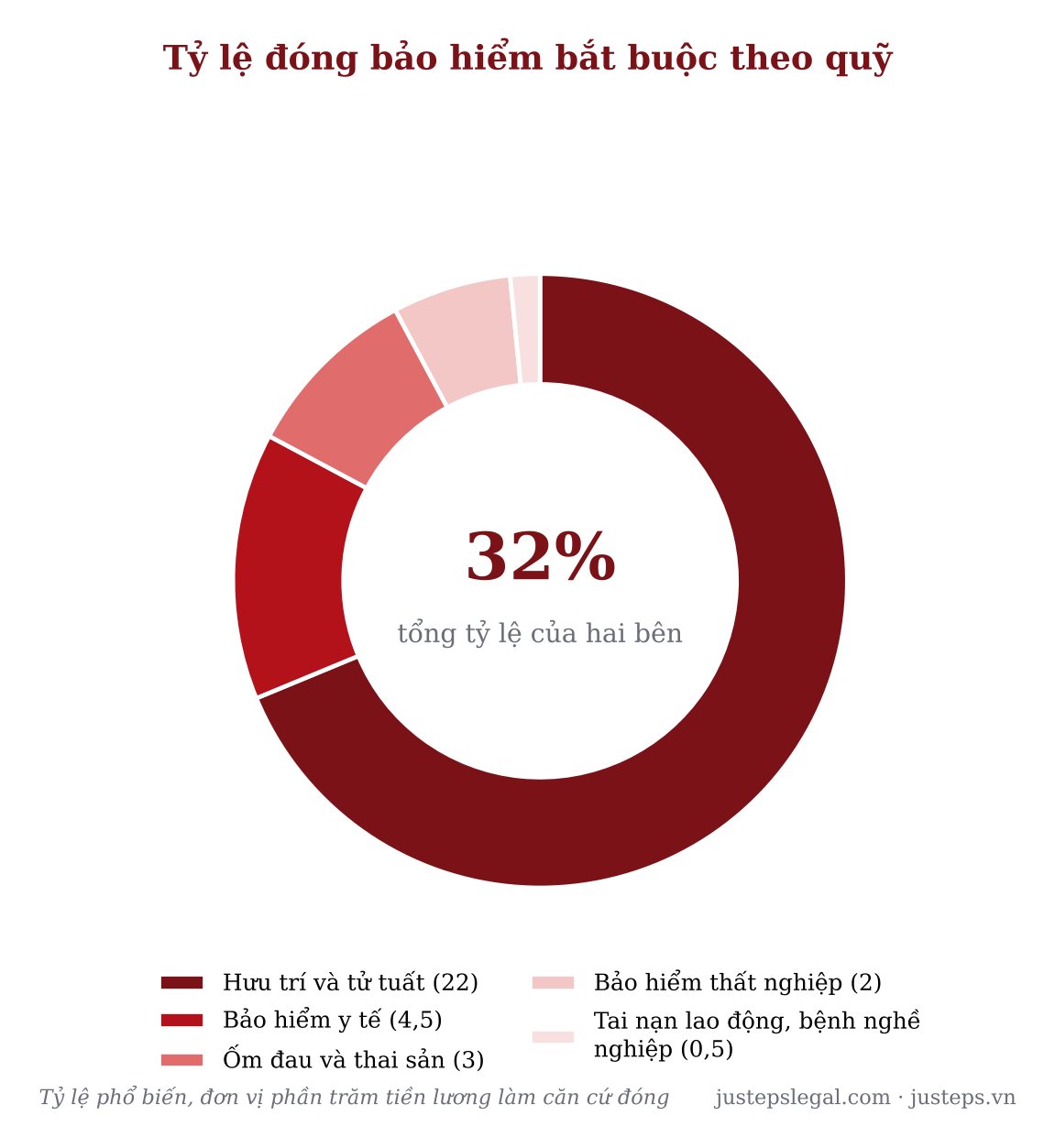
Breakdown of the total compulsory insurance contribution rate by fund
The chart shows that the total contribution rate of both parties is around 32% of the wages used as the contribution basis, of which the retirement and survivorship fund accounts for the largest share at 22%. Health insurance accounts for 4.5%, sickness and maternity for 3%, unemployment insurance for 2%, and occupational accident and disease insurance for the smallest share. Because the retirement and survivorship fund carries such a large weight, even a small error in the wages used as the contribution basis produces a significant discrepancy once multiplied by the number of employees and the number of months.
Determining the correct wages used as the contribution basis
For employees paid under a wage regime decided by the employer, the wages used as the basis for social insurance contributions are monthly wages, comprising the wage rate for the job or title, wage allowances and other supplementary amounts agreed to be paid regularly and consistently in each pay period[9]. This means that amounts described as fuel support, telephone support or housing support may still have to be included in the contribution basis if they are paid as a fixed monthly amount without being tied to specific conditions. Conversely, bonuses based on business results or benefits not paid regularly are usually outside the contribution basis, but the business should state clearly the nature of each amount in its pay and bonus regulations.
The most common error is to split part of the wage into several fixed support amounts in order to reduce the contributions payable. This practice is easily detected during an inspection, because the employment contract, the payroll and the pay regulations clearly show the amounts paid regularly every month. Once it is established that contributions were underpaid, the business must pay arrears on the difference for the entire period of underpayment, together with the sum calculated on the number of days of delay and an administrative fine[4]. Businesses that are restructuring their income components may refer to Justeps’ service on advice on compulsory social insurance and employee benefits to classify each amount before issuing the new structure.
Changes that alter the contribution basis
An employee’s contribution basis may change several times a year, and each change must be reported as an adjustment. The person in charge of insurance needs to receive information on the following types of change as soon as the relevant document is signed:
- A decision to raise pay, move an employee up a grade or adjust the wage to a new title, which changes the wage stated in the contract.
- A decision on appointment, transfer or change of job that creates or ends a position allowance or responsibility allowance.
- A contract annex adding a fixed monthly support amount, because that amount may have to be included in the contribution basis.
- A notice of unpaid leave, suspension of the employment contract or long-term sick leave, because these situations may change the contribution obligation for the month.
Under current rules, an employee who does not work and receives no wages for 14 working days or more in a month does not contribute to social insurance for that month, except in certain cases such as statutory maternity leave. Departments should therefore report extended unpaid leave to the human resources department immediately, rather than waiting until the end-of-month timekeeping to discover it. Where an employee takes maternity leave, the file is handled under a separate process and must be followed up until the date the employee returns to work.
Division of roles among departments
The monthly insurance process runs through at least four points of contact, and errors usually arise at the interfaces between them. The human resources department holds information on recruitment, resignations and pay rises, while the payroll accountant holds the calculation data and the chief accountant controls cash flow. If it is not clearly determined who passes information to whom and when, each department will assume that the other has dealt with it. The diagram below describes the division of roles commonly applied in medium-sized businesses.
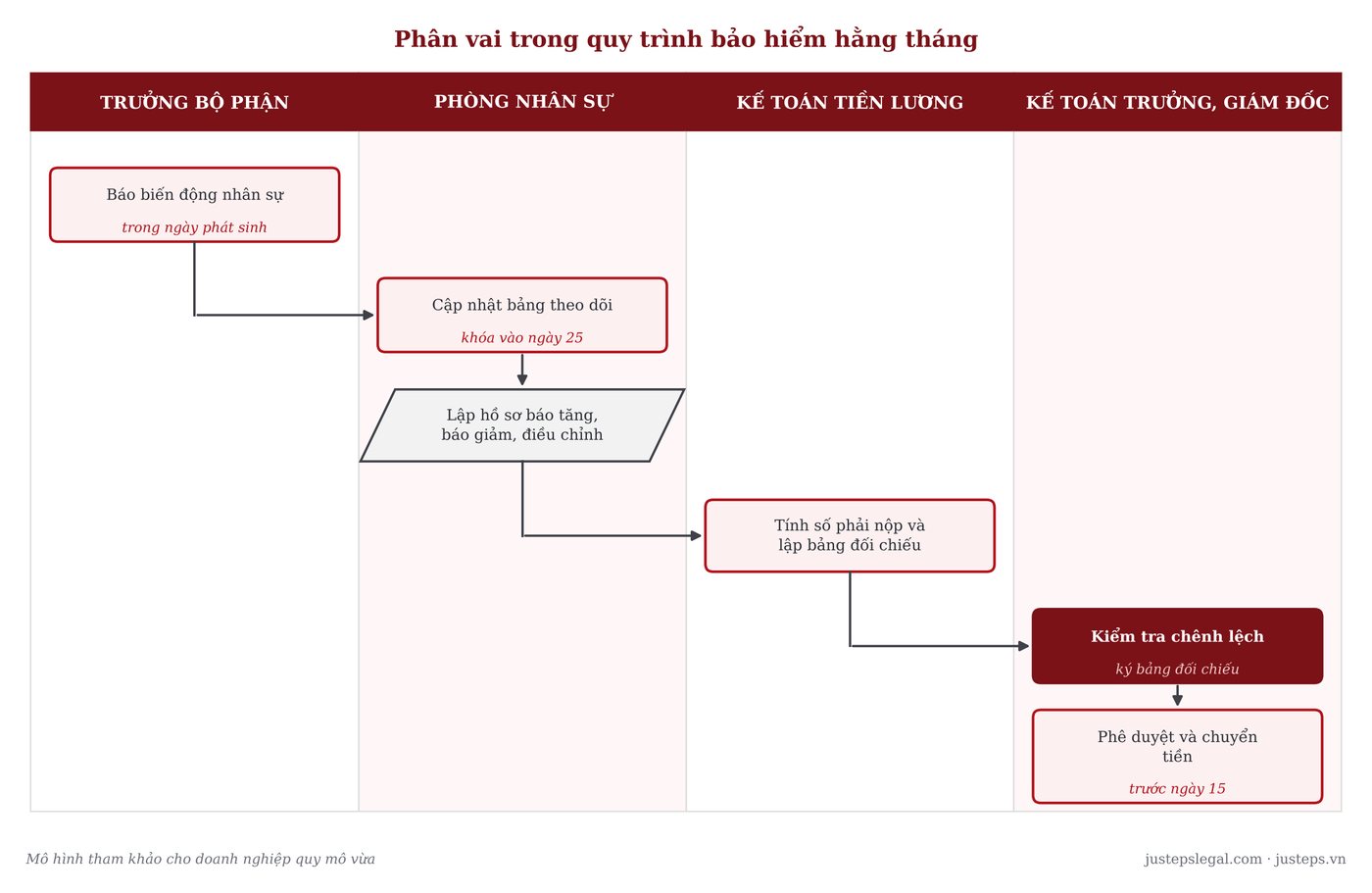
Division of roles among departments in the monthly insurance process
According to the diagram, department heads are where information originates and are responsible for reporting staffing changes in their unit to the human resources department. The human resources department consolidates the changes, prepares the registration, deregistration and adjustment files, and then passes them to the payroll accountant, who calculates the amount payable and reconciles it with the notice from the social insurance authority. The chief accountant carries out the final check before the money is transferred, while the director or an authorised person signs the files and approves the payment. In a small business, one person may handle both the human resources and the calculation work, but the second check should still be performed by someone else.
The division of roles should be put in writing, either as a short internal procedure or as a section of the pay and bonus regulations, with a specific time limit for each handover. For example, the procedure may require every new employment contract to be passed to the person in charge of insurance within two working days of signing, and every resignation decision to be passed on the same day it is issued. With written rules, the business can identify responsibility when an error occurs and has a basis for training a newcomer when the person in charge changes.
The monthly insurance work calendar
A fixed work calendar lets every department know in advance when it must send information and when the figures will be locked. The calendar below is a common arrangement, in which the cut-off date for changes is set on the 25th so that there is enough time to prepare the files before the end of the month.
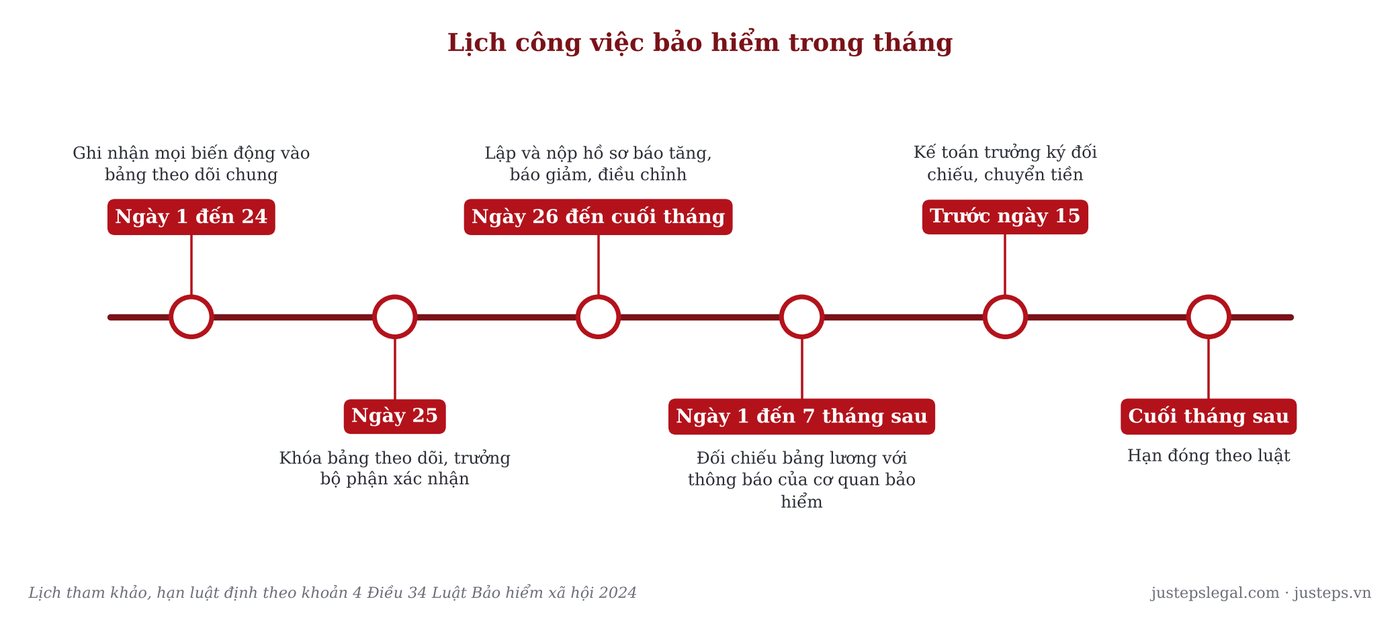
Social insurance work calendar over a monthly cycle
The calendar divides the work into three consecutive phases, namely recording changes during the month, preparing and submitting files at the end of the month, and reconciling and paying at the beginning of the following month. The internal payment milestone before the 15th of the following month is much earlier than the statutory deadline of the last day of the following month, leaving time to deal with any discrepancy in the notice from the social insurance authority. A business may choose a different cut-off date, but that date must match the payroll cut-off so that both sets of figures come from the same source.
Cutting off changes before the 25th
During the month, the human resources department records every change that arises in a shared tracking sheet, including new hires, resignations, changes in wages and allowances, unpaid leave, contract suspensions and maternity leave. Each entry states the effective date, the supporting document and the person who reported it. On the 25th, the human resources department locks the tracking sheet, sends it to department heads to confirm that no changes remain unreported, and then moves on to preparing the files. Changes arising after the cut-off date are recorded in the next period, except where an employee leaves, because deregistration should be carried out within the month of departure.
Preparing registration, deregistration and adjustment files
From the 25th to the end of the month, the human resources department prepares registration files for new employees, deregistration files for those who have left and adjustment files for those whose wages have changed, and submits them through the electronic transaction portal of the social insurance authority. For new employees, the file must be submitted within the 30-day time limit mentioned above, but the business should register them in the month the contract is signed so that the employee is covered by health insurance early[2]. For employees who leave, timely deregistration saves the business from paying for the following month and allows the employee to have the social insurance book closed on time so that benefits can be processed. All electronic receipts and result notices should be filed by month.
Reconciling and paying at the beginning of the following month
In the first week of the following month, the payroll accountant prepares a three-column reconciliation sheet showing the amount calculated from the payroll, the amount in the notice from the social insurance authority and the difference. Each line of difference must have a specific cause, for example a deregistration file not yet recorded, an adjusted wage that differs from the contract or an arrears payment from a previous period. The chief accountant checks the reconciliation sheet, resolves or records the outstanding differences, and then submits it for approval and transfers the money before the internal milestone. Paying on time without reconciling may allow differences to accumulate over several months and be discovered only when the social insurance authority sends a notice of late payment.
Special cases that need separate monitoring
Besides ordinary changes, certain groups of employees need to be monitored separately because their contribution obligations differ from those of employees under ordinary employment contracts. A person on probation under a separate probation contract is not subject to unemployment insurance, so the business must not deduct this contribution from the probationary wage[8]. If the probation arrangement is contained in the employment contract itself, the business should determine the contribution obligation from the date the contract takes effect in accordance with the guidance of the social insurance authority.
Foreign employees working in Vietnam under employment contracts may also be subject to compulsory social insurance, except in certain excluded cases such as intra-corporate transferees or cases covered by an international treaty to which Vietnam is a party. A person already receiving a pension who continues to work is not subject to compulsory social insurance, but the business still needs to check its obligation to pay the other types of insurance for that person. For each of these groups, the tracking sheet should have a separate notes column stating the applicable basis, so that a successor does not mistakenly apply the general rates.
Another group to watch is persons working under freelance collaborator or service contracts who in substance have a fixed working schedule, receive a monthly wage and are subject to the business’s management. As noted above, the 2024 Law on Social Insurance determines who must participate according to the substance of the relationship rather than the name of the contract[1]. The business should review these contracts at least once a year and convert them into employment contracts when the relationship has taken on the characteristics of an employment relationship. This review can be combined with Justeps’ service on labour and payroll compliance management to assess risks relating to contracts, wages and insurance at the same time.
Common errors and the records to be kept
Reviews of businesses’ insurance files show that recurring errors share the same root cause, namely information passed on late or the absence of a second check. The table below summarises the common errors and the corresponding preventive measures.
| Error | Common cause | Preventive measure |
|---|---|---|
| Late deregistration | The resignation decision is not passed to the person in charge of insurance within the month. | Require resignation decisions to be passed on the day they are issued and check again on the cut-off date. |
| No adjustment after a pay rise | A decision raising pay or an allowance is signed without a copy being sent to the insurance team. | Include the insurance team as a mandatory recipient of every decision on wages. |
| A single ceiling for both funds | The calculation sheet has only one ceiling column for both social insurance and unemployment insurance. | Keep two ceiling columns and update them when the base salary or regional minimum wage changes. |
| Wrong deductions for probationers | The software applies the general rates to everyone on the payroll. | Tag each person with a contract type code and check before running the payroll. |
| Payment without reconciliation | The accountant transfers the previous month’s amount in order to meet the deadline. | Require a reconciliation sheet signed by the chief accountant before payment is submitted for approval. |
The insurance records for each month should be kept as one set, comprising the locked change-tracking sheet, the registration, deregistration and adjustment files with their electronic receipts, the reconciliation sheet bearing the reviewer’s signature, the payment vouchers and the notice from the social insurance authority. This set of records is the basis for explanations during an inspection or audit, or when an employee complains about their contribution period. Because the records contain information on wages, health and personal details, their storage and access must be controlled in accordance with the law on personal data protection[12]. Every quarter, the chief accountant should review the differences that have arisen, their causes and the time taken to resolve them in order to adjust the process in good time.
Finally, the business should prepare in advance for changes to the base levels during the year. The new regional minimum wage applicable from 1 January 2027 changes the unemployment insurance ceiling and may require the business to adjust the wages of employees currently paid close to the minimum wage[11]. Before each such milestone, the human resources department and the accounting team should review the list of employees affected, update the calculation sheet and inform employees of the new deduction amounts.
How Justeps can help
Justeps supports businesses in building and operating their monthly social insurance management process through the following services:
- Advice on compulsory social insurance and employee benefits. Justeps reviews the wages used as the contribution basis and special cases, and guides businesses on benefit claim files for employees.
- Labour and payroll compliance management. Justeps designs the process, roles, cut-off calendar and insurance reconciliation sheet to suit the business’s organisation.
- Development of salary scales and pay and bonus regulations. Justeps classifies income components so that the pay regulations themselves identify correctly which amounts fall within the insurance contribution basis.
- Labour records and employment contracts. Justeps reviews employment contracts, freelance collaborator contracts and wage annexes so that insurance obligations are determined consistently.
- Training on compulsory social insurance under the 2024 Law on Social Insurance. Justeps trains HR staff and payroll accountants on the new rules and on how to run the monthly process.
Frequently asked questions
When is the monthly social insurance payment due?
Where contributions are made monthly, the deadline is no later than the last day of the following month[3]. A business should set an earlier internal milestone, for example before the 15th, so that there is time to deal with any discrepancy.
Within what period must a new employee be registered?
The employer must submit the participation file within 30 days from the date the employee becomes subject to participation[2]. Registering the employee in the month the contract is signed allows them to receive a health insurance card sooner.
Is a fuel allowance paid as a fixed monthly amount subject to insurance contributions?
Wages used as the contribution basis include supplementary amounts agreed to be paid regularly and consistently in each pay period[9]. A fixed support amount not tied to specific conditions therefore risks being included in the contribution basis, and the business should consider each amount individually.
What is the current maximum wage for social insurance contributions?
The maximum is 20 times the reference level[9], currently calculated on the statutory base salary of 2,530,000 dong from 1 July 2026, giving 50,600,000 dong per month[10]. Unemployment insurance uses a separate ceiling based on the regional minimum wage.
What are the consequences for a business that pays social insurance late?
The business must pay the full late amount plus an additional sum equal to 0.03% per day of the late amount[4]. The business may also be subject to administrative penalties under Decree No. 283/2026/ND-CP[5].
Must a person on probation contribute to unemployment insurance?
A person working under a separate probation contract is not subject to unemployment insurance under the 2025 Law on Employment[8]. The business should configure its payroll so that this contribution is not deducted for employees on probation.
Does a small business need a written insurance procedure?
The law does not require a business to issue a separate procedure for this work. However, a short procedure with a cut-off date, a reviewer and a reconciliation sheet significantly reduces errors, even where only one or two people are in charge.
Related articles
- Monthly labour and payroll compliance checklist for HR departments
- The annual pay review process, from criteria, budget and merit matrix to records and employee notification
- Reviewing pay arrangements before 1 January 2027
- Building an HR department from scratch once a business passes 30 employees
Notes
[1] Point a, Clause 1, Article 2 of the Law on Social Insurance No. 41/2024/QH15 dated 29 June 2024.
[2] Clause 1, Article 28 of the Law on Social Insurance No. 41/2024/QH15.
[3] Clause 4, Article 34 of the Law on Social Insurance No. 41/2024/QH15.
[4] Clause 1, Article 40 of the Law on Social Insurance No. 41/2024/QH15.
[5] Decree No. 283/2026/ND-CP dated 15 July 2026 on administrative penalties in the fields of labour and social insurance.
[6] Clause 1, Article 33 of the Law on Social Insurance No. 41/2024/QH15.
[7] Clause 1, Article 34 of the Law on Social Insurance No. 41/2024/QH15.
[8] Law on Employment No. 74/2025/QH15.
[9] Clause 1, Article 31 of the Law on Social Insurance No. 41/2024/QH15.
[10] Decree No. 161/2026/ND-CP dated 15 May 2026 on the statutory base salary.
[11] Decree No. 399/2026/ND-CP on the minimum wage for employees working under employment contracts.
[12] Law on Personal Data Protection No. 91/2025/QH15.
This article is for reference and reflects the regulations in force at the time of publication. Please consult Justeps for advice tailored to your company’s records and situation.
For further information, please contact:
📩 Email: info@justeps.vn
🌐 Website: https://justepslegal.com · https://justeps.vn
🌐 Page: Justeps
☎️ Hotline (Zalo): 096 172 2607
📍 Thanh Xuan Office: 12th Floor, Licogi 13 Tower, 164 Khuat Duy Tien Street, Thanh Xuan Ward, Hanoi, Vietnam
📍 Ha Dong Office: LK06B, No.10, Dong Dua Area, Ha Dong Ward, Hanoi, Vietnam
📍 Ho Chi Minh City Branch: 528 Le Van Sy, Ho Chi Minh City, Vietnam
📍 Hai Phong Office: Truong Thinh Village, Ha Dong Commune, Hai Phong, Vietnam
📍 Quang Ninh Office: Van Don Special Zone, Quang Ninh Province, Vietnam





