
Key takeaways
- From 1 March 2026, foreign investors may set up a company first and apply for the Investment Registration Certificate afterwards, provided that they meet the market access conditions.
- A company set up by this route has 12 months to obtain its Investment Registration Certificate and may implement the project or add other business lines only after that certificate has been issued.
- Cash capital contributions must be made through an investment capital account under Circular 38/2026/TT-NHNN; before the investment certificate is issued, this account may be used only for a limited range of transactions.
- The company-first route gives the investor a legal entity early on to lease an office and hire staff, but the investor must accept the risk of having to repatriate capital if the project is not licensed.
- After licensing, the company must contribute its capital in full within 90 days, report periodically on the National Investment Information System and manage related-party transactions with its parent company from the first year.
For many years, foreign investors wishing to set up a company in Vietnam had to follow a fixed sequence, obtaining an Investment Registration Certificate first and only then registering the enterprise. This sequence meant that investors waited for months without a legal entity able to lease an office, hire staff or open accounts, while preparation costs continued to accrue. The Law on Investment 2025, effective from 1 March 2026, together with its implementing decree and the State Bank of Vietnam’s new circular on foreign exchange management, has changed that sequence considerably.
This article analyses the two routes currently available for setting up a foreign-invested company, the market access conditions, the application file, the use of the investment capital account, capital contributions and the reporting obligations that apply after licensing. It is written primarily for foreign investors, the intended management of the new company and the legal and finance teams of the parent company. It does not cover in depth projects using land that require in-principle investment approval, nor capital contributions or share acquisitions by foreign investors in existing Vietnamese companies.
The two routes to incorporation under the Law on Investment 2025
Under the Law on Investment 2025, a foreign investor may establish an economic organisation to implement a project before applying for the issue or amendment of an Investment Registration Certificate (Investment Certificate), provided that it meets the market access conditions applicable to foreign investors[1]. As a result, two parallel routes are now available. The first is to obtain the Investment Certificate first and then register the enterprise, as before, while the second is to register the enterprise first and then apply for the Investment Certificate within the statutory time limit.
Under the implementing decree, a company established by the second route must complete the procedure for the issue of an Investment Certificate for a project consistent with its registered business lines within 12 months of its establishment[2]. During that period, the enterprise registration file must include an undertaking to meet the market access conditions, and the company may add other business lines and implement the project only after it has obtained the Investment Certificate. Projects subject to in-principle investment approval, such as projects requesting the State to allocate or lease land, must still pass through that approval stage before implementation[3]. The table below compares the two routes to help investors choose the one that suits them:
| Criterion | Investment certificate first | Company first |
|---|---|---|
| When the legal entity exists | After both the Investment Certificate and the Enterprise Registration Certificate have been issued. | As soon as the Enterprise Registration Certificate is issued, usually within a few working days. |
| Initial scope of activities | The project may be implemented as soon as both certificates are issued. | Investment preparation only; the project cannot yet be implemented and no other business lines may be added. |
| Investment capital account | Full receipts and payments for the registered purposes. | Receipt of capital and interest, payment of preparation costs and repatriation of capital if the project is not licensed. |
| Main risk | Long waiting time, with preparation costs incurred before a legal entity exists. | Dissolution or conversion of the company, and repatriation of capital, if the Investment Certificate is not issued. |
| Best suited to | Large projects using land or needing investment incentives recognised early. | Service and trading projects that need an early presence and depend little on land. |
The company-first route offers a clear advantage in timing, but it should be assessed carefully where the business line is subject to foreign ownership caps or requires a sector-specific licence. If the project is likely to be refused, the investor will lose the costs of establishment and dissolution as well as the time needed to repatriate the capital. A prudent approach is to seek the informal view of the investment registration authority on the business lines and location before choosing a route, and only then decide whether to set up the company first.
Market access conditions and business lines
Market access conditions are the first hurdle and apply to both routes. The decree implementing the Law on Investment sets out the List of business lines subject to restricted market access for foreign investors, comprising lines in which market access is not yet permitted and lines in which market access is conditional[4]. For conditional lines, restrictions may take the form of a maximum ownership percentage, a mandatory form of investment such as a joint venture with a Vietnamese partner, limits on the scope of activities or requirements as to the investor’s capability, depending on Vietnam’s international commitments for each sector.
In addition to the market access conditions, a business line may also fall within the list of conditional business lines, which applies equally to domestic and foreign investors[5]. These two layers of conditions are independent of each other, so a project may satisfy the market access conditions yet still need a sector-specific licence before it can operate. Before filing, the investor should prepare a comparison table mapping each intended business code against Vietnam’s international commitments, the restricted list and the business conditions, because a mistake at this stage will require the entire file to be revised.
Application file, receiving authority and processing time
Preparing the foreign investor’s documents
Documents issued by foreign authorities, such as the parent company’s certificate of incorporation, its financial statements and the representative’s passport, must be consularly legalised unless exempted under an international treaty, then translated into Vietnamese with the translation certified[6]. This is usually the most time-consuming step and may take two to six weeks depending on the country, so investors should begin as soon as the investment decision is made. The project file also includes the project proposal, evidence of financial capacity such as the financial statements for the two most recent years or a letter of financial support from the parent company, and documents relating to the project location.
Registration authority and time limits for issuing certificates
For projects outside industrial parks, export processing zones, hi-tech parks and economic zones, the investment registration authority is the Department of Finance of the province where the project is located; for projects within those zones, it is the relevant zone management board. For projects not subject to in-principle investment approval, the investment registration authority issues the Investment Certificate within 10 working days of receiving a complete and valid file, provided that the project is not in a prohibited sector, has a valid location, is consistent with planning and meets the market access conditions[7]. The Enterprise Registration Certificate is issued by the Business Registration Office of the Department of Finance within 3 working days of receiving a valid application[8]. The diagram below illustrates the company-first route and the tasks of each party.
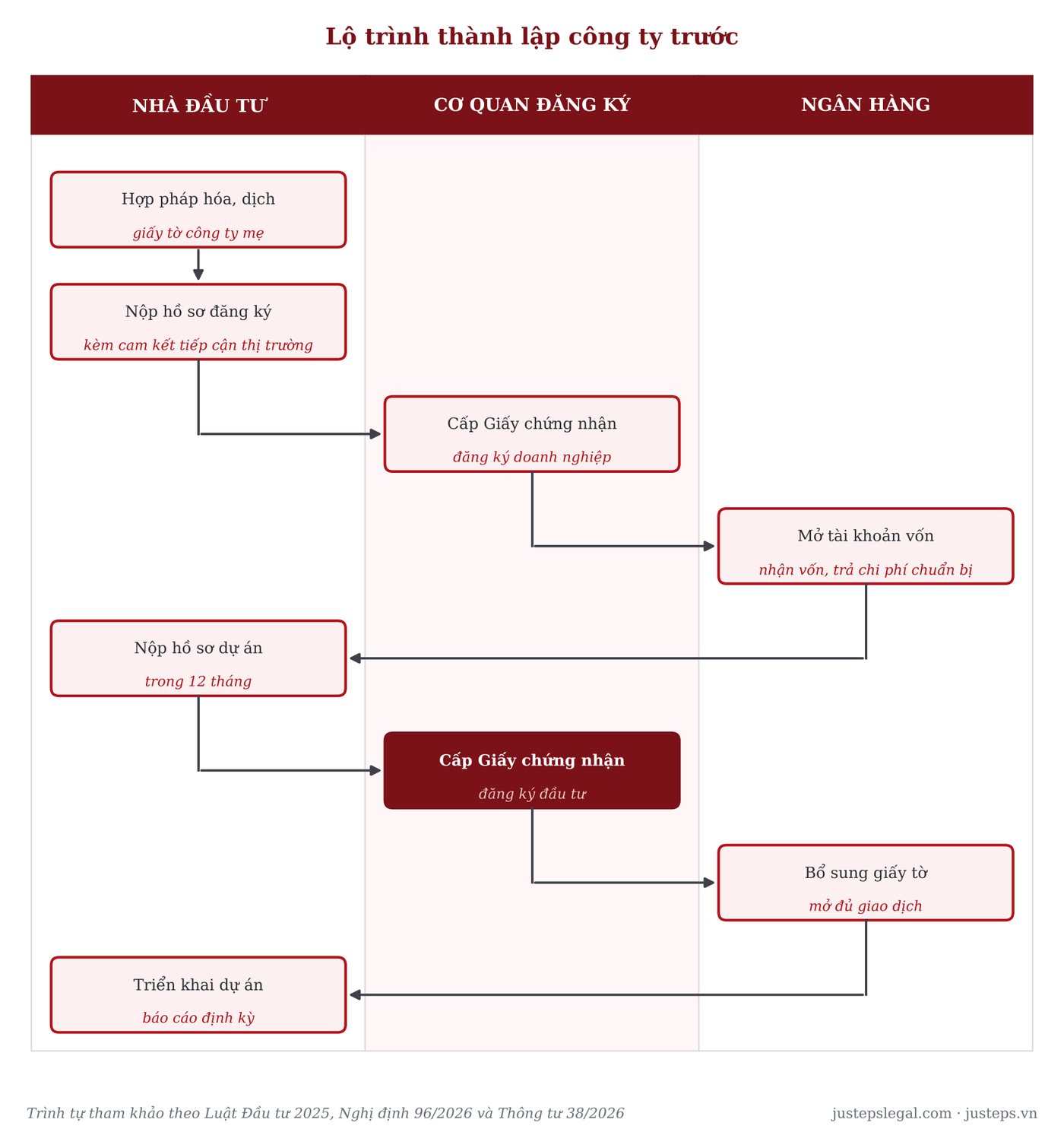
The company-first route to the investment certificate and the tasks of each party
Under this route, the investor prepares the legalised documents and files the enterprise registration application together with an undertaking to meet the market access conditions. Once the company has been established, the investor opens an investment capital account to transfer capital and pay preparation costs, while completing the project file for submission to the investment registration authority. The decisive step is the issue of the Investment Certificate, because only after that may the company implement the project and use the capital account for its full range of purposes. If the certificate is not issued, the company must return the capital to the investor, close the account and deal with its status as a legal entity.
The following chart illustrates the time taken by each step in a typical case, including both the statutory time limits and the time needed for preparation in practice. The figures are indicative only, because the time required for legalisation and for banks to review the file varies considerably from case to case.
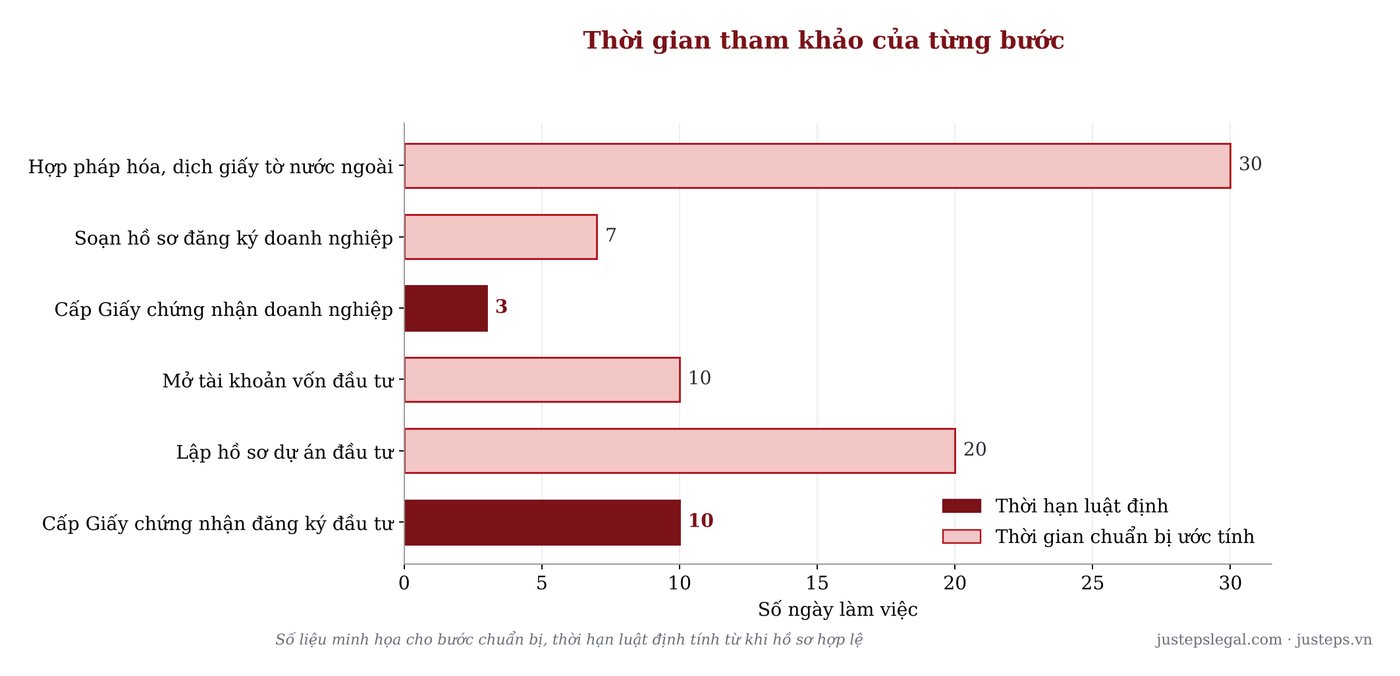
Indicative time required for each step in setting up a foreign-invested company
Most of the time is spent on steps within the investor’s control, namely legalising documents, preparing the project file and opening the account, rather than on the processing time of state authorities. The two steps with the shortest statutory time limits are the issue of the Enterprise Registration Certificate and of the Investment Certificate, but each request to amend the file restarts the clock. Companies may consider Justeps’ foreign-invested company formation service to prepare a consistent file from the outset.
The investment capital account and capital contributions
From 18 August 2026, Circular 38/2026/TT-NHNN replaces Circular 06/2019/TT-NHNN on foreign exchange management for foreign investment in Vietnam, and the former direct investment capital account has been replaced by an investment capital account under the new rules[9]. A company established by a foreign investor, or in which foreign investors hold more than 50% of the charter capital, must open this account at an authorised bank, and every cash capital contribution must be transferred into it. The company may open one account in Vietnamese dong and one account for each foreign currency used to contribute capital, all at the same bank.
A notable change is that a company established before obtaining its Investment Certificate may open an investment capital account immediately. During this phase, however, the account may be used only to receive capital contributions, receive deposit interest, pay lawful investment preparation costs and return capital to the investor if the project is not licensed[9]. Each transfer order must state its purpose clearly, and once the Investment Certificate has been issued the company must provide it to the bank in order to carry out the full range of transactions, such as remitting profits or receiving foreign loans. The company should engage with its bank early on the required supporting documents, because each bank issues its own internal rules on the documentation for opening and operating the account.
Deadline for contributing capital and the consequences of late contribution
Charter capital must be contributed in full within 90 days of the date of issue of the Enterprise Registration Certificate, excluding the time needed to transport or import contributed assets or to complete the transfer of their ownership[10]. Under the company-first route, this period starts running before the Investment Certificate is issued, so the investor must arrange its cash flow to bring the capital into the account within 90 days even while the project is still awaiting a licence. If the capital has not been fully contributed by the deadline, the company must register an adjustment of its charter capital to the amount actually contributed within the following 30 days[10]. In addition, the investment capital of the project stated in the Investment Certificate may exceed the charter capital, with the difference funded by borrowing, and the schedule for contributing capital and disbursing investment capital must be followed as registered.
A loan from the parent company or a foreign bank to cover this difference is a foreign loan, which must satisfy the conditions for borrowing and, in some cases, must be registered with the State Bank of Vietnam. A common mistake is for the parent company to transfer funds into an ordinary payment account with a vague payment reference, so that the funds are recognised neither as a capital contribution nor as a valid loan. In that case, the company will find it difficult to remit profits or repay the loan abroad and may face penalties for breaching foreign exchange rules.
The 12-month period and managing risk before the investment certificate is issued
The 12-month period from the date of establishment is the most important milestone on the company-first route[2]. During this period, the company has legal personality and may therefore sign an office lease, hire employees and engage advisers to prepare the project, but it may not sign contracts to sell goods or provide services forming part of the project. Management must therefore identify clearly which costs are investment preparation costs payable from the capital account and keep full supporting documents to justify them to the bank and the tax authority.
The roadmap below divides the 12 months into stages and sets out what needs to be completed in each, so that the company does not leave the project file until the final months.
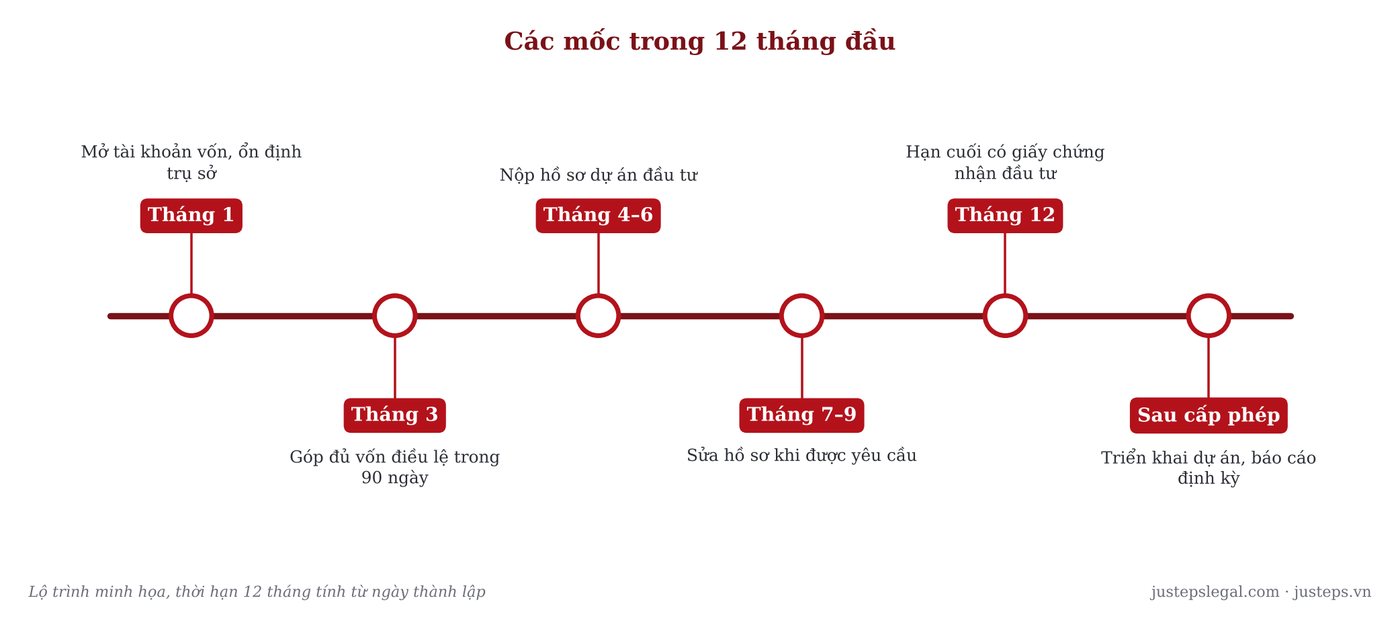
Milestones in the first 12 months of a company set up before obtaining its investment certificate
In the first three months, the company concentrates on opening the capital account, contributing its charter capital in full within 90 days and settling its head office. From the fourth to the sixth month, the company completes the project file and submits it to the investment registration authority, leaving enough time for amendments if requested. Investors should not wait until after the ninth month to file, because a refusal close to the deadline would leave the company no time to adjust the project or switch to an alternative plan. If the certificate is not issued, the company must repatriate the capital through the investment capital account after deducting legitimate costs and close the account in accordance with the regulations[9].
Post-licensing obligations in the first year of operation
Investment reporting and enterprise information
An economic organisation implementing a project is granted access to the National Investment Information System and must comply with the periodic reporting regime on project implementation under the decree implementing the Law on Investment[11]. The reports cover capital contributed, capital disbursed, revenue, headcount and obligations to the state budget, so the figures must match the accounting records and the capital account statements. Failure to report, or untruthful reporting, may attract penalties and gives the investment registration authority grounds to inspect the project and even to terminate it if combined with delays in implementation.
The company must also publish its enterprise registration details within 30 days, register changes within 10 days of their occurrence, and collect and retain information on its beneficial owners[12]. For a foreign-invested company, identifying beneficial owners is often more complex, because it requires tracing through several layers of parent companies and offshore investment funds to find the ultimate individual. The company should ask its parent company to provide a certified ownership chart and to update it whenever the chain of ownership changes.
Tax, related-party transactions and foreign employees
A foreign-invested company usually transacts with its parent company from the first year, for example through management fees, royalties, purchases of goods or loans. These are related-party transactions, which must be declared and priced on the arm’s length principle, and they are also subject to a cap on deductible interest expenses for corporate income tax purposes[13]. The company must register for e-invoicing, file tax returns on time even before it generates revenue, and maintain transfer pricing documentation once it reaches the threshold at which this is required. To manage these obligations on an ongoing basis, the company may use Justeps’ ongoing advisory service for FDI companies.
Foreign nationals seconded to work as directors, managers or experts must hold a work permit or a confirmation of exemption from the work permit requirement, unless they fall within the exempt categories provided by law[14]. Members or owners whose capital contribution reaches the statutory threshold may be exempt from the work permit requirement, but must still complete the confirmation procedure with the competent authority. The company must also pay compulsory social insurance for foreign employees who are within its scope and withhold personal income tax on all income arising in Vietnam[15].
How Justeps can help
Justeps supports foreign investors in choosing a route, setting up the company and maintaining compliance after licensing through the following services:
- Foreign-invested company formation. Justeps assesses the market access conditions, recommends a route and prepares the enterprise registration and investment registration files.
- Investment tax incentives and FDI advisory. Justeps identifies the tax incentives available to the project and how to have them recognised from the investment registration file onwards.
- Ongoing advisory for FDI companies. Justeps tracks the calendar for investment reporting, capital contributions, registration changes and transactions with the parent company.
- Labour, payroll and insurance services for FDI companies. Justeps prepares work permit applications, employment contracts and insurance records for foreign and Vietnamese employees.
Frequently asked questions
Must a foreign investor obtain an investment certificate before setting up a company?
From 1 March 2026, a foreign investor may set up a company before applying for the Investment Certificate if it meets the market access conditions[1]. The investor may still choose to obtain the Investment Certificate first, as before.
How long does a company set up first have to obtain its investment certificate?
The company must complete the procedure for the issue of the Investment Certificate within 12 months of its establishment[2]. During this period, it may not implement the project or add other business lines.
What may the investment capital account be used for before the investment certificate is issued?
The company may only receive capital contributions and interest, pay lawful investment preparation costs and return capital if the project is not licensed[9]. Other transactions, such as remitting profits, may be carried out only after the Investment Certificate has been issued.
When does the 90-day capital contribution period start if the company is set up first?
The period runs from the date of issue of the Enterprise Registration Certificate, regardless of when the Investment Certificate is issued[10]. The investor therefore needs to transfer capital into the investment capital account while the licence is still pending.
May capital be contributed by transferring funds into the company’s ordinary payment account?
Cash capital contributions by a foreign investor must be transferred into the company’s investment capital account[9]. A transfer into an ordinary payment account may mean that the funds are not recognised as a valid capital contribution.
Do the overseas parent company’s documents need consular legalisation?
Documents issued by foreign authorities must be consularly legalised unless exempted under an international treaty, then translated with the translation certified[6]. This step usually takes two to six weeks, so it should be started early.
Does a foreign national serving as the company’s director need a work permit?
In principle, a foreign national working as a director or manager must hold a work permit, unless exempt or outside the scope of the work permit requirement under the regulations[14]. Where the person is outside that scope, a confirmation procedure must still be completed with the competent authority.
Related articles
- Setting up a company in Hanoi: documents required, processing time and what to do immediately after registration
- Opening a representative office of a foreign trader in Vietnam, from the licence application to annual reporting
- How companies in Vietnam should manage foreign employees, from work permits and social insurance to the records they must keep
- Building a business conditions map to control conditional business lines before the launch date
Notes
[1] Clause 2 of Article 19 of the Law on Investment No. 143/2025/QH15, effective from 1 March 2026.
[2] Article 72 of Government Decree No. 96/2026/ND-CP dated 31 March 2026 detailing and guiding the implementation of the Law on Investment.
[3] Article 24 of the Law on Investment No. 143/2025/QH15, on projects subject to in-principle investment approval.
[4] Appendix I to Decree No. 96/2026/ND-CP, setting out the List of business lines subject to restricted market access for foreign investors.
[5] Article 7 of and Appendix IV to the Law on Investment No. 143/2025/QH15, on conditional business lines, effective from 1 July 2026.
[6] Government Decree No. 111/2011/ND-CP dated 5 December 2011 on consular certification and consular legalisation.
[7] Article 39 of Decree No. 96/2026/ND-CP.
[8] Article 26 of the Law on Enterprises No. 59/2020/QH14 dated 17 June 2020, as amended and supplemented by Law No. 76/2025/QH15; Decree No. 168/2025/ND-CP dated 30 June 2025 on enterprise registration.
[9] Circular No. 38/2026/TT-NHNN of the State Bank of Vietnam dated 31 July 2026 guiding foreign exchange management for foreign investment in Vietnam, effective from 18 August 2026.
[10] Clauses 2 and 4 of Article 47, Clauses 2 and 4 of Article 75 and Article 113 of the Law on Enterprises No. 59/2020/QH14.
[11] Clause 6 of Article 97 and the provisions on the investment reporting regime in Decree No. 96/2026/ND-CP.
[12] Articles 30, 31 and 32 of the Law on Enterprises No. 59/2020/QH14; Law No. 76/2025/QH15 and Decree No. 168/2025/ND-CP on beneficial ownership information.
[13] Government Decree No. 132/2020/ND-CP dated 5 November 2020 on tax administration for enterprises with related-party transactions, and its amending and supplementing instruments.
[14] Labour Code No. 45/2019/QH14 dated 20 November 2019; Government Decree No. 219/2025/ND-CP on foreign employees working in Vietnam.
[15] Law on Social Insurance No. 41/2024/QH15 dated 29 June 2024; Law on Personal Income Tax No. 109/2025/QH15.
This article is for reference and reflects the regulations in force at the time of publication. Please consult Justeps for advice tailored to your company’s records and situation.
For further information, please contact:
📩 Email: info@justeps.vn
🌐 Website: https://justepslegal.com · https://justeps.vn
🌐 Page: Justeps
☎️ Hotline (Zalo): 096 172 2607
📍 Thanh Xuan Office: 12th Floor, Licogi 13 Tower, 164 Khuat Duy Tien Street, Thanh Xuan Ward, Hanoi, Vietnam
📍 Ha Dong Office: LK06B, No.10, Dong Dua Area, Ha Dong Ward, Hanoi, Vietnam
📍 Ho Chi Minh City Branch: 528 Le Van Sy, Ho Chi Minh City, Vietnam
📍 Hai Phong Office: Truong Thinh Village, Ha Dong Commune, Hai Phong, Vietnam
📍 Quang Ninh Office: Van Don Special Zone, Quang Ninh Province, Vietnam





