
Key takeaways
- A start-up’s most valuable assets are its source code, designs, data and team, and these assets belong to the company with certainty only where there is a written instrument establishing the rights, signed with each person who creates them.
- A promise to give shares to staff that is not backed by regulations or a decision of the competent body often turns into a dispute when the company raises capital or when the employee leaves.
- A start-up employing ten or more workers must have written internal labour rules registered with the competent authority[7].
- Justeps does not draft every regulation at once but selects priority regulations for each stage, then builds them into contracts, annexes and technical systems so that the regulations take effect in practice.
A start-up with twenty people usually runs on group chats, shared spreadsheets and the habits of the founding team. This way of working is fast and flexible, but it leaves gaps that only come to light when something goes wrong, for example when a developer leaves and takes part of the source code, when an employee claims shares once promised by text message, or when a new feature collects user data without anyone having considered its legal basis. Investors are well aware of these gaps, which is why the due diligence questions on labour and intellectual property are usually the longest.
This page introduces Justeps’ service for building internal procedures and regulations for start-ups and innovative start-up enterprises. It covers five groups of regulations that start-ups commonly lack or get wrong, how Justeps implements them in phases and the deliverables. The design of the organisation and the allocation of authority are covered under the organisational structure design service for start-ups, while employment contracts, payroll and insurance are covered under the labour, payroll and insurance service for start-ups.
Intellectual property regulations come first
Under the Law on Intellectual Property, an organisation that assigns a creative task to a person within the organisation, or that enters into a creation contract with an author, is the owner of the copyright in the resulting work, unless otherwise agreed[1]. Computer programs are protected as a type of work, and the right to register inventions and industrial designs created with the company’s funding and facilities also belongs to the company under separate provisions[2]. These rules may seem sufficient, but they only take effect when the company can prove that the creator was performing an assigned task or that a contract states clearly who owns the results.
In start-up practice, three groups of cases usually fall outside these rules. The first group is source code and designs produced by the founders before the company was incorporated, when no legal entity existed to assign the task. The second group is collaborators, freelancers and outsourcing companies, who do not belong to the organisation and often sign contracts on their own templates. The third group is open-source components incorporated into the product without anyone tracking the licence conditions, as some licences require the company’s own source code to be disclosed when the product is distributed. Justeps’ intellectual property regulations deal with all three groups through an assignment agreement from the founders, model clauses for collaboration and outsourcing contracts, and a list of open-source licences permitted for use.
Start-up-specific regulations that are often missing or wrong
Apart from intellectual property, Justeps commonly finds four other groups of regulations that need to be standardised in start-ups. The table below summarises the core content of each group and the point at which it should be issued.
| Group of regulations | Core content | When to issue |
|---|---|---|
| Intellectual property | Assignment from the founders, clauses for collaborators and outsourcing, and a list of permitted open-source licences. | Before the seed round or when the first collaborator is engaged. |
| Employee share pool | Eligibility, vesting schedule, forfeiture conditions, issuance procedure and form of grant letter. | Before shares are promised to any member of staff. |
| Personal data | Data processing policy, access rights and data review when features are released. | Before the product collects data from real users. |
| Spending and approvals | Limits based on remaining cash runway, approvers and the form of report to investors. | Immediately after the first investment is received. |
| Labour rules and remote work | Working hours, place of work, equipment, information security, and joining and leaving procedures. | Once there are ten workers, or earlier if staff work remotely. |
Employee share pool
A promise of shares is a common tool for retaining people in a start-up, but it is also the most common source of disputes when the promise exists only in a text message or an offer letter. In a non-public joint stock company, shares for staff are issued by way of private placement and must be approved by the competent body[3]; in a limited liability company, admitting a new member changes the structure and requires a decision of the Members’ Council, so many start-ups use an equivalent cash bonus linked to the value of the company instead. The regulations drafted by Justeps set out eligibility, the total size of the pool, the vesting schedule, the cases in which rights are forfeited on leaving, the valuation method when the company buys back shares and the recipient’s personal income tax obligations.
The life cycle of a share grant to staff involves several steps spanning several years, as shown in the figure below, and each step requires its own document.
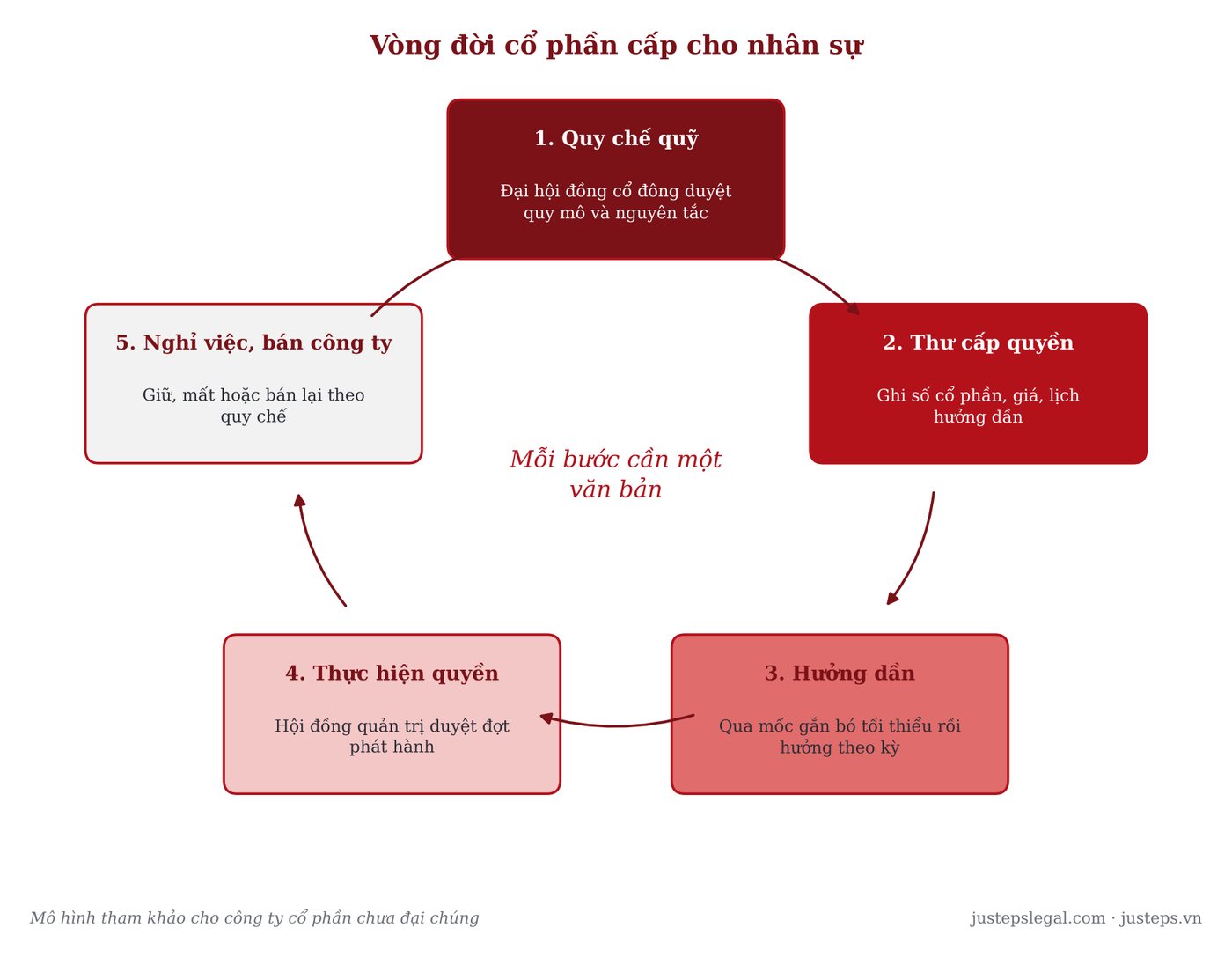
Life cycle of a share grant to staff in a start-up
The regulations are only the first step in this life cycle. From the grant letter, the employee vests according to a schedule, usually with a minimum service period before the first tranche vests, then exercises the purchase right and becomes a shareholder once the company completes the issuance procedure. When the employee leaves or the company is sold, the regulations must already specify which portion is retained, which portion the company buys back and at what price. Income from transfers of shares in innovative start-up enterprises is exempt from personal income tax under Resolution No. 198/2025/QH15[4], but the conditions for qualifying as an innovative start-up enterprise should be checked against the implementing guidance before this is stated in a grant letter.
Personal data and remote work
The Law on Personal Data Protection, effective from 1 January 2026, imposes direct obligations on every enterprise that processes personal data, including small start-ups[5]. A privacy policy posted in the app is not enough, because obligations arise with each new feature that collects data. Justeps therefore also drafts a short review procedure under which the product team answers a questionnaire on the type of data, the purpose, the legal basis for processing and the retention period before release. The review sequence is shown in the flowchart below.
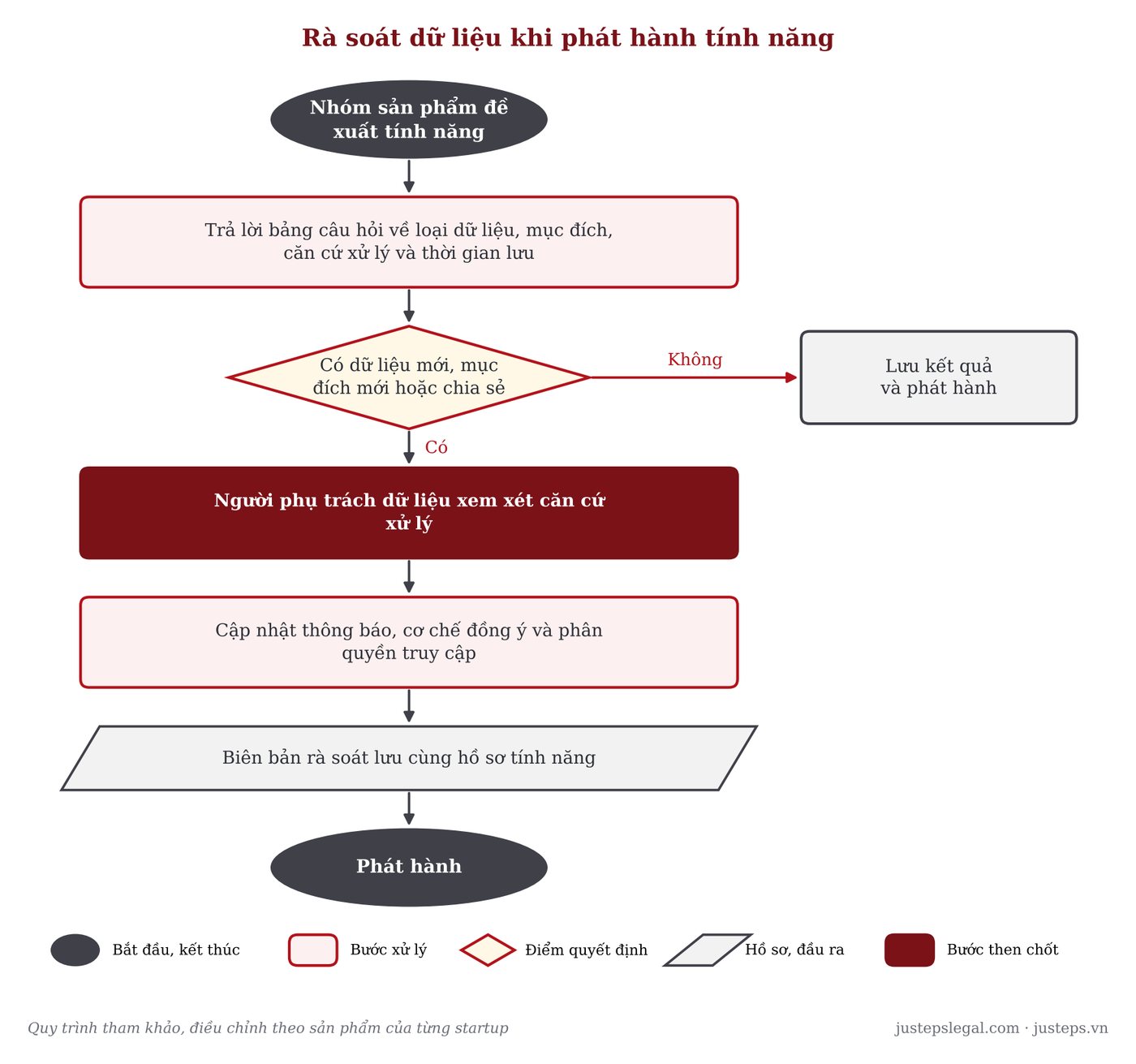
Sequence for reviewing personal data before a new feature is released
Most features only require the product team to complete the questionnaire and file the result, so the procedure does not slow down the release cycle. Only where a feature collects a new type of data, uses data for a purpose different from the original notice or shares data with a partner must the data protection officer review it and update the notice to users before the release date. For staff working remotely, the regulations specify the registered place of work, working hours, equipment, secure connections and confidentiality obligations, because these matters affect both occupational accidents and information security.
Risks of running a start-up without regulations
The greatest risk is a dispute over rights in the core product. When a former founder or an outsourcing company claims to hold rights in part of the source code, investors usually suspend the transaction until there is a written assignment, and this is precisely when the rights holder has the greatest negotiating leverage. The second risk is disputes with employees over shares and bonuses, because in the absence of regulations, promises are usually interpreted in the employee’s favour. The third risk is administrative penalties for failing to register internal labour rules as required or for breaching personal data protection obligations.
In addition, employees who know business secrets and technology secrets may be asked to sign a confidentiality agreement, together with the related benefits and compensation in the event of breach[6]. This agreement needs to be drafted together with the regulations on access rights, because it is difficult for a company to prove that information is secret if everyone in the company can see it. The leaving procedure must therefore be tied to the technical systems, so that access to source code repositories, cloud accounts and internal tools is revoked on the employee’s last working day.
How the service is delivered
A regulations project for a start-up usually takes about seven weeks and is divided into several small phases so as not to disrupt the product team. The figure below illustrates the degree of investor interest typically shown in each group of regulations, which Justeps and the founders use as the basis for setting priorities.
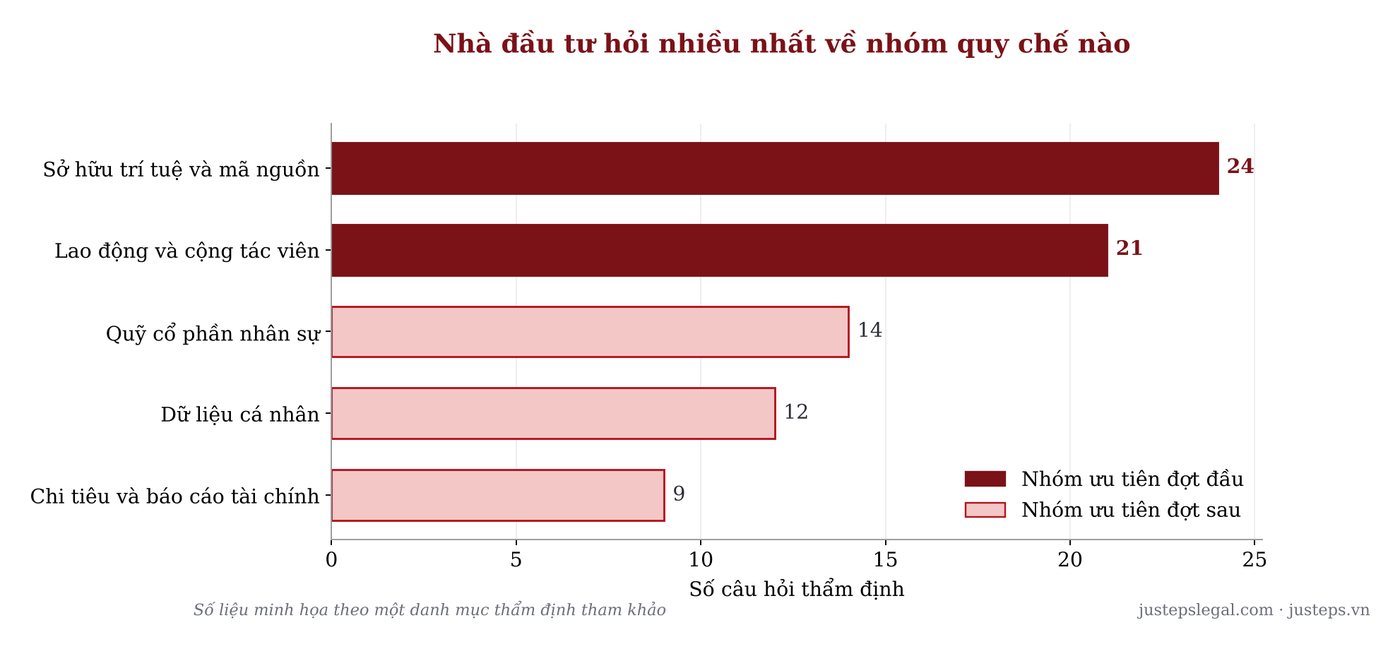
Indicative number of due diligence questions by group of regulations in a funding round
In this example, intellectual property and labour account for most of the due diligence questions, so they are usually included in the first phase. In the second week, Justeps agrees the priority list with the founders, because not every start-up needs all five groups at once. The following weeks are devoted to drafting, obtaining comments from the technical lead and the accountant, and submitting the documents to the competent body for issuance. The final step, which is often skipped, is signing supplementary documents with existing staff, because regulations bind employees only when referred to in a contract, an annex or registered internal labour rules; Justeps prepares the annexes in advance and suggests how to discuss them with each group of staff.
Deliverables and application by stage
The documents are delivered in editable electronic form, together with signed versions of those issued by the competent body, and comprise the following main items:
- Intellectual property regulations, an assignment agreement from the founders and model clauses for collaboration and outsourcing contracts.
- Employee share pool regulations, a form of grant letter and a form of buy-back document for when staff leave.
- A personal data processing policy, information security regulations and a review questionnaire for feature releases.
- Spending regulations, an approval limits table and a form of periodic report to investors.
- Internal labour rules, remote work regulations, joining and leaving procedures and the file for registering the labour rules.
- A set of contract annexes for signing with existing staff.
A start-up with fewer than ten people usually needs only a first phase covering intellectual property, confidentiality agreements and concise spending regulations. A start-up that has raised capital and employs ten or more workers also needs registered internal labour rules[7], share pool regulations and a full data policy. Start-ups in financial technology, digital health or online education need additional sector-specific regulations according to the licence or regulatory sandbox in which the enterprise participates.
What determines the service fee
Justeps quotes a fixed fee based on the number of groups of regulations selected for each phase, after the first working session with the founders. The main factors are the number of staff and collaborators who need to sign supplementary documents, the complexity of the share pool, the number of types of personal data the product processes, whether bilingual documents are needed and whether an investor is currently conducting due diligence. A start-up can begin with the priority phase and add the remaining groups as it grows.
How Justeps can help
In addition to building internal regulations, start-ups and innovative start-up enterprises may combine the following Justeps services:
- Organisational structure design for start-ups and innovative start-up enterprises. Justeps designs the founders’ roles, the authority matrix and the size of the share pool that form the foundation for the regulations.
- Labour, payroll and insurance services for start-ups and innovative start-up enterprises. Justeps standardises contracts, payroll and insurance so that the regulations are properly referred to in employment relationships.
- Intellectual property and trade mark protection. Justeps registers trade marks and copyright for the product and monitors protection deadlines.
- Personal data protection compliance. Justeps prepares data processing impact assessments and a compliance programme as the product expands.
Frequently asked questions
Who owns source code written by a founder before the company was incorporated?
Source code created before the company existed belongs to its author, because at that time no organisation had assigned the task[1]. The founder needs to sign an agreement assigning the rights to the company, which is usually one of the first documents investors ask for.
Is a promise of shares in an offer letter binding on the company?
The promise may be treated as a commitment, but the company will find it difficult to perform properly without regulations and a decision of the competent body on the issuance[3]. A start-up should issue share pool regulations first and then grant letters to each person on a uniform form.
Does a start-up with fewer than ten people need internal labour rules?
An enterprise employing fewer than ten workers is not required to issue written internal labour rules, but must still agree on discipline and material liability in the employment contracts[7]. Justeps recommends having short working regulations from the outset if staff work remotely.
Does every new feature need a personal data review?
A review is needed only for features that collect new data, use data for a new purpose or share data with third parties. Justeps’ questionnaire enables the product team to determine within a few minutes which features need to be passed to the responsible officer for review.
Do newly issued regulations apply immediately to existing staff?
Regulations bind employees when they are referred to in a contract, an annex or registered internal labour rules. Where the content changes benefits already agreed, the company needs to sign an annex with each person rather than simply sending a notice.
What are the risks of using open-source libraries in a commercial product?
Some open-source licences require the source code of software using the library to be disclosed when it is distributed, which can affect the value of the product. Intellectual property regulations should include a list of permitted licences and a person to approve each new library before it is added to the product.
Related articles
- Setting up a technology start-up, capital structure, ESOP and ownership of source code
- What the HR department must do to protect employees’ personal data under the 2025 Law on Personal Data Protection
- The procedure for a private placement of shares and registration of a charter capital increase by a non-public joint stock company
- Internal labour rules, mandatory contents, registration file and effective date
Notes
[1] Article 39 of the Law on Intellectual Property No. 50/2005/QH11 dated 29 November 2005, as amended and supplemented.
[2] Articles 22 and 86 of the Law on Intellectual Property No. 50/2005/QH11 dated 29 November 2005, as amended and supplemented.
[3] Article 125 of the Law on Enterprises No. 59/2020/QH14 dated 17 June 2020, as amended and supplemented by Law No. 03/2022/QH15 and Law No. 76/2025/QH15, on the private placement of shares by joint stock companies that are not public companies.
[4] Article 10 of Resolution No. 198/2025/QH15 dated 17 May 2025 of the National Assembly on certain special mechanisms and policies for the development of the private economy.
[5] Law on Personal Data Protection No. 91/2025/QH15 dated 26 June 2025, effective from 1 January 2026.
[6] Clause 2 of Article 21 of the Labour Code No. 45/2019/QH14 dated 20 November 2019.
[7] Articles 118 and 119 of the Labour Code No. 45/2019/QH14 dated 20 November 2019.
This article is for reference and reflects the regulations in force at the time of publication. Please consult Justeps for advice tailored to your company’s records and situation.
For further information, please contact:
📩 Email: info@justeps.vn
🌐 Website: https://justepslegal.com · https://justeps.vn
🌐 Page: Justeps
☎️ Hotline (Zalo): 096 172 2607
📍 Thanh Xuan Office: 12th Floor, Licogi 13 Tower, 164 Khuat Duy Tien Street, Thanh Xuan Ward, Hanoi, Vietnam
📍 Ha Dong Office: LK06B, No.10, Dong Dua Area, Ha Dong Ward, Hanoi, Vietnam
📍 Ho Chi Minh City Branch: 528 Le Van Sy, Ho Chi Minh City, Vietnam
📍 Hai Phong Office: Truong Thinh Village, Ha Dong Commune, Hai Phong, Vietnam
📍 Quang Ninh Office: Van Don Special Zone, Quang Ninh Province, Vietnam





