
Key takeaways
- Wages are deductible expenses only where the enterprise has employment contracts, timesheets, payrolls and payment documents; the verbal agreements and cash payments of household business days do not meet this requirement[9].
- People working under employment contracts of one month or more are subject to compulsory social insurance, with total contributions of about 21.5% from the enterprise and about 10.5% from the employee, calculated on the salary subject to contributions[7].
- Time that employees have worked for the household business is not automatically carried over by the company, so it should be agreed in writing at the time of conversion to avoid later disputes over severance allowance[2].
- From 1 January 2027, regional minimum wages increase under Decree No. 399/2026/ND-CP, so salary scales and insurance contribution levels should be reviewed before that date[6].
Imagine a building materials shop with 12 workers, five of whom have been with the household business owner for more than five years, none of whom has a written contract and none of whom has ever had social insurance contributions paid. On becoming an enterprise, the owner must immediately answer three questions. Who will sign a contract with the company and under which type of contract, how much more payroll and insurance will cost each month, and how the years employees have worked for the household will be counted if they later leave.
This page introduces Justeps’ labour, payroll and insurance service for household businesses converting into enterprises. It focuses on the tasks that arise only when workers move from the household business to the company, namely reviewing the people currently working, employment contracts, length of service, salary scales, insurance and personal income tax. Internal labour rules and other internal regulations are built under the internal procedures and regulations service in the same group.
Why labour is the hardest part of conversion
In a household business, the relationship with workers usually rests on promises and trust, wages are paid in cash and pay levels are rarely recorded. Once it becomes a company, the enterprise must enter into written employment contracts, except for contracts of less than one month in certain cases[1], while paying no less than the regional minimum wage, paying insurance contributions and withholding personal income tax. Each obligation leaves data in the systems of the social insurance authority and the tax authority, so what the enterprise declares must match what it actually pays.
Labour is also the cost that rises most visibly after conversion. The enterprise’s insurance contributions plus the employee’s share amount to about one third of the salary subject to contributions, not counting the trade union fee. Owners therefore tend to declare a low contribution salary or sign contracts with only a few people, and this is the greatest source of risk in the early years.
Common mistakes after conversion
Ignoring the time employees have worked for the household
The company is a new entity, distinct from the household business, and there is no specific legal provision requiring the company to inherit automatically the time employees worked for the household. On termination of a contract, the employer pays a severance allowance to employees who have worked regularly for 12 months or more, at half a month’s wages for each year of work, after deducting the time during which they participated in unemployment insurance[2]. Without a clear agreement, long-standing workers may claim that their time with the household should be counted, while the owner takes the view that it has nothing to do with the company. Justeps proposes one of two approaches, either the company commits in writing to recognise length of service, or the household business owner settles in full before conversion.
Declaring a contribution salary lower than the salary actually paid
A common practice is to state the regional minimum wage as the salary in the contract to keep insurance contributions low and to pay the rest in cash off the books. The off-book portion has no supporting documents and so cannot be counted as an expense, and when the social insurance authority inspects or an employee complains, the enterprise must pay the arrears with interest and is penalised. The salary subject to insurance contributions comprises the wage level, wage allowances and other supplementary amounts agreed to be paid regularly, so Justeps reviews the whole income structure, not just the basic salary figure.
Relatives working without contracts
A spouse, children or siblings of the owner often work full time without a contract, so the money paid to them is not deductible for tax purposes and they receive no insurance benefits. The opposite case also occurs, where the enterprise signs contracts with and pays wages to relatives who do not actually work, in order to increase expenses. The tax authority can detect this through timekeeping, place of residence and insurance data, so Justeps’ principle is that people who genuinely work sign genuine contracts, and people who do not work are not put on the payroll.
Keeping the household’s shift and overtime habits
Opening the shop from early morning until late evening and working on weekly rest days and public holidays is normal in a household business. In a company, overtime must be paid at no less than 150% on normal working days, 200% on weekly rest days and 300% on public holidays, Tet holidays and paid days off[3], and must remain within the number of hours permitted by law. Justeps redesigns the shift schedule to reduce unnecessary overtime and builds the cost of overtime into the pay plan from the start.
What Justeps does in this service
The service begins by compiling a complete list of the people currently working, including relatives, seasonal workers and hourly workers, together with their length of service, actual take-home pay and current method of payment. From that list, Justeps calculates the cost of each compliance option and proposes a roadmap that suits the enterprise’s financial capacity, rather than forcing it to switch everything over in a single day.
Contracts, length of service and salary scales
Justeps drafts employment contracts of the correct type, fixed-term or indefinite-term depending on the nature of the work[4], together with a written agreement on length of service for long-standing workers. Salary scales are built by position, with the lowest level not below the regional minimum wage where the enterprise operates, and the enterprise must consult the employees’ representative organisation where one exists and publish the scales at the workplace before applying them[5]. From 1 January 2027, the regional minimum wage is VND 5,700,000 in Region I, VND 5,080,000 in Region II, VND 4,450,000 in Region III and VND 4,040,000 in Region IV[6].
Insurance and personal income tax
People working under employment contracts of one month or more are subject to compulsory social insurance under the Law on Social Insurance No. 41/2024/QH15, together with health insurance and unemployment insurance[7]. The table below summarises the common contribution rates that Justeps uses when preparing cost options.
| Contribution | Paid by the enterprise | Paid by the employee |
|---|---|---|
| Retirement and survivorship | The enterprise pays 14% of the salary subject to contributions. | The employee pays 8%, deducted from monthly wages. |
| Sickness and maternity | The enterprise pays 3%. | The employee does not pay this contribution. |
| Occupational accidents and diseases | The enterprise pays 0.5%, which may be lower if the conditions are met. | The employee does not pay this contribution. |
| Health insurance | The enterprise pays 3%. | The employee pays 1.5%. |
| Unemployment insurance | The enterprise pays 1%. | The employee pays 1%. |
| Total | About 21.5%, excluding the trade union fee. | About 10.5%. |
At these rates, the minimum monthly insurance cost for one employee varies by wage region, as in the example below calculated for an employee whose salary equals the 2027 regional minimum wage.
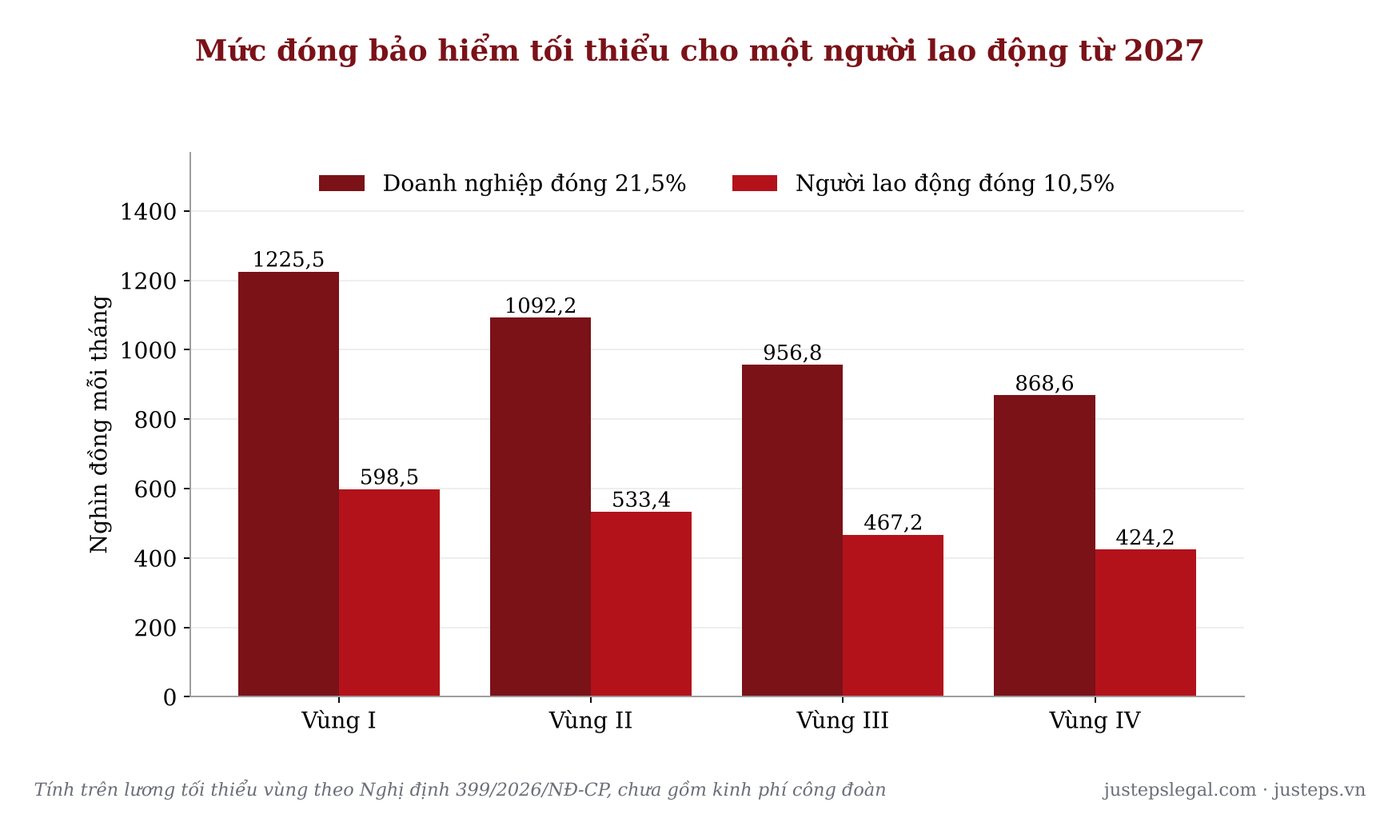
Minimum monthly insurance contributions for one employee by region from 2027
In Region I, the enterprise pays about VND 1.23 million and the employee about VND 0.6 million a month for one person on the minimum wage, while in Region IV the corresponding amounts are about VND 0.87 million and VND 0.42 million. For employees on higher salaries, the cost rises proportionately. In addition to insurance, the enterprise withholds personal income tax monthly under the Law on Personal Income Tax No. 109/2025/QH15[8] and finalises tax on behalf of employees who authorise it to do so.
Delivery process and deliverables
The project usually takes six to eight weeks, and the meeting with employees to explain the changes is the step that determines whether the transition goes smoothly. The indicative sequence is shown in the flowchart below.
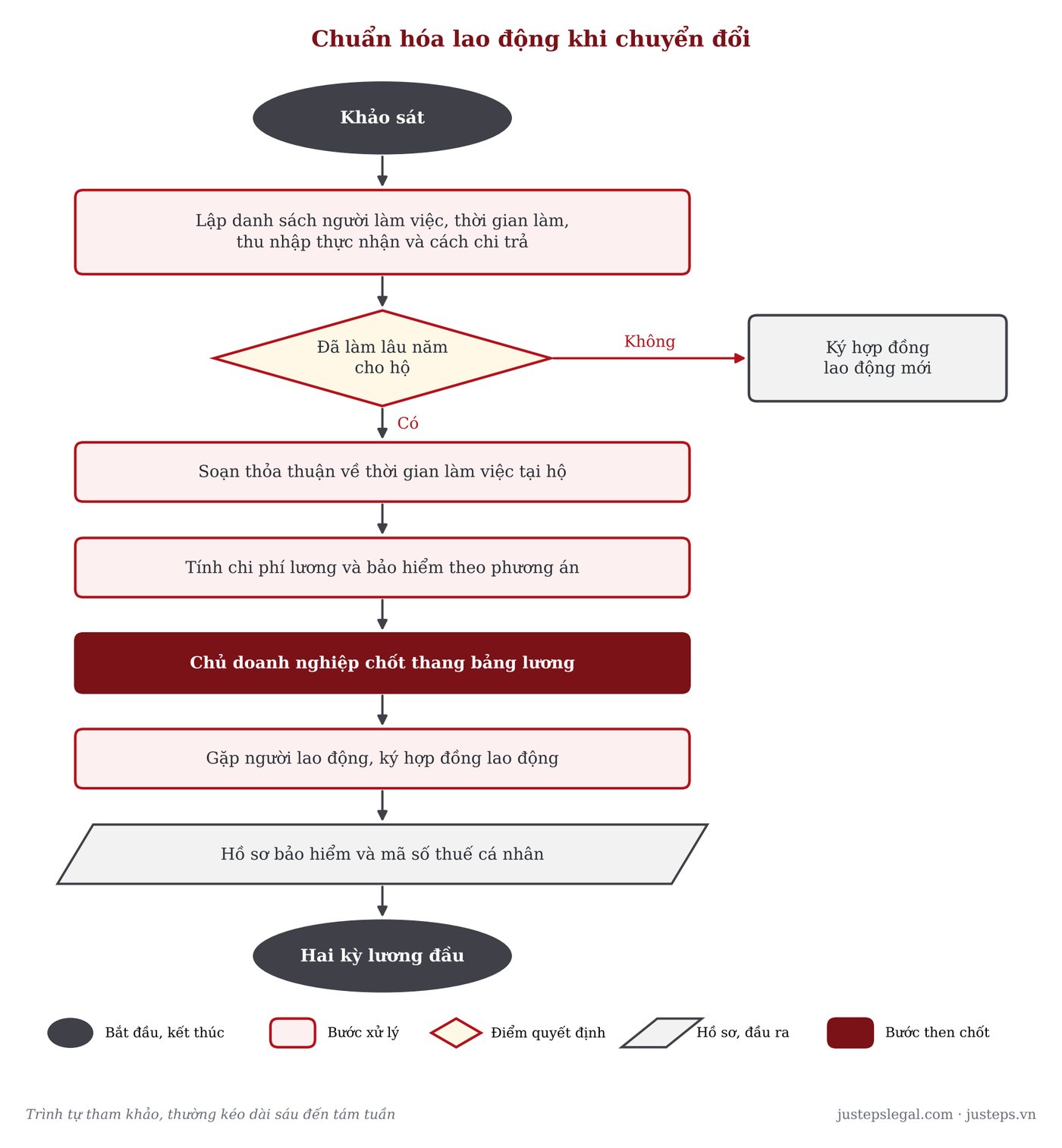
Sequence for standardising labour, payroll and insurance when a household business converts
Once the list of people working is available, Justeps separates out those who have worked for the household for many years in order to draft length of service agreements, while the others sign new contracts. The owner settles the salary scale on the basis of the cost calculation, after which Justeps and the enterprise meet the employees to explain pay levels, the insurance amounts deducted and the benefits they will receive. Contracts are signed after the meeting, the insurance files and personal tax codes are completed, and Justeps monitors the first two payroll cycles to correct any errors. The enterprise receives the following main documents:
- A list of the people working with a classification of contract types and a cost report for each option.
- Employment contracts of each type and written agreements on time worked at the household business.
- A salary scale, a pay and bonus regulation and the consultation and workplace publication records.
- Social insurance, health insurance and unemployment insurance registration files for employees.
- Timesheet and payroll templates and a procedure for monthly personal income tax withholding.
Application by size and sector, and fees
An enterprise with fewer than 10 workers usually needs only contracts, a salary scale and insurance files, while one with 10 or more must also have registered internal labour rules. Enterprises using many seasonal workers, such as agricultural produce and building materials shops, need a short-term contract solution and appropriate payment and tax withholding documents. Enterprises with outlets in several provinces must apply the regional minimum wage of each location, while heavy and hazardous work such as loading and unloading or operating machinery also requires safety training and periodic health checks.
The service fee is quoted as a fixed fee after the survey session and depends on the number of employees, the number of cases requiring length of service agreements, the number of wage regions, the need for internal labour rules and the number of payroll cycles Justeps monitors. On completion, the enterprise may move on to the ongoing legal advisory service for converting household businesses for support when hiring more staff, handling resignations or dealing with the social insurance authority.
How Justeps can help
In addition to the labour, payroll and insurance service, converting household businesses may combine the following Justeps services:
- Building internal procedures and regulations for converting household businesses. Justeps drafts internal labour rules, financial regulations and sales and inventory procedures that fit the way the shop currently operates.
- Ongoing legal advisory for converting household businesses. Justeps supports the enterprise through its first one to two years, tracking the compliance calendar and answering everyday questions.
- Labour, payroll and insurance. Justeps provides in-depth advice on contracts, discipline, termination and insurance benefits for enterprises of all sizes.
- Labour, payroll and insurance training. Justeps trains owners and accountants on preparing payrolls, declaring insurance and withholding personal income tax.
Frequently asked questions
Does time worked for the household business count towards length of service with the company?
It does not count automatically, because the company is a different entity from the household business. The enterprise should agree this in writing, either with the company recognising length of service or with the household business owner settling in full before conversion, to avoid disputes over severance allowance[2].
If an employee does not want to pay social insurance, can the enterprise leave them out?
No. Where an employee works under an employment contract of one month or more, social insurance participation is compulsory, even if the employee makes a written request not to contribute[7]. Justeps helps the enterprise explain the benefits so that employees agree.
Does the owner of a single-member limited liability company sign an employment contract with their own company?
An owner who is also the Director does not sign an employment contract with themselves. Whether the owner is subject to social insurance contributions depends on whether they receive a salary and on the specific conditions under the Law on Social Insurance, so it must be considered case by case.
Do seasonal workers employed for a few days need a written contract?
A contract of less than one month may be entered into verbally in certain cases[1]. Even so, the enterprise still needs payment documents and must withhold personal income tax as required for the expense to be deductible.
Does the salary scale have to be submitted to a state authority?
The enterprise does not have to submit its salary scale but must consult the employees’ representative organisation where one exists and publish the scale at the workplace before applying it[5]. The salary scale should be updated whenever the regional minimum wage changes.
If the enterprise has been paying wages in cash, does it need to switch to bank transfers?
The law does not prohibit paying wages in cash, but paying through a bank account makes it easier to prove the expense. If wages are paid in cash, the enterprise needs a payroll signed by each employee as acknowledgement of receipt for each pay period.
Related articles
- A monthly labour and payroll compliance checklist for HR departments
- What companies must satisfy when moving to electronic employment contracts and how those contracts should be stored
- What the HR department must do to protect employees’ personal data under the 2025 Law on Personal Data Protection
- How to choose a business form between a household business, a limited liability company and a joint stock company
Notes
[1] Article 14 of the Labour Code No. 45/2019/QH14 dated 20 November 2019.
[2] Article 46 of the Labour Code No. 45/2019/QH14 dated 20 November 2019.
[3] Article 98 of the Labour Code No. 45/2019/QH14 dated 20 November 2019.
[4] Article 20 of the Labour Code No. 45/2019/QH14 dated 20 November 2019.
[5] Article 93 of the Labour Code No. 45/2019/QH14 dated 20 November 2019.
[6] Decree No. 399/2026/ND-CP of the Government on minimum wages for employees working under employment contracts, applicable from 1 January 2027.
[7] Law on Social Insurance No. 41/2024/QH15 dated 29 June 2024; Law on Health Insurance; Law on Employment No. 74/2025/QH15 on unemployment insurance.
[8] Law on Personal Income Tax No. 109/2025/QH15 and its implementing documents on tax withholding on income from wages and salaries.
[9] Law on Corporate Income Tax No. 67/2025/QH15 and its implementing documents on the conditions for treating wages and salaries as deductible expenses.
This article is for reference and reflects the regulations in force at the time of publication. Please consult Justeps for advice tailored to your company’s records and situation.
For further information, please contact:
📩 Email: info@justeps.vn
🌐 Website: https://justepslegal.com · https://justeps.vn
🌐 Page: Justeps
☎️ Hotline (Zalo): 096 172 2607
📍 Thanh Xuan Office: 12th Floor, Licogi 13 Tower, 164 Khuat Duy Tien Street, Thanh Xuan Ward, Hanoi, Vietnam
📍 Ha Dong Office: LK06B, No.10, Dong Dua Area, Ha Dong Ward, Hanoi, Vietnam
📍 Ho Chi Minh City Branch: 528 Le Van Sy, Ho Chi Minh City, Vietnam
📍 Hai Phong Office: Truong Thinh Village, Ha Dong Commune, Hai Phong, Vietnam
📍 Quang Ninh Office: Van Don Special Zone, Quang Ninh Province, Vietnam





