
Key takeaways
- A single consignment often passes through several activities with their own conditions, such as road transport, customs declaration and warehousing[1], so the organisational chart should follow the service chain and identify the person responsible at each stage.
- The person monitoring fleet safety should be separate from the dispatcher who carries trip volume targets, because the dispatcher is always under pressure to assign one more trip to a driver who has already driven his full hours.
- Authority to digitally sign customs declarations, to accept goods into the warehouse and to agree compensation with customers needs clear limits for each position, as these are the three decisions most likely to create financial liability.
- The legal form of satellite warehouses and offices at ports and border gates[9] determines who signs contracts, where invoices are issued and how much the site head may decide alone, so it should be chosen before the organisation is drawn.
An ordinary logistics contract may include collecting goods at the shipper’s factory, customs declaration, hauling a container to the port, warehousing, repacking and delivery to the final consignee. Each stage is subject to its own legal framework and needs a qualified person to be responsible for it, yet in many businesses the whole chain sits within a single operations department run by one manager. Only when a consignment is damaged, a truck is fined for overloading or a declaration is reassessed for tax does the business discover that nobody was clearly assigned to control that stage.
This page introduces Justeps’ service of designing the organisational structure of freight forwarders, road freight carriers, warehouse operators and e-commerce fulfilment warehouses. It focuses on choosing the organisational model according to the type of service, assigning each business condition to a position, separating roles with conflicting interests, allocating authority between head office, warehouses and branches, and setting indirect headcount. How staff carry out each handover, dispatch and declaration task is set out under the internal procedures and regulations service for logistics, warehousing and freight transport businesses.
The service model determines the shape of the organisation
Under the Commercial Law, logistics services cover many activities such as receiving goods, transport, warehousing, storage, customs procedures, consultancy, packing, marking and delivery, and a business may perform only part of them or the whole package[1]. Each activity brings its own conditions under specialised legislation, so two businesses that both describe themselves as logistics companies may need very different organisations. Justeps begins by mapping the business’s actual service chain, identifying which stages it performs itself and which it outsources, and only then decides the functional blocks.
The table below summarises the three models Justeps encounters most often and the design focus for each. Businesses active in all three areas are usually organised into separate service divisions that share finance, human resources and legal functions at head office.
| Model | Core function | Positions that must not be left vacant |
|---|---|---|
| Asset-light freight forwarding | Documentation, customs declaration, sales and subcontractor management, because almost all transport is outsourced. | Customs agent staff holding a code, an independent declaration reviewer and a person reconciling disbursements and collections by shipment. |
| Road freight with own fleet | Dispatch, road safety, vehicle maintenance and driver management. | The person directly managing transport operations, the person monitoring tracking data and the maintenance manager. |
| Warehousing and e-commerce fulfilment | Shift-based warehouse operations, stocktaking, fire prevention and handling of exception orders. | The warehouse fire officer, shift leaders with authority over exceptions and a personal data protection contact for consignee data. |
The transport operations manager and a safety function separate from dispatch
A business providing road freight transport must hold a transport business licence, a badge for each vehicle and a person directly managing transport operations who meets the qualification and experience requirements[2][3]. From 10 August 2026, licence applications must include documents on the qualifications and the decision assigning the transport operations manager[3], so this position must be recorded in the organisational structure by a formal decision rather than being a name entered for form’s sake. Vehicles must be fitted with tracking devices, and the business must monitor and act on the data from them.
The design error Justeps sees most often in transport businesses is giving the same person responsibility for both dispatching trips and monitoring safety. The dispatcher is assessed on the number of trips and on-time delivery, so when a customer calls urgently he tends to assign another trip to a driver who has been driving for a long time or to load extra cargo onto a nearly full truck. The law limits continuous driving to no more than 4 hours, while a driver’s daily and weekly working time is governed by the Labour Code[4]. Overloading violations may also be sanctioned against the carrier, the driver and the party that loaded the goods.
Justeps therefore proposes that the road safety function reports directly to the director, with the power to stop a trip when the driver has not had sufficient rest, shows signs of alcohol use or the vehicle has not passed its pre-trip check, and the head of dispatch cannot override this power. In a business with fewer than twenty vehicles, the role may be held concurrently by the maintenance manager, provided that person carries no volume targets.
Customs agent staff and authority to digitally sign declarations
A business carrying out customs procedures on behalf of shippers must satisfy the conditions for a customs procedure agent, and the person who makes declarations must be agent staff holding a code issued by the customs authority[5]. The agent is responsible for the content declared within the scope authorised by the shipper, so errors in commodity codes, customs value or origin may lead to tax reassessment, penalties and disputes with the customer itself. When the number of staff holding a valid code falls because of resignations, the business needs to know immediately so that no declaration is signed in the name of someone who has left.
In the structure Justeps designs, customs agent staff sit within the documentation and forwarding division, but the preparer, the reviewer and the holder of the digital signature are separated into three roles. The decision authorising digital signature states the scope by type of import or export and the value limit per consignment, and consignments above the limit must be reviewed again by the head of the division before transmission. Forwarders serving importers and exporters can compare this with how the shipper side is organised on the page on organisational structure design for import-export trading businesses, so that both sides allocate documentary responsibility consistently.
Warehouses, fire prevention and authority to accept goods
A goods warehouse is a facility subject to fire prevention and fighting management and must have internal fire rules, a firefighting plan, an on-site force and a head of facility responsible for implementation[6]. A warehouse storing flammable or dangerous goods or working several shifts needs a fire officer present on each shift and cannot rely on one person at head office. Bonded warehouses, consolidation points for less-than-container-load cargo and warehouses under customs supervision also have specific requirements on the person in charge and on coordination with the customs authority[5].
Beyond fire prevention, the warehouse is where the business formally assumes responsibility for the customer’s goods, so the person who signs the goods received note must be authorised and answerable for the condition of the goods at signing. Justeps designs the warehouse as a unit with a warehouse head, shift leaders empowered to record reservations when packaging is dented or seal numbers do not match, and a stocktaking team independent of the staff handling daily inbound and outbound movements. In an e-commerce warehouse processing the data of thousands of consignees every day, the structure also needs a personal data protection contact under the Law on Personal Data Protection[7].
Authority to stop vehicles, accept goods and agree compensation
The three decisions with the greatest financial consequences in a logistics business are whether a truck runs or stops, whether goods are accepted into the warehouse or refused, and whether to agree compensation with a customer. The Commercial Law allows a business to be exempted from liability or to limit its liability in certain cases, but this advantage is lost when a salesperson promises to pay the full value of a consignment to keep the customer[1]. The example below is an authority matrix Justeps prepared for a business with about sixty vehicles and two warehouses.
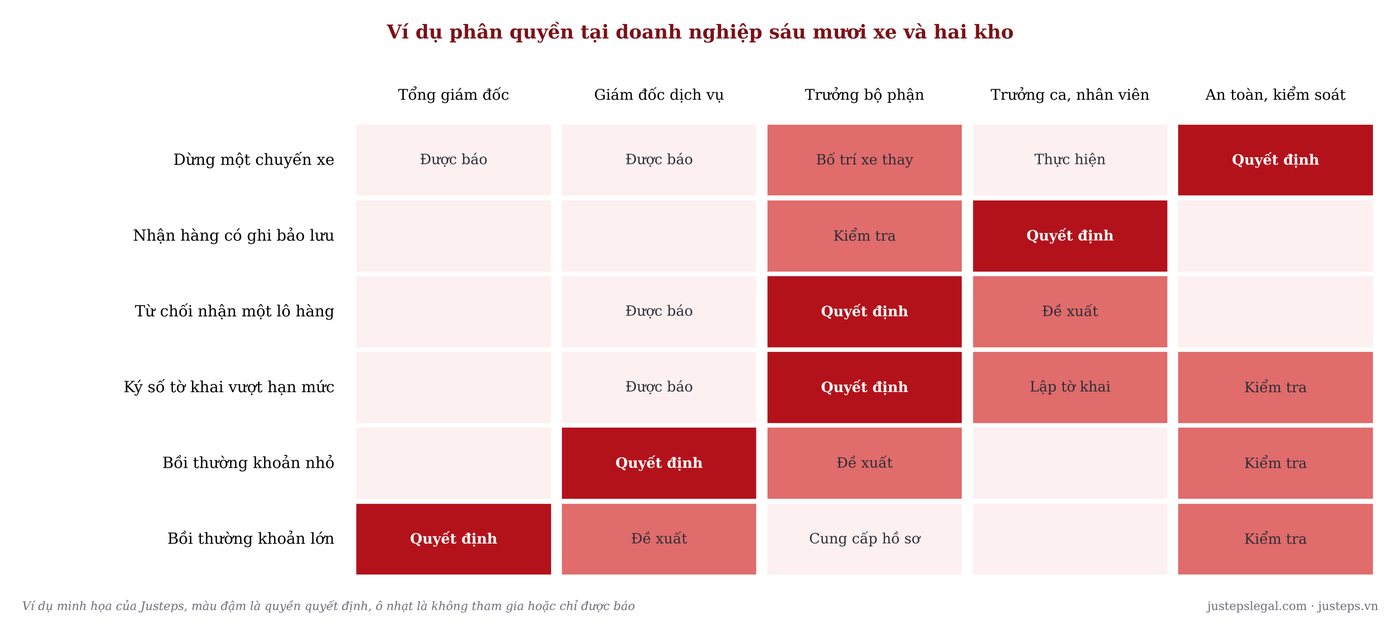
Example allocation of authority to stop vehicles, accept goods and agree compensation in a business with sixty vehicles and two warehouses
In the example, the safety officer decides whether to stop a trip, while the head of dispatch is only informed so as to arrange a replacement vehicle. The warehouse shift leader decides on accepting goods with a reservation, the warehouse head decides on refusing a consignment, and a declaration above the limit may be digitally signed only after the head of documentation decides and the control function has checked it. Compensation is divided by amount, with small amounts decided by the service director after accounting checks the documents, and large amounts or those affecting insurance recovery decided by the general director. The specific limits for each level are set under the financial regulations and delegation of authority service, while the power to issue the organisational structure lies with the owner, the Members’ Council or the Board of Directors depending on the type of enterprise[8].
Satellite warehouses, port offices and foreign investors
Logistics businesses often have warehouses near industrial parks and offices at seaports, airports or land border gates. Each site may be registered as a branch or a business location, a branch being a dependent unit that may perform all or part of the enterprise’s functions under authorisation[9], with notification procedures carried out under the decree on enterprise registration[10]. The head of a border-gate site often has to decide overnight when goods are held or a truck must turn back, and therefore needs sufficiently broad written authority rather than having to call head office for everything. Registration of these sites can be handled through the service for opening branches, representative offices and business locations.
For foreign-invested businesses, some logistics sub-sectors remain subject to market access conditions under international commitments and investment law[11], so whether each stage is performed in-house or outsourced must be checked before the organisation is designed. These businesses also often report in parallel to a parent group under a functional matrix, so Justeps states clearly which reporting line is the decision-making line under Vietnamese law and which serves only to consolidate information.
Indirect headcount by fleet and warehouse
The number of drivers and warehouse workers depends on volume, while the number of indirect staff such as dispatchers, safety officers, documentation and reconciliation staff depends on the model. A shortage of indirect staff is a common reason why handover documents are incomplete, tracking data goes unread and disbursements are never recovered from customers. The chart below compares indirect headcount in three typical businesses.
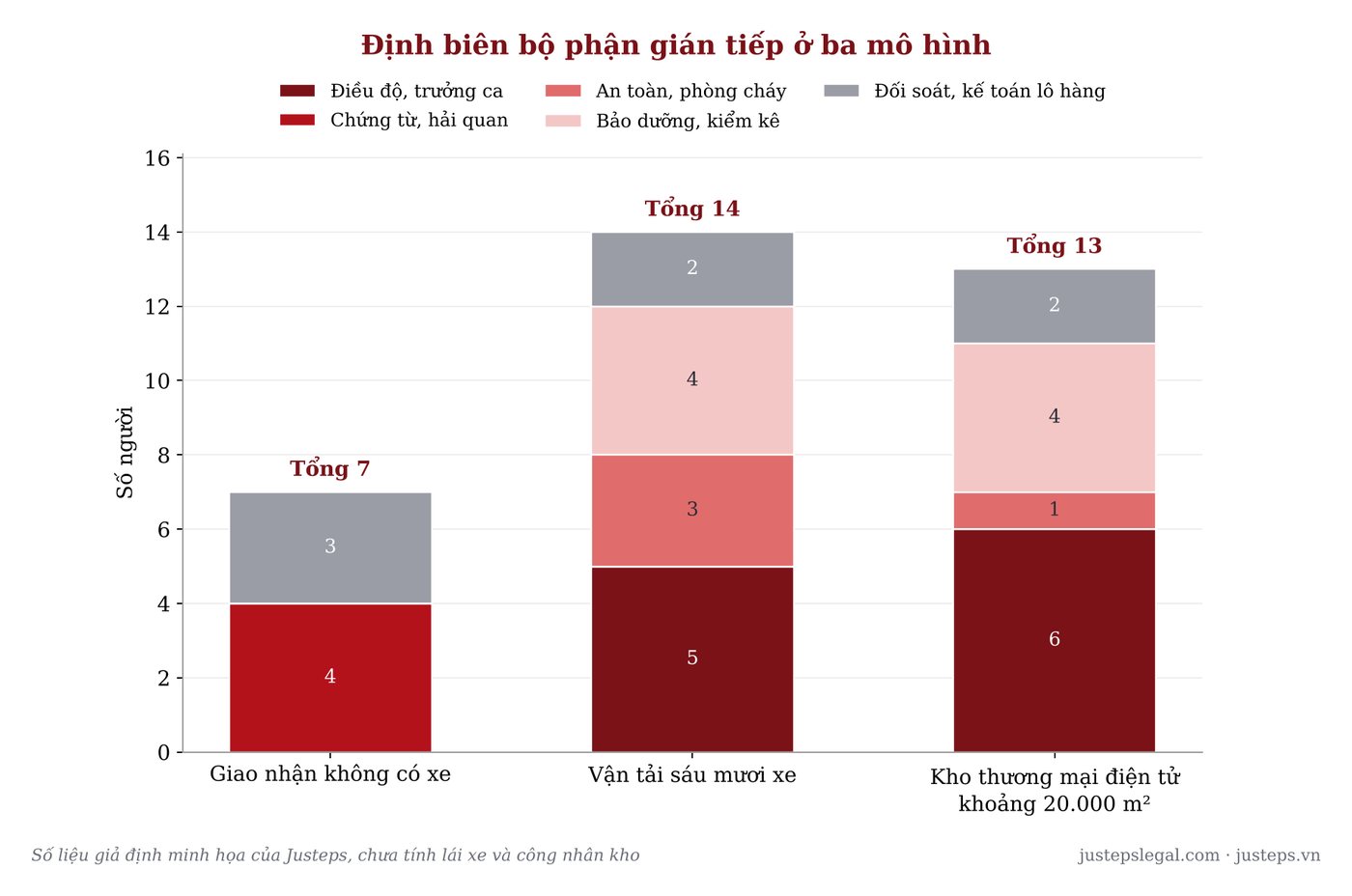
Example indirect headcount in three logistics business models
In the example, a forwarder without vehicles needs 7 indirect staff, comprising 4 documentation and customs staff and 3 reconciliation and shipment accounting staff. A business with sixty vehicles needs 14, of whom 5 are dispatchers, 3 handle safety and tracking, 4 handle maintenance and 2 handle reconciliation. An e-commerce warehouse of about 20,000 m² needs 13, comprising 6 shift leaders, 4 stocktakers, 2 staff reconciling cash on delivery and 1 dedicated fire officer. Direct labour headcount, trip-based pay and shift arrangements are dealt with under the labour, wages and social insurance service for logistics, warehousing and freight transport businesses.
Implementation process, deliverables and fees
An organisational design project for a small or medium-sized logistics business usually takes about eight weeks. Justeps works at head office and at least one warehouse or truck yard, observing a receiving shift and a dispatch session so as to see the actual work rather than relying on the chart hanging on the wall.
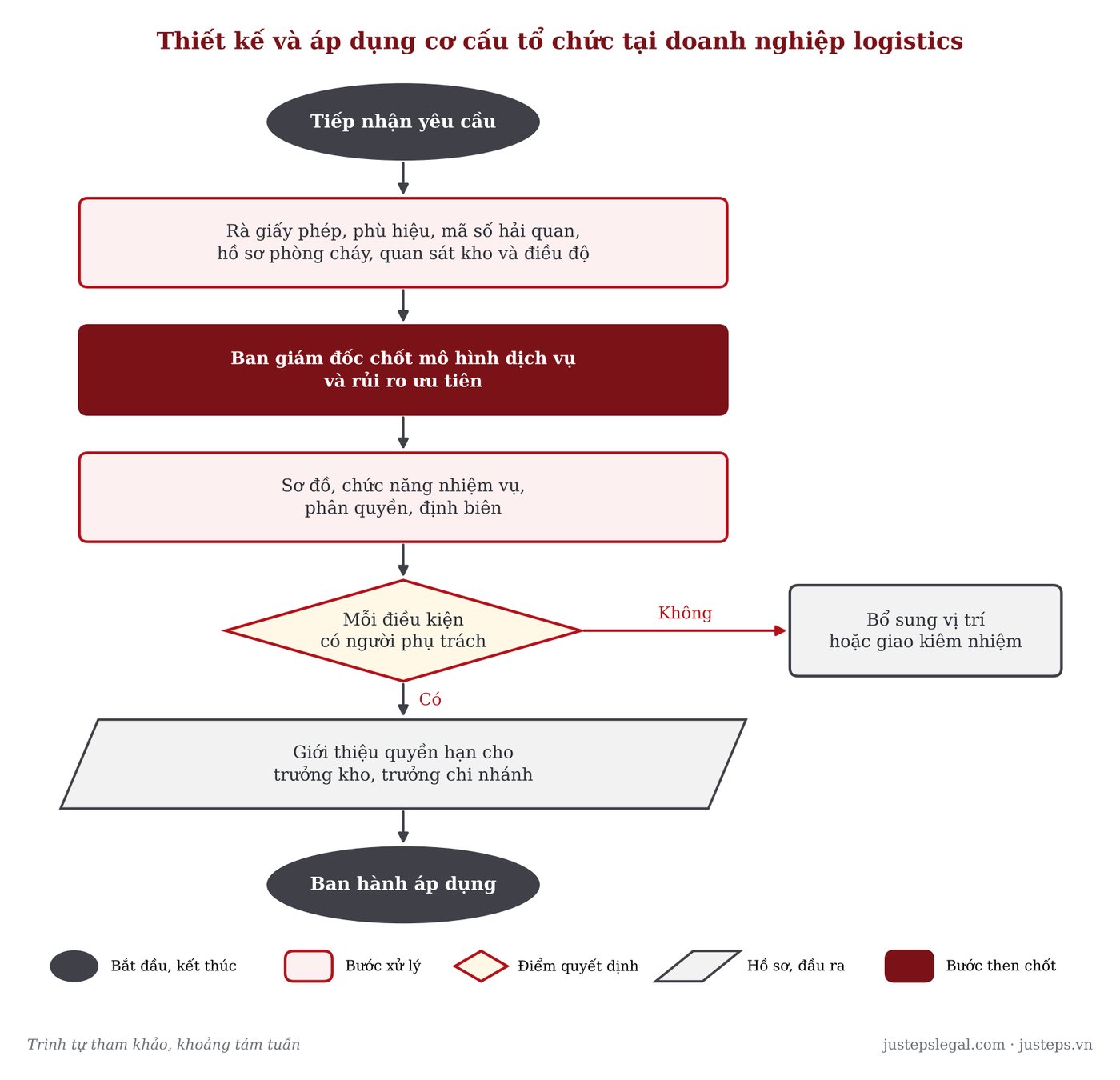
Sequence for designing and applying the organisational structure in a logistics and warehousing business
In the first two weeks Justeps reviews the transport business licence, badges, the list of customs agent staff and the warehouse fire records, and interviews dispatch, warehouse heads, documentation and receivables staff. In the third week the management board settles the service model and priority risks, after which Justeps drafts the chart, functions and duties, authority matrix and headcount table. If any business condition still lacks a responsible person, Justeps adds a position or assigns it concurrently, and then briefs warehouse heads and branch heads on their new authority in the final week. The deliverables comprise the following documents:
- An assessment of people and organisational readiness for each condition relating to road transport, customs agency, warehousing and fire prevention.
- The organisational chart of the whole business and standard charts for a warehouse and for a branch at a port or border gate.
- Rules on the functions and duties of each department, warehouse and branch.
- An authority matrix on stopping vehicles, accepting goods, digitally signing declarations and agreeing compensation.
- Draft decisions appointing the transport operations manager and the fire officer and authorising digital signatures.
- An indirect headcount table for each stage of fleet growth or warehouse expansion.
Justeps quotes a fixed project fee in writing after the initial meeting. The fee depends on the number of service lines, the number of warehouses and branches to be surveyed, fleet size, the need for bilingual documents for a foreign parent group, and whether the business also needs job descriptions for key positions. Job descriptions for warehouse heads, dispatchers, safety officers and documentation staff can be prepared through the organisational structure, functions and job description service.
How Justeps can help
In addition to organisational structure design, logistics, warehousing and freight transport businesses can combine the following Justeps services:
- Internal procedures and regulations for logistics, warehousing and freight transport businesses. Justeps writes the handover, dispatch, customs declaration and loss handling procedures for each newly designed position.
- Labour, wages and social insurance services for logistics, warehousing and freight transport businesses. Justeps turns the headcount table into contracts, trip-based pay, shift arrangements and insurance records for drivers and warehouse workers.
- Financial regulations and delegation of authority. Justeps sets spending, contract signing and compensation limits for each management level.
- Opening branches, representative offices and business locations. Justeps registers satellite warehouses and port or border-gate offices in the chosen legal form.
- Organisational structure, functions and job descriptions. Justeps prepares job descriptions for dispatchers, warehouse heads, safety officers and documentation staff.
Frequently asked questions
Must a transport business set up a road safety department?
The law requires a person directly managing transport operations and the monitoring and handling of tracking data[3], while the name of the unit is for the business to decide. What matters is that someone is assigned in writing and has the power to stop an unsafe trip.
Which functions does a forwarder without trucks need?
The core functions are documentation, customs declaration, sales and reconciliation of collections and disbursements. Because transport and warehousing are outsourced, the business also needs a role to assess, contract and supervise subcontractors.
Can the warehouse head also be responsible for fire prevention?
A small warehouse may assign this concurrently if there is an assignment decision and the person is trained. A large warehouse, one storing flammable goods or one working several shifts should have a dedicated officer and an on-site firefighting team on each shift[6].
Where should customs agent staff sit?
Usually in the documentation and forwarding division, but the declaration reviewer and the holder of the digital signature should be different from the preparer. The business also needs to track how many staff still hold a valid code[5].
Who should have authority to agree compensation with customers?
This authority should be divided by amount, with larger amounts escalated, especially where insurance or subcontractor recovery may be affected. Sales staff should not be allowed to promise compensation above the limitation of liability on their own[1].
How often should the organisational structure be reviewed?
Once a year and immediately when a new warehouse opens, a service line is added, the fleet grows significantly, an investor joins or transport and fire prevention rules change. These changes usually require reassigning the persons responsible for business conditions.
Related articles
- Internal procedures and regulations for logistics, warehousing and freight transport businesses, from handover to compensation
- Ongoing legal advisory for logistics, warehousing and freight transport businesses on contracts, claims and tax
- Labour, wages and social insurance services for logistics, warehousing and freight transport businesses with drivers and warehouse workers
- Warehousing and logistics service contracts, liability for goods and how to organise warehouse operations
Notes
[1] The Commercial Law and the documents amending and supplementing it, and Government Decree No. 163/2017/ND-CP dated 30 December 2017 on logistics services.
[2] The Law on Roads No. 35/2024/QH15.
[3] Government Decree No. 158/2024/ND-CP dated 18 December 2024 on road transport activities, as amended and supplemented by Decree No. 218/2026/ND-CP dated 19 June 2026, effective from 10 August 2026.
[4] Article 64 of the Law on Road Traffic Order and Safety No. 36/2024/QH15, as amended and supplemented by Law No. 118/2025/QH15, effective from 1 July 2026.
[5] The Law on Customs No. 54/2014/QH13 and the documents amending, supplementing and guiding it.
[6] The Law on Fire Prevention, Fire Fighting, Rescue and Salvage and the documents amending and supplementing it, and Government Decree No. 105/2025/ND-CP detailing this Law.
[7] The Law on Personal Data Protection No. 91/2025/QH15, effective from 1 January 2026.
[8] The Law on Enterprises No. 59/2020/QH14 dated 17 June 2020, as amended and supplemented by Law No. 76/2025/QH15.
[9] Article 44 of the Law on Enterprises No. 59/2020/QH14 dated 17 June 2020, as amended and supplemented by Law No. 76/2025/QH15.
[10] Government Decree No. 168/2025/ND-CP dated 30 June 2025 on enterprise registration, as amended and supplemented by Decree No. 296/2026/ND-CP dated 23 July 2026.
[11] The Law on Investment No. 143/2025/QH15, effective from 1 March 2026.
This article is for reference and reflects the regulations in force at the time of publication. Please consult Justeps for advice tailored to your company’s records and situation.
For further information, please contact:
📩 Email: info@justeps.vn
🌐 Website: https://justepslegal.com · https://justeps.vn
🌐 Page: Justeps
☎️ Hotline (Zalo): 096 172 2607
📍 Thanh Xuan Office: 12th Floor, Licogi 13 Tower, 164 Khuat Duy Tien Street, Thanh Xuan Ward, Hanoi, Vietnam
📍 Ha Dong Office: LK06B, No.10, Dong Dua Area, Ha Dong Ward, Hanoi, Vietnam
📍 Ho Chi Minh City Branch: 528 Le Van Sy, Ho Chi Minh City, Vietnam
📍 Hai Phong Office: Truong Thinh Village, Ha Dong Commune, Hai Phong, Vietnam
📍 Quang Ninh Office: Van Don Special Zone, Quang Ninh Province, Vietnam





