
Key takeaways
- A logistics business stands between several liability regimes, such as the Commercial Law towards shippers[1] and the Maritime Code towards shipping lines[2], so it may have to pay a customer more than it can recover from the actual carrier.
- Agreeing to compensation above the limitation of liability to keep a customer is a commercial decision that should be weighed beforehand, because the difference usually cannot be recovered from subcontractors or insurers.
- Retaining a customer’s goods to recover freight is safe only when the conditions and procedure of the Commercial Law are met[1], otherwise the business may face a counterclaim for damages.
- An accident caused by a driver on duty usually results in liability for the business itself[6], so it needs an advisory contact able to respond even outside office hours.
Logistics operations are measured in hours rather than weeks. A consignment held at port because of a document mismatch, a customer reporting wet cargo and demanding compensation for the whole lot, or a truck written up for overloading all need an answer before container storage charges rise or the claim deadline passes. Looking for an adviser for each matter is usually too slow, and a newcomer has to spend time learning the business’s standard contracts, partners and way of operating.
This page introduces Justeps’ ongoing legal advisory service for freight forwarding, warehousing and freight transport businesses, under which Justeps acts as the contact point for legal questions arising in operations on a monthly, quarterly or annual basis. It focuses on the matters logistics businesses ask about most and on how Justeps organises support when something is urgent. The handover, dispatch and loss handling procedures used every day are built separately under the internal procedures and regulations service for logistics, warehousing and freight transport businesses.
What logistics businesses typically ask during the year
From the advisory engagements it has carried out, Justeps sees the requests of logistics businesses concentrated in six groups, with contracts and cargo claims always making up the largest share. The chart below illustrates the breakdown of requests over one year for a freight forwarder with its own fleet and one warehouse.
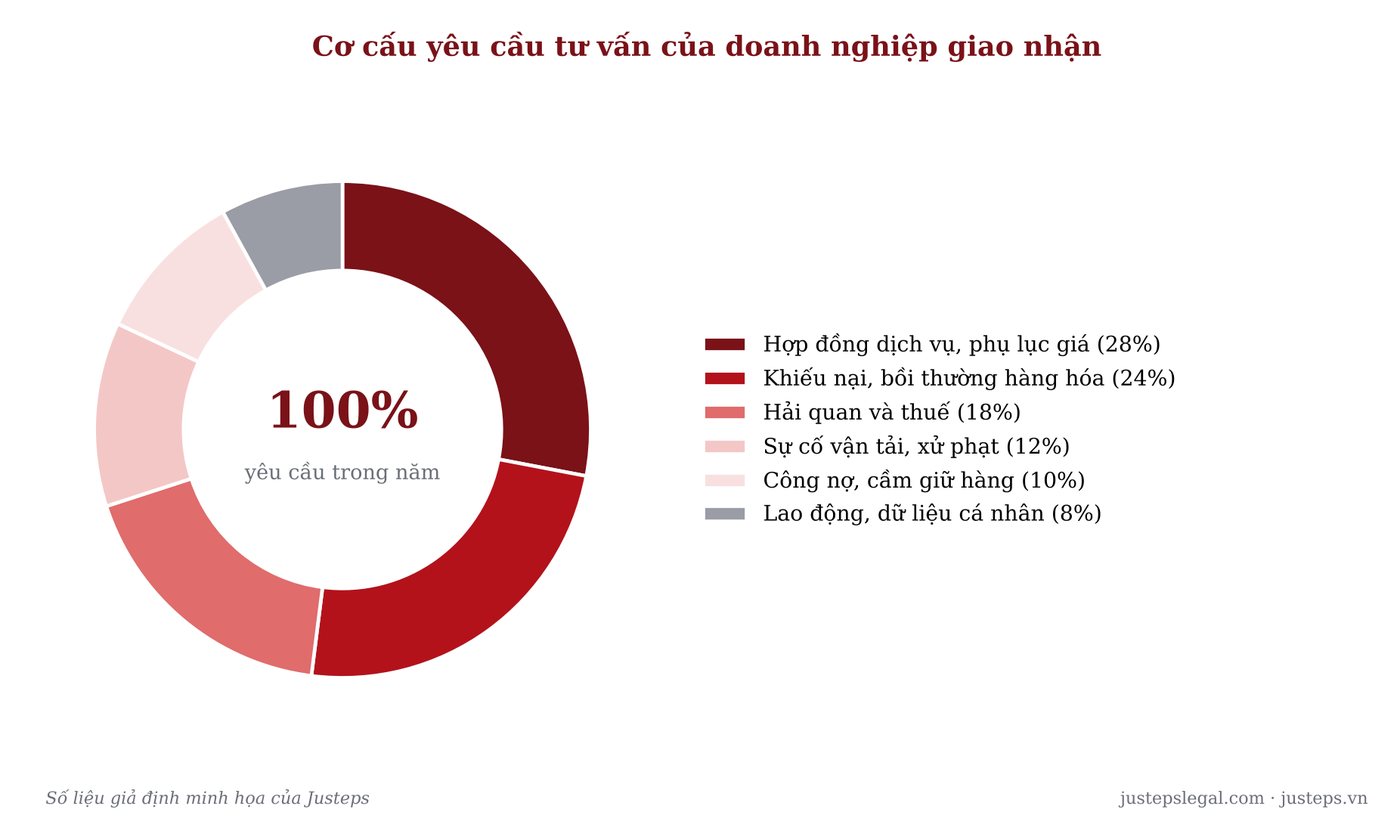
Example breakdown of advisory requests over one year for a freight forwarder with its own fleet and one warehouse
In the example, service contracts and rate addenda account for 28% of requests, cargo claims and compensation for 24%, and customs and tax for 18%. Transport incidents and administrative penalties account for 12%, debt recovery and retention of goods for 10%, and labour and personal data for 8%. The breakdown varies by model, for example a business without trucks will have a higher share of customs and tax, so Justeps adjusts the expected hours of the package to each year’s business plan.
Service contracts, standard trading conditions and limitation of liability
The Commercial Law allows logistics service providers to be exempted from liability in the cases provided by law and to limit their liability as prescribed by the Government, unless otherwise agreed or where the provider is at fault as provided by law[1]. This limit only has effect if it is clearly stated in the contract or in standard trading conditions accepted by the customer, so many businesses lose this advantage simply by relying on a quotation sent by email instead of a contract. Justeps reviews the standard contracts, standard trading conditions, rate addenda and the way customers confirm acceptance of these documents.
During the year the business continually signs new rate addenda, accepts shipping line bills of lading with unfavourable terms or agrees to change the port at the customer’s request. Each small decision may lead to obligations beyond the business’s ability to pay, so Justeps reviews these documents quickly within the committed time. High-value contracts, long-term warehouse leases or agency agreements with foreign networks can be reviewed in depth through the commercial contract drafting and review service.
Paying the customer and recovering from the carrier
A consignment exported by sea may be subject to three liability regimes at once, namely the Commercial Law between the logistics business and the shipper[1], the Maritime Code between the business and the shipping line[2], and civil aviation law if one leg is carried by air. The limitation amounts, loss notice periods and limitation periods for bringing claims differ under each regime, so the business may have paid the customer under one regime but be able to recover from the shipping line only under another, or the time to recover may have expired. For each claim Justeps prepares a comparison of the time limits on both sides so that no right of recourse is lost.
The mistake Justeps sees most often is a business agreeing to pay above the limitation to keep a large customer, only to discover that the difference cannot be recovered from subcontractors or insurers. On receiving a claim, Justeps examines the handover documents, identifies the stage at which the loss occurred, assesses the grounds for exemption or limitation of liability, and drafts the reply to the customer and the loss notice to the next party liable. How much to pay remains the business’s commercial decision, but it is made knowing which part can be recovered.
Retention of goods and recovery of unpaid freight
Customers paying freight and disbursements late is common, particularly among small shippers. The Commercial Law allows a logistics provider to retain a certain quantity of goods and to dispose of them when the conditions are met, but notice must be given and the procedure followed[1]. Retaining goods improperly, retaining more than corresponds to the debt or selling goods before the conditions are met may expose the business to a counterclaim for damages.
Justeps assesses each case before the business decides to retain goods, drafts the retention notice, demand letter and debt reconciliation record, and advises on negotiating a repayment schedule. When the business decides to sue or go to arbitration, Justeps prepares the evidence file, debt calculation and case summary for the business to proceed itself or to hand over to a practitioner of its choice, as Justeps is a consulting firm and does not conduct litigation.
Customs, tax and invoices
Businesses acting as customs agents often need advice on commodity classification, customs value, origin, procedures with bonded warehouses and how to provide explanations when a post-clearance audit decision is issued[3]. An explanation file prepared early and completely often determines the outcome, so Justeps reads all the documents of the consignment before proposing an approach and drafting documents for dealings with the customs authority.
On tax, common questions include the value added tax rate for international transport services and services linked to international transport[4], how to issue invoices for collections, disbursements and customer deposits[5], and the obligation to withhold foreign contractor tax when paying fees to overseas agents. Overlooking foreign contractor tax on overseas agents is a common error that can lead to reassessment over several years with late payment interest. When the business is subject to a tax inspection or audit, preparation of the file and explanations can be handled through the tax inspection and complaint support service.
Accidents, penalties and urgent matters outside office hours
A road accident caused by a driver performing assigned work usually results in liability of the business to the injured party, and the owner of a motor vehicle is also liable as the owner of a source of extreme danger[6]. The business may require the employee at fault to reimburse it as prescribed, but this must go through the procedure of labour law. There are also cases of trucks written up for overloading, surprise fire inspections at warehouses and leaks of consignee data[7].
Each type of risk needs a different kind of preparation depending on how often it occurs and how much damage it causes. The assessment below is a typical risk map Justeps prepares for transport and warehousing businesses in the first month of an advisory engagement.
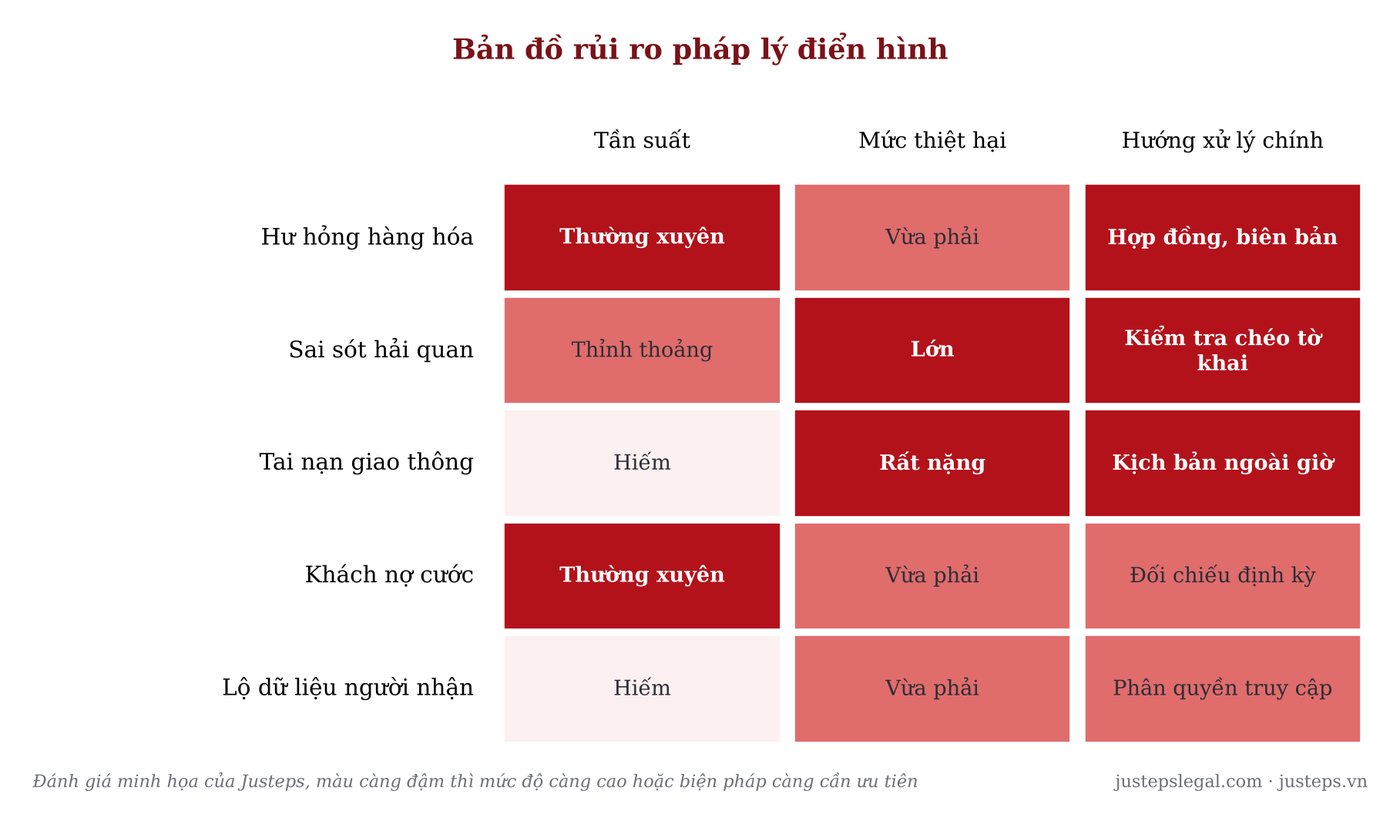
Example map of common legal risks for transport and warehousing businesses
In the example, cargo damage occurs frequently but each incident causes moderate loss, so the main response is tight contracts and handover records. Customs errors occur less often but may cause large losses, so declarations need cross-checking before transmission. Road accidents are rare but have the most serious consequences, so the business needs a ready response plan and Justeps’ out-of-hours contact number, while receivables and data leaks are controlled through periodic reconciliation and access rights.
Working method, deliverables and fees
In the first month Justeps works with the management board, the head of sales, the head of forwarding and the accountant to agree on contact persons, communication channels and the urgency level of each type of request, and reviews licences, standard contracts, standard trading conditions and outstanding disputes and receivables. From the second month, every request follows a single sequence as shown in the flowchart below.
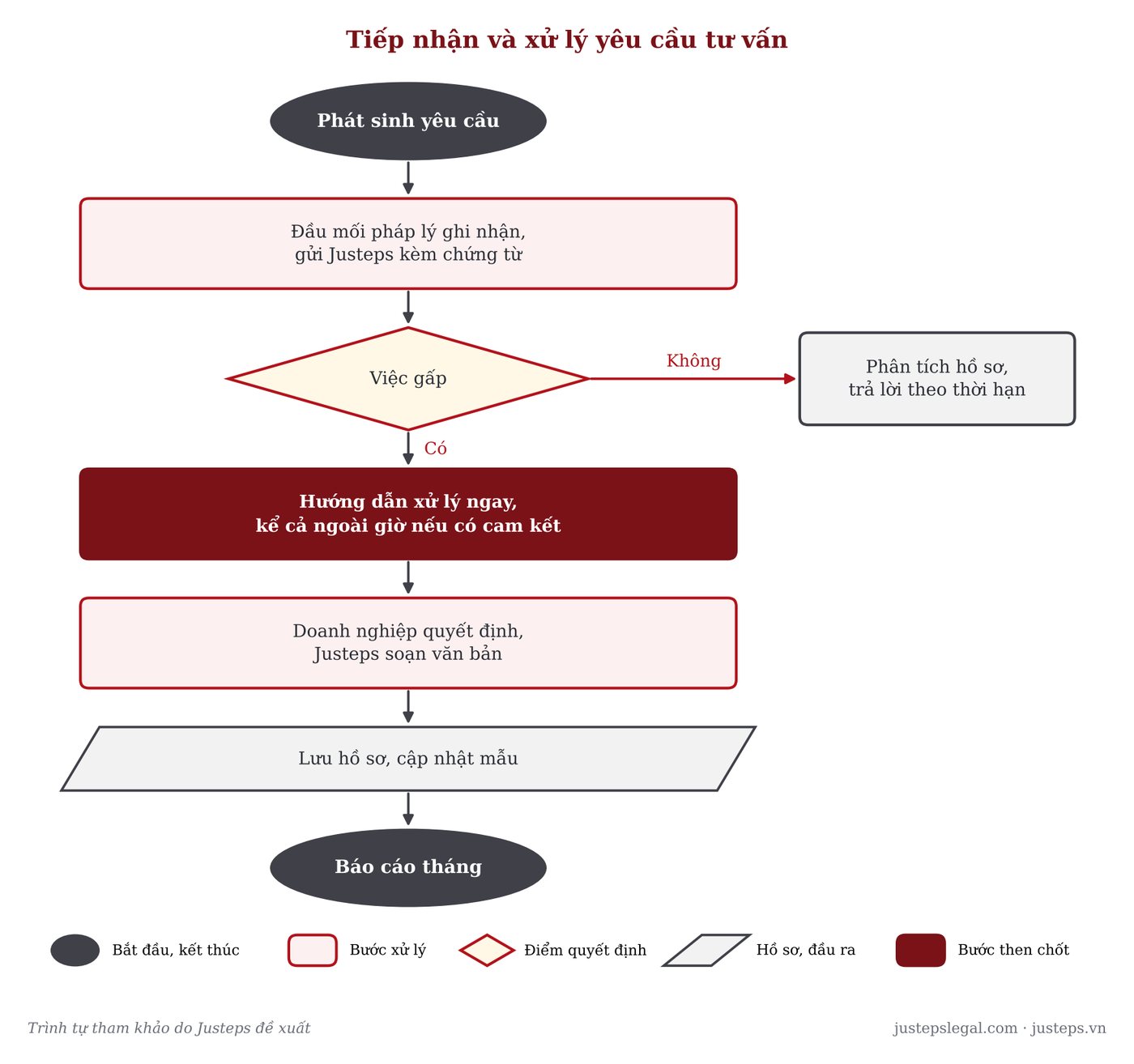
Sequence for receiving and handling requests under the ongoing legal advisory package for logistics businesses
Simple questions are answered in writing the same day. Matters requiring documents, such as cargo claims or customs problems, are analysed on the actual documents before options are proposed, the business decides and Justeps drafts documents or meets counterparties and administrative authorities together with the business within the scope of the package. Urgent matters such as accidents, detained goods or warehouse inspections are handled immediately, including outside office hours if the package includes this commitment. The business receives the following documents:
- An initial legal review report on licences, standard contracts, disputes and outstanding receivables.
- Advice and drafted documents for each request, kept as precedents for similar matters.
- A monthly report to the management board on open risks and work done.
- Standard contracts, standard trading conditions and claim reply letters updated when a type of dispute recurs.
- An annual summary of changes in transport, customs, tax and labour law, with an impact assessment.
Justeps quotes the fee monthly or annually in writing after the initial review, depending on the expected advisory hours, the number of service lines, bilingual needs, the out-of-hours support commitment and the number of in-person meetings. Small forwarders may choose an hourly basis, while businesses with large fleets or several warehouses usually need a package with a committed response time. In-depth matters on drivers’ employment contracts, trip-based pay and insurance are handled under the labour, wages and social insurance service for logistics, warehousing and freight transport businesses.
How Justeps can help
In addition to ongoing legal advisory, logistics, warehousing and freight transport businesses can combine the following Justeps services:
- Internal procedures and regulations for logistics, warehousing and freight transport businesses. Justeps writes handover and loss handling procedures so that every claim has complete documents from the start.
- Organisational structure design for logistics, warehousing and freight transport businesses. Justeps defines who may agree compensation, digitally sign declarations and stop a trip.
- Commercial contract drafting and review. Justeps reviews warehouse leases, foreign agency agreements and framework contracts with major customers in depth.
- Tax inspection and complaint support. Justeps prepares explanation files on collections, disbursements and foreign contractor tax when the business is inspected or audited.
Frequently asked questions
How does an ongoing advisory package differ from engaging an adviser case by case?
An ongoing adviser already knows the business’s standard contracts, partners and operations, so responses are faster and more consistent. Costs are budgeted in advance, and prevention such as revising standard contracts happens continuously.
How does Justeps help when goods are detained by customs or a post-clearance audit decision is issued?
Justeps analyses the consignment file, advises on the approach to explanations, drafts documents and can work with the customs authority together with the business within the scope of the package[3]. A file prepared early often determines the outcome.
Can a logistics business limit its liability for compensation?
Yes, under the Commercial Law and the Government’s regulations on logistics services, except in the cases provided by law[1]. The limit must be clearly stated in the contract or in standard trading conditions accepted by the customer.
May goods be retained when a customer owes freight?
The Commercial Law allows retention of a certain quantity of goods when the conditions are met, together with a duty to give notice and a procedure for disposal[1]. The business should seek advice before retaining goods to avoid a counterclaim for damages.
How far does Justeps support a dispute that has to go to court or arbitration?
Justeps is a consulting firm and does not conduct litigation. Justeps assesses the case, reviews evidence, drafts documents, advises on negotiation and mediation and prepares the file for the business to proceed itself or to hand over to a practitioner of its choice.
What is the minimum term of the package?
Justeps recommends at least six months to complete the initial review and revise standard contracts. Many logistics businesses sign annually to match the contract cycle of their major customers.
Related articles
- Organisational structure design for logistics, warehousing and freight transport businesses by service chain and handover point
- Internal procedures and regulations for logistics, warehousing and freight transport businesses, from handover to compensation
- Labour, wages and social insurance services for logistics, warehousing and freight transport businesses with drivers and warehouse workers
- Warehousing and logistics service contracts, liability for goods and how to organise warehouse operations
Notes
[1] The Commercial Law and the documents amending and supplementing it, and Government Decree No. 163/2017/ND-CP dated 30 December 2017 on logistics services.
[2] The Maritime Code of Vietnam No. 95/2015/QH13 and the documents amending and supplementing it.
[3] The Law on Customs No. 54/2014/QH13 and the documents amending, supplementing and guiding it.
[4] The Law on Value Added Tax No. 48/2024/QH15 and the documents amending and supplementing it, and Government Decree No. 181/2025/ND-CP dated 1 July 2025 detailing this Law.
[5] Government Decree No. 254/2026/ND-CP dated 30 June 2026 on electronic invoices and electronic documents.
[6] Articles 597 and 601 of the Civil Code No. 91/2015/QH13 dated 24 November 2015.
[7] The Law on Personal Data Protection No. 91/2025/QH15, effective from 1 January 2026.
This article is for reference and reflects the regulations in force at the time of publication. Please consult Justeps for advice tailored to your company’s records and situation.
For further information, please contact:
📩 Email: info@justeps.vn
🌐 Website: https://justepslegal.com · https://justeps.vn
🌐 Page: Justeps
☎️ Hotline (Zalo): 096 172 2607
📍 Thanh Xuan Office: 12th Floor, Licogi 13 Tower, 164 Khuat Duy Tien Street, Thanh Xuan Ward, Hanoi, Vietnam
📍 Ha Dong Office: LK06B, No.10, Dong Dua Area, Ha Dong Ward, Hanoi, Vietnam
📍 Ho Chi Minh City Branch: 528 Le Van Sy, Ho Chi Minh City, Vietnam
📍 Hai Phong Office: Truong Thinh Village, Ha Dong Commune, Hai Phong, Vietnam
📍 Quang Ninh Office: Van Don Special Zone, Quang Ninh Province, Vietnam





