
Key takeaways
- The premises lease is an outlet’s largest financial commitment, so it should be reviewed before a deposit is paid[1], particularly the clauses on fit-out costs, early termination rights and whether the lessor has the right to lease.
- Trade marks are protected on a first-to-file basis[3], so a chain should file its application before opening its first outlet and certainly before franchising.
- Standard contracts of food delivery apps and large suppliers are usually pre-drafted, but the business still needs to know which clauses are unfavourable, the commission rate and how refunds and negative reviews are handled in order to decide whether to sign.
- A single ongoing advisory point of contact allows same-day responses when an inspection team arrives or a food safety complaint is made, instead of looking for help after the minutes have been signed or a reply has been posted.
An F&B outlet exists within many legal relationships at once, including the lease with the landlord, contracts with the fit-out contractor, ingredient suppliers, food delivery apps and the bank collecting card and QR code payments, together with documents on food safety, fire prevention and signage. A chain of ten outlets may have hundreds of documents in force, each with its own deadlines and obligations. Most chain owners have no in-house legal department, so legal questions are usually resolved through managers’ experience or only asked once something has already happened.
This page introduces Justeps’ ongoing legal advisory service for restaurants, cafés and F&B chains, under which Justeps acts as the point of contact for all legal questions arising in operations on a monthly, quarterly or annual basis. It focuses on the matters F&B chains ask about most and how Justeps organises its support. The set of day-to-day operating procedures at outlets is built separately under the internal procedures and regulations service for restaurant, café and F&B chain businesses.
What an F&B chain typically needs to ask during the year
From the advisory packages it has delivered, Justeps finds that the requests of F&B chains fall into six groups. The chart below illustrates the breakdown of requests over one year for an expanding chain of about eight outlets.
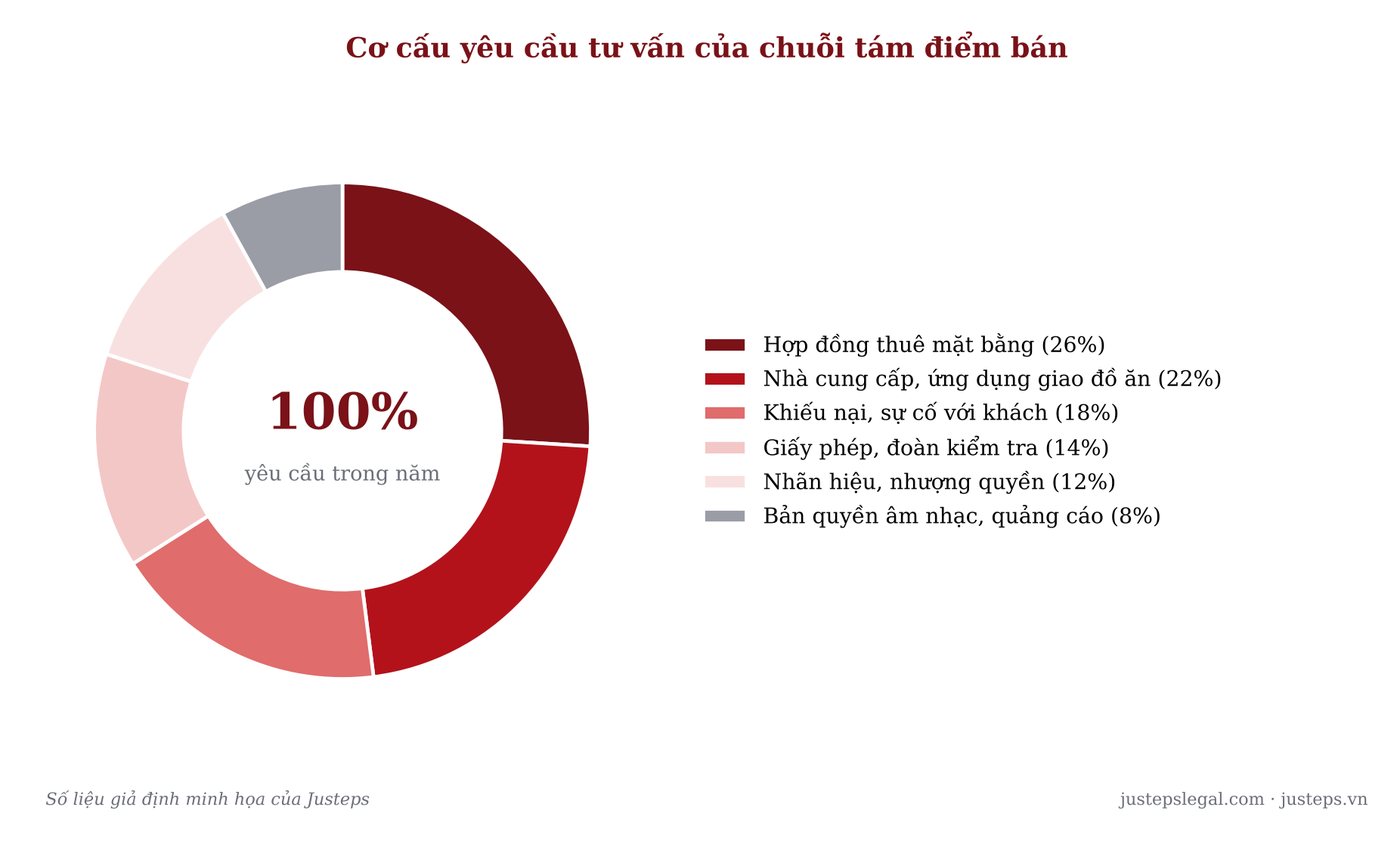
Example breakdown of advisory requests over one year for an eight-outlet chain
In the example, premises leases account for 26% of requests because the chain is opening new outlets and renewing existing ones. Contracts with suppliers and food delivery apps account for 22%, customer complaints and incidents for 18%, and licences and inspection teams for 14%. Trade marks and franchising account for 12%, and music copyright and advertising for 8%. This breakdown changes with the stage of development, for example a chain preparing to franchise will have a much higher share of trade mark and franchise contract work, so Justeps adjusts the expected hours of the package to each year’s business plan.
Premises leases and fit-out costs
Restaurants usually invest heavily in fitting out the premises, the kitchen system, extraction and fire prevention before opening, while the lease is drafted by the landlord and mainly protects the landlord. Before a deposit is paid, Justeps checks whether the signatory has the right to lease, whether the permitted use of the premises is suitable for food and beverage business and meets fire prevention requirements, and the conditions under which the deposit is forfeited or returned[1]. The clauses to negotiate include a rent-free period during fit-out, rent increases on renewal, the right to sublet or assign the lease when selling the outlet to a franchisee, and the treatment of the tenant’s investment if the landlord terminates the lease early[2].
Throughout the lease term, Justeps monitors renewal deadlines, deadlines for notice of non-renewal and correspondence with the landlord. When the landlord demands a sudden rent increase or gives notice to repossess the premises, the business receives an assessment of its rights under the lease and a draft reply within a short time.
Trade marks, recipes and franchise agreements
The outlet name and logo are the most valuable assets of a successful F&B chain, yet many chains have only registered their enterprise name without filing a trade mark application. Intellectual property law protects trade marks on a first-to-file basis, so another party filing first can obstruct expansion and even force the chain to change its name[3]. Justeps assesses registrability, recommends the classes of goods and services to file in and tracks the application through the intellectual property and trade mark protection service.
Recipes and drink preparation methods usually cannot be registered like trade marks, so they are protected through confidentiality agreements with employees, suppliers and franchisees. When the chain franchises, the franchise agreement must clearly define the right to use the trade mark, operating standards, fees, exclusive territory, the franchisor’s inspection rights and the consequences of termination[4]. If a foreign franchisor franchises into Vietnam, the business must also check the procedure for registering the franchising activity with the commerce authority before proceeding.
Food delivery apps, suppliers and online sales
Food delivery apps bring in a growing share of revenue, but their contracts are almost non-negotiable. The advice therefore focuses on helping the business understand the commission rate, the cost of promotional programmes run by the app, the app’s rights when customers complain or are refunded, how customer data is handled and liability when food is spoiled during delivery. Sales through online platforms are also governed by the Law on E-commerce[5], so the chain’s sales page needs information on the business, prices, return policy and complaint handling as required.
For ingredient suppliers, Justeps drafts framework contracts covering quality standards, documents of origin, conditions for rejecting deliveries, liability when ingredients cause a food safety incident and a price adjustment mechanism. High-value commercial contracts or those with complex clauses can be reviewed in depth through the commercial contract drafting and review service.
Background music, advertising and online reviews
A café playing background music, a restaurant with live music or one showing football matches are all forms of use of works, sound recordings or broadcasts for which intellectual property law may require royalties to be paid[3]. Justeps determines which cases require payment, to which organisation, and whether to sign an annual agreement or one per event. Advertising content about the benefits of drinks or food supplements, or comparisons with competitors, also needs to be reviewed before publication under advertising law[6].
Negative reviews on online maps or social media are something every chain encounters. Justeps helps the business distinguish consumer feedback that it must receive and resolve under consumer protection law[7] from false content that it can ask to be removed, and drafts public replies that do not spread the matter further.
Receiving requests and responding to urgent matters
The value of an ongoing advisory package lies in speed, especially when a food safety or fire prevention inspection team arrives at peak time or a customer reports food poisoning. Justeps organises the intake through a single point of contact at the business, to avoid each outlet asking in a different way, following the sequence below.
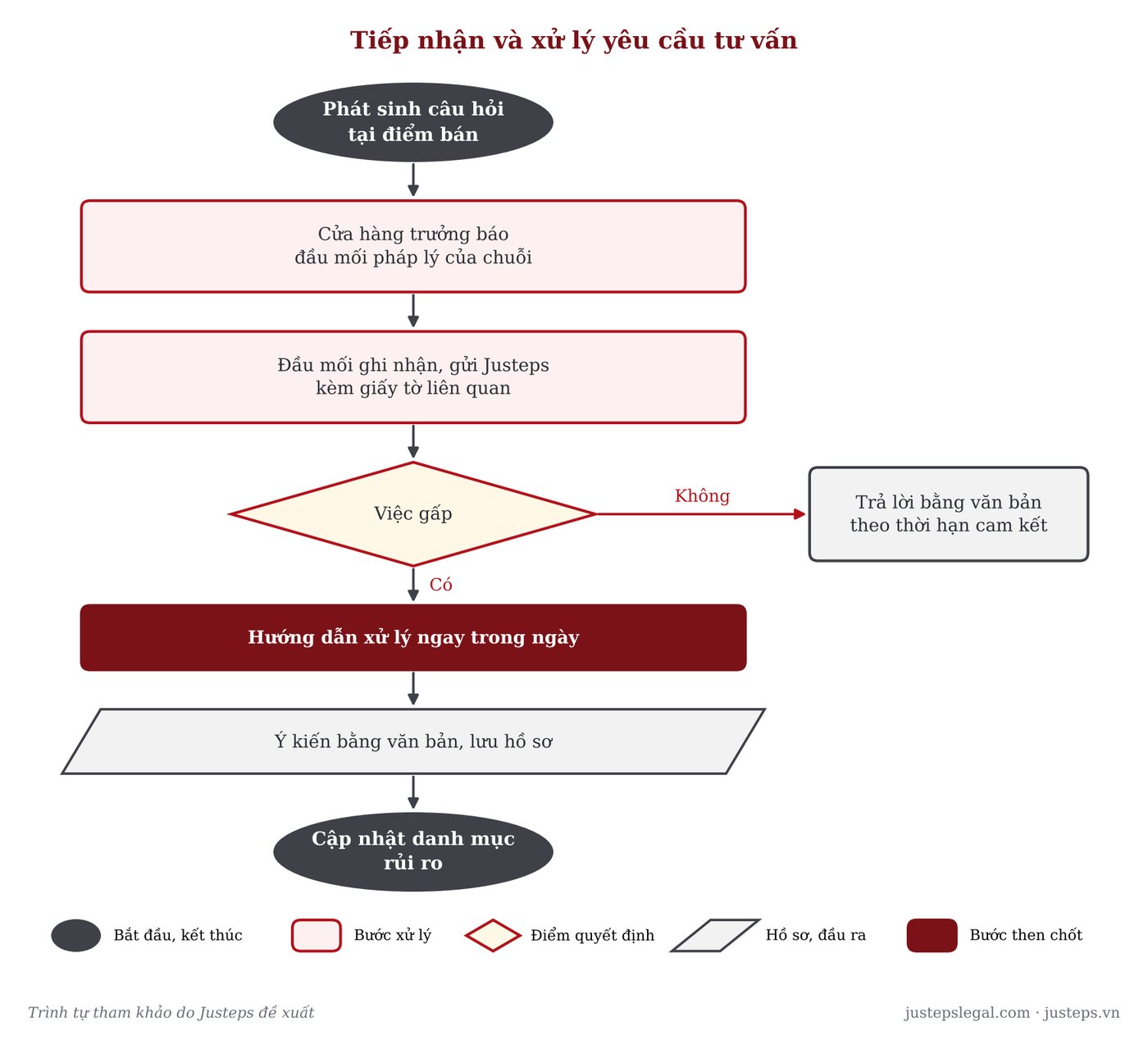
Sequence for receiving and handling requests under the ongoing legal advisory package
Under this sequence, the outlet manager reports to the chain’s legal point of contact, who logs the request and passes it to Justeps with the relevant documents. Urgent matters such as an inspection team, a customer suspected of food poisoning or a landlord locking the premises receive a same-day response with specific guidance, while ordinary matters are answered in writing within the time committed in the service contract. Work outside the scope of the package is quoted separately before it is carried out. For disputes, Justeps assesses the case, reviews the evidence, drafts documents and supports negotiation and mediation, and when the business decides to bring proceedings, the file is prepared for the business to proceed itself or to hand over to a practitioner of the business’s own choosing.
Way of working, records received and fees
In the first month, Justeps reviews all the legal documents of each outlet, including food safety certificates, fire prevention records, leases, trade mark applications and contracts with food delivery apps and main suppliers, and then draws up a list of matters to be remedied in order of priority. From the second month, requests are handled on an ongoing basis, and at the end of each period the business receives a report on the work done together with an updated risk register. The business receives the following records:
- An initial legal review report for each outlet, with remedial priorities.
- A tracker of expiry dates for certificates, leases, trade mark applications and periodic obligations.
- A set of standardised template contracts for premises leases, suppliers, fit-out contractors and confidentiality agreements.
- Written advice on each specific matter.
- Periodic reports on the work done and the overall legal position of the chain.
Packages may be charged monthly, quarterly or annually, a single-outlet café may choose an hourly arrangement, while multi-outlet chains usually need a package with committed response times. Justeps quotes the fee in writing after the initial meeting, depending on the number of outlets and legal entities, the expected hours, the response commitment, the need for on-site work, whether there is franchising or a foreign investor and the volume of contract drafting. Questions on employment contracts, wages and insurance can be included in the package or handled in depth under the labour, wages and social insurance service for restaurant, café and F&B chain businesses.
How Justeps can help
In addition to ongoing legal advisory, restaurant, café and F&B chain businesses can combine the following Justeps services:
- Internal procedures and regulations for restaurant, café and F&B chain businesses. Justeps writes procedures for receiving goods, food checks, shift close and incident handling to reduce the number of situations that need to be asked about again.
- Organisational structure design for restaurant, café and F&B chain businesses. Justeps chooses the legal form of each outlet and assigns a person at the chain office to monitor documents.
- Intellectual property and trade mark protection. Justeps searches, files and tracks trade mark applications for the chain’s outlet name and logo.
- Commercial contract drafting and review. Justeps drafts and reviews high-value or complex lease, supply and franchise contracts.
Frequently asked questions
Does a single-outlet café need an ongoing advisory package?
Not necessarily. A single-outlet café can use an hourly arrangement for matters such as reviewing a lease or responding to an inspection team. When the chain has three or more outlets or is preparing to franchise, an ongoing package is usually more economical.
When should a trade mark be registered?
The application should be filed before the first outlet opens or as soon as the outlet name is settled, because trade marks are protected on a first-to-file basis[3]. This is all the more necessary before signing a franchise agreement.
What should be done when the landlord wants the premises back before the end of the term?
First reread the termination and compensation clauses of the lease, then assess the fit-out investment and the deposit[2]. Justeps drafts the reply and supports negotiation, and if proceedings become necessary the file is prepared for handover to a practitioner of the business’s own choosing.
Must a café playing background music pay royalties?
Playing music at business premises is usually a use of works and sound recordings for which payment must be made to the right holders under intellectual property law[3]. Justeps determines the specific obligation according to how the café uses music.
Does Justeps act for the business in disputes with customers or landlords?
Justeps is a consulting company and does no litigation. Justeps assesses the case, reviews evidence, drafts documents, advises on negotiation and mediation and prepares the file for the business to proceed itself or to hand over to a practitioner of the business’s own choosing.
Can the advisory package be terminated part-way through?
The termination conditions are set out in the service contract between the business and Justeps. On termination, Justeps hands over the deadline tracker, the files and the advice already provided so that the business can continue to use them.
Related articles
- Organisational structure design for restaurant, café and F&B chain businesses by outlet and central kitchen
- Internal procedures and regulations for restaurant, café and F&B chain businesses, from goods receipt to shift close
- Labour, wages and social insurance services for restaurant, café and F&B chain businesses with part-time workers and split shifts
- Preparing food safety records for a restaurant before opening day
Notes
[1] Article 328 of the Civil Code No. 91/2015/QH13 dated 24 November 2015.
[2] The Civil Code No. 91/2015/QH13 dated 24 November 2015.
[3] The Law on Intellectual Property and the documents amending and supplementing it.
[4] The Commercial Law and the documents amending and supplementing it, and Government Decree No. 35/2006/ND-CP detailing the Commercial Law on franchising activities, together with the documents amending and supplementing it.
[5] The Law on E-commerce No. 122/2025/QH15, effective from 1 July 2026.
[6] The Law on Advertising and the documents amending and supplementing it.
[7] The Law on Protection of Consumers’ Rights and the documents amending and supplementing it.
This article is for reference and reflects the regulations in force at the time of publication. Please consult Justeps for advice tailored to your company’s records and situation.
For further information, please contact:
📩 Email: info@justeps.vn
🌐 Website: https://justepslegal.com · https://justeps.vn
🌐 Page: Justeps
☎️ Hotline (Zalo): 096 172 2607
📍 Thanh Xuan Office: 12th Floor, Licogi 13 Tower, 164 Khuat Duy Tien Street, Thanh Xuan Ward, Hanoi, Vietnam
📍 Ha Dong Office: LK06B, No.10, Dong Dua Area, Ha Dong Ward, Hanoi, Vietnam
📍 Ho Chi Minh City Branch: 528 Le Van Sy, Ho Chi Minh City, Vietnam
📍 Hai Phong Office: Truong Thinh Village, Ha Dong Commune, Hai Phong, Vietnam
📍 Quang Ninh Office: Van Don Special Zone, Quang Ninh Province, Vietnam





