
Key takeaways
- A logistics provider’s right to be exempted from or to limit its liability only works when it can prove the condition of the goods at each handover point[1], so the warehouse receiving record and the delivery record to the consignee are the two documents to standardise first.
- A dispatch order should be issued only after checking the driver’s continuous driving time[4], the condition of the vehicle and the actual weight of the cargo, and not simply because a truck is free.
- Amounts paid on behalf of customers, such as ocean freight, port charges and container storage, need documents in the customer’s name and reconciliation by shipment before the service invoice is issued[9], otherwise they may be treated as the business’s own revenue.
- Deducting the wages of a driver or storekeeper when goods are damaged is lawful only where the internal labour rules provide for it, there is a record establishing fault and the monthly deduction stays within the limit of the Labour Code[11].
Most disputes in logistics businesses do not start with the contract but with a step skipped during the working day. A consignee signs a blank delivery record for the driver to fill in later, a container seal is not photographed when opened, a truck is dispatched when the driver has just driven all night, or a port charge paid for a customer has no document in the customer’s name. When the customer complains or the tax authority inspects, the business no longer has the evidence to prove it acted correctly.
This page introduces Justeps’ service of building a set of internal procedures and regulations for freight forwarding, warehousing and freight transport businesses. The focus is on turning legal requirements on transport, customs, warehousing and tax into specific steps with forms, a person who performs each step and a person who checks it. The positions that carry out the procedures, such as the transport operations manager, warehouse shift leaders and customs agent staff, are defined first under the organisational structure design service for logistics, warehousing and freight transport businesses.
Two handover points decide who is liable
The Commercial Law allows logistics service providers to be exempted from liability in certain cases and to benefit from limitation of liability as prescribed, while setting time limits for customers to complain and to sue[1]. To use these rights, the business must prove what condition the goods were in when received and when delivered, and at which stage the loss occurred. Justeps therefore treats the handover procedure as a tool for the business to protect itself against claims, and designs each step to generate evidence that can be used later.
The first point is when goods are received into the warehouse or loaded onto the truck. The procedure requires recording the number of packages, the condition of the packaging and the seal number, taking photographs from specified angles and noting reservations on the record immediately where packaging is torn, dented or damp. The second point is delivery to the consignee, who must sign on the spot, record the time of receipt and note any irregularity found, and must never sign a blank record or sign in bulk at the end of the day. An electronic delivery record on the driver’s app is valid where the signer and time of signing can be identified, the content has not been altered and it is stored so that it can be retrieved, in accordance with the law on electronic transactions[2].
Dispatch and checks before each trip
Transport businesses must monitor drivers and vehicles through tracking devices and deal with the violations detected[3]. Continuous driving time must not exceed 4 hours, while a driver’s daily and weekly working time is governed by the Labour Code[4]. A driver is absolutely prohibited from driving with alcohol in the blood or breath, and must hold a suitable health certificate[5].
The dispatch procedure Justeps builds places a check before the dispatch order, covering the driver’s driving and rest time on the tracking data, the result of the alcohol test at the start of the shift, the pre-trip vehicle inspection sheet and the actual weight of the cargo compared with the permitted load of the vehicle and of the route[6]. Only when these conditions are met does the software or the dispatcher issue the order. When a condition is not met, the procedure specifies who may decide to change the driver, change the vehicle or split the load, and how the customer is informed of the new delivery time.
Subcontracted trucks must go through the same steps. The subcontractor selection rules require checking the transport business licence, badges and vehicle insurance, signing a contract with clauses on allocation of liability and rights of recourse, and reassessing subcontractors periodically based on the number of incidents.
Dangerous goods, high-value goods and cold chain
Some types of goods need their own procedures because the risk is much higher than for ordinary cargo. Dangerous goods such as chemicals, batteries and gas must be classified, labelled, stored separately, accompanied by transport documents and handled by trained staff under the law on transport of dangerous goods, even if the business accepts such goods only occasionally. A warehouse holding flammable goods must arrange zones, separation distances and a firefighting plan suited to the nature of the goods[7].
High-value goods such as mobile phones and electronic components require an access-controlled area, cameras and counting signed by two persons. Cold-chain goods require temperature records at receipt, loading, in transit and at delivery, with clear rules on who may decide whether to continue delivery or hold the goods when the temperature logger reports an excursion. These rules help the business reasonably refuse consignments that do not meet the conditions from the outset rather than accepting them and bearing the risk.
Customs declaration with a preparer and a reviewer
Errors in the commodity code, customs value or origin on a declaration can lead to tax reassessment, penalties and post-clearance audit, while a customs procedure agent is responsible for the content declared within the scope of its authorisation[8]. The declaration procedure therefore separates three steps, namely receiving and checking the shipper’s document set, preparing the declaration, and having another person check the declaration against the documents before transmitting it with a digital signature. Any unclear point on the commodity code or value is raised with the shipper in writing and kept with the shipment file.
The procedure also governs how customs files are kept for the statutory period, how to respond when the customs authority requires physical inspection of the goods or additional documents, and the duty to inform the legal function immediately upon receiving a post-clearance audit decision.
Collections, disbursements, cash on delivery and consignee data
Forwarders frequently pay ocean freight, port handling charges, container storage fees and import duties on behalf of customers and recover them later. If the documents are not in the customer’s name and are not tracked separately, these amounts may be treated as the business’s own revenue and costs, leading to tax and invoicing errors[9]. Justeps builds collection and disbursement rules requiring each amount to be linked to a shipment number, supported by original documents in the customer’s name, reconciled before the service invoice is issued and recovered from the customer in the correct period.
E-commerce warehouses and last-mile delivery units also collect cash on delivery on behalf of sellers. The procedures for handing in cash at the end of the shift, reconciling with the marketplace or seller and dealing with discrepancies must be written clearly and connected with the financial internal control system service. Consignees’ names, telephone numbers and addresses are personal data, so the rules must limit who may view them, how long they are kept and how they are destroyed under the Law on Personal Data Protection[10].
Losses, claims and compensation
In Justeps’ experience, most cargo losses come not from road accidents but from handling and storage. The chart below illustrates the causes of cargo loss over one year in a warehousing business with its own fleet.
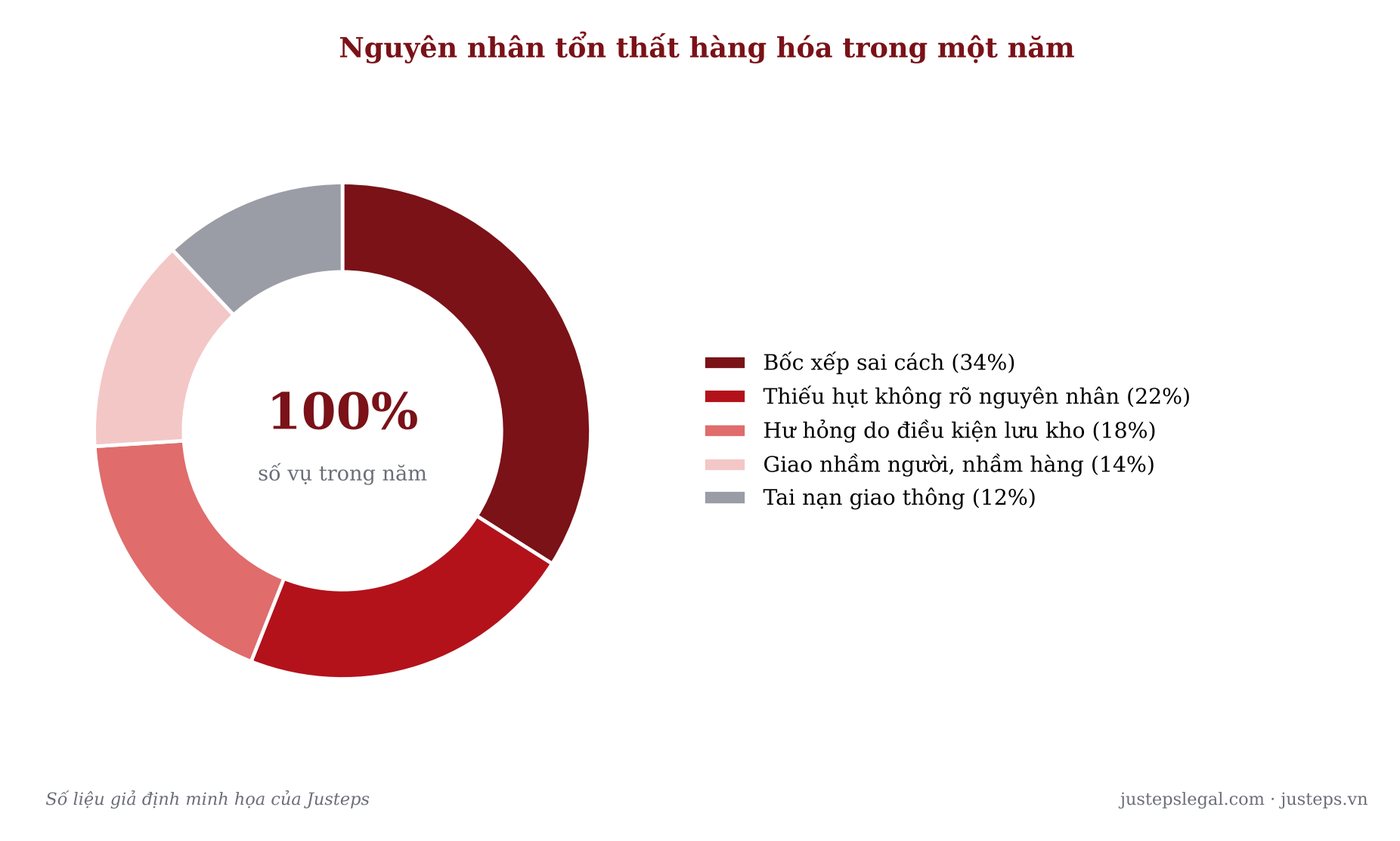
Example breakdown of the causes of cargo loss over one year in a warehousing business with its own fleet
In the example, improper loading and unloading accounts for 34% of incidents, unexplained shortages for 22%, damage due to storage conditions for 18%, delivery to the wrong person or of the wrong goods for 14% and road accidents for only 12%. Unexplained shortages cause the greatest loss because the business has no basis to reject the claim or to identify who was at fault. The loss handling rules therefore begin with drawing up a record as soon as the loss is discovered, preserving the scene and the damaged goods, and notifying the insurer and subcontractors within the contractual time limits.
The rules then specify who may respond to the customer and within what time, which compensation amounts fall within each level’s authority, when to apply the limitation of liability under the contract and the law[1], and how to seek recovery from shipping lines, subcontractors or insurers. The share of liability of an employee at fault is handled through the compensation procedure in the internal labour rules, with monthly wage deductions not exceeding 30% of the wages actually paid after social insurance and personal income tax[11]. Each case is entered in an incident log so that at the end of each quarter the business can see which step of the procedure is most often skipped.
Implementation process, deliverables and fees
A project to build the procedures of a logistics business usually takes about ten weeks, because the procedures must be piloted on site before they are issued.
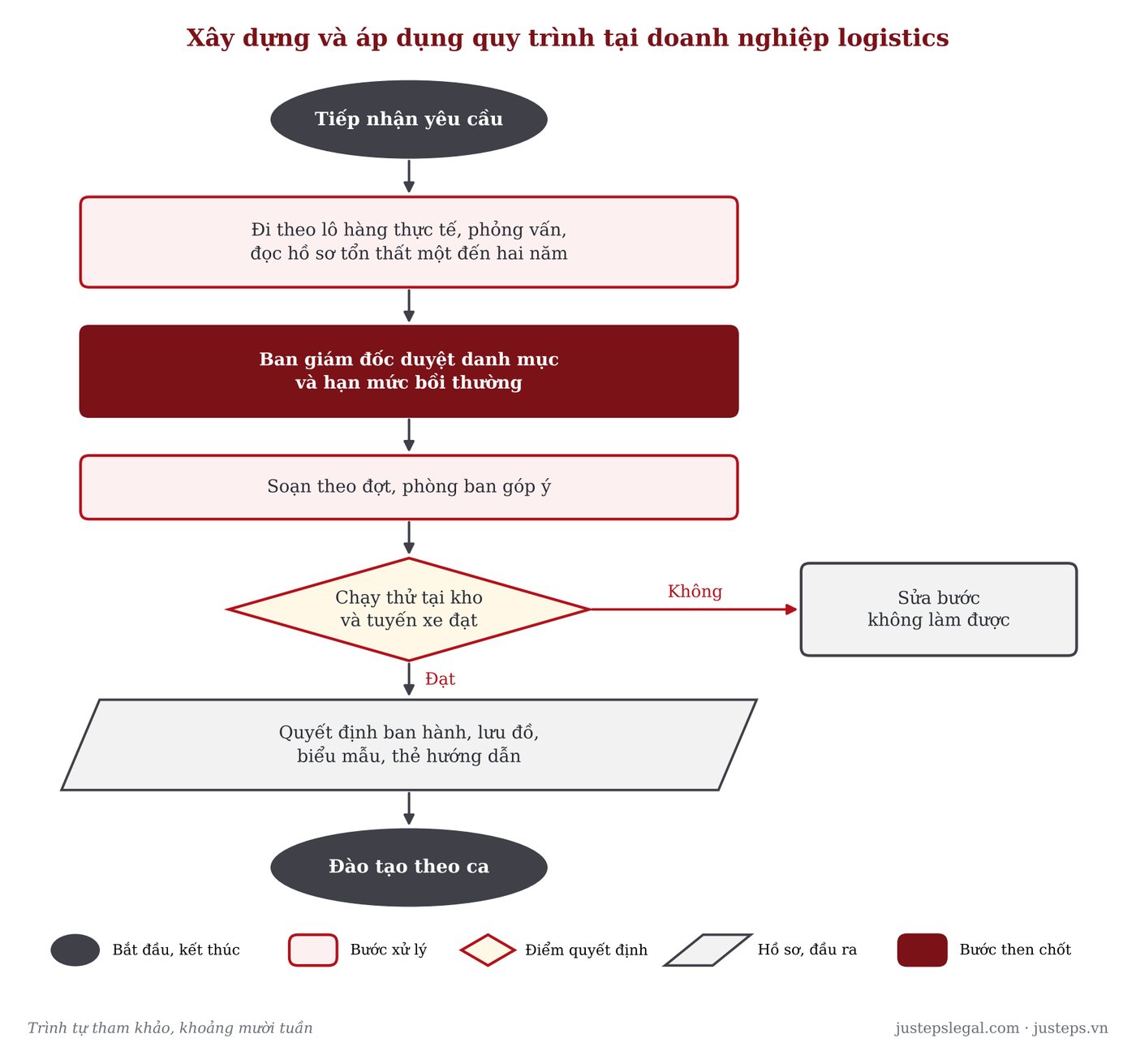
Sequence for building and applying procedures and regulations in a logistics and warehousing business
In the first two weeks Justeps follows selected shipments from order to invoice, interviews warehouse, dispatch, drivers, documentation and accounting staff, and reads the loss and violation files of the previous one to two years. In the third week the management board approves the list of documents and the approval limits for compensation. In the following weeks Justeps drafts in rounds for departments to comment, pilots for about two weeks at one warehouse and on one truck route, and corrects steps that cannot be performed in practice before submitting for issue. The deliverables comprise the following documents:
- The finalised procedures and regulations on handover, dispatch, special cargo, customs declaration, collections and disbursements and loss handling.
- Flowcharts of each core procedure to be displayed in the warehouse and the dispatch room.
- A set of forms including delivery records, loss reports, pre-trip vehicle inspection sheets and requests for payment of disbursements.
- An authority matrix for handling claims and compensation by amount.
- Draft issuing decisions and condensed training materials for each position, with quick-reference cards placed at warehouse doors and in vehicles.
Justeps quotes a fixed project fee in writing after the initial meeting, depending on the number of service lines, the number of warehouses and routes to be surveyed, how many documents already exist, the need for bilingual versions, linking the procedures to warehouse and transport management software and how long Justeps follows the pilot. After issue, questions arising in application can be supported through the ongoing legal advisory service for logistics, warehousing and freight transport businesses.
How Justeps can help
In addition to building internal procedures and regulations, logistics, warehousing and freight transport businesses can combine the following Justeps services:
- Organisational structure design for logistics, warehousing and freight transport businesses. Justeps defines the transport operations manager, warehouse shift leaders and declaration reviewer before writing procedures for them.
- Ongoing legal advisory for logistics, warehousing and freight transport businesses. Justeps answers situations arising when procedures are applied and updates them when the law changes.
- Labour, wages and social insurance services for logistics, warehousing and freight transport businesses. Justeps incorporates compensation, alcohol testing and discipline rules into the registered internal labour rules.
- Financial internal control system. Justeps designs controls over reconciliation of collections, disbursements, cash on delivery and receivables by shipment.
- Personal data protection and cybersecurity. Justeps builds rules on processing consignee data and driver monitoring data.
Frequently asked questions
Which procedures should be written first?
Usually the handover procedure and the loss handling rules, because these two stages relate directly to compensation payments. Businesses with a fleet should build the dispatch and pre-trip inspection procedure in parallel.
Is a delivery record signed on a mobile app valid?
It can be valid if the signer and time of signing can be identified, the content has not been altered and it is stored for later retrieval under the law on electronic transactions[2]. The procedure should specify how records are stored and extracted when a claim arises.
May a driver’s wages be deducted when goods are damaged?
Yes, if this follows the compensation procedure in the internal labour rules, fault and the amount of damage are clearly established, and the monthly deduction does not exceed the statutory limit[11]. Arbitrary fines or wage deductions are not permitted.
Can internal procedures replace the contract with the customer?
No. Procedures generate evidence for the business to apply the exemption, limitation of liability and claim time limit clauses in the contract and under the law[1], while the contract is where those clauses are agreed.
Is a separate procedure needed for dangerous goods if they are accepted only occasionally?
Yes. A single consignment of dangerous goods stored in the wrong place can set fire to the whole warehouse, so the procedure must cover classification, labelling, storage zones, transport documents and trained staff[7].
How often should the procedures be updated?
Once a year and immediately after a major incident, when warehouse or transport management software is replaced, or when rules on transport, customs or fire prevention change.
Related articles
- Organisational structure design for logistics, warehousing and freight transport businesses by service chain and handover point
- Ongoing legal advisory for logistics, warehousing and freight transport businesses on contracts, claims and tax
- Labour, wages and social insurance services for logistics, warehousing and freight transport businesses with drivers and warehouse workers
- Warehousing and logistics service contracts, liability for goods and how to organise warehouse operations
Notes
[1] The Commercial Law and the documents amending and supplementing it, and Government Decree No. 163/2017/ND-CP dated 30 December 2017 on logistics services.
[2] The Law on Electronic Transactions No. 20/2023/QH15.
[3] Government Decree No. 158/2024/ND-CP dated 18 December 2024 on road transport activities, as amended and supplemented by Decree No. 218/2026/ND-CP dated 19 June 2026.
[4] Article 64 of the Law on Road Traffic Order and Safety No. 36/2024/QH15, as amended and supplemented by Law No. 118/2025/QH15, effective from 1 July 2026.
[5] The Law on Road Traffic Order and Safety No. 36/2024/QH15 and the documents amending and supplementing it.
[6] The Law on Roads No. 35/2024/QH15.
[7] The Law on Fire Prevention, Fire Fighting, Rescue and Salvage and the documents amending and supplementing it, and Government Decree No. 105/2025/ND-CP detailing this Law.
[8] The Law on Customs No. 54/2014/QH13 and the documents amending, supplementing and guiding it.
[9] Government Decree No. 254/2026/ND-CP dated 30 June 2026 on electronic invoices and electronic documents.
[10] The Law on Personal Data Protection No. 91/2025/QH15, effective from 1 January 2026.
[11] The Labour Code and the documents amending and supplementing it.
This article is for reference and reflects the regulations in force at the time of publication. Please consult Justeps for advice tailored to your company’s records and situation.
For further information, please contact:
📩 Email: info@justeps.vn
🌐 Website: https://justepslegal.com · https://justeps.vn
🌐 Page: Justeps
☎️ Hotline (Zalo): 096 172 2607
📍 Thanh Xuan Office: 12th Floor, Licogi 13 Tower, 164 Khuat Duy Tien Street, Thanh Xuan Ward, Hanoi, Vietnam
📍 Ha Dong Office: LK06B, No.10, Dong Dua Area, Ha Dong Ward, Hanoi, Vietnam
📍 Ho Chi Minh City Branch: 528 Le Van Sy, Ho Chi Minh City, Vietnam
📍 Hai Phong Office: Truong Thinh Village, Ha Dong Commune, Hai Phong, Vietnam
📍 Quang Ninh Office: Van Don Special Zone, Quang Ninh Province, Vietnam





