
Key takeaways
- When a counterparty is in breach of contract, the first step is to preserve evidence and check the contract terms, because suspending performance or terminating the contract without a proper basis can make the company itself the party in breach.
- A written notice of breach should identify the obligation breached, the evidence, the deadline for remedying the breach and the remedies that will be applied, and must be sent to the address and in the manner specified in the contract.
- For commercial contracts, contractual penalties are currently capped at 8% of the value of the obligation breached; the remedies provisions of the Commercial Law are expected to be repealed from 1 January 2028, but contracts signed before then remain subject to the law in force when they were concluded.
- A debt acknowledgement signed by the defaulting party is both strong evidence and a reason for the limitation period to start afresh, so it is usually the first objective of negotiations.
- Companies should work out the limitation period and the deadline for complaints as soon as a breach is discovered, because prolonged negotiations do not stop the limitation period from running.
Late payment, late delivery, delivery of goods of the wrong quality or abandonment of work by a counterparty are situations every company encounters at some point. A common reaction is to send an immediate, sharply worded letter threatening legal action, or to stop delivering goods or withhold the remaining payments unilaterally to apply pressure. Such reactions can cost the company its advantage, because if the suspension has no basis in the contract or in law, the company itself becomes the party in breach and the counterparty gains further arguments for a counterclaim.
This article analyses the steps to take when a counterparty breaches a commercial contract between businesses, from gathering evidence, giving notice and choosing remedies to negotiation, mediation and preparing a claim for court or arbitration. It is written for the board of management and the legal, credit control and sales functions of companies whose contracts are governed by Vietnamese law. Justeps does not act in proceedings before courts, arbitral tribunals or enforcement agencies; its role is to assess the case, review evidence, draft documents, advise on negotiation and mediation and prepare the file so that the company can proceed itself or pass it to a licensed legal practice of its choice.
Identifying the breach correctly and the law governing the contract
As a rule, a breach of contract occurs when a party fails to perform, performs late, performs incompletely or performs otherwise than as agreed, and the party in breach bears civil liability towards the party entitled to performance[1]. Commercial law also distinguishes a fundamental breach, meaning a breach that causes such damage to the other party that it cannot achieve the purpose for which it entered into the contract[2]. The distinction matters greatly in practice, because certain severe remedies such as suspension or rescission of the contract are available only for a fundamental breach, unless the parties have agreed otherwise.
The company must establish whether the contract is governed by the Commercial Law or only by the Civil Code, because the two differ on penalty caps, limitation periods and the conditions for applying remedies. This analysis is about to acquire a time dimension. The Law amending and supplementing the Commercial Law, passed by the National Assembly on 13 November 2026, repeals the chapter on commercial remedies and dispute resolution with effect from 1 January 2028, with a view to applying the Civil Code uniformly[3]. Under the transitional provisions, contracts concluded before 1 January 2028 continue to be governed by the law in force at the time of conclusion, including on limitation periods, unless the parties agree otherwise, so each contract file should clearly record the date on which the contract was concluded.
Before holding the counterparty liable, the company should also check whether the counterparty has grounds for exemption from liability. The party in breach is exempt where the parties have so agreed, in the event of force majeure, where the breach is entirely the fault of the other party, or where it results from complying with a decision of a state authority that the parties could not have known of when entering into the contract, but it must give notice and prove the grounds for exemption[4]. If the company itself handed over the site late, approved drawings late or paid an earlier instalment late, the counterparty’s argument that the other party was at fault will carry weight, and the company should take this into account before making any demand.
The overall sequence can be pictured in the flowchart below, in which each step moves on to the next only if the previous step has not resolved the problem.
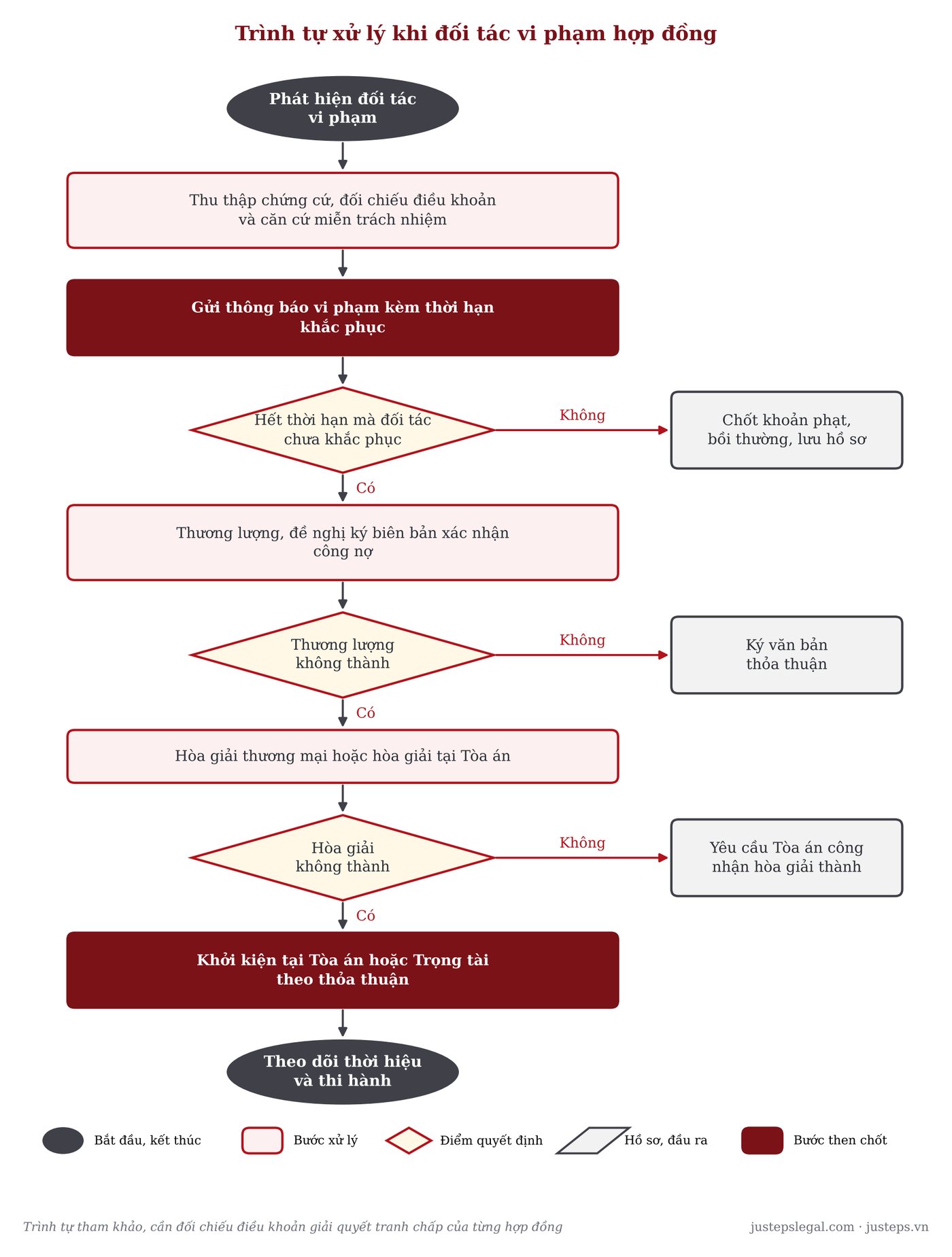
Sequence for handling a counterparty’s breach of contract, from gathering evidence to bringing a claim
The flowchart starts with gathering evidence and assessing the breach, after which the company sends a notice of breach with a deadline for remedying it. If the counterparty remedies the breach within the deadline, the company only needs to settle the penalties and damages and file the records. If the counterparty fails to do so, the parties move on to negotiation, and if negotiation fails, to mediation; whenever an agreement is reached, it should be recorded in writing, and a successful mediation outcome should be submitted to the court for recognition. Only if these routes produce no result should the company bring a claim before the court or arbitration as agreed in the contract, keeping track of the limitation period throughout.
Gathering and preserving evidence as soon as the breach is discovered
In any contractual dispute, the party making a claim must prove it, so the strength of the evidence often determines the outcome more than the legal arguments do. The minimum file comprises the contract, its appendices, purchase orders, delivery records, acceptance records, invoices, payment documents and all correspondence between the parties. The team responsible for the contract should prepare a chronology recording each performance milestone, each obligation falling due and the corresponding evidence, because the chronology will be reused at every later step.
Emails, messages sent through messaging apps and data in order management systems can all be used as evidence in the form of electronic data messages[5]. To increase their evidential value, the company should keep the originals on the device or server and record the sending and receiving accounts and the times, rather than relying only on isolated screenshots[6]. For events that are hard to reconstruct, such as goods damaged in a warehouse or abandoned construction works, the company may ask a bailiff to prepare an official record of facts (vi bằng) or engage an independent inspection body before disposing of the goods or continuing the works.
The aggrieved party is also obliged to take reasonable measures to mitigate its loss, and if it fails to do so, the party in breach may ask for the compensation to be reduced by the amount of loss that could have been avoided[7]. The file should therefore also show what the company has done to limit its loss, such as finding replacement suppliers, storing rejected goods or adjusting its production plan. Costs arising from these measures should also be fully documented so that they can be included in the damages claim.
Giving notice of breach and choosing the appropriate remedy
The notice of breach is the first formal document the company sends to the counterparty, and it must be drafted carefully because it will become evidence if the matter goes to court or arbitration. It should set out the clause and obligation breached, the course of events and the evidence, a reasonable deadline for remedying the breach, the remedies the company intends to apply if the breach is not remedied and a reservation of all other rights under the contract and the law. The notice must be sent to the correct address and recipient and in the manner required by the notice clause of the contract, with proof of dispatch such as a courier receipt with confirmation of delivery or an email to the address registered in the contract.
The language of the notice should be objective, should avoid alleging an intention to deceive without evidence and should avoid committing to steps the company is not sure it will take. Where goods are delivered in the wrong quantity or of the wrong quality, the company must also observe the time limit for complaints under the contract or the law, for example three months for quantity and six months for quality from the date of delivery where the parties have not agreed otherwise[8]. Missing this time limit may cost the company its right to make a claim in respect of that consignment, even though the breach is real.
Each remedy has its own conditions, and the company may combine several remedies where the law permits. The table below summarises the remedies commonly applied in commercial contracts and the conditions to watch:
| Remedy | When it applies | Points to note |
|---|---|---|
| Specific performance | Where the aggrieved party still needs the counterparty to deliver, repair or complete the work. | During this period, the aggrieved party may still claim damages and penalties but may not apply other remedies. |
| Contractual penalty | Only where the contract provides for a penalty. | The Commercial Law caps the total penalty at 8% of the value of the obligation breached. |
| Damages | Where there is a breach, actual loss and a causal link between the two. | The claimant must prove the loss, its amount and the direct profit it would otherwise have earned. |
| Late payment interest | Where the counterparty pays late for goods, service fees or other reasonable costs. | Applies even if the contract is silent, at the interest rate permitted by law. |
| Suspension of performance | Where a breach agreed by the parties as a trigger occurs or the breach is fundamental. | The counterparty must be notified immediately, failing which any resulting loss must be compensated. |
| Rescission | Where the breach is an agreed ground for rescission or is a fundamental breach. | Rescission without a proper basis makes the rescinding party itself the party in breach. |
Contractual penalties and damages are two different remedies. Under a commercial contract, the aggrieved party may apply both at the same time if the contract provides for a penalty, but the total penalty may not exceed 8% of the value of the obligation breached, save in certain special cases[9]. Under a civil contract, the Civil Code leaves the amount of the penalty to the parties, and if they have agreed only on a penalty and not on both a penalty and damages, the party in breach is liable only for the penalty. Where a counterparty pays late, the company is also entitled to claim interest on the overdue amount, even if the contract does not provide for it[10].
Suspension, termination or rescission must have a proper basis and be notified
Remedies that bring performance of the contract to a halt have the most serious consequences, so their conditions are also the strictest. A party suspending, terminating or rescinding a contract must notify the other party immediately, and if it fails to do so and loss results, it must pay compensation[11]. Where a contract is terminated or rescinded without a proper basis, the terminating party is regarded as the party in breach and is liable as for a breach of contract. Before issuing a notice of rescission, the company should therefore check the termination clause of the contract, the seriousness of the breach and the evidence of a fundamental breach once more.
Prepared negotiation to recover money and preserve the business relationship
Most breaches of contract are resolved through negotiation, because both sides want to avoid the cost and time of litigation. Before negotiating, the company should calculate the total amount claimed, including the principal debt, penalties, late payment interest and documented losses, and decide on the minimum acceptable outcome and its alternative if negotiation fails. Those taking part in the negotiation should have a clear mandate on how far they may concede, so that they do not have to keep going back for instructions and lose the initiative.
The first objective of negotiation should be a debt acknowledgement or an acknowledgement of breach signed by an authorised person on the counterparty’s side. Such a document is both strong evidence and causes the limitation period to start afresh from the date on which the obligor acknowledges all or part of its obligation[12]. If the parties agree on a repayment schedule, the agreement should specify each instalment and the consequences of missing one, and, where possible, add security such as a parent company guarantee, a bank guarantee or a pledge or mortgage of assets.
The minutes of each meeting should record the points agreed and not agreed, with a note that any proposed concessions are valid only once incorporated into a signed final agreement. This allows the company to negotiate flexibly without being regarded as having waived its claims if negotiation fails. To prepare a negotiation strategy and the accompanying documents, companies may consider Justeps’ negotiation strategy and contract breach handling services.
Commercial mediation and court-annexed mediation
Where direct negotiation fails, the parties may ask an independent commercial mediator to help them find a solution. Commercial mediation takes place where the parties have a mediation agreement, which may be included in the contract in advance or made after the dispute arises, and is based on the principles of voluntariness, equality and confidentiality[13]. The mediator has no power to make a decision, so the outcome is binding only once the parties sign a settlement agreement.
A mediated settlement agreement has the effect of a civil agreement between the parties. To be able to ask the civil judgment enforcement agency to enforce it when one party does not comply voluntarily, the party entitled must ask the court to recognise the out-of-court mediated settlement[14]. In addition, when a company files a claim, the court may refer the matter to court-annexed mediation and dialogue before accepting the case if the parties agree, with the costs borne by the state budget[15]. The choice between dispute resolution methods depends on time, cost, confidentiality and the enforceability of the outcome, as shown in the comparison matrix below.
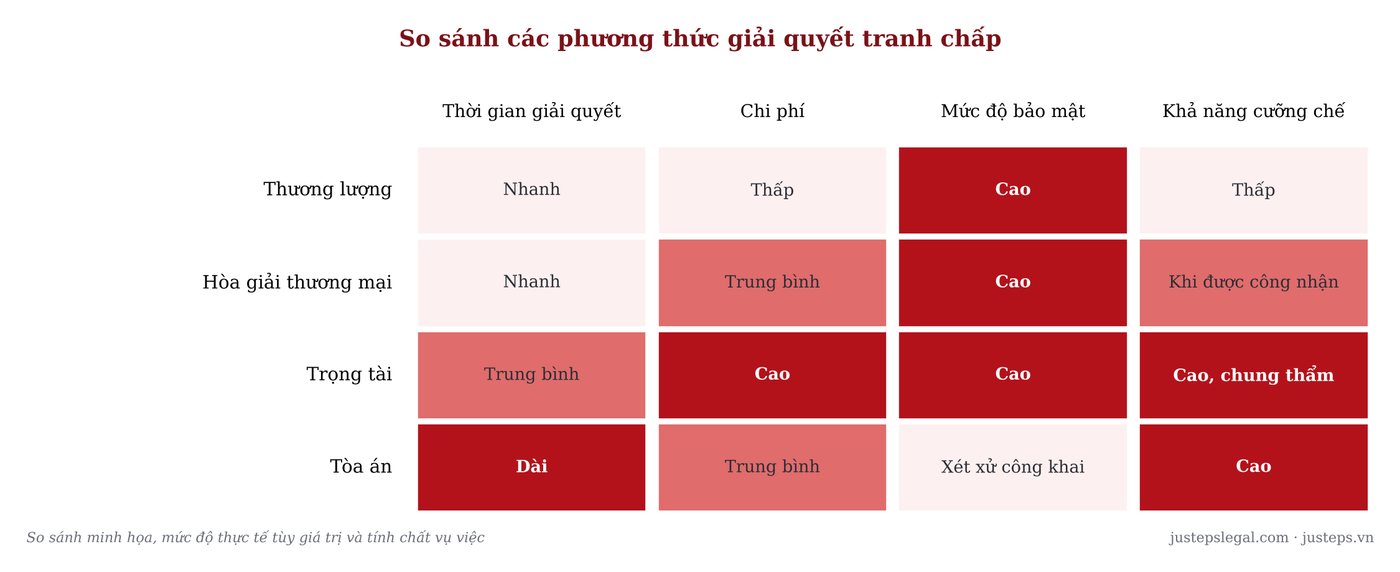
Illustrative comparison of four methods of resolving contractual disputes against the criteria that matter to companies
Negotiation and mediation are usually quick, inexpensive and confidential, but the outcome depends on the counterparty’s goodwill and can only be enforced once recognised by the court. Commercial arbitration costs more but is confidential and its awards are final, which makes it suitable for high-value disputes or disputes with a foreign element. Court proceedings involve lower upfront costs than arbitration, but hearings are public and first-instance judgments may be appealed, so resolution usually takes longer.
Preparing a claim for court or arbitration
Where amicable methods fail, the company must determine which body has jurisdiction. If the contract contains a valid arbitration agreement, the dispute will be resolved by arbitration and the court must decline jurisdiction, unless the arbitration agreement is void or incapable of being performed[16]. If there is no arbitration agreement, business and commercial disputes fall within the jurisdiction of the courts, and since 1 July 2025 most disputes have been heard at first instance by the regional people’s courts[17]. Vaguely worded arbitration agreements, such as those naming two arbitration centres at once or failing to identify a specific arbitral institution, are a frequent source of prolonged disputes over jurisdiction.
The limitation period is a deadline the company must not miss. For commercial disputes under the Commercial Law, the limitation period is two years from the time the lawful rights and interests are infringed, whereas for contracts under the Civil Code it is three years from the date on which the party entitled knew or ought to have known of the infringement[18]. Once the limitation period has expired, the company may lose its right to sue if the other party asks for the limitation period to be applied, so the expiry date should be entered in a monitoring calendar as soon as the breach is discovered. The chart below compares the common time limits in months.
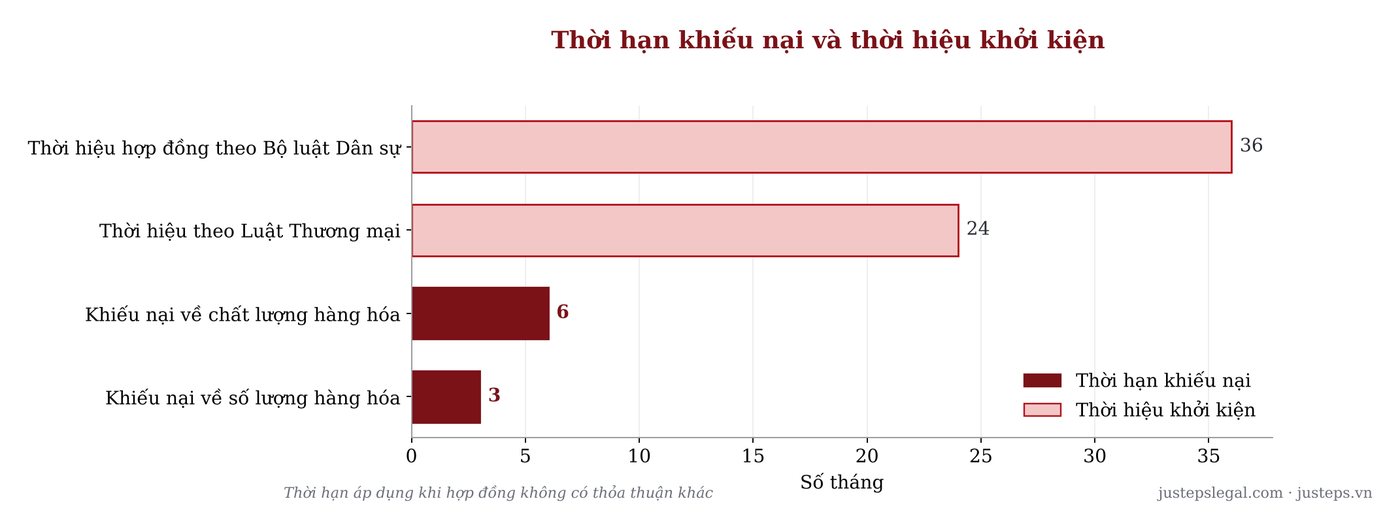
Common time limits for complaints and limitation periods for claims, in months
The two shortest time limits are those for complaints about the quantity and quality of goods, only three to six months where the contract does not provide otherwise, so the warehouse and quality control teams should report any discrepancy immediately. The two-year limitation period under the Commercial Law is shorter than the three-year period under the Civil Code, and commercial contracts signed before 1 January 2028 remain subject to the two-year period. Time spent negotiating or mediating does not automatically stop the limitation period from running, unless the other party acknowledges its obligation in writing.
The claim file should set out specific claims, a detailed calculation of the amounts claimed and evidence organised by claim. Where there is a risk that the counterparty will dissipate its assets, the company may ask the court or the arbitral tribunal to grant interim measures such as freezing bank accounts or attaching assets, but it will usually have to provide security corresponding to the loss that may arise if the request proves unjustified. Justeps helps companies assess the merits of the case, review and organise the evidence, calculate the amounts to be claimed and prepare the file, after which the company files the claim itself or passes it to a licensed legal practice of its choice to handle the procedural steps.
Learning lessons to make future contracts more robust
Every breach is an opportunity for the company to review its standard contracts. Clauses that commonly reveal weaknesses when a dispute arises include notice clauses that do not specify an official email address, penalty clauses that do not state how the penalty is calculated, termination clauses that do not list the breaches regarded as serious and unclear dispute resolution clauses. Companies should add a multi-tier dispute resolution mechanism, for example negotiation for 30 days, then mediation and only then arbitration or court proceedings, naming a specific arbitral institution if arbitration is chosen.
With the remedies provisions of the Commercial Law expected to be repealed from 1 January 2028, new standard contracts should be reviewed for penalty amounts, the relationship between penalties and damages, the conditions for rescission and limitation periods, so that they do not depend on the default rules of the law. Companies with high-value dealings with a single counterparty should consider requiring security from the outset, such as a payment guarantee or a performance guarantee. This standardisation can be carried out with Justeps’ commercial contract drafting and review services, combined with training for the sales team on how to keep evidence during contract performance.
How Justeps can help
Justeps helps companies deal with breaches of contract at the pre-litigation stage through the following services:
- Negotiation strategy and contract breach handling. Justeps assesses the case, drafts notices of breach and develops negotiation and mediation strategies with the counterparty.
- Commercial contract drafting and review. Justeps reviews standard contracts and their penalty, termination and dispute resolution clauses ahead of 1 January 2028.
- Review and control of contractual risk. Justeps identifies the clauses most likely to lead to disputes and proposes how to redraft them for each type of contract.
- Debt restructuring and enforcement of security. Justeps drafts debt acknowledgements, repayment schedules and additional security arrangements when a counterparty pays late.
- Commercial contract drafting skills. Justeps trains sales and legal teams on remedies, notice clauses and the retention of evidence.
Frequently asked questions
Is it mandatory to send a notice of breach before bringing a claim?
The law does not require a notice to be sent before a claim in every case, unless the contract provides for a pre-action procedure. However, a notice of breach is important evidence and is a condition for applying certain remedies such as suspension, termination or rescission of the contract[11].
If the contract has no penalty clause, can the company impose a penalty on the counterparty?
The company cannot impose a penalty where the contract contains no agreement on penalties[9]. In that case, the company may still claim damages for actual loss and late payment interest if it can prove them.
Will the 8% penalty cap still apply after 1 January 2028?
According to information on the amending law that has been passed, the chapter on remedies in the Commercial Law is repealed from 1 January 2028[3]. Contracts signed before that date remain subject to the law in force when they were concluded, while contracts signed afterwards will be governed by the Civil Code, so companies should check the official text when drafting new standard contracts.
Can messages sent through a messaging app be used as evidence?
Messages can be used as evidence in the form of electronic data messages[5]. The company should keep the originals on the device and may have an official record of facts prepared to increase their evidential value.
Do prolonged negotiations stop the limitation period from running?
Negotiation does not automatically stop the limitation period from running. The limitation period starts afresh only when the obligor acknowledges all or part of its obligation, for example by signing a debt acknowledgement[12].
Is the counterparty bound to comply with the outcome of commercial mediation?
A mediated settlement agreement binds the parties as a civil agreement. To be able to seek enforcement, the party entitled must ask the court to recognise the out-of-court mediated settlement[14].
If the contract contains an arbitration agreement, can the company still bring a claim in court?
Where the arbitration agreement is valid and capable of being performed, the court must decline jurisdiction and the dispute is resolved by arbitration[16]. The company should check the validity of the arbitration agreement carefully before choosing where to file.
Related articles
- How an exclusive distribution agreement should deal with sales targets, territory and inventory on termination
- What a software development contract should provide on acceptance, warranty and ownership of source code
- How construction companies should manage subcontractors, from selection and contracting to acceptance and payment
- Drafting warehousing contracts and logistics service agreements to allocate responsibility for goods clearly in warehouse operations
Notes
[1] Articles 351 and 360 of the Civil Code No. 91/2015/QH13 dated 24 November 2015.
[2] Clause 13 of Article 3, Articles 292, 310 and 312 of the Commercial Law No. 36/2005/QH11 dated 14 June 2005.
[3] Law amending and supplementing certain articles of the Commercial Law and certain related laws, passed by the National Assembly on 13 November 2026; the provision repealing Chapter VII of the Commercial Law takes effect from 1 January 2028.
[4] Articles 294 and 295 of the Commercial Law No. 36/2005/QH11; Article 156 and Clause 2 of Article 351 of the Civil Code No. 91/2015/QH13.
[5] Articles 94 and 95 of the Civil Procedure Code No. 92/2015/QH13 dated 25 November 2015, as amended and supplemented by Law No. 85/2025/QH15.
[6] Law on Electronic Transactions No. 20/2023/QH15 dated 22 June 2023.
[7] Article 305 of the Commercial Law No. 36/2005/QH11; Article 362 of the Civil Code No. 91/2015/QH13.
[8] Article 318 of the Commercial Law No. 36/2005/QH11.
[9] Articles 300, 301 and 307 of the Commercial Law No. 36/2005/QH11; Article 418 of the Civil Code No. 91/2015/QH13.
[10] Article 306 of the Commercial Law No. 36/2005/QH11; Articles 357 and 468 of the Civil Code No. 91/2015/QH13.
[11] Articles 308, 310, 312 and 315 of the Commercial Law No. 36/2005/QH11; Articles 423 and 428 of the Civil Code No. 91/2015/QH13.
[12] Article 157 of the Civil Code No. 91/2015/QH13.
[13] Government Decree No. 22/2017/ND-CP dated 24 February 2017 on commercial mediation, as amended and supplemented.
[14] Chapter XXXIII of the Civil Procedure Code No. 92/2015/QH13 on recognition of out-of-court mediated settlements.
[15] Law on Mediation and Dialogue at Court No. 58/2020/QH14 dated 16 June 2020, as amended and supplemented by Law No. 85/2025/QH15.
[16] Articles 2, 5, 6 and 18 of the Law on Commercial Arbitration No. 54/2010/QH12 dated 17 June 2010.
[17] Article 35 of the Civil Procedure Code No. 92/2015/QH13, as amended and supplemented by Law No. 85/2025/QH15.
[18] Article 319 of the Commercial Law No. 36/2005/QH11; Article 429 of the Civil Code No. 91/2015/QH13; Article 33 of the Law on Commercial Arbitration No. 54/2010/QH12.
This article is for reference and reflects the regulations in force at the time of publication. Please consult Justeps for advice tailored to your company’s records and situation.
For further information, please contact:
📩 Email: info@justeps.vn
🌐 Website: https://justepslegal.com · https://justeps.vn
🌐 Page: Justeps
☎️ Hotline (Zalo): 096 172 2607
📍 Thanh Xuan Office: 12th Floor, Licogi 13 Tower, 164 Khuat Duy Tien Street, Thanh Xuan Ward, Hanoi, Vietnam
📍 Ha Dong Office: LK06B, No.10, Dong Dua Area, Ha Dong Ward, Hanoi, Vietnam
📍 Ho Chi Minh City Branch: 528 Le Van Sy, Ho Chi Minh City, Vietnam
📍 Hai Phong Office: Truong Thinh Village, Ha Dong Commune, Hai Phong, Vietnam
📍 Quang Ninh Office: Van Don Special Zone, Quang Ninh Province, Vietnam





