
Key takeaways
- The handover plan should start as soon as the resignation is received, because the employee’s notice period may range from only 3 working days to 45 days depending on the type of contract.
- When the chief accountant or the person in charge of accounting is replaced, the business must organise the handover of accounting work and records and notify the bank of the new person, while the outgoing person remains responsible for the work done during their tenure.
- A handover record is only meaningful when it comes with detailed appendices and is signed after bank balances, cash, major debts, tax obligations and invoices have been reconciled.
- Digital signatures, e-tax accounts, internet banking and accounting software are assets of the business, so passwords and PIN codes must be changed and the outgoing person’s rights revoked on their last working day.
- A business may not withhold the salary or documents of a departing employee to force completion of the handover, so it needs a clear handover timetable that fits entirely within the notice period.
An accountant leaving is a common occurrence in small and medium-sized businesses, but the consequences of a cursory handover usually come to light only a few months later. The new accountant discovers that the balance owed by a major customer does not match the confirmation record, but nobody can explain why. The tax authority sends a notice requesting explanations on a tax refund file submitted by the previous accountant, while the password to the e-tax account has been changed and the authentication codes are still being sent to the personal phone of the person who has left. Some businesses have even found the digital signature device still sitting in the former accountant’s desk drawer, which means that, technically, that person could still sign tax returns in the name of the company.
This article explains how to hand over when an accountant leaves, covering when to plan, the list of records and unfinished work, how to recover digital signatures and access to systems, how to reconcile figures before signing the handover record, how to choose the person receiving the handover and what to bear in mind regarding the employment relationship with the departing employee. The content applies when replacing a chief accountant, a person in charge of accounting, a tax accountant, a receivables and payables accountant or a payroll accountant, as well as when a business moves from in-house accounting to an outsourced accounting service or changes its service provider. It is written mainly for directors, owners of small businesses, chief accountants and the people in charge of human resources.
When to start planning the handover
The handover plan should be drawn up as soon as the business receives the resignation, rather than waiting until the final week. An employee who unilaterally terminates a labour contract must give at least 45 days’ notice under an indefinite-term contract, at least 30 days under a fixed-term contract of 12 to 36 months and at least 3 working days under a contract of less than 12 months, except in certain special sectors and occupations[1]. For an accountant on a short-term contract, the business may have only three working days to prepare, so even before anyone leaves, each accounting position should have a handover list that is updated periodically. If the two sides agree on a longer period, that agreement should be put in writing together with the handover timetable.
For the position of chief accountant or person in charge of accounting, the handover is an obligation under the accounting regulations. When the chief accountant or the person in charge of accounting is changed, the legal representative or the manager must organise the handover of accounting work and records between the outgoing and incoming persons, and notify the relevant departments and the institutions where the unit holds accounts of the name and specimen signature of the new person[2]. The new person is responsible from the date of receiving the handover, while the outgoing person remains responsible for the work during their tenure[2]. The handover date stated in the record is therefore the point that divides responsibility, and the business should state this date explicitly rather than merely recording that all work has been handed over.
A similar procedure should apply when a tax, receivables and payables or payroll accountant leaves, when an accountant takes maternity leave or extended leave, and when the business changes its accounting service provider. Where the service provider is changed, the service contract should include a clause on handing over data, passwords and records upon termination, because the previous provider is not under the direct management that applies to an employee.
What must be handed over
The handover record should have a main section stating the handover date, the person handing over, the recipient and the witness, together with detailed appendices by group, each appendix signed by all three. A record that merely states that all documents and books have been handed over will be of no help if a dispute arises over whether a particular document was handed over. The following table suggests four main groups of appendices:
| Group | Main contents | How to confirm |
|---|---|---|
| Documents and books | Monthly vouchers, accounting books, financial statements, tax returns and payment receipts, payroll and insurance records. | A list by period, stating whether each item is paper or electronic and where it is stored. |
| Unfinished work | Upcoming tax filing and payment deadlines, invoices not yet issued, disputed debts and unanswered official letters. | A task list with deadlines, status and accompanying documents. |
| Accounts and devices | Digital signatures, e-tax account, internet banking, accounting software and e-invoices. | A list of accounts, the date passwords were changed and the new holder. |
| Reconciled balances | Bank deposits, cash, major debts, tax payable or overpaid, invoices issued. | A reconciliation schedule with source documents and confirming signatures. |
Documents, books and reports
The first group comprises accounting vouchers recorded in the books for each month, vouchers not yet recorded, general and detailed ledgers, financial statements for each year, data exported from the accounting software, tax returns, tax payment receipts, correspondence with the tax authority, payroll and social insurance records and commercial contracts in progress. Accounting records must be retained for the statutory periods, and vouchers used directly for bookkeeping and preparing financial statements, accounting books and annual financial statements belong to the group that must be kept for at least 10 years[3]. The appendix should therefore state where the records of previous years are stored, even if they have been boxed up or sent to a warehouse, so that the new person does not have to search for them when an inspection team arrives.
For businesses that have moved to the accounting regime under Circular No. 99/2025/TT-BTC from the 2026 financial year[4], the appendix should also include the chart of accounts in use, the entries converting balances from the old regime and the accounting policies registered for application. This is the part that the new person will find hardest to infer from the books, especially when the previous accountant set up the detailed chart of accounts in the software on their own. Destroying or deliberately damaging accounting records before the end of the retention period is strictly prohibited[5], so the business should also confirm that the departing employee has not taken away or deleted accounting data on the computer assigned to them.
Unfinished work and upcoming deadlines
Unfinished work is the group most often overlooked, because it does not sit in any particular file but in the memory of the person doing the job. This list should include tax filing and payment deadlines in the next three months, taxes still owed or awaiting offset, invoices for which payment has been received but which have not yet been issued, debts in dispute or awaiting confirmation, unanswered letters from the tax and social insurance authorities and tax refund files being processed. If the accountant leaves in the first quarter of the year, the list must also cover progress on the annual financial statements and tax finalisation, because this is the period with the heaviest workload and the filing deadlines are concentrated within about 90 days after the end of the financial year.
Electronic accounts and digital signatures
A digital signature is issued to the business, not to the individual accountant, and an electronic signature that meets the statutory conditions has the same legal validity as the signatory’s signature on a paper document[6]. This means that anyone who holds the digital signature device and knows the PIN can sign tax returns, invoices and electronic contracts in the name of the business. The business needs to recover the device, change the PIN and check the validity period of the certificate under the regulations on electronic signatures and trust services[7]; only where there are signs that the PIN has been disclosed or the device has been lost does it need to ask the service provider to revoke the certificate.
Other electronic accounts should be dealt with on the departing employee’s last working day. For the e-tax account, the business changes the password and also changes the email address and phone number receiving authentication codes if they are the accountant’s personal details. For internet banking, the business asks the bank to revoke the outgoing person’s role in creating or approving payment orders and registers the new person and the new specimen signature. For the accounting software and the e-invoice software, the business creates a new administrator account for the recipient and disables the old account rather than simply changing the password, so that the system log can still distinguish the actions of each person.
Reconciling figures before signing the handover record
The handover record should be signed only after both sides have reconciled the main balances, because once the outgoing person has left, finding the cause of any discrepancy becomes difficult and costly. Bank deposit balances must match the statement from each bank on the handover date, and cash on hand must be physically counted with the cashier also signing. Balances with major customers and suppliers should be reconciled through confirmation records from the counterparties, at least for the group accounting for most of the value. Tax payable or overpaid in the books must match the data on the e-tax portal, and the total of invoices issued in the period must match the revenue recognised.
Justeps’ experience in helping businesses review their records after a handover shows that discrepancies are not evenly distributed across groups of figures. The chart below illustrates the share of handover files with discrepancies in each group of figures.
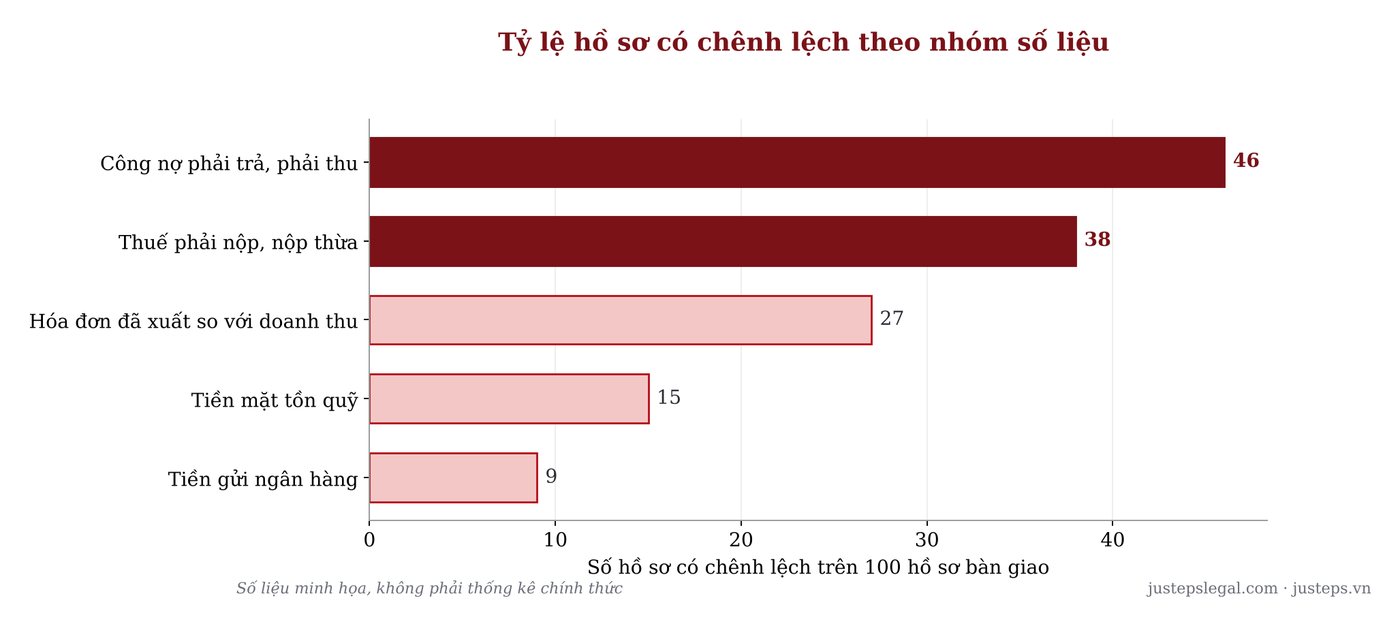
Share of handover files with discrepancies by group of figures
According to the illustrative figures, payables and receivables and tax obligations are the two groups most often affected by discrepancies, because they depend on external data and on adjusting entries that the previous accountant had not yet recorded. Bank deposits show fewer discrepancies thanks to bank statements, but discrepancies still arise where a receipt cannot be matched to a customer. Reconciliation time should therefore be devoted mostly to debts and taxes, and any discrepancy that remains unexplained must be recorded in the appendix together with the outgoing person’s undertaking to explain it in writing within a specific period.
The handover timetable and the employment relationship with the departing employee
An organised handover should be divided into clear milestones within the notice period, so that the departing employee knows what they must complete and the business is not left with everything piled up on the last day. The timetable below is an example for an accountant with a 30-day notice period.
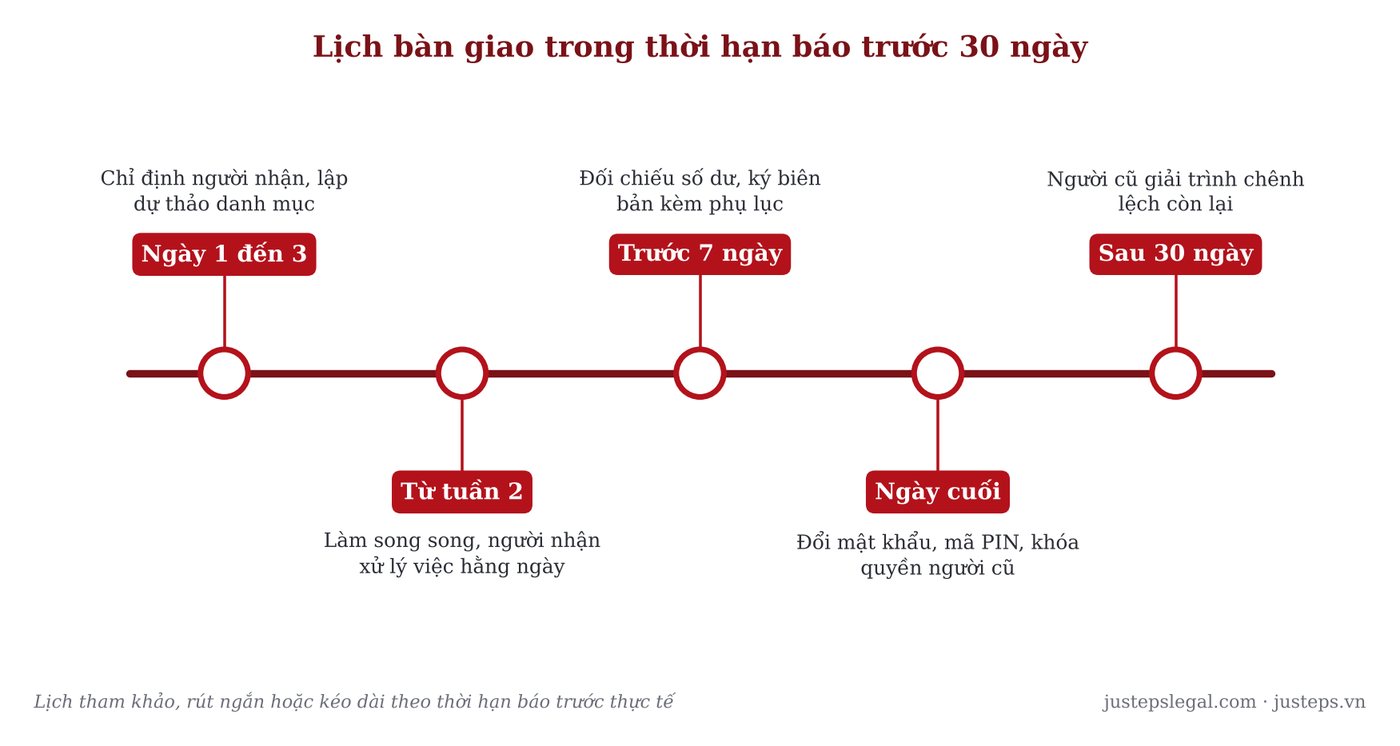
Reference handover timetable within a 30-day notice period
In the first three days, the director designates the recipient and the outgoing person prepares a draft handover list. From the second week, the two work in parallel, with the new person handling day-to-day work directly under the guidance of the outgoing person, so that tasks missing from the list are detected early. About one week before the departure date, the two sides reconcile balances and sign the record with its appendices; on the last working day, the business changes passwords and PIN codes and revokes the outgoing person’s rights. During the following 30 days, the recipient records any newly discovered issues and the outgoing person explains them in writing in accordance with the undertaking in the record.
Some businesses withhold the final month’s salary or the accountant’s documents to force completion of the handover, but this practice carries legal risk. The employer is responsible for paying in full all amounts relating to the entitlements of each party within 14 working days from the termination of the labour contract, which may be extended to no more than 30 days only in certain cases provided by law[8]. The law also prohibits employers from keeping the originals of employees’ identity papers, diplomas and certificates[9]. Instead, the business should rely on the handover timetable, a record containing an undertaking to provide explanations and, where agreed in the labour contract, clauses on the protection of business secrets and compensation for breach[10].
Where the departing employee does not cooperate, the business should make a record of the refusal to hand over in the presence of witnesses, send a written request for handover with a specific list and keep proof of sending. At the same time, the business should proactively revoke access, ask the bank and the digital signature provider to deal with the outgoing person’s rights, and rebuild the figures from bank statements, e-invoice data and the tax portal. If there are signs that damage has been caused, the business needs to assess the grounds for claiming compensation under the labour contract and the internal labour regulations before deciding on further measures.
Choosing the person to receive the handover
The person receiving the handover must meet the conditions for working as an accountant. Persons who are managers or executives, storekeepers, cashiers or persons buying and selling assets in the same accounting unit may not work as accountants, except in private enterprises, limited liability companies owned by one individual and other cases prescribed by the Government[11]. Temporarily assigning accounting work to the cashier or the director is therefore suitable only for certain types of enterprise, and micro-enterprises need to check against the separate accounting regime that applies to them.
If a chief accountant cannot be appointed immediately, the business may assign a person in charge of accounting or engage a service provider to act as chief accountant, and a person in charge of accounting may be assigned for a maximum of 12 months, after which a chief accountant must be appointed[12]. The Law amending and supplementing a number of articles of the Law on Accounting and the Law on Independent Audit was passed by the National Assembly on 21 November 2026 and includes provisions on accounting services, so businesses planning to outsource after an accountant leaves should follow the guiding documents before signing a service contract. Whichever option is chosen, the recipient should take part from the first week of the handover timetable, rather than appearing only on the day the record is signed. Businesses weighing in-house accounting against outsourcing may refer to Justeps’ service for organising the accounting function and documentation.
Roles in signing the record and common mistakes
Three parties take part in the handover with different roles, and many handovers fail because the director appears only to sign without checking. The diagram below sets out the roles of the person handing over, the recipient and the director during reconciliation and signing of the record.
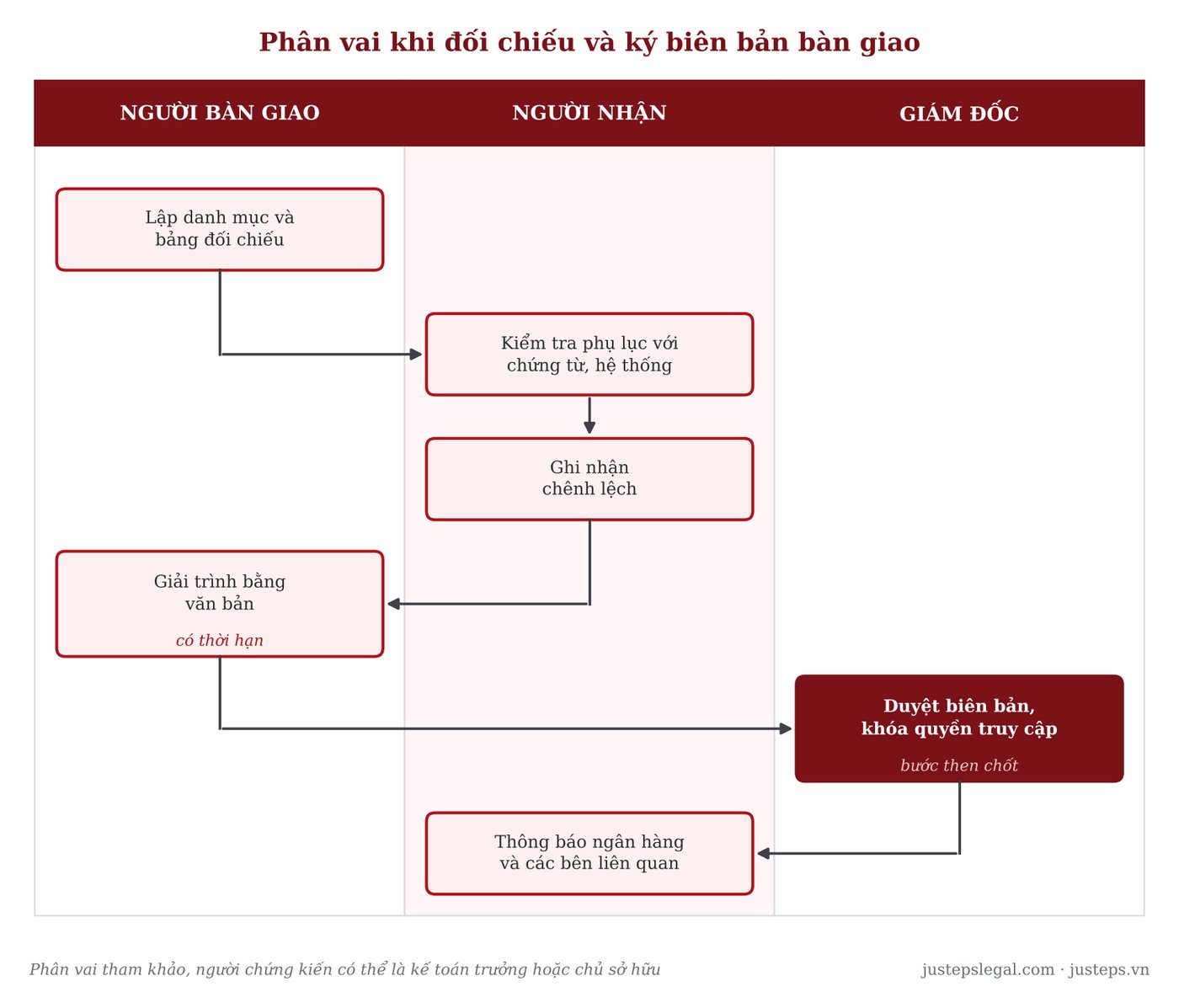
Roles of the person handing over, the recipient and the director
The person handing over is responsible for preparing the list and the reconciliation schedules, while the recipient checks each appendix against source documents and data in the systems. If discrepancies are found, the recipient records them and the person handing over explains them; unexplained discrepancies do not stop the signing of the record but are clearly noted in the appendix together with a deadline for explanation. The critical step belongs to the director, who approves the record and decides to revoke access on the last working day, then notifies the bank and other relevant parties of the new person.
From the cases in which Justeps has helped review records after a handover, the mistakes that recur most often and cause the greatest damage include the following situations:
- The e-tax account and internet banking were registered with the accountant’s personal email address and phone number, so authentication codes are still sent to the person who has left.
- The record merely states that all records have been handed over, without appendices, making it impossible to check later which documents were actually handed over.
- The record was signed on the very first day before balances were reconciled, so any discrepancy found afterwards leaves no basis for requiring the outgoing person to explain.
- The business forgot to notify the bank, and the outgoing person retained the right to approve payment orders on internet banking for several weeks.
- Accounting data was stored only on the accountant’s personal computer, with no backup on the business’s systems.
Most of the above mistakes can be prevented before anyone leaves, through a regulation on managing electronic accounts and digital signatures, a handover list for each position updated every quarter and a centralised data backup policy. Businesses that wish to put these controls in place may refer to Justeps’ service for building an internal financial control system.
How Justeps can help
Justeps supports businesses in organising the handover when an accountant leaves and in preventing the loss of data and access through the following services:
- Organising the accounting function and documentation. Justeps drafts the handover procedure and template handover records with appendices for each accounting position, and reviews the qualifications of the recipient.
- Building an internal financial control system. Justeps develops regulations on managing digital signatures, electronic accounts, bank access rights and accounting data backups.
- Managing labour disputes and contract termination. Justeps advises on the termination procedure, payment of entitlements and what to do when a departing employee does not cooperate with the handover.
- Information security and conflict-of-interest prevention. Justeps drafts confidentiality agreements and undertakings to return assets and data for positions holding financial information.
Frequently asked questions
Does the former accountant remain responsible after leaving?
Yes. For a chief accountant or a person in charge of accounting, the outgoing person remains responsible for the work during their tenure, while the new person is responsible from the date of receiving the handover[2]. The record must therefore state the handover date clearly.
May the business withhold the final month’s salary until the accountant completes the handover?
This is not advisable. The business must pay the amounts relating to the employee’s entitlements within 14 working days from the termination of the contract, except in certain cases where this may be extended to no more than 30 days[8]. The correct approach is to set a handover timetable that fits within the notice period.
Does the digital signature need to be reissued when the accountant leaves?
Usually not, because the digital signature certificate is issued to the business. The business recovers the device, changes the PIN and asks for the certificate to be revoked only where there are signs that the PIN has been disclosed or the device has been lost.
Can the cashier temporarily take over the accounting work?
A cashier may not work as an accountant in the same accounting unit, except in private enterprises, limited liability companies owned by one individual and other cases prescribed by the Government[11]. Other businesses should choose a different recipient or engage an accounting service during the transition.
How long does an accounting handover usually take?
A small business usually needs one to two weeks of parallel work and reconciliation, while a business with several branches may need three to four weeks. The timetable should be designed to finish before the departing employee’s last working day.
What should the business do first if the accountant leaves abruptly without handing over?
The business should immediately revoke access to internet banking, the tax account and the software, recover the digital signature device or change its PIN, and then send a written request for handover with a specific list. At the same time, the business rebuilds the figures from bank statements, e-invoice data and the tax portal.
How long must accounting records from previous years be kept?
Vouchers used directly for bookkeeping and preparing financial statements, accounting books and annual financial statements must be kept for at least 10 years[3]. The handover appendix should state clearly where these records are stored.
Related articles
- Organising accounting for a newly incorporated company, from choosing the accounting regime to document flows and record retention
- Practical guidance on dealing with an employee who quits without notice or handover while staying within labour law
- Lessons on conducting exit interviews and using the results to retain employees
- The year-end stocktaking process for businesses, from planning to handling discrepancies
Notes
[1] Clause 1 of Article 35 of the Labour Code No. 45/2019/QH14 dated 20 November 2019.
[2] Clause 4 of Article 20 of Decree No. 174/2016/ND-CP dated 30 December 2016 detailing a number of articles of the Law on Accounting.
[3] Article 41 of the Law on Accounting No. 88/2015/QH13 dated 20 November 2015; Article 13 of Decree No. 174/2016/ND-CP.
[4] Circular No. 99/2025/TT-BTC dated 27 October 2025 of the Ministry of Finance providing guidance on the enterprise accounting regime, effective from 1 January 2026.
[5] Article 13 of the Law on Accounting No. 88/2015/QH13.
[6] Article 23 of the Law on Electronic Transactions No. 20/2023/QH15 dated 22 June 2023.
[7] Government Decree No. 23/2025/ND-CP on electronic signatures and trust services.
[8] Clause 1 of Article 48 of the Labour Code No. 45/2019/QH14.
[9] Clause 1 of Article 17 of the Labour Code No. 45/2019/QH14.
[10] Clause 2 of Article 21 of the Labour Code No. 45/2019/QH14.
[11] Clause 4 of Article 52 of the Law on Accounting No. 88/2015/QH13.
[12] Clause 1 of Article 20 of Decree No. 174/2016/ND-CP.
This article is for reference and reflects the regulations in force at the time of publication. Please consult Justeps for advice tailored to your company’s records and situation.
For further information, please contact:
📩 Email: info@justeps.vn
🌐 Website: https://justepslegal.com · https://justeps.vn
🌐 Page: Justeps
☎️ Hotline (Zalo): 096 172 2607
📍 Thanh Xuan Office: 12th Floor, Licogi 13 Tower, 164 Khuat Duy Tien Street, Thanh Xuan Ward, Hanoi, Vietnam
📍 Ha Dong Office: LK06B, No.10, Dong Dua Area, Ha Dong Ward, Hanoi, Vietnam
📍 Ho Chi Minh City Branch: 528 Le Van Sy, Ho Chi Minh City, Vietnam
📍 Hai Phong Office: Truong Thinh Village, Ha Dong Commune, Hai Phong, Vietnam
📍 Quang Ninh Office: Van Don Special Zone, Quang Ninh Province, Vietnam





