
Key takeaways
- The Law on Accounting requires every accounting unit to take stock of its assets at the end of the annual accounting period, including small businesses without their own warehouse, and every discrepancy must be dealt with in the books before the financial statements are prepared.
- 2026 is the first year in which Circular 99/2025/TT-BTC applies, so the year-end stocktake is an opportunity to review the chart of accounts, item codes and the classification of assets under the new accounting regime.
- The person who keeps assets should not count the assets in their own custody; storekeepers and cashiers only witness the count and give explanations, while counting and recording count sheets are done by people from other departments.
- Inventory should be blind-counted by location, with a clear cut-off time for receipts and issues and a sample recount, while receivables, payables and bank deposits are checked by obtaining balance confirmations from counterparties and banks.
- Discrepancies may be recorded in the books only after their causes have been explained and the director has decided how to deal with them, and the full set of stocktaking records must be retained as accounting documents.
At the end of every year, many businesses treat stocktaking as a task for the accountant and the storekeeper, done in a single afternoon on 31 December simply to produce a set of minutes. The consequences usually come to light only a few months later, when the auditor refuses to accept the inventory figures because goods were still moving in and out of the warehouse during the count, when the tax authority disallows damaged goods as a deductible expense because there are no minutes establishing the cause, or when the business is still depreciating machinery that broke down years ago and has been sitting in a corner of the workshop ever since. These errors do not arise from a lack of staff but from a stocktaking process that was never designed properly in the first place, with no allocation of roles and no rules for dealing with discrepancies.
This article sets out the year-end stocktaking process in the order in which it is carried out, covering the legal basis and what is new in 2026, how to plan and set up the stocktaking committee, how to check each group of assets, how to deal with discrepancies, common mistakes and the set of records to be kept. The content applies to trading, manufacturing and service businesses whose financial year coincides with the calendar year, and it can be scaled down for small businesses. It is written mainly for directors, chief accountants, storekeepers and the people in charge of administration and assets.
When a business must take stock and what is different in 2026
Under the Law on Accounting, stocktaking of assets means weighing, measuring and counting quantities, and confirming and assessing the quality and value of the assets and capital sources existing at the time of the stocktake, in order to check and reconcile them against the figures in the accounting books[1]. This definition shows that stocktaking has two parts. The first part is counting, which applies to cash on hand, inventory, fixed assets and tools and supplies. The second part is confirmation, which applies to items that cannot be counted, such as bank deposits, receivables, payables and advances.
An accounting unit must take stock at the end of the annual accounting period, and must also do so upon division, separation, consolidation, merger, dissolution, termination of operations or bankruptcy, upon conversion of its type or form of ownership, in the event of fire, flood or other unusual damage, or when assets are revalued under a decision of a competent state authority[2]. This obligation applies regardless of size, so a small service business without a warehouse must still count its cash, reconcile its bank deposits and debts and check the list of assets and tools in use. A business whose financial year differs from the calendar year carries out the stocktake on the last day of its own financial year.
What is different in 2026 is that the new enterprise accounting regime under Circular No. 99/2025/TT-BTC applies from 1 January 2026, replacing Circular No. 200/2014/TT-BTC[3]. The year-end stocktake for 2026 is therefore the first time businesses reconcile actual quantities against balances prepared under the new chart of accounts, and it is also a good opportunity to review the list of item codes, asset groups, the criteria for distinguishing tools and supplies from fixed assets, and the way goods sent on consignment and goods held on behalf of others are tracked. In addition, the Law amending and supplementing a number of articles of the Law on Accounting and the Law on Independent Audit was passed by the National Assembly on 21 November 2026, with amendments directed mainly at accounting and audit services, so the current rules on stocktaking remain the basis for this year’s stocktake and businesses should follow the implementing documents issued afterwards.
Planning and setting up the stocktaking committee
A proper stocktake starts with a decision signed by the director establishing the stocktaking committee, usually around three to four weeks before the cut-off date. The decision should state the members, the items to be counted, the cut-off date, the time at which receipts and issues stop, how the counting teams are divided and the deadline for submitting the summary report. It should be accompanied by a detailed stocktaking plan, including a warehouse layout, a list of locations, a list of assets by department and the forms to be used. Issuing all of this in writing helps every department arrange its people and work, and it also serves as evidence for the auditor and the tax authority when needed.
The most important principle in allocating roles is that the person who keeps assets does not count the assets in their own custody. The Law on Accounting already separates the bookkeeping function from the custody function by providing that a person who is a storekeeper, a cashier or a person buying or selling assets may not act as an accountant, except in certain types of business and in cases permitted by law[4]. Applying the same principle to stocktaking, storekeepers and cashiers are present only to witness, point out locations and give explanations, while counting and recording count sheets are done by people from other departments. The table below shows a reference allocation of roles for small and medium-sized businesses.
| Role | Main tasks during the stocktake |
|---|---|
| Director | Signs the decision establishing the stocktaking committee and approves how discrepancies are dealt with, including any decision on liability for compensation. |
| Chief accountant | Chairs the committee, prepares the book figures at the cut-off time, consolidates the results and prepares the stocktaking report. |
| Storekeeper and cashier | Arrange goods and cash by location, witness the count and explain discrepancies, but do not record the counted quantities themselves. |
| Independent count team | Made up of staff from sales, administration or engineering, who carry out the count, fill in the count sheets and sign each sheet. |
| Auditor | For businesses subject to audit, the auditor usually observes the stocktake and should be invited according to the agreed schedule. |
The stocktaking schedule should be built backwards from the cut-off date. Around 30 days beforehand, the committee agrees the plan and sends balance confirmation requests to customers and suppliers. Around one week beforehand, the warehouse arranges goods by item code and separates damaged goods, goods held on behalf of others and goods awaiting return to suppliers, while employees are asked to settle their advances. On the cut-off date, the warehouse stops receipts and issues from the set time, and every slip issued before the cut-off must be recorded in the books. Over the following ten days or so, the committee reconciles the figures, traces the causes of discrepancies and submits proposals for dealing with them so that the accountant can close the books on time.
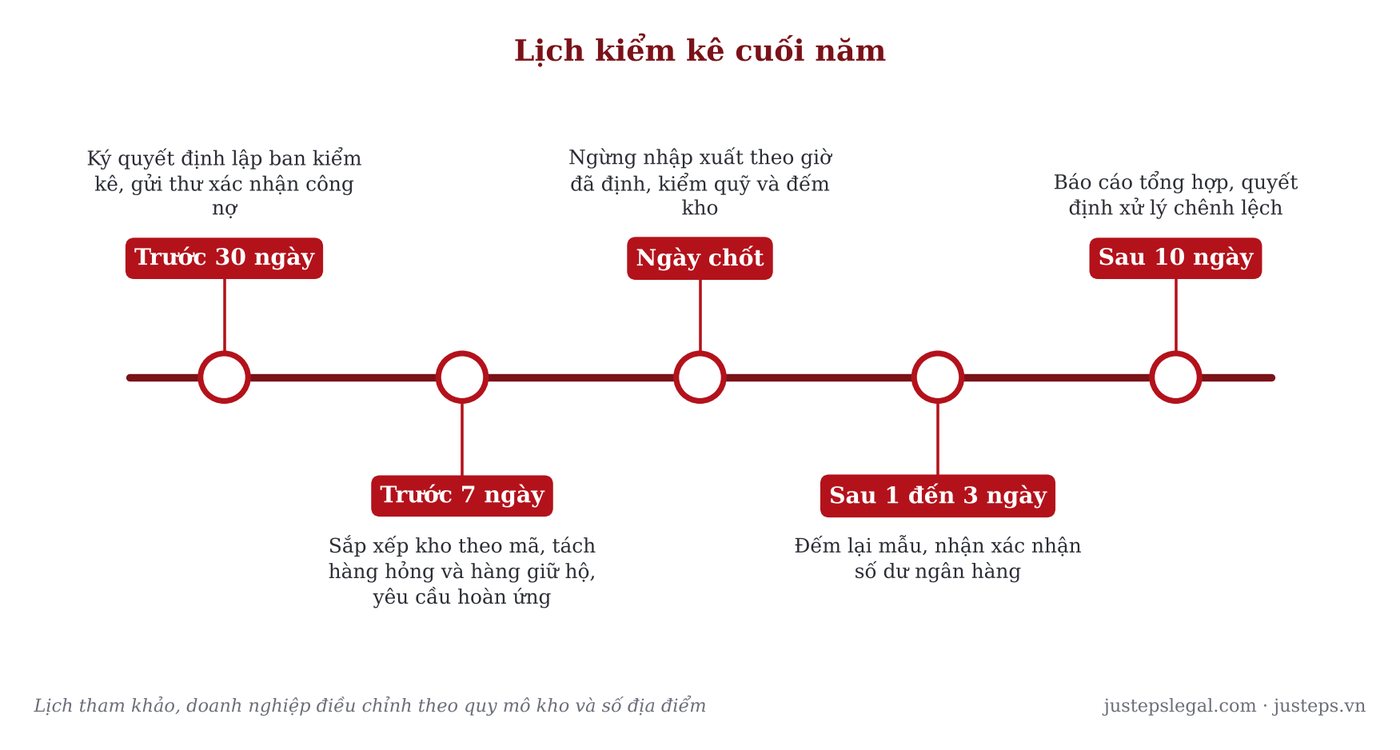
Reference stocktaking schedule built backwards from the cut-off date
The schedule shows that most of the work takes place before and after the counting day, not on the day itself. Sending debt confirmation requests a month in advance allows enough time to receive replies, while arranging the warehouse a week in advance helps the count teams work quickly and with fewer mistakes. The final milestone is the summary report and the decision on how to deal with discrepancies, because these are the basis on which the accountant records entries before preparing the annual financial statements.
Carrying out the stocktake for each group of assets
Each group of assets is checked in a different way, and a good stocktaking procedure should set out separate steps for each group instead of using a single set of minutes for everything. The section below covers the four most common groups in small and medium-sized businesses, in the order in which they are usually checked on the cut-off date and the days around it.
Cash on hand and bank deposits
Cash on hand is counted at the end of the last working day of the year, after all receipt and payment vouchers for that day have been recorded. The cashier opens the safe in the presence of the stocktaking committee, and the counter records the number of notes for each denomination, adds up the actual cash and compares it with the balance in the cash book. For bank deposits, the business asks each bank to confirm the balance as at 31 December and reconciles it with the deposit ledger of each account, including accounts with few transactions, foreign currency accounts and escrow accounts. Cash in transit, such as cheques deposited but not yet credited by the bank, must be listed separately to explain any difference.
Inventory
Inventory is the group most prone to discrepancies and requires the strictest counting discipline. Businesses should use blind counting, meaning that count sheets show only the item code, item name and location and not the book quantity, so that counters record what they actually see rather than a figure they already know. Each count team consists of one person who counts and one who records, working location by location from left to right and from top to bottom, and putting a counted label on each shelf. After a team has finished, another person recounts around one tenth of the item codes at random; if the error rate in the sample exceeds the level set by the business, for example 2%, the whole area must be counted again.
Four kinds of goods need to be recorded separately because they are easily counted in by mistake or left out of inventory. Goods in transit already belong to the business but have not yet arrived at the warehouse, goods sent to agents or on consignment are held in someone else’s warehouse, goods held on behalf of customers are in the warehouse but do not belong to the business, and substandard or slow-moving goods are still inventory but may require a provision for decline in value. For goods held by a third party, the business needs a written confirmation from the party holding the goods as at the cut-off date. For substandard goods, the count team records their condition clearly so that the accountant has a basis for considering a provision and the director can decide whether to dispose of them or continue selling them.
Fixed assets and tools and supplies
Fixed assets and tools and supplies are checked against the list for each department or each location. Each asset should carry a tag whose code matches the code in the asset register, and the stocktaking team records the condition of each asset as in use, not in use, damaged awaiting repair or damaged awaiting disposal. The result should be two separate lists, namely assets that appear in the books but cannot be found, and assets that physically exist but are not yet in the books. The first list is the basis for establishing responsibility or writing assets off, while the second usually arises from small purchases that were never recorded or assets that were donated or transferred without supporting documents.
Continuing to depreciate damaged assets is a very common mistake, which misstates depreciation expense and makes it likely to be disallowed as a deductible expense for corporate income tax purposes. Businesses that already have an annual procedure for managing assets and tools will find the year-end stocktake much faster, because the list has been updated with each issue, transfer and return.
Receivables, payables and advances
Debts cannot be counted, so they are checked by reconciling and confirming balances with counterparties as at the cut-off date. The accountant sends reconciliation statements to customers and suppliers with significant balances, stating the balance according to the business’s books and asking the counterparty to confirm it or provide its own figures. For advances, employees must settle their advances or confirm the remaining balance before the books are closed, because long-outstanding advances often conceal expenses that have been incurred but are not yet supported by documents. Receivables should be analysed by age, because long-overdue amounts are the basis for considering a provision for doubtful debts and for the sales department to plan collection.
Dealing with discrepancies and recording stocktaking results
After the stocktake, the accounting unit must prepare a summary report of the results, and where there is a difference between the actual figures and the accounting books, it must identify the cause and reflect the difference and the outcome of its treatment in the books before preparing the financial statements[5]. The law also requires the stocktake to reflect accurately the actual assets and the sources from which they were formed, and the persons who prepare and sign the summary report on stocktaking results are responsible for those results[6]. Accordingly, the accountant should not record a difference straight away as an expense or as income once the count figures are available, but must go through the steps of explanation and a decision on treatment.
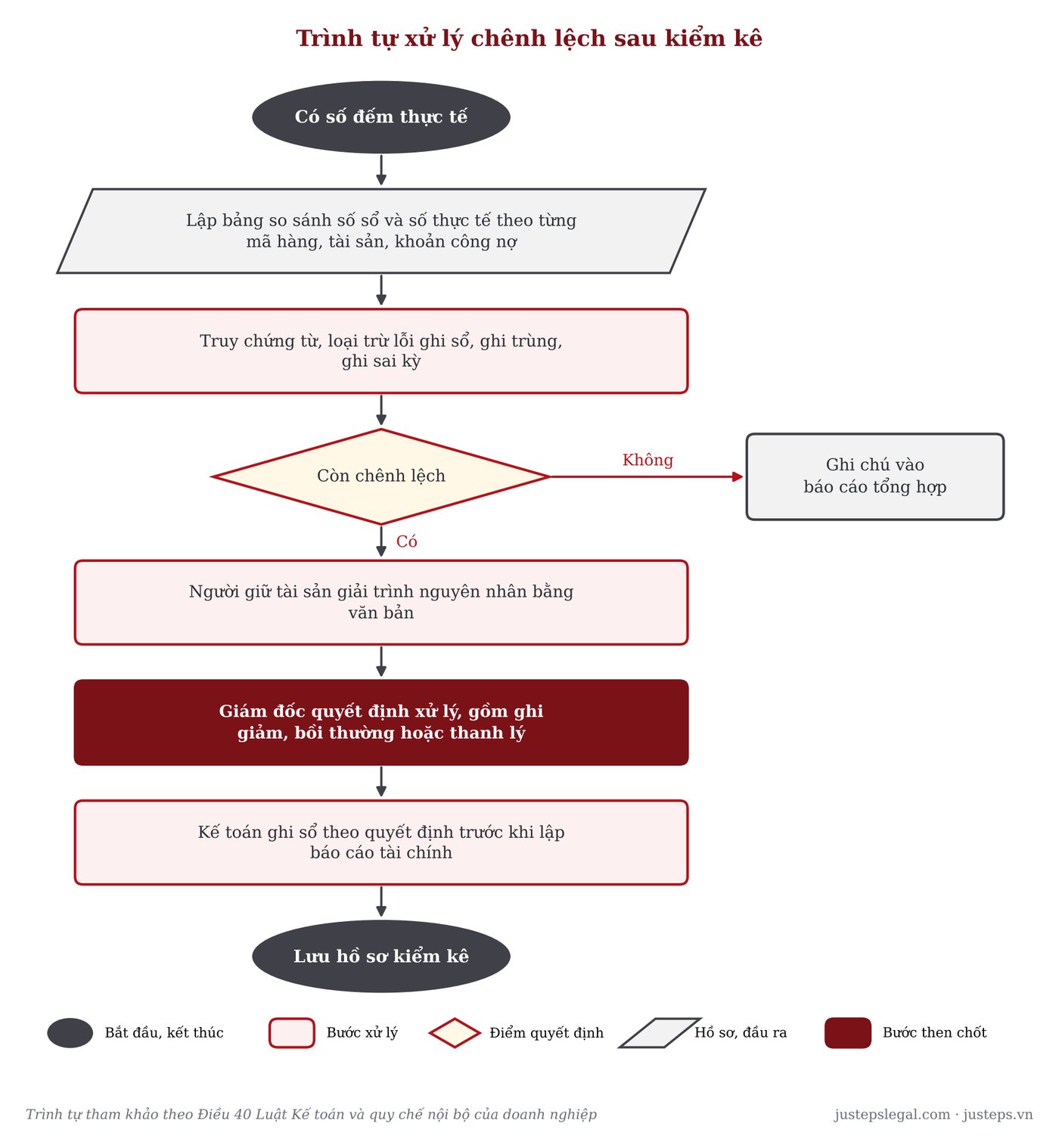
Sequence for dealing with discrepancies after the stocktake
The sequence begins with a comparison of book and actual figures for each item code, each asset and each debt. Before concluding that there is a shortage or a surplus, the accountant and the storekeeper trace back through the documents to rule out bookkeeping errors such as receipt or issue slips recorded under the wrong code, recorded twice or recorded in the wrong period. Only the difference remaining after this step is a genuine discrepancy, and its cause must be explained in writing. The director decides how each item is to be dealt with, and the accountant records entries only on the basis of that decision.
The treatment differs according to the type of discrepancy. For inventory shortages, the business separates losses within the norms it has issued from losses exceeding those norms, because losses above the norms require the cause and the person responsible to be identified. For cash shortages, the cashier must give an explanation and the director decides on compensation. Where an employee loses tools, equipment or other property of the business, compensation is governed by the Labour Code and the internal labour regulations, following the prescribed procedure for review and decision[7], so the level of compensation should be set out in the internal labour regulations before it is applied. For debts that do not match, the accountant reconciles each document with the counterparty and prepares adjustment minutes once the cause has been found.
Damaged goods discovered during the stocktake should not be written off immediately. The business needs minutes establishing the cause, quantity and value, together with the director’s decision on treatment, and only then destroys or disposes of the goods and records the entries. This set of records is also the basis on which the loss may be considered a deductible expense under the law on corporate income tax[8], whereas losses without supporting records are usually disallowed at finalisation or during a tax inspection. Businesses wishing to standardise this entire stage in their internal regulations may refer to Justeps’ service for building an internal financial control system.
Common mistakes in the year-end stocktake
Mistakes in stocktaking tend to repeat themselves from one business to another, regardless of industry or size. The chart below illustrates how often each type of mistake occurs in a hypothetical group of files, to help businesses decide which points to control first.
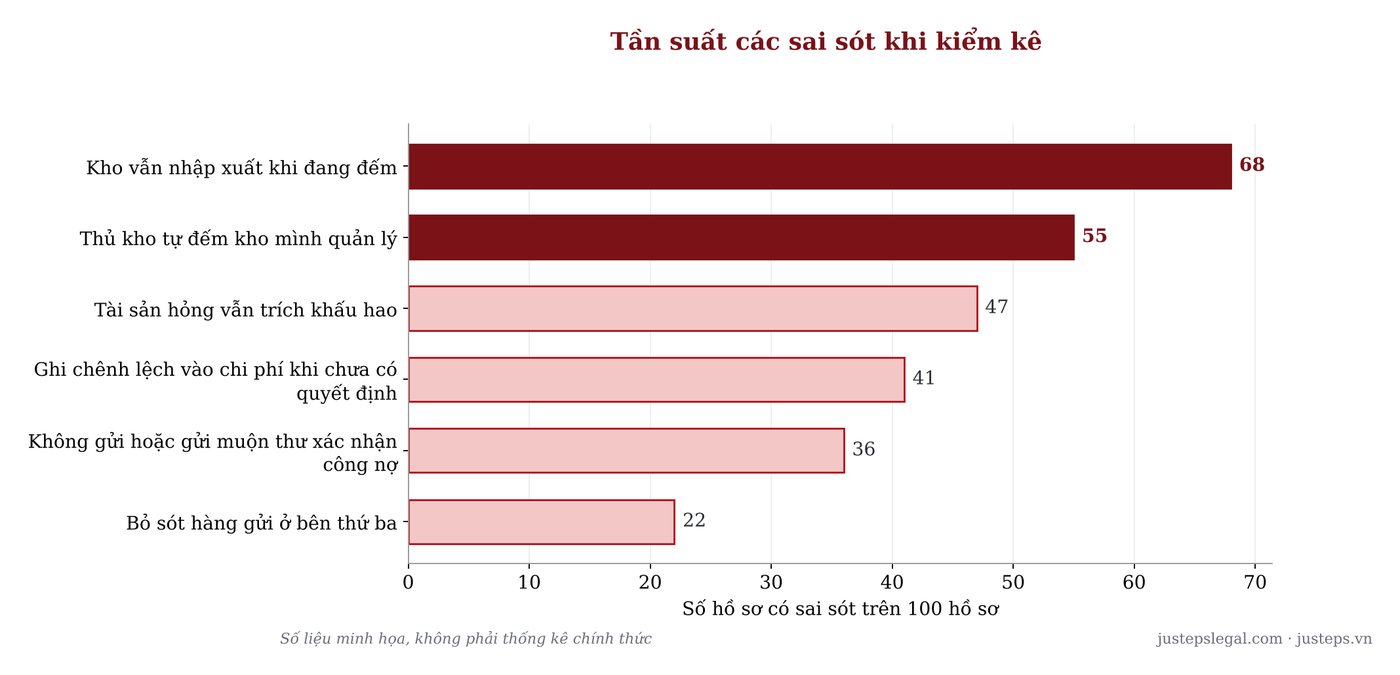
Common mistakes in the year-end stocktake
The two most common mistakes in the example are goods still moving in and out of the warehouse during the count without a cut-off time, and storekeepers counting the warehouse they manage themselves. The first mistake means the count cannot be tied to a specific point in time, so it cannot be reconciled with the book figures. The second mistake undermines the independence of the results, because the person with an interest in concealing differences is the one recording the figures. Both mistakes can be eliminated entirely by a decision establishing the stocktaking committee that states the cut-off time and the composition of the count teams.
The remaining mistakes are continuing to depreciate damaged assets, recording differences directly as expenses without a decision on treatment, failing to send debt confirmation requests or sending them too late, and leaving out goods held by third parties. Each mistake may be small on its own, but together they often lead to a qualified audit opinion on inventory or receivables, or to adjustments when the tax authority carries out an inspection. Businesses should turn these mistakes into a checklist within their stocktaking regulation so that the committee can review them before signing the report.
Stocktaking records and retention periods
Stocktaking results are valid only when they are supported by complete records signed by those who took part. The minimum set of records for a year-end stocktake comprises the following documents:
- The decision establishing the stocktaking committee and the stocktaking plan, with the schedule, the cut-off time and the assignment of count teams.
- Inventory count sheets by location, signed by the counter, the recorder and the witness.
- Minutes of the cash count recorded by denomination, together with balance confirmations from each bank.
- Minutes of the stocktake of materials and goods, showing the book quantity, the actual quantity and the difference for each item code.
- Minutes of the stocktake of fixed assets and tools and supplies, showing the condition of each asset.
- Debt reconciliation statements confirmed by counterparties, or evidence that confirmation requests were sent.
- The summary report on stocktaking results, the written explanations and the director’s decisions on dealing with discrepancies.
Stocktaking records are accounting documents, so they must be placed in storage within 12 months from the end of the annual accounting period, and documents used directly for recording entries and preparing financial statements must be kept for at least 10 years[9]. The decree guiding the Law on Accounting lists the specific types of documents in the 10-year retention group, including documents relating to stocktaking and asset valuation[10]. Businesses should keep signed paper copies together with scanned copies in folders by year, so that they can be provided immediately when an auditor or tax inspector asks for them.
After each stocktake, the committee should hold a short lessons-learned meeting to update the regulation and forms for the following year, for example by adding new warehouse locations, adjusting the sample recount rate or changing the composition of the count teams. Businesses can also move part of the work to periodic quarterly counts or rotating counts by product group, so that the year-end stocktake is lighter and discrepancies are detected earlier. Businesses that need to develop a stocktaking regulation, a set of forms and an allocation of roles within the accounting department may refer to Justeps’ service for organising the accounting function and documentation.
How Justeps can help
Justeps supports businesses in preparing for and organising the year-end stocktake through the following services:
- Organising the accounting function and documentation. Justeps drafts the stocktaking regulation, the set of count sheets and minutes, and the allocation of roles within the accounting department under the new accounting regime.
- Building an internal financial control system. Justeps designs rules separating asset custody from bookkeeping, the procedure for dealing with discrepancies and the approval authorities.
- Review of deductible expenses and corporate income tax finalisation. Justeps reviews the records for damaged goods, losses, provisions and disposed assets before the business finalises its tax.
- Finance, accounting and internal control training for managers. Justeps runs briefing sessions for the stocktaking committee, storekeepers and count teams before the cut-off date.
Frequently asked questions
May a business take stock a few days before or after 31 December?
Yes, if it is not possible to organise the count on 31 December itself. In that case the business must adjust the counted quantities for the receipts and issues between the count date and the cut-off date to arrive at the correct closing stock at the end of the annual accounting period.
Does a small business without its own warehouse have to take stock?
Yes, because the obligation to take stock at the end of the annual accounting period applies to every accounting unit. The business must still count its cash, confirm its bank balances, reconcile its debts and check the list of assets and tools in use[2].
May the storekeeper sit on the stocktaking committee?
The storekeeper should be present to witness the count, point out where goods are located and explain discrepancies. Counting and recording count sheets should be done by people from other departments, in keeping with the principle in the Law on Accounting of separating the custody of assets from bookkeeping[4].
What if a counterparty does not reply to a debt confirmation request?
The business keeps evidence that the request was sent and checks payment documents arising after the cut-off date to verify the balance. Unconfirmed balances should be noted in the summary report on stocktaking results.
May damaged goods found during the stocktake be written off immediately?
This is not advisable. The business needs minutes establishing the cause, quantity and value, together with the director’s decision on treatment, before recording any entries, because these are the basis on which the loss may be considered a deductible expense[8].
Who is responsible for the stocktaking results?
The persons who prepare and sign the summary report on stocktaking results are responsible for those results[6]. In practice, these are usually the chief accountant as chair of the committee and the director as the approver.
How long must stocktaking records be kept?
Stocktaking records are accounting documents, which must be placed in storage within 12 months from the end of the year and belong to the group of documents kept for at least 10 years[9].
Related articles
- Managing fixed assets and tools in a business, from the asset register and issue to stocktaking and compensation
- Inventory management for small trading businesses
- Organising accounting for a newly incorporated company, from choosing the accounting regime to document flows and record retention
- Practical lessons on handover when an accountant leaves the business
Notes
[1] Clause 1 of Article 40 of the Law on Accounting No. 88/2015/QH13 dated 20 November 2015.
[2] Clause 2 of Article 40 of the Law on Accounting No. 88/2015/QH13.
[3] Circular No. 99/2025/TT-BTC of the Ministry of Finance providing guidance on the enterprise accounting regime, applicable from 1 January 2026 and replacing Circular No. 200/2014/TT-BTC.
[4] Clause 4 of Article 52 of the Law on Accounting No. 88/2015/QH13.
[5] Clause 3 of Article 40 of the Law on Accounting No. 88/2015/QH13.
[6] Clause 4 of Article 40 of the Law on Accounting No. 88/2015/QH13.
[7] Articles 129 and 130 of the Labour Code No. 45/2019/QH14 dated 20 November 2019.
[8] Law on Corporate Income Tax No. 67/2025/QH15 and its guiding documents on deductible expenses.
[9] Clause 3 and Point b, Clause 5 of Article 41 of the Law on Accounting No. 88/2015/QH13.
[10] Article 13 of Government Decree No. 174/2016/ND-CP dated 30 December 2016 detailing a number of articles of the Law on Accounting.
This article is for reference and reflects the regulations in force at the time of publication. Please consult Justeps for advice tailored to your company’s records and situation.
For further information, please contact:
📩 Email: info@justeps.vn
🌐 Website: https://justepslegal.com · https://justeps.vn
🌐 Page: Justeps
☎️ Hotline (Zalo): 096 172 2607
📍 Thanh Xuan Office: 12th Floor, Licogi 13 Tower, 164 Khuat Duy Tien Street, Thanh Xuan Ward, Hanoi, Vietnam
📍 Ha Dong Office: LK06B, No.10, Dong Dua Area, Ha Dong Ward, Hanoi, Vietnam
📍 Ho Chi Minh City Branch: 528 Le Van Sy, Ho Chi Minh City, Vietnam
📍 Hai Phong Office: Truong Thinh Village, Ha Dong Commune, Hai Phong, Vietnam
📍 Quang Ninh Office: Van Don Special Zone, Quang Ninh Province, Vietnam





