
Key takeaways
- When a business grows beyond 50 staff, the number of working relationships grows far faster than headcount, so a way of running the business that relies on the owner approving everything becomes a bottleneck.
- An approval matrix based on value thresholds and letters of authorisation with a fixed term and limits is the quickest remedy, but it works only if the director genuinely stops re-approving matters that have been delegated.
- Greater size brings stricter requirements on wage scales and pay tables, registered internal labour regulations, contract records and labour reporting; the business may also no longer qualify as a small enterprise for support purposes.
- A six-month roadmap, moving from the organisation chart, delegation and pay to labour records and management reporting, helps the business deal with bottlenecks in order of priority without disrupting its operations.
Many businesses grow well in their first few years because the owner handles everything directly, from orders and recruitment to every item of expenditure. Once headcount passes about 50, this very approach begins to hold the business back, as documents wait days for signature, staff do not know whom to ask, team leaders do not dare to decide, capable people leave because their pay does not reflect their contribution and the first labour disputes appear. Revenue continues to rise, but profit and the speed of decision-making fall, and the owner works longer hours yet still finds everything slow.
This article analyses why the 50-staff mark is often the point at which the old way of operating no longer fits, identifies common bottlenecks in approvals, middle management, pay, recruitment and management data, and sets out the legal obligations that change with the size of the workforce. The final part suggests a six-month roadmap for resolving them. It is written for business owners, boards of management and those responsible for HR and administration in private businesses with 30 to 150 staff, including family businesses moving towards professional management.
Why the 50-staff mark changes the way a business operates
When a business has about 20 staff, the owner can talk directly to each employee, information spreads through short meetings and everyone knows who is doing what. The number of working relationships between individuals in a group grows much faster than the number of people, since it equals the number of people multiplied by that number minus one, divided by two, so when headcount rises from 20 to 50, the number of relationships rises more than sixfold. Meanwhile, the director’s time does not increase, and one person can effectively manage only about 6 to 10 people directly.
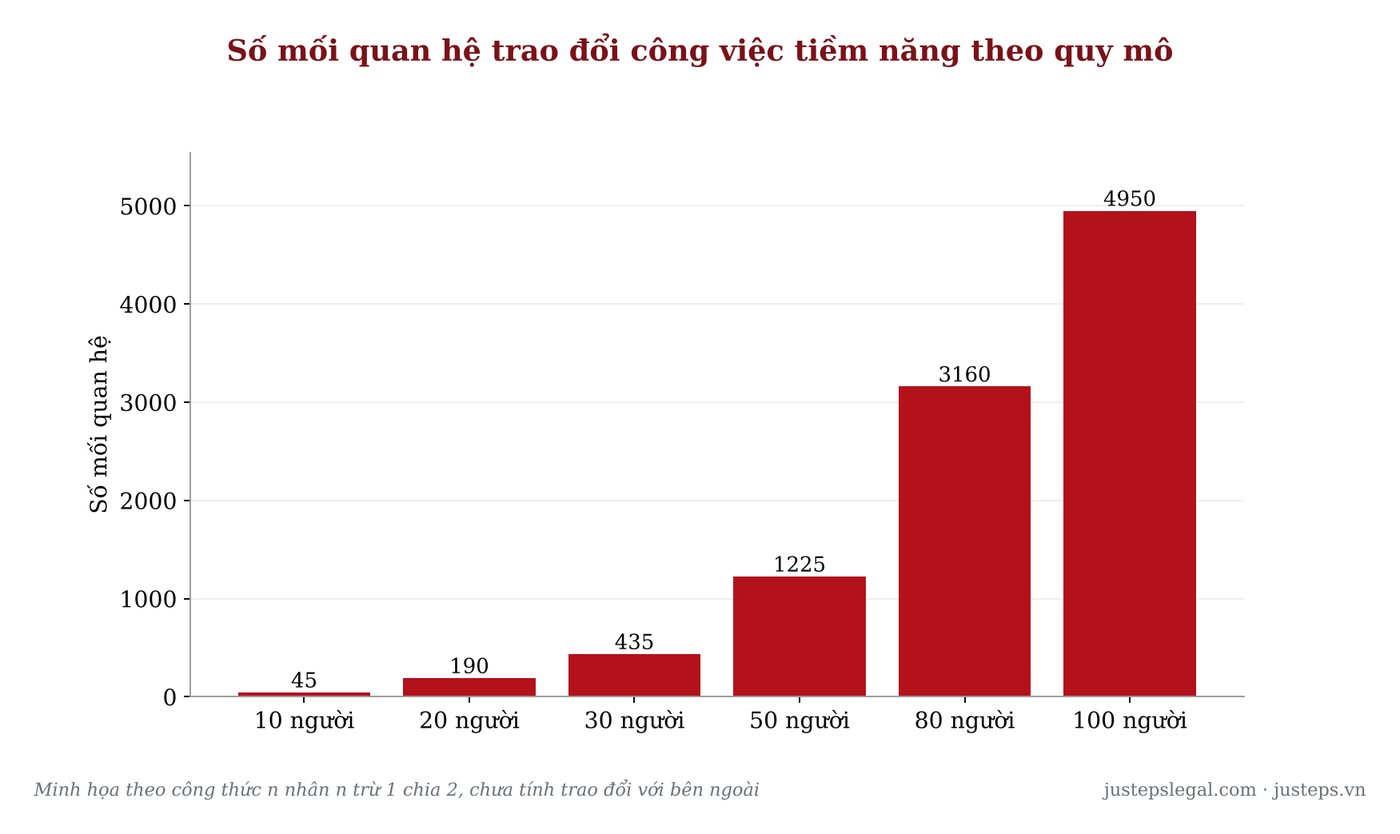
Number of potential working relationships by headcount
The chart shows that a business with 20 staff has 190 potential working relationships, but at 50 staff the figure is already 1,225 and at 100 staff it is 4,950. Not every relationship is used, but if the business has no clear reporting structure, most information still has to pass through the director, who becomes the blockage point for the whole system. At this size, therefore, the business needs an intermediate layer of managers with real authority, together with standardised rules on delegation, information flows and records.
Approvals concentrated on the director and how to delegate authority
The most visible bottleneck is that every request to spend money, buy goods, recruit staff or sign contracts waits for the director’s approval. The cause is usually not that the director wants to keep control of everything, but that the business has no document setting out who may decide what, and up to what amount. As a result, orders are delayed, suppliers are not paid on time, the business loses early payment discounts and the director no longer has time for major customers, negotiations and recruiting key people.
Legally, the authority of the director or general director is determined by the Law on Enterprises, the company charter and the decisions of the owner, the Members’ Council or the Board of Directors[1]. Within that authority, the legal representative may authorise another person to enter into and perform transactions in the name of the company, and the authorised person may act only within the scope of the authorisation[2]. A transaction exceeding the scope of authorisation does not create obligations for the company in respect of the excess unless the company consents or knows of it and does not object, so the letter of authorisation must state clearly the type of matter, the value limit and the term.
A common remedy is to draw up an approval matrix by type of transaction and value threshold. For example, routine expenditure below VND 20 million is approved by the head of department, amounts from VND 20 million to VND 200 million are approved jointly by the chief accountant and the deputy director in charge, and only amounts above VND 200 million, loans, guarantees and transactions with related persons go to the director. The specific thresholds depend on revenue, profit margins and the degree of trust in the team, and should be reviewed after three to six months of use. The flowchart below illustrates how a payment request passes through the approval matrix.
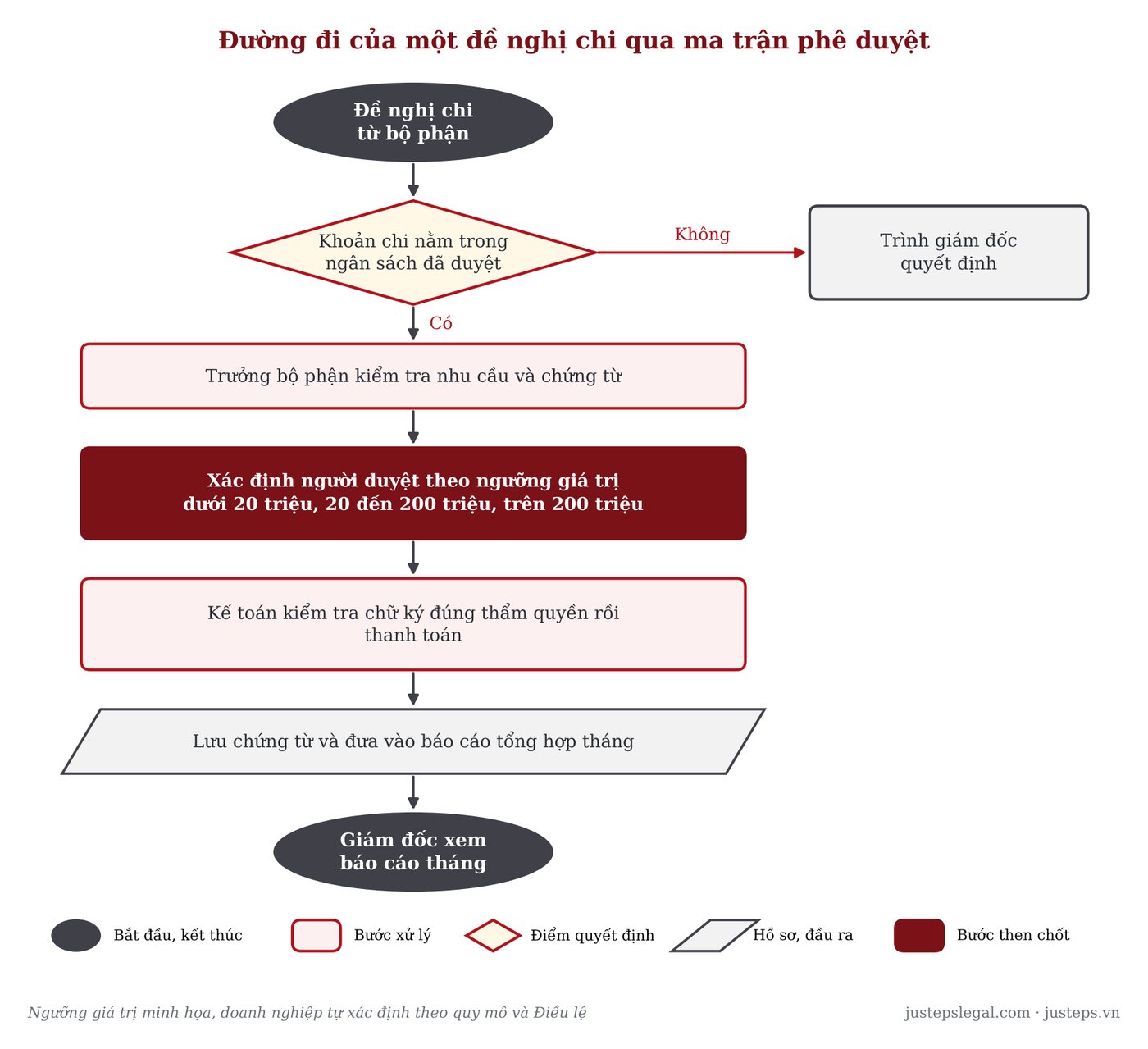
The route of a payment request through an approval matrix based on value thresholds
Each request is first checked to establish whether it falls within the approved budget, because items outside the budget always require a decision at a higher level. For items within the budget, the amount determines the approver, and the accountant makes payment only when the documents carry all the signatures required by the delegated authority. The crucial point is that the director does not re-approve items delegated to subordinates but reviews only the periodic summary report, because if the director still intervenes item by item, the matrix exists only on paper. Businesses may consider Justeps’ service on financial regulations and delegation of authority to build a matrix and letters of authorisation consistent with the charter.
Middle management and internal information flows
At around 50 staff, a business usually has 5 to 8 team leaders, most of whom were promoted for their technical expertise rather than their management skills. Without training and without job descriptions for management positions, they continue doing technical work, are reluctant to delegate and push every decision up to the director. The intermediate management layer then exists only on the organisation chart, while the director still has to deal directly with the work of dozens of people.
The business should write a separate job description for each management position, stating the number of direct reports, the decisions the manager may take alone, the team’s targets and the responsibility for developing staff. The first three months after promotion are decisive, so new managers need training in delegating work, appraisal, giving feedback and handling disciplinary breaches through the proper procedure. At the same time, information flows should be organised in tiers, with weekly meetings at team level, monthly meetings at board of management level and an official channel for announcing decisions, instead of letting information drift through many chat groups with no hierarchy. To develop a consistent organisation chart and job descriptions, businesses may consider Justeps’ service on organisational structure, functions and duties, and job descriptions.
Pay, recruitment and labour records need to be standardised
While a business is small, each employee usually agrees their pay individually with the owner. At 50 staff, employees start comparing their earnings with one another, and differences that cannot be explained become a reason for leaving. The Labour Code requires the business to develop wage scales, pay tables and labour norms as the basis for recruitment, agreeing wages and paying wages, to consult the employee representative organisation where one exists and to publish them at the workplace before applying them[3], and also to pay equal wages for work of equal value[4]. A business that fails to develop or publish wage scales and pay tables, or fails to pay equal wages, may face administrative penalties, with the fine for an organisation being twice that for an individual[5].
Recruitment and onboarding also need a common procedure. When each department recruits in its own way, the business finds it difficult to control headcount, agreed wages and the quality of candidates, and the proportion of new starters leaving within the first two months is often high. Every employee must be engaged under a written employment contract, except where a contract of less than one month may be concluded orally as permitted[6], and the contract must contain the main terms such as the job, wage, form of pay, working hours and social insurance[7]. The business should use a single set of contract templates and a common onboarding checklist for new staff, covering an introduction to the internal rules, the job description, probation targets and a mentor.
Labour records are easily neglected when a business grows quickly. The business must keep a labour management register, declare its use of labour and periodically report changes in its workforce to the provincial labour authority, while also notifying the social insurance authority[8]. As headcount rises quickly, small errors such as expired contracts not renewed, staff not registered for insurance or contributions that do not match the wages actually paid add up to a major risk in the event of an inspection or dispute.
Legal obligations that change with the size of the workforce
Beyond management issues, the size of the workforce is also the basis on which certain legal obligations and support policies apply. Businesses often discover these changes only when a state authority asks them to supplement their records or when an application for support is refused. The table below summarises the thresholds to watch:
| Size threshold | Obligation or consequence | What the business should do |
|---|---|---|
| From 10 employees | The internal labour regulations must be in writing and registered with the provincial labour authority. | Review the existing regulations, re-register them when amended and communicate them to employees. |
| Any size | Workplace dialogue must be held periodically at least once a year and whenever one party requests it. | Schedule dialogue sessions and keep minutes recording employees’ views and how they were addressed. |
| Over 50 or 100 employees | The business may no longer be a small enterprise under the criterion of employees participating in social insurance. | Recheck eligibility before applying for support intended for small and medium-sized enterprises. |
| Size and sector | Staff must be assigned to occupational safety and hygiene and to healthcare according to headcount and the nature of the sector. | Determine whether full-time or part-time staff are required and assign the duties in writing. |
| Not based on headcount | The preferential corporate income tax rates for small enterprises are determined by annual revenue. | Monitor annual revenue rather than headcount when planning tax. |
As regards internal labour regulations, a business employing 10 or more employees must issue them in writing and register them with the provincial labour authority within 10 days of issue[9]. Regulations drafted when the business had 15 staff often no longer fit the new structure, especially the provisions on shifts, protection of assets, business secrets and disciplinary offences. Where the internal regulations do not specify a particular act, the business may not discipline an employee for that act, so updating the regulations is a precondition for managing discipline at a larger scale. In addition, the business must hold periodic dialogue at the workplace at least once a year[10], and at 50 staff or more a meaningful dialogue session is often the channel through which dissatisfaction over pay is detected early.
As regards the classification of small and medium-sized enterprises, the headcount criterion is the annual average number of employees participating in social insurance, combined with total revenue or total capital. In trade and services, a small enterprise has no more than 50 employees and a medium-sized enterprise no more than 100, while in industry and construction the corresponding thresholds are 100 and 200 employees[11]. A business that passes a threshold may therefore move into a different category and see its entitlement under support programmes change. Similarly, the 2025 Law on Personal Data Protection allows small enterprises and start-ups to choose not yet to perform certain obligations for a specified period, such as designating a personal data protection unit or officer, except in certain cases involving the processing of sensitive data or the provision of data processing services[12], so a business that has reached medium size needs to prepare to comply in full.
Some other obligations depend on both headcount and sector. The Law on Occupational Safety and Hygiene requires the business to assign staff to occupational safety and hygiene and to healthcare, on a full-time or part-time basis depending on its size and the nature of the work[13]. Conversely, the preferential corporate income tax rates of 15% and 17% for businesses with annual revenue of no more than VND 3 billion and no more than VND 50 billion are determined by revenue rather than headcount[14], so taking on more staff does not automatically change the tax rate.
Management data and the cost of delaying restructuring
The last bottleneck, and one that often receives little attention, is fragmented management data. Each department tracks its figures in its own spreadsheet, and sales, receivables and inventory are calculated inconsistently, so every board of management meeting spends time reconciling figures instead of making decisions. The business should agree on a single monthly management report template with around 10 to 15 indicators, including revenue, gross margin, cash flow, overdue receivables, inventory, payroll cost as a share of revenue, staff turnover and average approval time.
The cost of delaying restructuring is usually greater than the owner thinks, because it is scattered across many small items. Time spent waiting for approval slows deliveries and loses discounts, excessive staff turnover brings recruitment and retraining costs, and errors caused by slow information lead to rework and customer complaints. The business should estimate these items using its own data for the last six months and compare them with the cost of investing in management staff, consultancy and software, rather than deciding on impressions.
A six-month roadmap for resolving the bottlenecks
The bottlenecks described above are closely linked, so the business should not deal with them piecemeal, solving each problem only as it appears. The sensible order is to settle the organisational structure first, then delegate authority, develop pay arrangements, standardise records and finally measure again. The indicative roadmap below divides the work over six months.
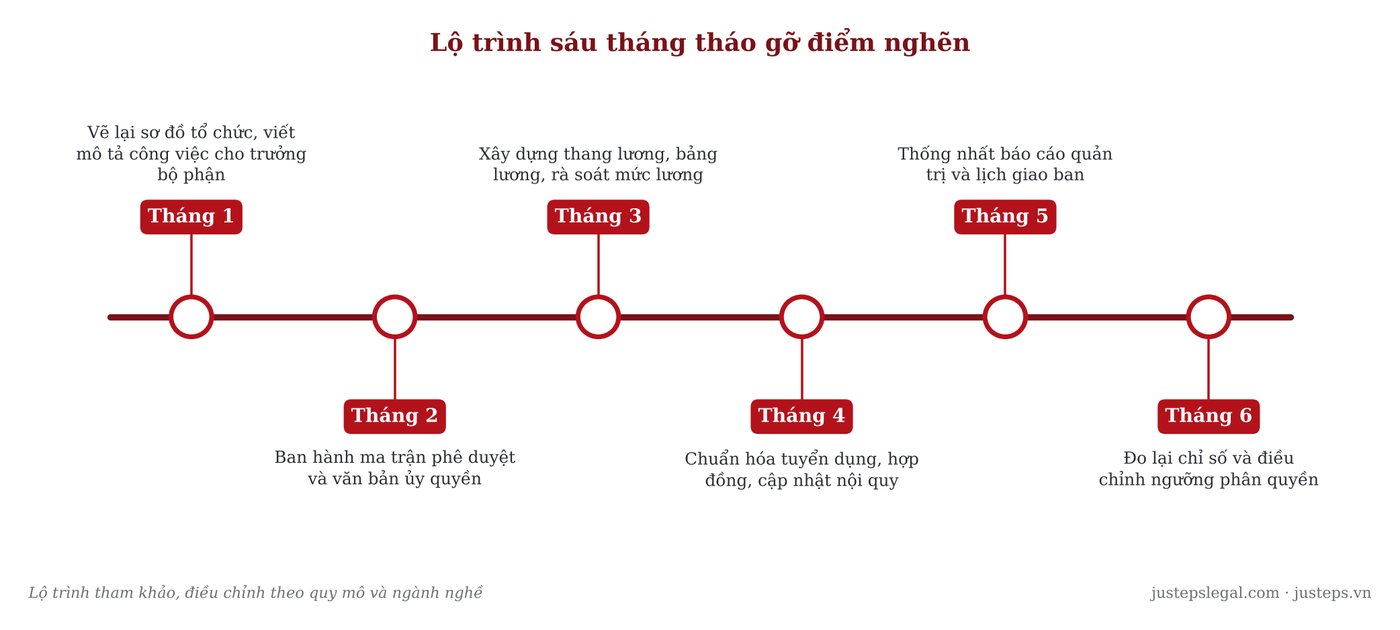
Six-month roadmap for resolving management bottlenecks
The first month is spent redrawing the organisation chart, defining the intermediate management layer and writing job descriptions for heads of department, since this is the foundation for every later step. The second month is for issuing the approval matrix and the letters of authorisation, and the third for developing or updating the wage scales, pay tables and pay bands and reviewing current wage levels. The fourth month focuses on recruitment, onboarding, reviewing contracts and updating the internal labour regulations, with re-registration if they have changed, while the fifth month standardises the management report template and the schedule of tiered meetings. By the sixth month, the business measures approval times, staff turnover and errors again and adjusts the delegation thresholds accordingly.
Certain mistakes commonly cause the roadmap to fail. The business adds a management layer but the director still approves everything, recruits an HR manager before having an organisation chart and a budget, copies the entire set of rules of a large business that does not fit its own size, or keeps its old internal regulations even though the structure has changed. The set of documents the business should have after six months comprises the organisation chart and job descriptions, the approval matrix and authorisation decisions, the wage scales, pay tables and pay and bonus rules, the registered internal labour regulations, the labour management register, a set of contract templates and an operating indicators tracker.
How Justeps can help
Justeps helps businesses resolve management bottlenecks when they grow beyond 50 staff through the following services:
- Organisational structure, functions and duties, and job descriptions. Justeps redesigns the organisation chart, defines the intermediate management layer and writes a job description for each position.
- Financial regulations and delegation of authority. Justeps develops an approval matrix based on value thresholds and drafts letters of authorisation consistent with the charter.
- Salary scales and pay and bonus regulations. Justeps develops wage scales, pay tables, pay bands and bonus rules to address differences in pay that are hard to explain.
- Internal governance rules and procedures development. Justeps standardises the recruitment and onboarding procedures, internal labour regulations and management report templates.
- In-house training. Justeps trains newly promoted team leaders in management skills, including delegation, appraisal and handling discipline through the proper procedure.
Frequently asked questions
Should the 50-staff mark be counted by employees with employment contracts or by those paying social insurance?
For management purposes, the business should count everyone who works regularly, including collaborators who work continuously. When determining whether a business is a small or medium-sized enterprise, the legal criterion is the annual average number of employees participating in social insurance[11].
Does exceeding 50 employees change the corporate income tax rate?
No. The preferential rates of 15% and 17% are determined by the annual revenue of the business, not by the number of employees[14].
Must a business that registered its internal regulations when it had 15 staff register them again?
The business is not required to re-register merely because its headcount has grown. However, when it amends or supplements the regulations to fit its new structure, it must register the amended regulations through the proper procedure[9].
Does a business with 50 staff need its own HR department?
The business should have at least one person dedicated to HR to manage contracts, insurance, internal regulations and recruitment. An HR department of two to three people is usually appropriate once the business reaches around 80 to 100 staff.
May the director authorise a deputy director to sign contracts on their behalf?
Yes, if the authorisation falls within the director’s authority under the charter and is made in a letter of authorisation stating the scope, value limit and term. The authorised person may sign only within the scope of the authorisation[2].
At what level should approval thresholds be set?
There is no single level for every business, because thresholds depend on revenue, profit margins and the reliability of the team. The business should start at a cautious level, monitor it for three to six months and then gradually raise the thresholds for routine expenditure.
Related articles
- Which documents make up the minimum set of internal governance rules for a company with 50 to 200 staff
- The authority of the General Director and how to delegate executive powers within the limits of the charter and internal rules
- Restructuring a fast-growing business so that its organisation keeps pace with its new scale
- Five common pay models and how a business can choose the right one for each group of positions
Notes
[1] Articles 63 and 162 of the Law on Enterprises No. 59/2020/QH14 dated 17 June 2020, as amended and supplemented by Law No. 76/2025/QH15.
[2] Articles 138, 141 and 143 of the Civil Code No. 91/2015/QH13 dated 24 November 2015.
[3] Article 93 of the Labour Code No. 45/2019/QH14 dated 20 November 2019.
[4] Clause 3 of Article 90 of the Labour Code No. 45/2019/QH14.
[5] Government Decree No. 283/2026/ND-CP on administrative penalties for violations in the fields of labour and social insurance, effective from 10 September 2026.
[6] Article 14 of the Labour Code No. 45/2019/QH14.
[7] Clause 1 of Article 21 of the Labour Code No. 45/2019/QH14.
[8] Article 12 of the Labour Code No. 45/2019/QH14; Government Decree No. 145/2020/ND-CP dated 14 December 2020.
[9] Articles 118, 119 and 127 of the Labour Code No. 45/2019/QH14.
[10] Article 63 of the Labour Code No. 45/2019/QH14.
[11] Article 5 of Government Decree No. 80/2021/ND-CP dated 26 August 2021 detailing and guiding the implementation of certain articles of the Law on Support for Small and Medium-sized Enterprises.
[12] The Law on Personal Data Protection No. 91/2025/QH15 and Decree No. 363/2026/ND-CP.
[13] Articles 72 and 73 of the Law on Occupational Safety and Hygiene No. 84/2015/QH13 dated 25 June 2015.
[14] Clauses 2 and 3 of Article 10 of the Law on Corporate Income Tax No. 67/2025/QH15.
This article is for reference and reflects the regulations in force at the time of publication. Please consult Justeps for advice tailored to your company’s records and situation.
For further information, please contact:
📩 Email: info@justeps.vn
🌐 Website: https://justepslegal.com · https://justeps.vn
🌐 Page: Justeps
☎️ Hotline (Zalo): 096 172 2607
📍 Thanh Xuan Office: 12th Floor, Licogi 13 Tower, 164 Khuat Duy Tien Street, Thanh Xuan Ward, Hanoi, Vietnam
📍 Ha Dong Office: LK06B, No.10, Dong Dua Area, Ha Dong Ward, Hanoi, Vietnam
📍 Ho Chi Minh City Branch: 528 Le Van Sy, Ho Chi Minh City, Vietnam
📍 Hai Phong Office: Truong Thinh Village, Ha Dong Commune, Hai Phong, Vietnam
📍 Quang Ninh Office: Van Don Special Zone, Quang Ninh Province, Vietnam





