
Key takeaways
- The law has no separate seasonal contract or collaborator contract, so a relationship is assessed by its actual content rather than by the name of the document.
- An agreement involving work, payment and management and direction by one party is an employment contract, even if the parties call it a collaborator contract or a service contract.
- Employees working under an employment contract of one full month or more are subject to compulsory social insurance, so splitting contracts to avoid this obligation creates a risk of arrears being collected.
- When paying VND 5 million or more per payment to an individual who has not signed an employment contract or has a contract of less than three months, the paying organisation must withhold 10% personal income tax.
- Freelance collaborators providing services should be managed through work orders and acceptance records, without timekeeping and without applying internal labour regulations and discipline as for employees.
Many businesses use seasonal workers and freelance collaborators to meet sudden surges in demand, such as a packing plant hiring several dozen extra people for the last three months of the year, a retail chain hiring sales staff for each promotional campaign, or a media company engaging freelance writers and designers project by project. The common practice is to agree verbally, pay cash weekly and refer to everyone as collaborators. Only when a labour inspection takes place, a worker has an accident or a long-serving collaborator claims an allowance does the business realise that the actual relationship is far removed from the name it was given.
This article analyses how to distinguish seasonal workers, freelance collaborators and service providers, the signs that cause an agreement to be regarded as an employment contract, how to conclude and manage seasonal employment, how to manage collaborators by work results, the obligation to withhold personal income tax, the records to keep and common mistakes. It applies to businesses in all sectors with seasonal or project-based staffing needs, and is written mainly for HR departments, payroll accountants and the direct managers of these groups of workers.
Seasonal workers and freelance collaborators from a legal perspective
The Labour Code 2019 provides for only two types of employment contract, namely indefinite-term contracts and fixed-term contracts with a term of no more than 36 months[1]. The seasonal contract of less than 12 months under the Labour Code 2012 no longer exists, so the people businesses habitually call seasonal workers are in substance employees working under short fixed-term employment contracts. All of the employer’s obligations on wages, working hours, occupational safety and insurance still apply to this group as to other employees, depending on the term of the contract.
A freelance collaborator, by contrast, is not a legal concept. Depending on how the work is actually done, a collaborator may be an employee under an employment contract or a service provider under a service contract under the Civil Code, in which the service provider performs work for the service user and the service user pays the service fee[2]. These two types of contract lead to very different obligations on social insurance, allowances, discipline and tax withholding, so the true nature must be determined before signing, not after a problem has arisen.
To choose the right form from the outset, a business should compare the expected duration of work and the way the work is organised with the obligations that arise. The table below summarises the common forms and their main obligations:
| Form | Suitable when | Main obligations of the business |
|---|---|---|
| Employment contract under 1 month | Work in very short bursts, such as loading goods over a few peak days. | No probation, not yet subject to compulsory social insurance, and 10% withholding on payments of VND 5 million or more. |
| Employment contract of 1 to under 3 months | Work for a whole season, such as the harvest or the year-end peak season. | A written contract is required, with compulsory social insurance and 10% withholding on payments of VND 5 million or more. |
| Employment contract of 3 months or more | Long-term work or work repeated continuously over several seasons. | Full insurance contributions, with tax withheld at progressive rates after family deductions. |
| Service contract with an individual | Buying a specific result such as an article, design or translation, without managing how it is done. | No social insurance if genuinely a service, and 10% withholding on payments of VND 5 million or more. |
The table shows that the biggest difference lies in the social insurance obligation. Persons working under an employment contract of one full month or more are subject to compulsory social insurance under the Law on Social Insurance 2024[3], whereas a genuine service provider is not. It is this difference that leads many businesses to label as service contracts relationships that are in substance employment, and it is also the point that the insurance authority and labour inspectors examine most closely.
Signs that cause an agreement to be regarded as an employment contract
The Labour Code provides that an employment contract is an agreement on paid work, wages, working conditions and the rights and obligations of each party, and that where the parties use a different name but the content shows paid work, wages and management, direction and supervision by one party, the agreement is regarded as an employment contract[4]. The decisive element is management, direction and supervision, because work and payment are present in service contracts too. A business therefore needs to look at how the work is organised day to day, rather than merely reading the title and terms of the signed document.
When labour inspectors or the insurance authority examine a collaborator relationship, they usually cross-check statements, timesheets and payment records. In practice, the following signs are often used to assess the degree of management and direction:
- The person must be present at hours or shifts arranged by the business and is subject to timekeeping.
- The person receives a fixed monthly amount that does not depend on the results or the volume of work delivered.
- The person is assigned tasks daily by a manager, must comply with internal labour regulations and is disciplined for breaches.
- The business provides the tools, uniform and workplace and decides how the work is to be performed.
- The work is repeated continuously for many months and forms part of the business’s core activities.
No single sign is decisive on its own, but the level of risk rises quickly when several signs appear together. The following chart assesses the extent to which each sign indicates an employment relationship in two common situations.
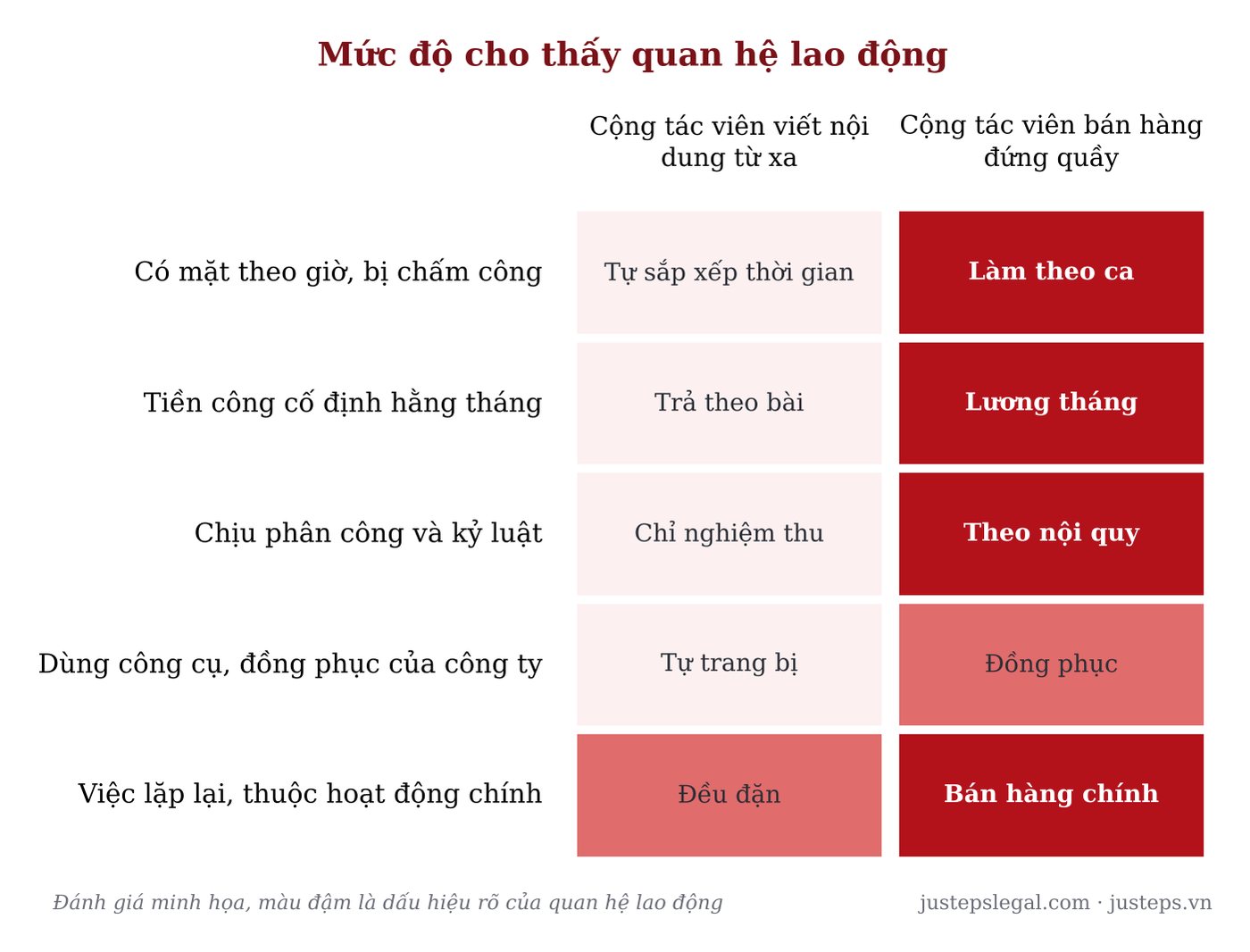
Extent to which each sign indicates an employment relationship in two collaborator situations
For a content writing collaborator who works remotely, accepts orders article by article and arranges their own time, most signs are at a low level, so a service contract is appropriate. For a sales collaborator who staffs a counter in shifts, wears a uniform and receives a fixed wage, the signs relating to working hours, fixed pay and discipline are all high, so the relationship is almost certainly an employment contract. Once it is reclassified as an employment relationship, the business may be required to pay social insurance arrears for the entire period of work, be subject to administrative penalties under Decree No. 283/2026/ND-CP[5], and have to settle allowances and annual leave as for ordinary employees.
Concluding and managing seasonal employment
Form of contract and probation
An employment contract must be concluded in writing, although a contract with a term of less than one month may be concluded verbally, except in certain cases where the law requires writing, such as contracts with a group of employees through an authorised person, with persons under 15 years of age or with domestic workers[6]. Even where a verbal contract is permitted, the business should prepare a short document stating the work, duration, pay and method of payment, because this is the supporting document for recording the expense and for resolving any dispute. In addition, a business may not agree on probation for a contract with a term of less than one month[7].
For seasonal work or specific work with a term of less than 12 months, a group of employees aged 18 or over may authorise one member of the group to conclude the employment contract on behalf of the whole group. In this case the contract must be in writing and accompanied by a list stating the full name, date of birth, gender, place of residence and signature of each person[8]. This approach suits groups of harvest workers or loaders from the same locality, but the business must still pay wages to and meet its obligations towards each person, and may not hand all the pay to the group representative to divide.
Successive contracts and time limits
A common mistake is signing several short contracts in succession with the same person to keep that person on seasonal status. Under the Labour Code, when a fixed-term contract expires and the employee continues working, the parties must sign a new contract within 30 days, failing which the existing contract becomes an indefinite-term contract, and the parties may sign only one further fixed-term contract, after which they must sign an indefinite-term contract, save in certain special cases[9]. A business therefore needs to track the number of contracts signed and the total working time of each seasonal worker who returns over several seasons.
The process from recruitment to payment
To manage seasonal workers in an orderly way during peak weeks, a business should apply a fixed process from planning to the end of the contract. The following flowchart shows the main steps and control points.
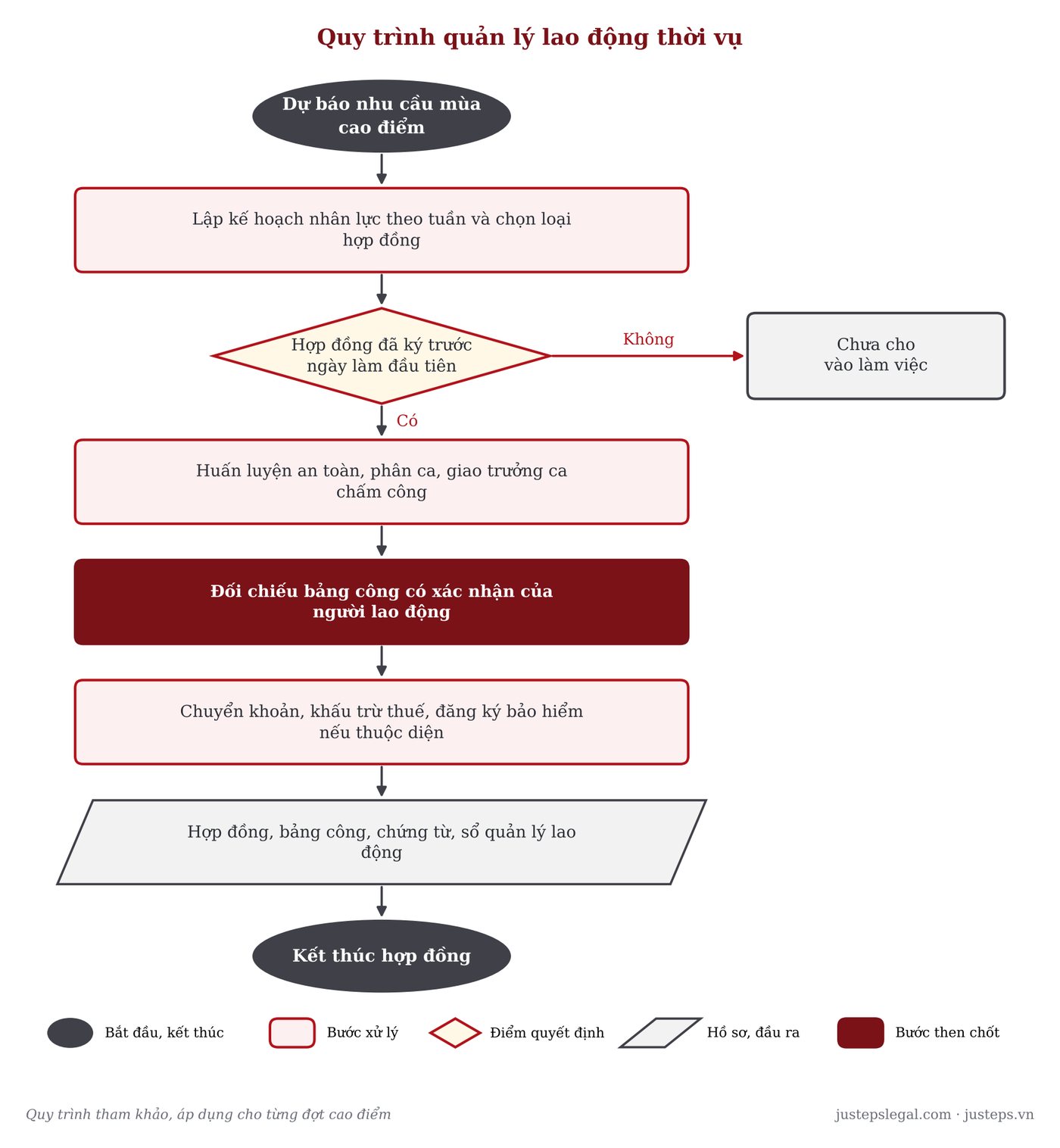
Process for managing seasonal workers from planning to payment and record keeping
The staffing plan should be finalised at least three weeks before the peak, stating the number of people needed each week and the type of contract suited to the expected period of work. The first control point is not allowing anyone to start work before the contract is signed, because the law requires the contract to be concluded before the person is taken on[4]. Before the first shift, workers must receive occupational safety and health training appropriate to the job and sign to confirm it, even if they will work only a few days[10]. The decisive step is reconciling the end-of-period timesheet confirmed by the worker, because this is the most important basis for paying wages, withholding tax and resolving complaints.
While working, seasonal workers enjoy the same rights as other employees regarding overtime limits, breaks and overtime pay[11]. Wages for normal working hours must not be lower than the regional minimum wage, and from 1 January 2027 the monthly minimum wage is VND 5,700,000 in Region I, VND 5,080,000 in Region II, VND 4,450,000 in Region III and VND 4,040,000 in Region IV[12]. Each team of seasonal workers should have a shift leader who is a permanent employee responsible for assigning tasks, timekeeping and reporting incidents, so that the business controls both productivity and safety.
Managing freelance collaborators by work results
The principle for managing collaborators who provide services is that the business manages outputs, not working hours or methods. Each task should be assigned through a work order stating the deliverable, the acceptance criteria, the deadline and the price, while the collaborator decides the time, place and tools for doing the work. The business pays only after an acceptance record has been prepared, and where the deliverable falls short, it requests corrections under the contract rather than deducting pay or taking disciplinary action.
A service contract with a collaborator should include clauses on the scope of work, acceptance criteria, price and payment, confidentiality obligations, ownership of the work results and termination. The ownership clause is particularly important for articles, images, designs or software, because without a clear agreement, determining the copyright owner will depend on the general provisions of the Law on Intellectual Property and may be contentious. The business should also avoid including in a service contract terms characteristic of an employment relationship, such as fixed working hours, a monthly salary, allowances or disciplinary measures.
When a collaborator works regularly for many months, performs work forming part of the core business and is gradually given daily tasks like an employee, the relationship may turn into an employment relationship. The HR department should review the list of collaborators at least every quarter, compare the actual way of working with the signs described above and switch to an employment contract where necessary. Businesses needing to standardise the contracts and records for both groups may consider Justeps’ service on labour records and employment contracts.
Withholding personal income tax on payment
Under Decree No. 253/2026/ND-CP guiding the Law on Personal Income Tax 2025, an organisation paying wages or remuneration to a resident individual who has not signed an employment contract or has signed an employment contract of less than three months must withhold 10% of the income where the total payment is VND 5 million or more per payment, a threshold raised from the previous VND 2 million[13]. For employees with contracts of three months or more, the business withholds tax at progressive rates after family deductions, as for permanent staff[14]. The following chart illustrates the tax to be withheld at several common payment levels for resident collaborators.
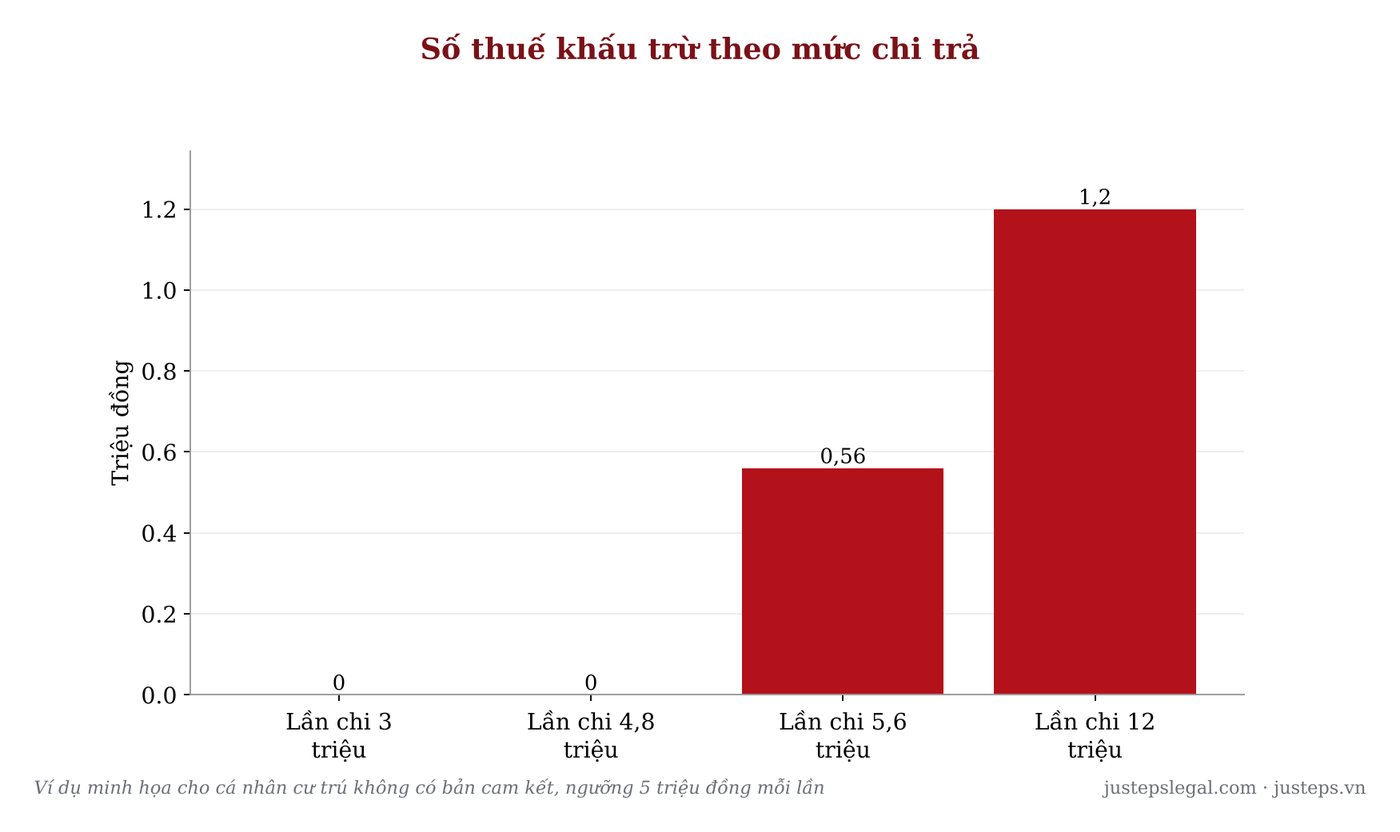
Tax withheld at 10% at several payment levels to resident collaborators
For payments of VND 3 million and VND 4.8 million, the business is not required to withhold because the threshold has not been reached, but it must still keep the contract, the acceptance record and the bank transfer records. For a payment of VND 5.6 million, for example 14 articles at VND 400,000 each, the business withholds VND 560,000 and transfers VND 5,040,000 to the collaborator, while for a payment of VND 12 million the tax withheld is VND 1,200,000. A business should not split a payment into several instalments below VND 5 million to avoid withholding, because the tax authority looks at the substance of each payment according to the contract and actual acceptance.
An individual whose only income is subject to 10% withholding and whose estimated total taxable income after family deductions is below the taxable level may give the business a written commitment so that tax is temporarily not withheld. A business receiving such commitments must still list these individuals and report their income to the tax authority, and an individual who declares falsely is liable under the law on tax administration. When withholding, the business issues a tax withholding certificate to the individual and uses the personal identification number in place of a tax code[15]. Businesses with many collaborators may standardise this process through Justeps’ service on personal income tax on salaries and wages.
Records to keep and common mistakes
A minimum set of records for seasonal workers and collaborators enables a business both to prove that its expenses are valid when finalising tax and to have a basis when inspected or in a dispute. The records should include the seasonal staffing plan, the short-term employment contract template, the letter of authorisation for group contracting with the attached list, the service contract template, work orders, acceptance records, timesheets confirmed by workers, payment records, tax withholding certificates and the labour management register updated when workers start and finish work[16].
The records of seasonal workers and collaborators contain personal data such as identification numbers, bank account numbers and residential addresses, so the business must give notice of the purpose of processing, restrict who may access the data and delete it when the retention period ends[17]. Photographing the identity cards of dozens of people and sending them through a shared chat group is a common but unsafe practice, and should be replaced with a folder with access controls.
In reviews of labour records at businesses, certain mistakes recur quite frequently, and all of them can be prevented if detected early. The common mistakes that businesses should review include the following:
- The business signs a collaborator contract but still keeps time records, pays a fixed monthly wage and applies internal labour regulations and discipline.
- The business signs several short contracts in succession with the same person without tracking the number of contracts and the total working time.
- The business does not put in writing its arrangements with people working for one month or more and does not register them for social insurance.
- The business pays cash without a signed receipt and does not withhold tax on payments of VND 5 million or more.
- The business keeps the originals of workers’ identity documents or qualifications, or requires a deposit to secure performance of the contract, both of which are prohibited[19].
The most effective preventive measure is to give one person in the HR department responsibility for the list of seasonal workers and collaborators, with a review every quarter and before each peak season. Each review should answer three questions, namely whether the type of contract matches the actual way of working, whether insurance and tax obligations have been fully met, and whether the records are sufficient to explain the position if inspected. When the Law amending and supplementing the Labour Code passed by the National Assembly on 21 November 2026 takes effect on 1 March 2027, businesses also need to update their contract templates and working schedules for the newly added public holidays[18].
How Justeps can help
Justeps helps businesses manage seasonal workers and freelance collaborators lawfully through the following services:
- Labour records and employment contracts. Justeps drafts a set of short-term employment contract templates, letters of authorisation for group contracting and service contracts with collaborators.
- Labour and payroll compliance management. Justeps reviews the list of seasonal workers and collaborators and assesses the risk of reclassification as an employment relationship.
- Personal income tax on salaries and wages. Justeps guides the business on 10% withholding, handling written commitments and issuing withholding certificates for collaborators.
- Internal labour regulations and disciplinary procedures. Justeps supplements the internal labour regulations and procedures applicable to seasonal workers working in shifts during peak seasons.
Frequently asked questions
Must workers employed for less than one month sign a written contract?
A contract with a term of less than one month may be concluded verbally, except in certain cases where the law requires writing, such as contracts concluded through a person authorised by a group[6]. The business should still prepare a short written document as a basis for payment and for resolving disputes.
Must freelance collaborators pay social insurance?
Collaborators who sign a genuine service contract are not subject to compulsory social insurance. If in practice there is timekeeping, payment of wages and management and direction, the relationship is regarded as an employment contract[4] and the insurance obligation arises where the term is one full month or more.
Must tax be withheld on payments to collaborators of less than VND 5 million each?
10% withholding is not mandatory for a payment of less than VND 5 million[13]. The business must still keep the contract, the acceptance record and the payment records to substantiate the expense.
May seasonal workers be put on probation?
Probation is not permitted for a contract with a term of less than one month[7]. For longer contracts, the probationary period must suit the nature of the work and must not exceed the period permitted by law.
May several three-month contracts be signed in succession with the same person?
No. The parties may sign only one further fixed-term contract, after which they must switch to an indefinite-term contract if the employee continues working[9].
May a group representative receive the pay and divide it among the group?
The business should pay each person directly according to the list attached to the contract, because the obligation to pay wages is owed to each individual employee[8]. Paying through a representative makes it difficult for the business to prove that it has paid in full and to withhold tax correctly.
Do seasonal workers employed for a few days need safety training?
Yes. Workers must receive occupational safety and health training appropriate to the job before starting work[10], and the business should keep each person’s signed confirmation.
Related articles
- Five common pay models and how a business can choose the right one for each group of positions
- Hiring the first employees of a newly established company, from the order of positions to contracts and insurance
- A monthly labour and payroll compliance checklist for HR departments
- What companies must satisfy when moving to electronic employment contracts and how those contracts should be stored
Notes
[1] Clause 1 of Article 20 of the Labour Code No. 45/2019/QH14 dated 20 November 2019.
[2] Article 513 of the Civil Code No. 91/2015/QH13 dated 24 November 2015.
[3] Clause 1 of Article 2 of the Law on Social Insurance No. 41/2024/QH15 dated 29 June 2024.
[4] Article 13 of the Labour Code No. 45/2019/QH14.
[5] Government Decree No. 283/2026/ND-CP on administrative penalties in the fields of labour and social insurance, effective from 10 September 2026.
[6] Clause 2 of Article 14 of the Labour Code No. 45/2019/QH14.
[7] Clause 3 of Article 24 of the Labour Code No. 45/2019/QH14.
[8] Clause 2 of Article 18 of the Labour Code No. 45/2019/QH14.
[9] Clause 2 of Article 20 of the Labour Code No. 45/2019/QH14.
[10] Article 14 of the Law on Occupational Safety and Health No. 84/2015/QH13 dated 25 June 2015.
[11] Article 107 of the Labour Code No. 45/2019/QH14.
[12] Government Decree No. 399/2026/ND-CP on the minimum wage, applicable from 1 January 2027.
[13] Government Decree No. 253/2026/ND-CP detailing a number of articles of and guiding the implementation of the Law on Personal Income Tax.
[14] The Law on Personal Income Tax No. 109/2025/QH15.
[15] Circular No. 86/2024/TT-BTC dated 23 December 2024 of the Ministry of Finance on tax registration; Decree No. 254/2026/ND-CP dated 30 June 2026 on electronic invoices and electronic documents, effective from 1 July 2026, replacing Decree No. 123/2020/ND-CP and Decree No. 70/2025/ND-CP.
[16] Article 12 of the Labour Code No. 45/2019/QH14.
[17] The Law on Personal Data Protection No. 91/2025/QH15 and Decree No. 363/2026/ND-CP.
[18] The Law amending and supplementing a number of articles of the Labour Code, passed by the National Assembly on 21 November 2026 and effective from 1 March 2027.
[19] Clauses 1 and 2 of Article 17 of the Labour Code No. 45/2019/QH14.
This article is for reference and reflects the regulations in force at the time of publication. Please consult Justeps for advice tailored to your company’s records and situation.
For further information, please contact:
📩 Email: info@justeps.vn
🌐 Website: https://justepslegal.com · https://justeps.vn
🌐 Page: Justeps
☎️ Hotline (Zalo): 096 172 2607
📍 Thanh Xuan Office: 12th Floor, Licogi 13 Tower, 164 Khuat Duy Tien Street, Thanh Xuan Ward, Hanoi, Vietnam
📍 Ha Dong Office: LK06B, No.10, Dong Dua Area, Ha Dong Ward, Hanoi, Vietnam
📍 Ho Chi Minh City Branch: 528 Le Van Sy, Ho Chi Minh City, Vietnam
📍 Hai Phong Office: Truong Thinh Village, Ha Dong Commune, Hai Phong, Vietnam
📍 Quang Ninh Office: Van Don Special Zone, Quang Ninh Province, Vietnam





