
Key takeaways
- From 26 June 2026, free samples, gifts, price discounts, purchase vouchers, loyalty programmes and cultural or entertainment programmes no longer need to be notified to the provincial Department of Industry and Trade.
- Sales with contest entry coupons need to be notified only where the total prize value is VND 100 million or more and the programme does not take place solely online.
- Promotional games of chance must still be registered in advance, with winners determined publicly, results reported and 50% of the value of unclaimed prizes paid to the state budget.
- The 50% cap on the value of promotional goods and the maximum discount have been abolished at decree level, but the Minister of Industry and Trade will be empowered to set new caps when the amending law takes effect on 1 July 2027.
For many years, the marketing departments of retailers, consumer goods companies and e-commerce businesses had to file a sales promotion notification with the provincial Department of Industry and Trade before almost every programme, even a weekend discount. Following two rounds of amendments to Decree 81/2018/ND-CP in 2024 and 2026, most of these formalities have been abolished, while some obligations remain unchanged and certain limits are awaiting new rules. As a result, many businesses find themselves in one of two situations, either still filing documents that are no longer required, or overlooking procedures that remain mandatory, such as registering a game of chance.
This article sets out the sales promotion procedures in force at the end of 2026 under the Commercial Law and Decree 81/2018/ND-CP, as amended by Decree 128/2024/ND-CP and Decree 239/2026/ND-CP, together with the forthcoming changes introduced by the 2026 amending law. It covers the legal framework, how to determine the form of promotion, the cases requiring notification and registration, reporting of results, limits on value and the consequences of getting it wrong. It is written for the marketing, legal and accounting departments of retailers, distributors, fast-moving consumer goods companies and businesses selling online.
The legal framework for sales promotions at the end of 2026
A sales promotion is a trade promotion activity by which a trader stimulates the sale of goods or the provision of services by granting customers certain benefits. The 2005 Commercial Law sets out the forms of sales promotion, the rights and obligations of traders, the information that must be disclosed and the prohibited acts[1], while Decree 81/2018/ND-CP provides detailed conditions and procedures[2]. That decree was first amended by Decree 128/2024/ND-CP, effective from 1 December 2024, and for a second time by Decree 239/2026/ND-CP, effective from 26 June 2026.
Decree 239/2026/ND-CP considerably narrows the scope of notification, abolishes the rules on the maximum value of goods used for promotion and the maximum discount, simplifies the registration file and allows applications to be submitted by post or through the National Public Service Portal[3]. Valid applications submitted before 26 June 2026 continue to be processed under the previous rules, while applications submitted from that date are subject to the new rules[4]. On 13 November 2026, the National Assembly passed a law amending and supplementing a number of articles of the Commercial Law and three other laws, generally effective from 1 July 2027, which empowers the Minister of Industry and Trade to set the maximum value of goods and services used for promotion and the maximum discount[5].
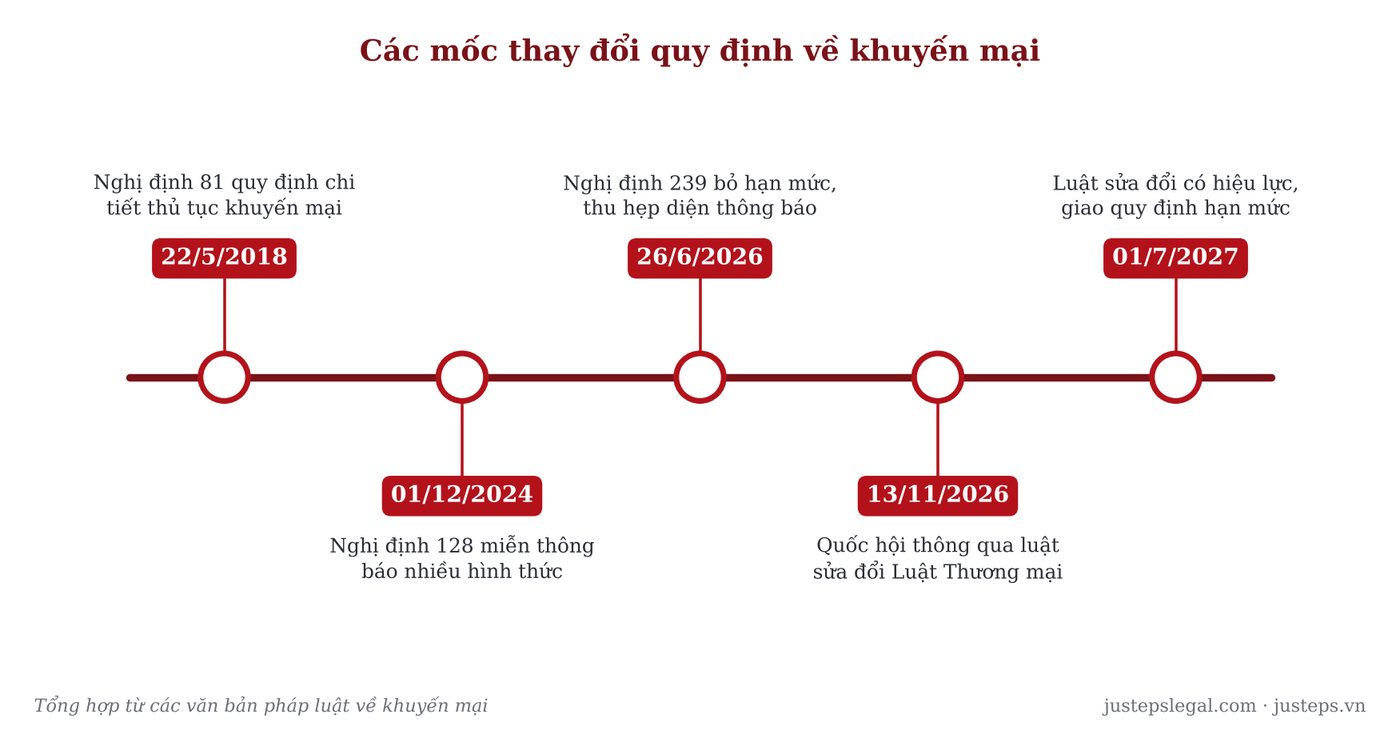
Milestones in the rules on sales promotion procedures from 2018 to 2027
These milestones show that the rules on sales promotions are in a period of transition. Businesses planning for 2027 need to distinguish programmes ending before 1 July 2027, which are governed by the current rules, from programmes running beyond that date, which may be subject to new caps issued by the Minister of Industry and Trade. Rules for long-running programmes should therefore include a clause allowing them to be adjusted when the law changes.
Identifying the correct form of promotion before choosing the procedure
The Commercial Law lists the forms of sales promotion as free samples for trial use, free gifts of goods or services, price discounts, sales accompanied by purchase vouchers or service vouchers, sales accompanied by contest entry coupons, games of chance, loyalty programmes, cultural, artistic and entertainment programmes and other forms approved by the regulator[1]. The procedure required depends on the form of the promotion, not on the name the business gives to the programme. A lucky draw promoted as a customer appreciation event is still a promotional game of chance and must be registered.
A common mistake is to confuse contest entry coupons with games of chance. With contest entry coupons, customers win by answering questions correctly or correctly predicting an outcome under the programme rules, so the result depends on the participant’s knowledge. With games of chance, such as scratch cards, draws or spinning wheels, winning depends entirely on luck, and this is the most tightly controlled form. A programme combining several forms must follow the procedure for the form with the strictest requirements.
Following the entry into force of Decree 239/2026/ND-CP, the procedure with the regulator and the points to note for each form of promotion can be summarised as follows:
| Form | Procedure with the regulator | Points to note in practice |
|---|---|---|
| Samples and gifts | No notification required. | Gifts must be goods that are lawfully traded and of the quality announced. |
| Price discounts | No notification required, and the limit of 120 days a year per brand no longer applies. | Prices before and after the discount must be disclosed truthfully, and the original price must not be raised beforehand to create a fictitious discount. |
| Purchase vouchers | No notification required. | Traders issuing and accepting vouchers are themselves responsible for complying with anti-money laundering law. |
| Loyalty programmes | No notification required, including membership cards and points schemes. | The conditions for earning points, redeeming gifts and the validity period of points must be clearly disclosed to customers. |
| Culture and entertainment | No notification required. | The participation rules and prizes must still be made public. |
| Contest entry coupons | Notification where total prizes reach VND 100 million and the programme is not solely online. | Results must be announced publicly at the place of promotion or through the media. |
| Games of chance and other forms | Registration and confirmation before launch, followed by a report on results. | Fifty per cent of the value of unclaimed prizes must be paid to the state budget. |
Cases in which a sales promotion must still be notified
Under the amended rules, traders are not required to notify promotions in the form of free samples, gifts, price discounts, purchase vouchers, loyalty programmes or cultural, artistic and entertainment programmes[6]. The notification obligation now remains only for sales accompanied by contest entry coupons, and even then it does not apply where the total value of prizes and gifts is below VND 100 million or where the programme is carried out solely through an e-commerce platform, a website or an online promotion application[6]. The scope of notification is therefore now very narrow compared with the period before December 2024.
Where notification is required, the trader sends the file to the Department of Industry and Trade of the province where the promotion takes place at least three working days before the programme begins[6]. The file may be sent by post, through an enterprise or individual engaged or authorised for that purpose, or online through the National Public Service Portal. Where a programme runs in several provinces or cities, the business must notify each Department of Industry and Trade where a promotion venue is located, so it should draw up a list of participating stores at the planning stage.
Exemption from notification does not mean exemption from every obligation. Traders must still disclose the name of the programme, its duration, scope, the goods promoted, the value and the conditions for receiving the promotional benefits, and must deliver what they have announced[7]. As no file is now held by a state authority, businesses should keep their own copies of the programme rules, screenshots of the published content and lists of customers who received gifts, so they can prove compliance if there is a complaint or an inspection.
Registering a promotional game of chance
Receiving authority, application file and time limit for confirmation
Promotional games of chance and other forms of promotion not on the statutory list must be registered and confirmed by the regulator before they are carried out[8]. As a general rule, a programme taking place in a single province or city is registered with the provincial Department of Industry and Trade, while a programme taking place in two or more provinces or cities is registered with the Ministry of Industry and Trade. Following the amendments, the file consists only of a written request and the programme rules, and samples or descriptions of the means of determining winners no longer need to be submitted[3].
The regulator considers the application and replies in writing confirming or refusing confirmation within four working days of receiving the file, stating its reasons if it refuses[8]. Since the rules often have to be revised at the regulator’s request, businesses should submit the file at least two weeks before the intended start date. Scratch cards should be printed, prize codes issued or the programme advertised only once written confirmation has been received, as amending the rules after release is very costly.
Determining winners and awarding prizes
The determination of winners must be carried out publicly, in accordance with the registered rules, witnessed by customers and recorded in minutes[9]. Under the amended rules, customers may witness the draw in person or online, so a business may hold a draw by live stream provided it keeps a recording and a list of witnesses. The results must be announced publicly, and prizes must be awarded within the time limit stated in the rules.
The sequence from registration to the completion of all obligations for a game of chance can be pictured as shown below.
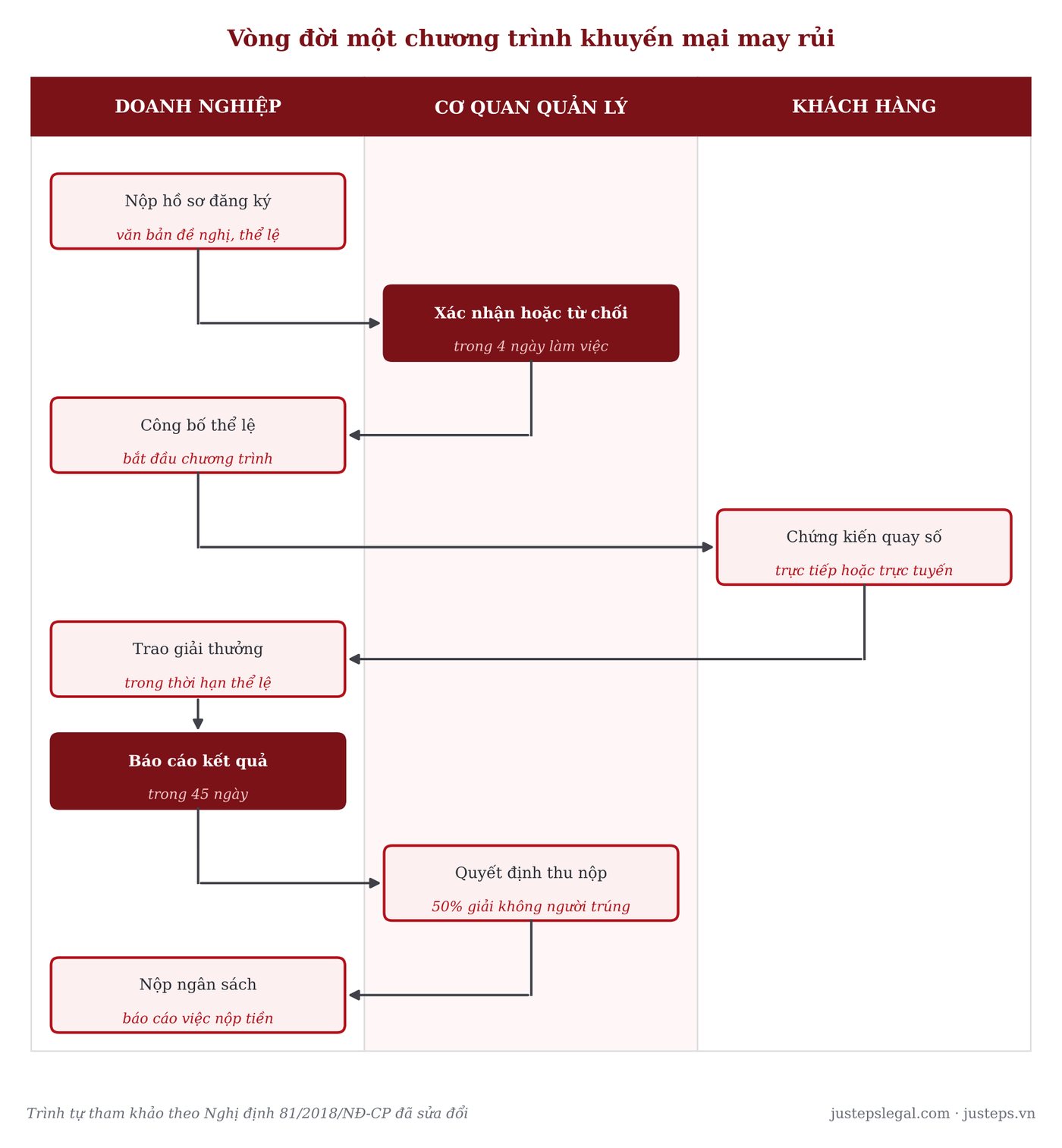
Sequence of registration, prize awarding and reporting of results for a promotional game of chance
The business launches the programme only after receiving written confirmation, then organises the determination of winners witnessed by customers and awards prizes within the time limit set out in the rules. Once the period for awarding prizes has expired, the business reports the results to the authority that gave confirmation, and that authority issues a decision requiring payment of part of the value of any unclaimed prizes. The programme is only truly closed once the business has paid the money into the state budget and submitted a report on the payment.
Reporting results and dealing with unclaimed prizes
A trader that has carried out a registered programme must report the results in writing to the authority that gave confirmation within 45 days from the expiry of the period for awarding prizes[10]. For sales accompanied by contest entry coupons, the business need not submit a results report to a state authority but must announce the results publicly. The report should be accompanied by the list of winning customers, the minutes of the draw and the prize award documents, since these also form the file for explaining matters to the tax authority.
For a game of chance, the trader must pay 50% of the announced value of unclaimed prizes into the state budget in accordance with the decision of the authority that gave confirmation[9]. Decree 239/2026/ND-CP clarifies that unclaimed prizes are those remaining when the period for awarding prizes ends, and excludes prizes awarded late because of force majeure or objective obstacles[9]. The following chart illustrates how the amount payable is calculated for a specific programme.
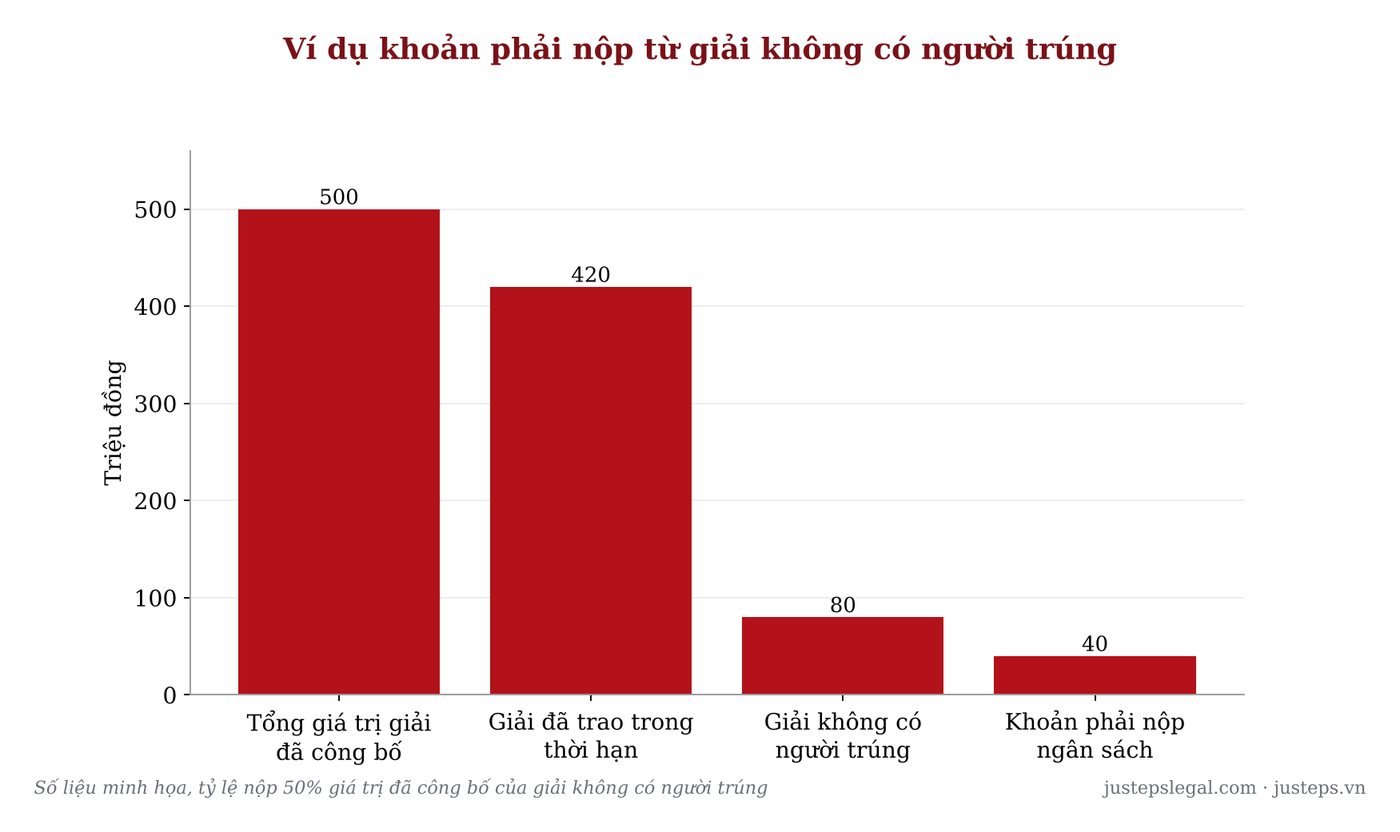
Example of calculating the amount payable to the state budget for a lucky draw
In this example, the programme announces total prizes worth VND 500 million but, by the end of the period for awarding prizes, has awarded only VND 420 million because some winning codes were not claimed. The remaining VND 80 million represents unclaimed prizes, so the business must pay VND 40 million into the state budget. To reduce this amount, businesses should build a reserve prize mechanism into the rules, contact winners proactively and record in writing any case where a prize is awarded late for objective reasons.
Value limits, goods that may not be promoted and related obligations
Decree 239/2026/ND-CP repeals Articles 6 and 7 of Decree 81/2018/ND-CP, which set the maximum value of goods and services used for promotion and the maximum discount, and also removes the limit on the total duration of discounts in a year[11]. This gives businesses more flexibility for deep discounts, but it is not a permanent repeal, because the 2026 amending law empowers the Minister of Industry and Trade to set new caps from 1 July 2027[5]. In the meantime, deep discounts may still be examined under competition law, especially where a business holds a dominant position and sells below cost in order to eliminate competitors[12].
Certain goods and services still may not be used for promotion or may not be promoted, such as alcohol, lottery tickets, tobacco, breast milk substitutes, medical examination and treatment services and education services of public institutions[13]. Under the amended rules, prescription medicines may only be promoted between traders dealing in medicines, while non-prescription medicines may be promoted to consumers in compliance with the relevant sector-specific law[13]. Marketing departments should check this list before designing gifts, particularly for programmes run jointly with partners selling alcoholic beverages.
Beyond the promotion procedures themselves, businesses should bear in mind three groups of related obligations. In terms of tax, goods and services used for promotion in accordance with commercial law are subject to special value added tax treatment, and prizes won by individual customers may be subject to personal income tax withholding[14]. In terms of data, the collection of customer information for participation in a programme must comply with personal data protection law[15]. In terms of information, advertising for the programme must be truthful and complete under consumer protection law and advertising law[7].
Consequences of getting it wrong and how to organise compliance within the business
Breaches relating to sales promotions, such as failing to register a game of chance, not following the programme rules, failing to report results or failing to pay the portion of unclaimed prizes, are subject to penalties under the decree on administrative penalties in commercial activities[16]. In addition to fines, a business may be required to surrender the unlawful gains and may face collective complaints if customers do not receive the promised benefits. A programme that does not comply with the rules also puts at risk the tax treatment that applies to lawful promotion expenses.
To choose the correct procedure for each programme, businesses can apply the checking sequence below before the marketing plan is submitted for approval.
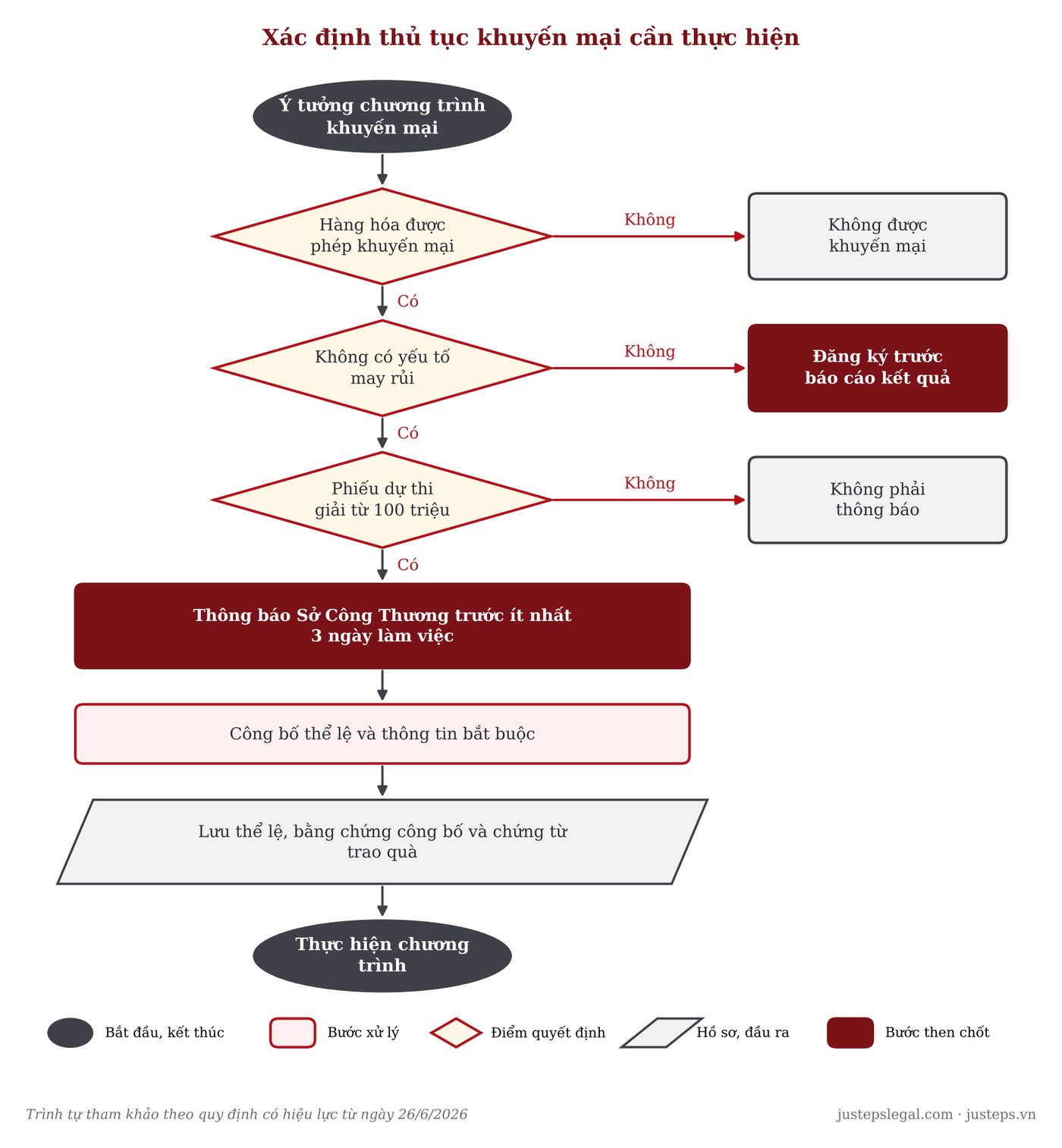
Sequence for determining which sales promotion procedure applies to a programme
The first question is whether the goods or services may be promoted at all, because if not, the programme must stop at the idea stage. Next, a programme involving an element of chance or not falling within a statutory form must follow the route of registration and reporting of results. A contest entry coupon programme needs to be notified only when it reaches the value threshold and takes place outside the online environment, while all other forms go straight to the step of disclosing information to customers.
In organisational terms, businesses should assign the legal department or the compliance officer to review the rules of every programme before they are announced, including programmes that do not require notification. The accounting team should track prizes awarded, unclaimed prizes and tax obligations, while the marketing department keeps evidence of what was published. Businesses may consider Justeps’ advertising, sales promotion and consumer protection services to standardise programme rule templates and, for programmes run on online platforms, its legal services for e-commerce platforms and sales promotions to review the specific requirements of each platform.
How Justeps can help
Justeps supports businesses in designing and carrying out sales promotion programmes with the correct procedures through the following services:
- Advertising, sales promotion and consumer protection. Justeps reviews programme rules, identifies the procedures required and prepares registration files and results reports for sales promotion programmes.
- Legal services for e-commerce platforms and sales promotions. Justeps advises on promotions on platforms, websites and applications, including contest entry coupons, online draws and discount codes.
- Ongoing legal advice for retail chains and convenience stores. Justeps gives prompt opinions on individual programmes across store chains and provides updates on changes in sales promotion law.
- Internal process and policy development for e-commerce and livestream sales businesses. Justeps develops procedures for approving sales promotion programmes, keeping evidence of disclosures and coordinating marketing, legal and accounting.
- In-house training. Justeps trains marketing and sales teams on the forms of sales promotion, the procedures involved and prohibited conduct.
Frequently asked questions
Does a 70% discount still require approval?
Decree 239/2026/ND-CP has abolished the rules on the maximum discount and the limit on the duration of discounts, so a discount programme requires neither notification nor approval[11]. However, new caps may be set by the Minister of Industry and Trade from 1 July 2027[5].
Does a points-for-gifts scheme for membership cardholders have to be notified?
Loyalty programmes no longer need to be notified to the Department of Industry and Trade[6]. The business must still clearly disclose the conditions for earning points and redeeming gifts and honour its commitments.
Does a lucky draw held only on the business’s own live stream have to be registered?
A promotional game of chance must be registered and confirmed before it is carried out, even if it is held online[8]. Customers may witness the draw online, provided there are minutes and a recording[9].
Does a contest entry coupon programme run only on an e-commerce platform have to be notified?
A contest entry coupon programme carried out solely through an e-commerce platform, a website or an online promotion application is exempt from notification[6]. If the programme also takes place in stores and the total prize value is VND 100 million or more, it must still be notified.
How should prizes that remain unclaimed at the end of the award period be dealt with?
Prizes remaining when the period for awarding prizes ends are unclaimed prizes, and the business must pay 50% of their announced value into the state budget in accordance with the decision of the authority that gave confirmation[9]. Prizes awarded late because of force majeure or objective obstacles are excluded.
Which rules apply to a registration application submitted before 26 June 2026?
Valid applications submitted before Decree 239/2026/ND-CP took effect continue to be processed under the previous rules[4]. Applications submitted from 26 June 2026 follow the new procedure.
May a business use purchase vouchers that it has issued itself as promotional gifts?
A business may use purchase vouchers for promotion without notification[6]. Under the amended rules, the trader issuing the vouchers and the trader accepting them are each responsible for complying with anti-money laundering law[17].
Related articles
- Selling on e-commerce marketplaces in Vietnam and the rules on invoices, tax, returns and complaints
- Building a business conditions map to control conditional business lines before the launch date
- How an exclusive distribution agreement should deal with sales targets, territory and inventory on termination
- An annual periodic legal review covering 12 areas that companies should check themselves
Notes
[1] Articles 88, 92, 97 and 100 of the Commercial Law No. 36/2005/QH11 dated 14 June 2005.
[2] Government Decree No. 81/2018/ND-CP dated 22 May 2018 detailing the Commercial Law on trade promotion activities, as amended and supplemented by Decree No. 128/2024/ND-CP and Decree No. 239/2026/ND-CP.
[3] Government Decree No. 239/2026/ND-CP dated 26 June 2026 amending and supplementing a number of articles of Decree No. 81/2018/ND-CP, effective from the date of signing.
[4] Clause 1 of Article 13 of Decree No. 239/2026/ND-CP dated 26 June 2026.
[5] Law amending and supplementing a number of articles of the Commercial Law, the Competition Law, the Law on Foreign Trade Management and the Law on Consumer Rights Protection, passed by the National Assembly on 13 November 2026, generally effective from 1 July 2027.
[6] Article 17 of Decree No. 81/2018/ND-CP, as amended and supplemented by Article 4 of Decree No. 239/2026/ND-CP.
[7] Articles 97 and 98 of the Commercial Law No. 36/2005/QH11; Law on Consumer Rights Protection No. 19/2023/QH15 dated 20 June 2023.
[8] Articles 19 and 20 of Decree No. 81/2018/ND-CP, as amended and supplemented by Decree No. 128/2024/ND-CP and Decree No. 239/2026/ND-CP.
[9] Article 13 of Decree No. 81/2018/ND-CP, as amended and supplemented by Article 3 of Decree No. 239/2026/ND-CP.
[10] Article 101 of the Commercial Law No. 36/2005/QH11; Article 21 of Decree No. 81/2018/ND-CP, as amended and supplemented by Decree No. 128/2024/ND-CP.
[11] Clause 1 of Article 11 of Decree No. 239/2026/ND-CP repealing Articles 6 and 7 of Decree No. 81/2018/ND-CP.
[12] Competition Law No. 23/2018/QH14 dated 12 June 2018, provisions on abuse of a dominant market position and unfair competition.
[13] Article 100 of the Commercial Law No. 36/2005/QH11; Article 5 of Decree No. 81/2018/ND-CP, as amended and supplemented by Decree No. 239/2026/ND-CP.
[14] Law on Value Added Tax No. 48/2024/QH15 and Law on Personal Income Tax No. 109/2025/QH15, together with their implementing instruments.
[15] Law on Personal Data Protection No. 91/2025/QH15.
[16] Government Decree No. 98/2020/ND-CP dated 26 August 2020 on administrative penalties in commercial activities, the production and trading of counterfeit and prohibited goods and consumer rights protection, as amended and supplemented by Decree No. 17/2022/ND-CP and Decree No. 24/2025/ND-CP.
[17] Clause 1 of Article 11 of Decree No. 81/2018/ND-CP, as amended and supplemented by Article 2 of Decree No. 239/2026/ND-CP.
This article is for reference and reflects the regulations in force at the time of publication. Please consult Justeps for advice tailored to your company’s records and situation.
For further information, please contact:
📩 Email: info@justeps.vn
🌐 Website: https://justepslegal.com · https://justeps.vn
🌐 Page: Justeps
☎️ Hotline (Zalo): 096 172 2607
📍 Thanh Xuan Office: 12th Floor, Licogi 13 Tower, 164 Khuat Duy Tien Street, Thanh Xuan Ward, Hanoi, Vietnam
📍 Ha Dong Office: LK06B, No.10, Dong Dua Area, Ha Dong Ward, Hanoi, Vietnam
📍 Ho Chi Minh City Branch: 528 Le Van Sy, Ho Chi Minh City, Vietnam
📍 Hai Phong Office: Truong Thinh Village, Ha Dong Commune, Hai Phong, Vietnam
📍 Quang Ninh Office: Van Don Special Zone, Quang Ninh Province, Vietnam





