
Key takeaways
- The three deadlines most often missed at the start are the declaration of labour use, social insurance registration within 30 days and full payment of charter capital within 90 days.
- A business must register to use electronic invoices before its first sale, so the sensible order is to open a bank account, obtain a digital signature and then register for invoices.
- The business licence fee was abolished from 1 January 2026, and newly established small and medium-sized enterprises may be exempt from corporate income tax for three years, but filing obligations remain unchanged.
- If capital is not contributed in full on time, the company must register an adjustment of its charter capital and ownership ratios to reflect the capital actually contributed within the following 30 days.
- Each obligation should be assigned to a specific person, and the records should be kept at the head office as soon as it has been completed.
Many founders regard the day they receive the Enterprise Registration Certificate as the moment the formalities are complete, when in fact it is the point from which a whole series of legal deadlines begins to run. Familiar situations include a first customer asking for an invoice before the company has registered for electronic invoices, a first employee who has worked for two months without a social insurance book, or the members realising only on day 85 that the charter capital has not been paid up in full. Each of these mistakes can be remedied, but if they are left to drag on, the business will face penalties, arrears of contributions or unnecessary adjustment procedures.
This article arranges the tasks to be done after setting up a business into a 90-day schedule, analysing the legal basis, the conditions, the consequences of getting it wrong and who should be responsible for each task. It applies mainly to small limited liability companies and joint stock companies established by domestic investors from 2026 onwards; foreign-invested enterprises have additional obligations relating to direct investment capital accounts and investment reporting, which are not analysed here. It is written mainly for founders, directors and the people responsible for administration and accounting in the early stage.
Three groups of obligations arising immediately after the certificate is issued
The tasks in the first 90 days can be divided into three groups according to the regulating authority and their nature. The first group comprises obligations under the Law on Enterprises, including setting up the register of members or register of shareholders, paying up charter capital in full, issuing capital contribution certificates or share certificates and keeping beneficial ownership information. The second group comprises tax and accounting obligations, including registering for electronic invoices, determining the tax calculation method and filing periods and organising the accounting books. The third group comprises labour and insurance obligations, which arise once the business starts employing workers.
The difficulty is that the deadlines in the three groups run from different starting points. The capital contribution deadline runs from the date of issue of the Enterprise Registration Certificate, the insurance registration deadline runs from the date the employee becomes subject to insurance, and the labour declaration deadline runs from the date the business commences operations. The following chart summarises the maximum deadlines for the main obligations so that the business can see which falls due first.
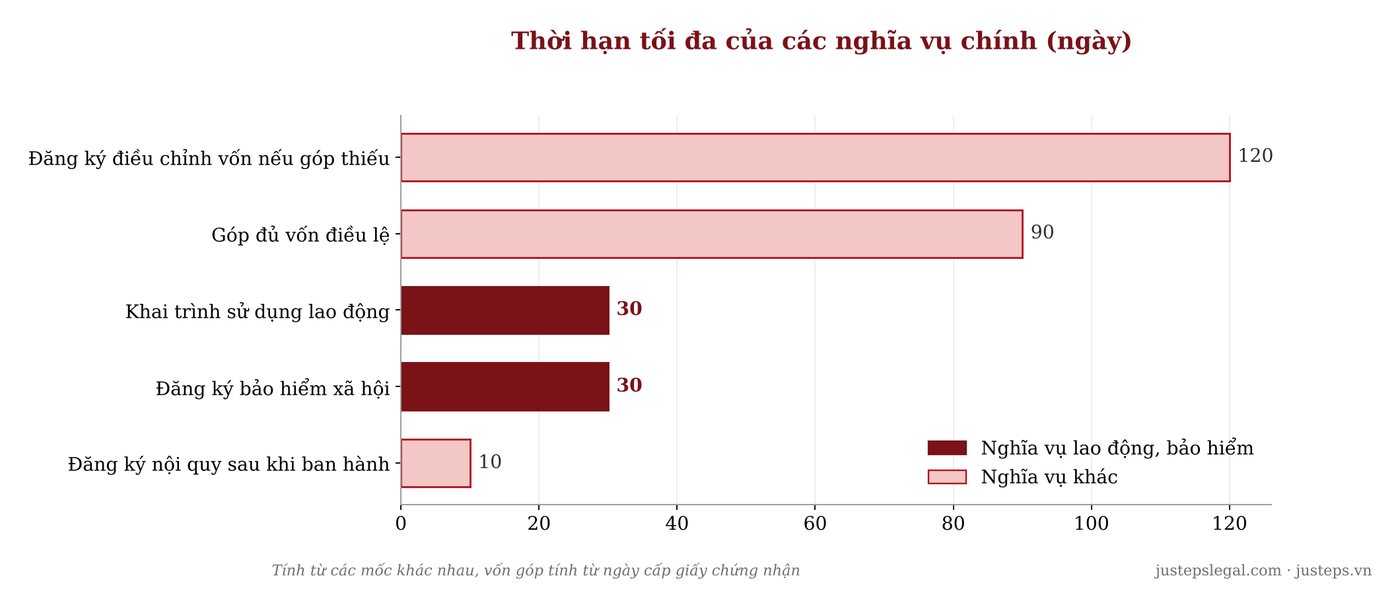
Maximum deadlines for the main obligations in the early stage, in days
Labour obligations have the shortest deadlines, only 30 days, and must therefore be dealt with as soon as the company signs its first employment contract. The 90-day capital contribution deadline is longer but the most easily forgotten, as no authority sends a reminder and the consequences appear only when the company needs to prove its capital to a bank or a counterparty. The 120-day deadline is in effect the final deadline for registering a capital adjustment where capital has not been paid up in full, that is, 30 days after the contribution period expires. Registration of internal labour regulations arises only when the company employs 10 or more workers, with a deadline of 10 days from the date of issue.
Company seal, statutory registers, bank account and electronic invoices
The company seal and the register of members or shareholders
A business decides for itself the type, number, form and content of its seal, which may be a physical seal made at a seal-making establishment or a seal in the form of a digital signature[1]. The management and use of the seal follow the charter or rules issued by the business, so in the very first week the company should issue a short decision designating the person who keeps the seal, where it is kept and the types of document that may be sealed. Businesses no longer have to notify their seal specimen to the business registration authority, so responsibility for controlling the use of the seal rests entirely with the company.
A limited liability company with two or more members must set up its register of members immediately after the Enterprise Registration Certificate is issued[2], while a joint stock company must set up and keep a register of shareholders from the time the certificate is issued[3]. The register records the name and address of each person, the amount of capital or number of shares subscribed, the amount paid, the time of payment and the type of asset contributed. Many small companies skip this register because nobody asks to see it, but in the event of a transfer, a dispute or due diligence by an investor, the register is the first basis for determining who owns how much.
Bank account, digital signature and electronic invoices
The sensible order is to open the business’s bank account, obtain a digital signature and then register with the tax authority to use electronic invoices. A business must register to use electronic invoices and have that registration accepted by the tax authority before it first sells goods or provides services[4], so if it already has its first contract, this needs to be completed within one to two weeks of incorporation. The enterprise code also serves as the tax code[5], so the business uses this code at once for all dealings with the tax authority and banks.
When opening the account, the company should register for online banking with two tiers of users, in which the accountant or an administrative employee prepares payment orders and the Director approves them. These access rights should be set up from the start, because changing them after transactions have begun usually requires a good deal of additional paperwork and disrupts payments. The digital signature used for tax filing and signing invoices should not be held entirely by one person either; there should be a handover record stating who holds it and who is given the access details.
Tax and accounting in the early stage
From 1 January 2026, the collection and payment of the business licence fee came to an end, and small and medium-sized enterprises are exempt from corporate income tax for three years from the date their Enterprise Registration Certificate is first issued[6]. The tax exemption does not apply automatically to every new business, as the implementing regulations exclude certain cases, such as businesses formed through division, separation, merger, consolidation or conversion of company type, or those whose representative or major capital contributor is linked to another business that was dissolved or ceased operations shortly beforehand[7]. The business should therefore keep records proving that it meets the criteria for a small or medium-sized enterprise and check the exclusions from the first year, to avoid back taxes being assessed on finalisation.
Exemption from tax does not mean exemption from filing. The business must still file value added tax returns and returns for personal income tax withheld from wages for each period, and at the end of the year it must prepare financial statements and finalise corporate income tax in accordance with the tax administration rules[8]. The first annual accounting period runs from the date of issue of the Enterprise Registration Certificate to the last day of the financial year, and if this period is shorter than 90 days it may be added to the following annual accounting period, provided the total does not exceed 15 months[9]. A company established in October or November should consider this option to save one round of financial statements.
In the first month, the accountant needs to determine the value added tax calculation method and the filing period and draw up a filing calendar for the whole year. A new business should register for the credit method if it expects many input invoices or to sell to other businesses, as customers usually require value added tax invoices in order to claim input credits[10]. The filing calendar should be assigned to one person to monitor, with reminders at least five working days before each deadline, including in months in which no revenue has yet arisen.
Labour and insurance obligations when hiring the first employee
As soon as it signs its first employment contract, the business must set up a labour management register and declare its use of labour within 30 days of the date it commences operations, and thereafter report changes in its workforce periodically[11]. The declaration can be made online, and the labour management register may be kept in paper or electronic form[12]. Failing to declare on time or to keep a labour management register may result in an administrative penalty under Decree No. 283/2026/ND-CP[13].
Persons working under an employment contract of one full month or more and business managers who receive a salary are subject to compulsory social insurance[14]. The employer must submit the registration file for the employee within 30 days of the date the employee becomes subject to insurance[15]. Accordingly, a salaried Director must also be registered, and the additional cost of about 21.5% of the wage used as the contribution base that the business pays for social insurance, health insurance and unemployment insurance should be included in the wage budget from the first month.
Employment contracts may be concluded in paper form or by electronic means, and a new business may choose electronic contracts from the outset for ease of storage[16]. Whichever form is chosen, the business should use a standard contract template containing a confidentiality clause and a clear provision that intellectual property created by the employee belongs to the company. As headcount approaches 10 people, the company needs to prepare written internal labour regulations so that they can be registered within the statutory deadline[17].
Paying up charter capital in full and what to do if it is not
Members of a limited liability company and shareholders of a joint stock company must contribute the full amount of capital they have committed within 90 days of the date of issue of the Enterprise Registration Certificate, excluding the time needed to transport and import contributed assets and to complete the procedures for transferring ownership of those assets[18]. Cash contributions should be transferred to the company’s account with a payment reference stating the contributor’s name and the words contribution of charter capital, because bank records are the strongest evidence in a dispute or a tax inspection. Contributing capital in cash without a valid receipt or confirmation record is a common mistake and is very difficult to prove again years later.
Once a member has paid in full, the limited liability company issues a capital contribution certificate corresponding to the value contributed and updates the register of members[2]. In a joint stock company, a shareholder who has paid in full is entitled to be issued a share certificate or to be recorded in the register of shareholders. Where, on expiry of the period, someone has still not contributed or has not contributed in full, the company must register a change of its charter capital and ownership ratios to reflect the capital actually contributed within 30 days of the last day for full payment, and those who have not contributed in full remain liable, in proportion to the capital they committed, for financial obligations arising before that time[19]. The procedure to follow when the contribution period expires can be described as follows.
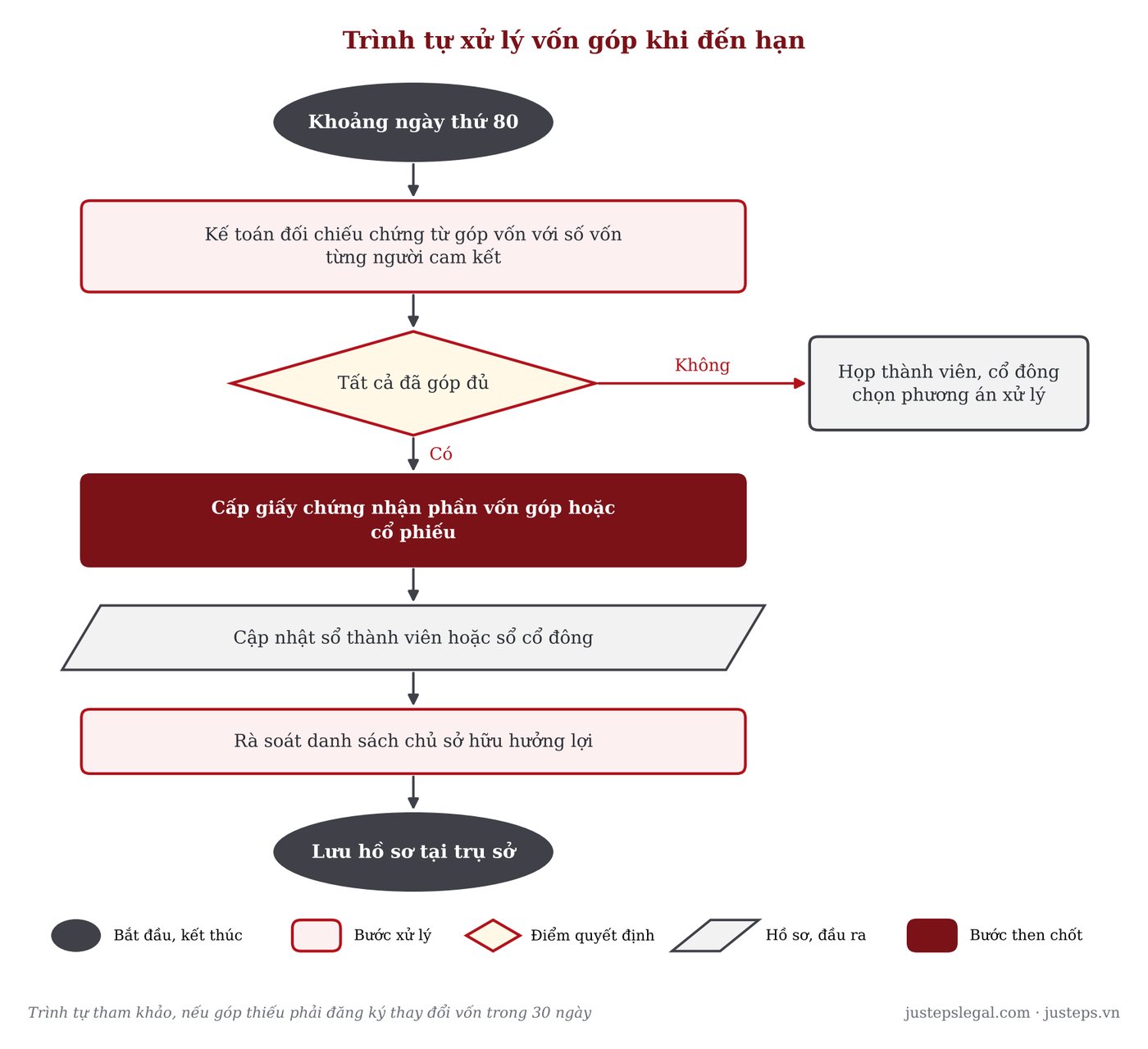
Procedure for checking and dealing with capital contributions when the 90-day deadline arrives
Around day 80, the accountant reconciles each member’s contribution records with the capital they committed, leaving time to remind anyone who has not yet paid in full. If everyone has paid in full, the company issues capital contribution certificates or share certificates and updates the register. If someone has not paid in full, the company holds a meeting of members or shareholders to decide what to do, for example allowing other members to contribute the shortfall pro rata or reducing the charter capital, and then submits the change registration file within 30 days. Skipping the adjustment step leaves the charter capital on the certificate higher than the capital actually contributed, and those who committed to contribute remain liable up to the amount of capital registered.
Beneficial owners, minimum internal rules and records kept at the head office
Under the Law on Enterprises as amended in 2025, businesses are obliged to collect, update and keep information on their beneficial owners and to provide it when requested by a competent state authority[20]. A beneficial owner is an individual who actually owns charter capital or has the right to control the business, including where the capital is held indirectly through another legal entity. This information has already been declared in the incorporation file, but whenever ownership ratios change because of a capital shortfall or a transfer, the list kept at the company must be updated together with supporting documents.
In the second and third months, the business should issue a minimum set of internal rules, comprising expense rules with approval limits, payment and advance procedures, wage and allowance rules and a set of commonly used contract templates. This set of rules does not need to be long, but it gives the company a basis for spending money, signing contracts and paying wages, and it is also the accounting documentation needed to prove deductible expenses. Businesses wishing to standardise early may consider Justeps’ service on developing internal procedures and rules for start-ups.
A business must keep the prescribed documents at its head office or at another location specified in the charter[21]. The table below summarises the groups of records a new company should have after the first 90 days and the person who should be responsible for keeping them:
| Group of records | Main documents | Custodian |
|---|---|---|
| Corporate documents | Enterprise Registration Certificate, charter and decision on the company seal. | The Director or the person in charge of administration. |
| Ownership and capital contributions | Register of members or shareholders, contribution records, capital contribution certificates or share certificates. | The person in charge of administration, with the accountant keeping copies of the payment records. |
| Beneficial owners | List of beneficial owners and verification documents, updated when ownership changes. | The person in charge of administration. |
| Tax and accounting | Invoice registration file, tax returns, accounting books and original documents. | The in-house accountant or the contact person working with the service provider. |
| Labour and insurance | Employment contracts, labour management register, labour declaration and insurance registration files. | The person in charge of HR. |
| Internal governance | Minutes of meetings, resolutions and decisions of the owner, the Members’ Council or the Board of Directors. | The company secretary or the person in charge of administration. |
All of the tasks above can be arranged into a 90-day schedule with clearly assigned owners, as in the indicative roadmap below.
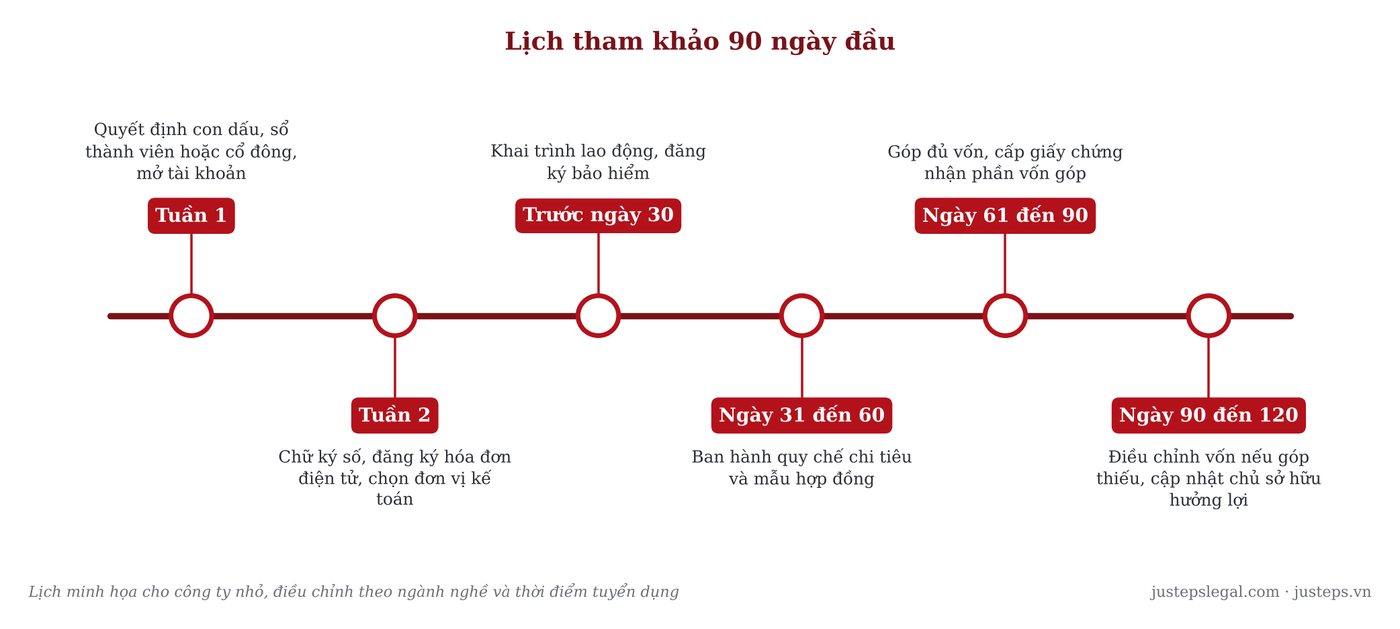
Indicative schedule of tasks for the first 90 days after incorporation
The first week focuses on foundational tasks such as the decision on the company seal, the register of members or shareholders and the bank account, because all later tasks depend on these records. The second week is for the digital signature, electronic invoices and choosing an accounting provider, so that the company is ready to issue an invoice for its first contract. All labour obligations must be completed before day 30, and from day 31 to day 90 the company completes its capital contributions, issues its internal rules and updates its beneficial ownership information. Businesses wishing to hand over all of these tasks as a package may consider Justeps’ service for setting up operating records for the first 90 days.
How Justeps can help
Justeps helps new businesses complete the tasks required after incorporation on time through the following services:
- Setting up operating records for the first 90 days. Justeps draws up a 90-day obligations schedule by company type and business line and prepares the register of members or shareholders and capital contribution certificates.
- Organising the accounting function and documentation. Justeps sets up the documentation procedure and online banking access rights and coordinates with the outsourced accounting provider.
- Labour, payroll and insurance services for start-ups. Justeps drafts employment contracts and wage rules and guides the labour declaration and insurance registration for the first employees.
- Developing internal procedures and rules for start-ups. Justeps drafts expense rules, payment and advance procedures and a set of commonly used contract templates.
- Ongoing advisory support for start-ups. Justeps monitors deadlines and answers questions on corporate, tax and labour matters during the first year of operation.
Frequently asked questions
Must a company with no employees yet declare its use of labour?
The declaration obligation is tied to the use of employees[11]. A company with no employees yet should make the declaration as soon as it signs its first employment contract so as not to miss the 30-day deadline.
Must a business notify its seal specimen to the business registration authority?
A business does not have to notify its seal specimen, as it decides on and manages its own seal under its charter or internal rules[1]. The company should issue a decision designating who keeps the seal and the scope of its use.
What must be done if charter capital has not been paid up in full after 90 days?
The company must register an adjustment of its charter capital and ownership ratios to reflect the capital actually contributed within 30 days of the last day for full payment[19]. Before that, the members or shareholders should meet to decide whether to allow others to contribute the shortfall.
Is a new business automatically exempt from corporate income tax?
The incentive applies only to small and medium-sized enterprises established for the first time that do not fall within the excluded cases[6]. The business must still file returns, finalise its tax and keep records proving that it qualifies for the exemption.
Must tax returns be filed when there is no revenue yet?
The business must still file returns for each determined period, even when no revenue has arisen[8]. Late filing may be penalised even where no tax is payable.
Must a Director who is a capital-contributing member be registered for social insurance?
If the Director receives a salary from the company, they are subject to compulsory social insurance as a business manager[14]. The company must register them within 30 days of the date they become subject to insurance.
Can capital be contributed in cash?
The law does not prohibit cash contributions to a domestic company, but a transfer to the company’s account is the safest way to prove the contribution. If cash is contributed, the company must issue a receipt and a confirmation record signed by the contributor and the company’s representative.
Related articles
- Estimating a new company’s operating costs in its first year and how to build a realistic budget
- Setting up the organisation of a newly incorporated company with fewer than 10 staff so that roles, authority and cash flow are under control
- Setting up a company in Hanoi: documents required, processing time and what to do immediately after registration
- What a turnkey business operations set-up covers, in what order it should be done and how it should be signed off
Notes
[1] Article 43 of the Law on Enterprises No. 59/2020/QH14 dated 17 June 2020, as amended and supplemented by Law No. 76/2025/QH15.
[2] Articles 47 and 48 of the Law on Enterprises No. 59/2020/QH14.
[3] Article 122 of the Law on Enterprises No. 59/2020/QH14.
[4] Decree No. 254/2026/ND-CP dated 30 June 2026 of the Government on electronic invoices and electronic documents, effective from 1 July 2026, replacing Decree No. 123/2020/ND-CP and Decree No. 70/2025/ND-CP.
[5] Clause 1 of Article 29 of the Law on Enterprises No. 59/2020/QH14.
[6] Article 10 of Resolution No. 198/2025/QH15 of the National Assembly dated 17 May 2025 on a number of special mechanisms and policies for the development of the private economy.
[7] Government Decree No. 20/2026/ND-CP guiding the tax policies under Resolution No. 198/2025/QH15.
[8] The Law on Tax Administration No. 108/2025/QH15 and its implementing regulations.
[9] Clause 3 of Article 12 of the Law on Accounting No. 88/2015/QH13 dated 20 November 2015.
[10] The Law on Value Added Tax No. 48/2024/QH15 dated 26 November 2024.
[11] Clauses 1 and 2 of Article 12 of the Labour Code No. 45/2019/QH14 dated 20 November 2019.
[12] Article 3 of Government Decree No. 145/2020/ND-CP dated 14 December 2020.
[13] Decree No. 283/2026/ND-CP on administrative penalties in the fields of labour and social insurance.
[14] Points a and i of Clause 1 of Article 2 of the Law on Social Insurance No. 41/2024/QH15 dated 29 June 2024.
[15] Article 28 of the Law on Social Insurance No. 41/2024/QH15.
[16] Article 14 of the Labour Code No. 45/2019/QH14; Decree No. 337/2025/ND-CP on electronic employment contracts.
[17] Clause 1 of Article 118 and Article 119 of the Labour Code No. 45/2019/QH14.
[18] Clause 2 of Article 47, Clause 2 of Article 75 and Clause 1 of Article 113 of the Law on Enterprises No. 59/2020/QH14.
[19] Clauses 3 and 4 of Article 47, Clauses 3 and 4 of Article 75 and Clause 3 of Article 113 of the Law on Enterprises No. 59/2020/QH14.
[20] Law No. 76/2025/QH15 dated 17 June 2025 amending and supplementing a number of articles of the Law on Enterprises; Decree No. 168/2025/ND-CP dated 30 June 2025 on enterprise registration, as amended and supplemented by Decree No. 296/2026/ND-CP.
[21] Article 11 of the Law on Enterprises No. 59/2020/QH14.
This article is for reference and reflects the regulations in force at the time of publication. Please consult Justeps for advice tailored to your company’s records and situation.
For further information, please contact:
📩 Email: info@justeps.vn
🌐 Website: https://justepslegal.com · https://justeps.vn
🌐 Page: Justeps
☎️ Hotline (Zalo): 096 172 2607
📍 Thanh Xuan Office: 12th Floor, Licogi 13 Tower, 164 Khuat Duy Tien Street, Thanh Xuan Ward, Hanoi, Vietnam
📍 Ha Dong Office: LK06B, No.10, Dong Dua Area, Ha Dong Ward, Hanoi, Vietnam
📍 Ho Chi Minh City Branch: 528 Le Van Sy, Ho Chi Minh City, Vietnam
📍 Hai Phong Office: Truong Thinh Village, Ha Dong Commune, Hai Phong, Vietnam
📍 Quang Ninh Office: Van Don Special Zone, Quang Ninh Province, Vietnam





