
Key takeaways
- Receiving the enterprise registration certificate does not mark the end of conversion; over the following 12 to 24 months, the enterprise must both clear up the unfinished business of the former household and meet the new obligations of a company.
- Debts and contracts signed by the household business owner do not automatically pass to the company; transferring an obligation to pay a debt to the company requires the obligee’s consent[3].
- A shop name or logo used for many years may still be registered first by someone else, because rights to a trade mark are established on a first-to-file basis[5].
- Small and medium-sized enterprises may be exempt from corporate income tax for 3 years from the date they are first granted an enterprise registration certificate, but the conditions must be checked against the case of conversion from a household business[7].
Most household business owners move up to an enterprise believing that the hardest part is preparing the registration file. In practice, the real difficulties appear over the following one to two years, when the owner must for the first time file tax returns themselves, sign contracts with large partners, deal with the social insurance authority and answer questions from banks. Each individual question is not large, but with nobody to ask, owners tend to follow old habits or word-of-mouth advice, and errors gradually build up until the annual finalisation.
This page introduces Justeps’ ongoing legal advisory service designed specifically for enterprises converted from household businesses, usually engaged on an annual basis. It focuses on the two layers of work to be dealt with after conversion, how Justeps receives and responds to requests, the first-year compliance calendar and the factors that determine the fee. Choosing the company type and management titles and building regulations fall within the sister services in the same group and are described on separate pages.
Two layers of work the enterprise must handle after conversion
The first layer is the unfinished business of the former household business. After the enterprise is granted its certificate, the household business is moved to terminated status only once the tax authority confirms that the household has fulfilled its tax obligations[1]. The owner therefore needs to complete the tax declarations and payments for the period as a household, collect or settle debts and decide what happens to each contract in progress. If these matters are left open, the former household may remain stuck in the process of termination for a long time, causing difficulties when the owner needs to carry out other procedures.
The second layer is the company’s new obligations, including contributing the full capital within the statutory period, opening a bank account, registering a digital signature and e-invoices, filing periodic tax returns, preparing financial statements, registering employees for social insurance and making periodic labour reports. Members and owners must contribute the full capital within 90 days of the date the certificate is issued, excluding the time needed to transport or import contributed assets and to complete ownership transfer procedures[2]. The table below summarises the two layers of work by group.
| Area | Unfinished business of the former household | New obligations of the company |
|---|---|---|
| Tax | Declare and pay tax for the period as a household so that the tax authority confirms the obligations have been fulfilled. | File periodic returns for value added tax and corporate income tax and withhold personal income tax. |
| Contracts | Re-sign, add an appendix to or enter into a tripartite agreement for premises leases and purchase contracts still in the household business owner’s name. | Review standard contracts from suppliers, agents and distributors before signing. |
| Debts | Collect, or agree to transfer, receivables and payables with the consent of the parties concerned. | Track debts by contract and by documents issued in the company’s name. |
| Intellectual property | Check whether the shop name and logo have already been registered by anyone. | File trade mark applications and manage protection periods. |
| Licences | List the licences and certificates issued in the household’s name. | Obtain new licences or amend existing licences in the company’s name. |
The two layers overlap in the first months, exactly when the owner is busiest stabilising sales. This is why Justeps proposes a minimum support period of one year, during which the former household’s layer of work is cleared up completely in the first quarter.
Common issues in the first year
Contracts and debts still in the household business owner’s name
The premises lease is often signed by the household business owner with the landlord many years earlier and is still in force. If the company continues to use the premises without re-signing or a transfer document, the rent paid by the company is difficult to treat as a valid expense because the contract is not in the company’s name. As for debts, amounts the household still owes suppliers pass to the company only if the supplier agrees[3], while amounts owed to the household may be assigned to the company but the obligor must be notified in writing[4]. Justeps drafts an appendix, a tripartite agreement or an assignment agreement suited to each case.
The brand has not been registered as a trade mark
Many shops have used their name, signboard and logo for decades but have never filed a trade mark application. Intellectual property law gives priority to the person who files the earliest valid application[5], so if a competitor or a former partner files first, the enterprise may have to change its name or spend a long time proving its rights. Justeps searches for registrability and advises on whether the company or the owner personally should hold the trade mark, because the two options have different consequences for assets and tax if the mark is later transferred or licensed.
Incentives and support that are easily missed
The Law on Support for Small and Medium-sized Enterprises contains specific provisions on supporting enterprises converted from household businesses, such as free advice on incorporation procedures and exemption from certain fees and charges the first time[6]. Resolution No. 198/2025/QH15 adds a 3-year corporate income tax exemption for small and medium-sized enterprises and ends the collection of business licence fees from 1 January 2026[7]. A draft Law on the Development of Small and Medium-sized Enterprises, replacing the 2017 law and containing a core group of policies for enterprises converted from household businesses, is being considered by the National Assembly. Justeps follows these documents, checks the conditions against the enterprise’s records and reminds it of the procedures required so that it does not miss out on incentives.
How Justeps supports the enterprise
Each enterprise is assigned a lead consultant who knows its records and compliance calendar. The owner, the accountant or the manager can send questions by telephone, Zalo or email, and every request is entered in a tracking log so that nothing is lost. The process for receiving and responding to requests is shown in the figure below.
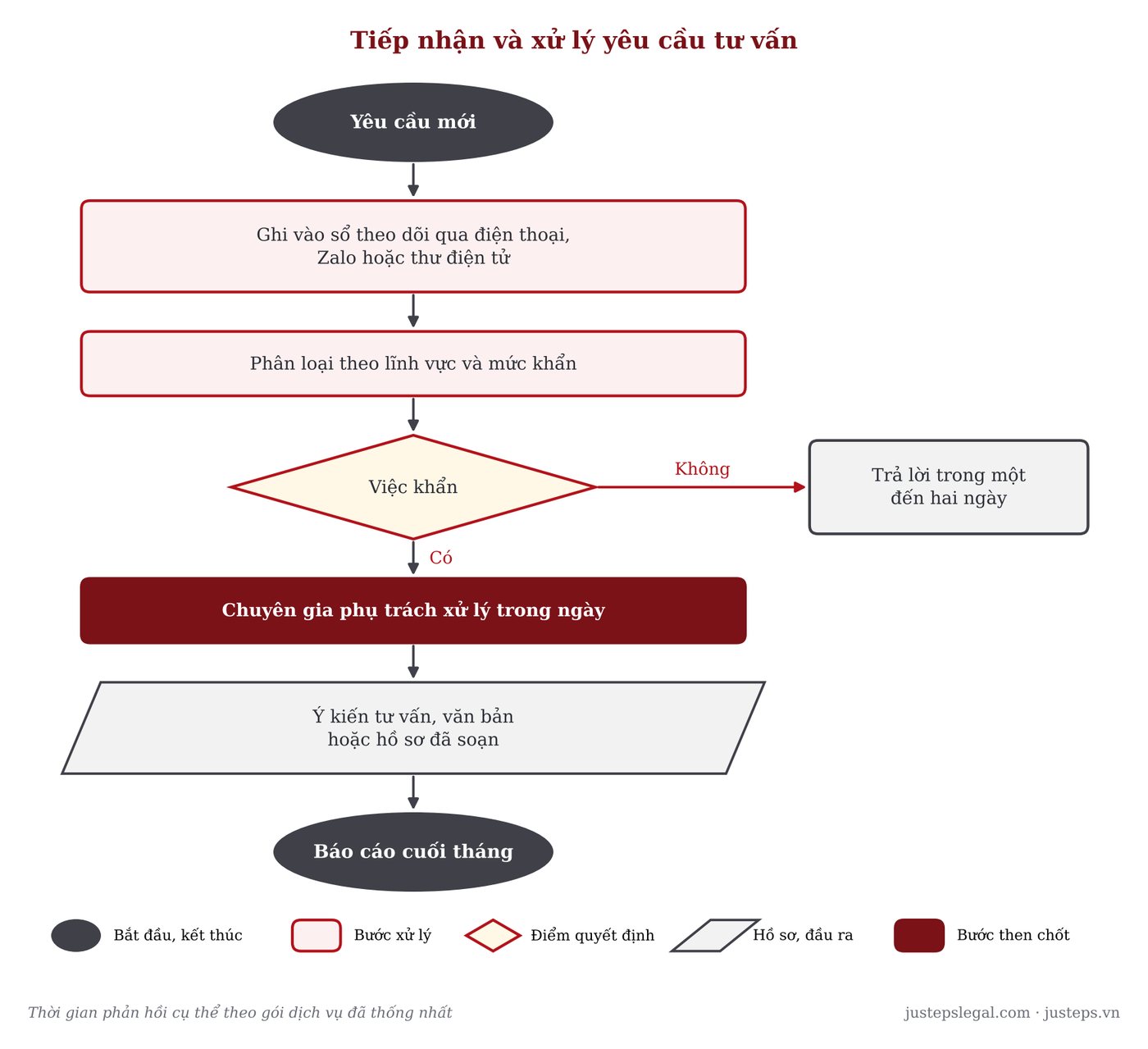
How Justeps receives and handles requests from the enterprise
Requests are classified by area and urgency as soon as they are received. Urgent matters, such as a partner asking for a contract to be signed the same day, a state authority arriving for a working session or an employee leaving suddenly, are handled on the same day. Ordinary questions are answered within one to two working days, while matters requiring careful reasoning are answered with a written advisory opinion. At the end of each month, Justeps sends a summary report of the matters handled and the deadlines coming up.
The content of requests changes noticeably over time. In the first year, questions on tax, invoices and documents make up the majority, followed by contracts, as in the illustrative example below.
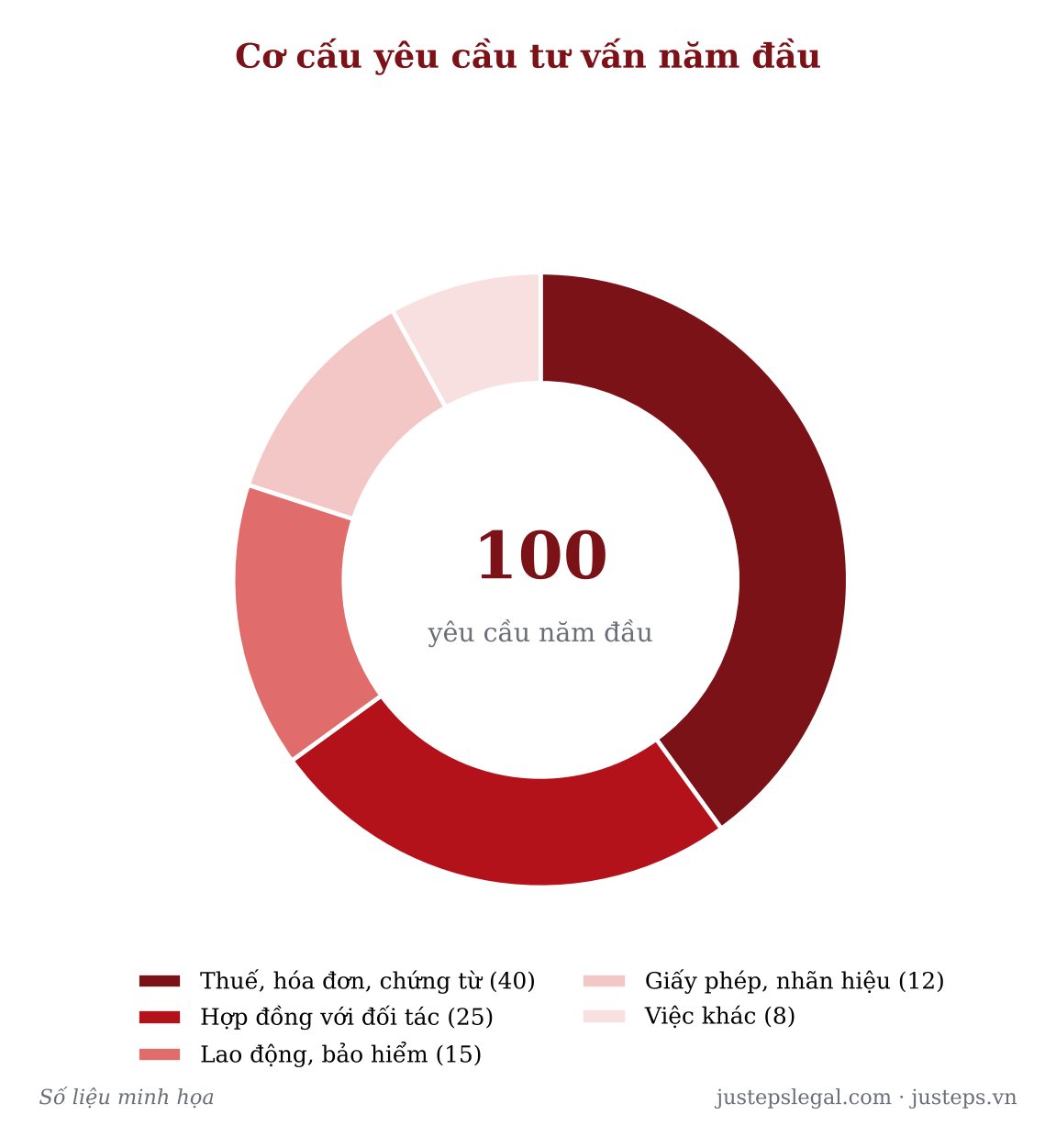
Example breakdown of advisory requests in the first year of a converted enterprise
From the second year, once invoicing and tax filing have settled into a routine, the share of questions gradually shifts towards contracts with partners, labour and business expansion, such as opening more outlets or selling on e-commerce marketplaces. Justeps adjusts the scope of the advisory package to reflect this shift when the contract is renewed.
First-year compliance calendar and deliverables
At the initial review session, Justeps prepares an enterprise profile and a compliance calendar for the whole year, stating clearly what must be done, by whom and by when. The figure below is an indicative calendar for a company whose financial year coincides with the calendar year.
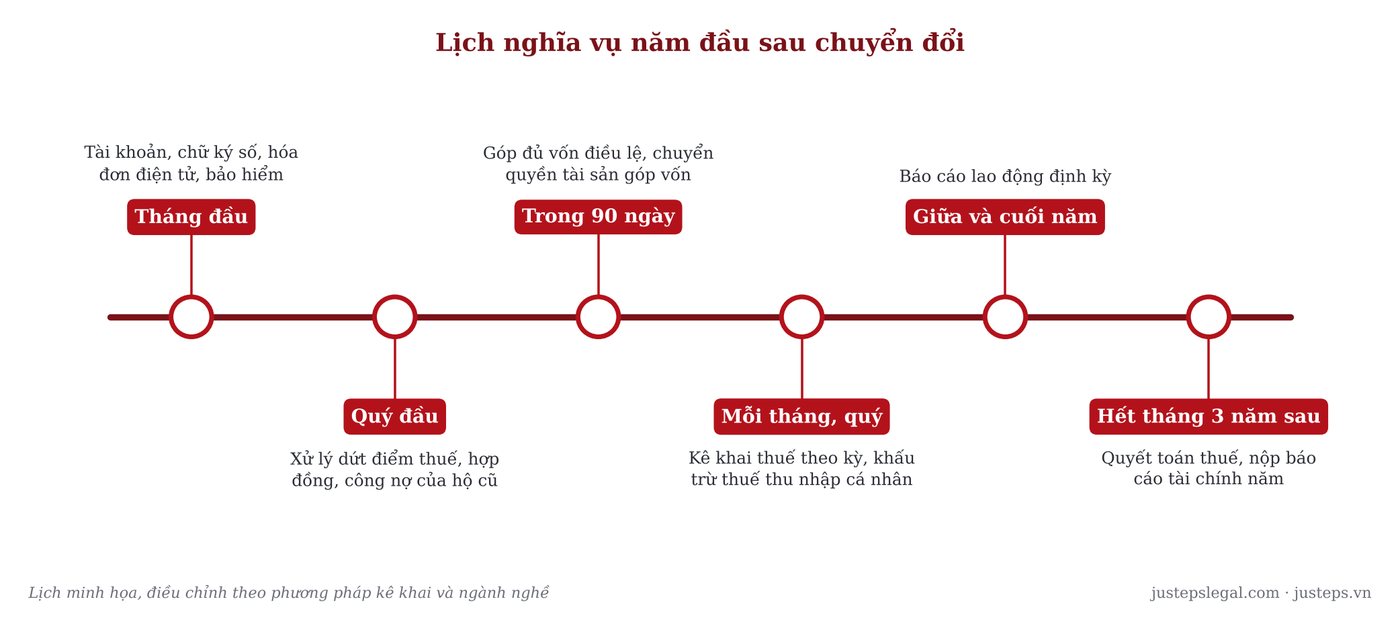
Example first-year compliance calendar for a company converted from a household business
Under this calendar, the full capital contribution must be completed within the first 90 days, tax filing periods recur monthly or quarterly depending on the method applied, and the annual corporate income tax finalisation return is filed no later than the last day of the third month after the end of the financial year[8]. Labour reports and sector-specific deadlines are added to the calendar by Justeps according to the particular records. When the contract ends, the enterprise receives all the records created during the engagement, including the following documents:
- An initial review report setting out the former household’s unfinished business, the risks and the order in which they should be addressed.
- A periodic compliance calendar updated in line with new legal documents.
- The written advisory opinions issued during the period.
- Monthly activity reports recording the matters handled and the deadlines coming up.
- A set of standardised template contracts for purchasing, sales, premises leases and agency.
Application by size and sector, and fees
An enterprise with one shop usually chooses a basic package with a limited number of advisory hours and responses by telephone and messaging. An enterprise with several outlets, a production workshop or sales on e-commerce marketplaces needs a fuller package, with review of an unlimited number of contracts and support in preparing files for working with state authorities. The food sector also needs advice on food safety and goods labelling, while the building materials and agricultural produce sectors need considerable support with input documents.
The fee is fixed monthly or annually and depends on the expected number of advisory hours, the number of contracts to be reviewed, the committed response time, whether Justeps takes part in preparing for working sessions with state authorities and the number of business locations. Larger matters such as trade mark registration, applications for new licences or preparing files for disputes are quoted separately. Where a dispute has to go to court or arbitration, Justeps assesses the matter and prepares the file for the enterprise to handle itself or to pass to a practitioner of its own choosing. An enterprise whose structure has not yet taken shape may combine this service with the organisational structure design service for converting household businesses in the first quarter.
How Justeps can help
In addition to ongoing legal advisory, converting household businesses may combine the following Justeps services:
- Organisational structure design for converting household businesses. Justeps determines the company type, the capital contributors and the managers and deals with contributed assets before the conversion file is submitted.
- Labour, payroll and insurance for converting household businesses. Justeps standardises employment contracts, payroll and insurance registration for workers moving from the household business to the company.
- Setting up business operations. Justeps assists with post-licensing tasks such as bank accounts, digital signatures, e-invoices and initial internal records.
- Business growth. Justeps advises on legal matters when the enterprise opens more outlets, takes up a franchise, raises capital or expands its distribution channels.
Frequently asked questions
How does ongoing legal advisory differ from an accounting service?
An accounting service focuses on bookkeeping, preparing financial statements and tax returns. Ongoing legal advisory focuses on contracts, partners, labour, licences, trade marks and how to deal with issues when they arise, so the two services complement each other.
Does a premises lease signed by the household business owner need to be re-signed?
It should be re-signed, or an appendix or tripartite agreement should be made, so that the company becomes the tenant. Otherwise, the rent paid by the company is difficult to recognise as a valid expense and the company’s rights to the premises are unclear.
Do the former household’s debts to suppliers pass to the company automatically?
No. For the company to take over the debt, there must be an agreement transferring the obligation to which the supplier consents[3]. Without such an agreement, the household business owner remains the person obliged to pay the debt.
Should a trade mark be registered immediately after conversion?
It should be done early, because rights to a trade mark belong to the first person to file a valid application[5]. Justeps carries out a search before filing to reduce the risk of refusal and advises on the appropriate applicant.
Is an enterprise converted from a household business entitled to a 3-year corporate income tax exemption?
Resolution No. 198/2025/QH15 exempts small and medium-sized enterprises from corporate income tax for 3 years from the date they are first granted an enterprise registration certificate[7]. Whether it applies to a particular converted enterprise must be checked against the conditions in the implementing documents, so Justeps reviews this case by case.
Does Justeps accompany the enterprise when the tax authority comes for a working session?
Where the package includes this, Justeps prepares the records and explanations and may attend the working session to support the enterprise. Justeps does not undertake litigation before courts or arbitral tribunals.
Related articles
- How should a business choose an annual retainer for ongoing legal advice, and how can it get the most out of it
- Trade mark management in business, from searching, filing and renewal to dealing with infringement
- How to choose a business form between a household business, a limited liability company and a joint stock company
- An annual periodic legal review covering 12 areas that companies should check themselves
Notes
[1] Article 27 of Decree No. 168/2025/ND-CP dated 30 June 2025 of the Government on enterprise registration, as amended and supplemented by Decree No. 296/2026/ND-CP.
[2] Clause 2 of Article 47 and Clause 2 of Article 75 of the Law on Enterprises No. 59/2020/QH14, as amended and supplemented by Law No. 03/2022/QH15 and Law No. 76/2025/QH15.
[3] Article 370 of the Civil Code No. 91/2015/QH13 dated 24 November 2015.
[4] Article 365 of the Civil Code No. 91/2015/QH13.
[5] Article 90 of the Law on Intellectual Property No. 50/2005/QH11, as amended and supplemented.
[6] Article 16 of the Law on Support for Small and Medium-sized Enterprises No. 04/2017/QH14 dated 12 June 2017.
[7] Clauses 4 and 7 of Article 10 of Resolution No. 198/2025/QH15 dated 17 May 2025 of the National Assembly on a number of special mechanisms and policies for private economic development.
[8] The law on tax administration sets the deadline for filing annual tax finalisation returns; Law on Tax Administration and current implementing documents.
This article is for reference and reflects the regulations in force at the time of publication. Please consult Justeps for advice tailored to your company’s records and situation.
For further information, please contact:
📩 Email: info@justeps.vn
🌐 Website: https://justepslegal.com · https://justeps.vn
🌐 Page: Justeps
☎️ Hotline (Zalo): 096 172 2607
📍 Thanh Xuan Office: 12th Floor, Licogi 13 Tower, 164 Khuat Duy Tien Street, Thanh Xuan Ward, Hanoi, Vietnam
📍 Ha Dong Office: LK06B, No.10, Dong Dua Area, Ha Dong Ward, Hanoi, Vietnam
📍 Ho Chi Minh City Branch: 528 Le Van Sy, Ho Chi Minh City, Vietnam
📍 Hai Phong Office: Truong Thinh Village, Ha Dong Commune, Hai Phong, Vietnam
📍 Quang Ninh Office: Van Don Special Zone, Quang Ninh Province, Vietnam





