
Key takeaways
- Rights in an ordinary trade mark arise only upon grant of a protection title and belong to the first applicant, so businesses should search and file before investing heavily in packaging and advertising.
- A trade mark registration certificate is valid for 10 years from the filing date and may be renewed repeatedly, but it may be terminated if the mark is not used for 5 consecutive years.
- An assignment of a trade mark takes effect only upon registration, while an unregistered licence agreement has no effect against third parties.
- From 1 April 2026, owners have an additional tool to request the removal of, or blocking of access to, infringing content in the digital environment, alongside administrative, civil and criminal remedies and border control measures.
- Every business should keep a trade mark portfolio register maintained by one designated person, recording the legal status, renewal deadlines, evidence of use and related agreements for each mark.
A trade mark is often the asset in which a business invests most heavily through advertising, packaging and customer goodwill, yet it is seldom managed as an asset. Many businesses discover a problem only when a competitor has already filed first for the same name, when a registration has expired because nobody remembered to renew it, or when the founder in whose name the mark is registered leaves the company. All of these situations can be avoided if the business monitors the mark from the moment the name is chosen and throughout its period of use.
This article sets out the life cycle of a trade mark under the Law on Intellectual Property, most recently amended by Law No. 131/2025/QH15 effective from 1 April 2026, taking in turn searching, filing, maintenance and renewal, transfer and dealing with infringement, before suggesting how to organise its management internally. It is written primarily for boards of directors, in-house legal teams, marketing departments and product development managers of Vietnamese businesses, including those preparing to export or to franchise.
How trade marks are protected under Vietnamese law
As a rule, industrial property rights in a trade mark are established on the basis of a decision of the competent state authority to grant a protection title, except for well-known marks, which are established through use[1]. To be protected, a trade mark must be a visible sign in the form of letters, words, drawings or images, including three-dimensional shapes, or a sound sign capable of graphical representation, and must be capable of distinguishing the goods or services of its owner from those of others[2]. Accordingly, the fact that a business has used a name for many years does not automatically give rise to trade mark rights, unless it can prove that the mark has become well known, a standard that is very difficult to meet.
Vietnamese law applies the first-to-file principle, under which, where several applications are filed for identical or confusingly similar marks for the same goods or services, the protection title is granted only to the application with the earliest priority date or filing date[3]. An applicant who has filed in a member state of the Paris Convention may claim priority when filing in Vietnam within 6 months, and vice versa. Trade mark rights are also territorial, meaning that a certificate granted by the Intellectual Property Office of Vietnam is effective only in Vietnam, so exporters must register in each market or through the Madrid system.
The 2025 amendments introduce an expedited examination mechanism for certain trade mark applications, set out the responsibilities of intermediary service providers and digital platforms in preventing infringement, and permit measures to remove, or block access to, infringing content online[4]. Decree 100/2026/ND-CP and Circular 10/2026/TT-BKHCN, both effective from 1 April 2026, provide guidance on these changes, including a requirement that owners keep a register of intellectual property rights not yet recognised as assets in their accounting books[5]. Taken together, the new instruments move trade mark management away from a one-off registration procedure towards an asset management function with its own records, responsible person and monitoring calendar.
Searching and assessing registrability before use
Searching is the cheapest step in the life cycle of a trade mark, yet it is also the step most often skipped. The purpose of a search is to establish whether any identical or confusingly similar mark has already been registered or applied for in respect of the same or similar goods or services as the sign the business intends to use[6]. A business can carry out a preliminary search itself on the public database of the Intellectual Property Office, and then assess more closely the degree of similarity in structure, pronunciation, meaning and presentation before reaching a decision. In addition to the trade mark database, it is advisable to check company names, domain names and account names on e-commerce platforms to avoid disputes in those channels.
Apart from the risk of conflict with another party’s mark, many signs are refused for lack of distinctiveness, such as words that merely describe the quality, function or geographical origin of a product, simple geometric shapes, or signs identical to the national flag, the national emblem or the names of state bodies[7]. A search result is only an assessment of registrability and does not guarantee that the application will be accepted, because the examiner will also compare it with applications not yet published. Businesses should prepare at least two alternative names, and should order printed packaging or signage only once the chosen option has a favourable search result and the application has been filed.
Another risk that receives little attention is copyright in the logo. Where a logo is designed by an employee in the course of assigned duties or by an external designer under a contract, the business needs a written assignment of duties or a contract stating clearly that the business owns the copyright[8]. Without such a document, the designer may still dispute ownership of the work of applied art, and a trade mark that conflicts with another person’s copyright may be the subject of a request to invalidate the registration.
Preparing and monitoring a trade mark application
Who should be the applicant and which classes to cover
Organisations and individuals that lawfully produce goods or provide services have the right to register trade marks for their own goods and services[9]. In start-ups, the mark is often filed by a founder in a personal capacity before the company is formed, and unless it is assigned to the company, the mark remains that person’s own property. When the founder leaves the company or a dispute arises between members, failing to transfer the mark proactively will cause the business to lose its rights in its own brand.
The scope of trade mark protection is defined by the mark as represented and the list of goods and services in the certificate, classified under the International Nice Classification. Businesses should therefore register both for the classes of products they currently sell and for those into which they plan to expand over the next few years, weighed against costs that rise with the number of classes. As regards the representation of the mark, a common approach is to register the word element in standard characters on its own to obtain the broadest protection, and then to register the logo or composite mark separately if the figurative element has its own distinctive value.
Stages of examination and what the business must do
After filing, a trade mark application is processed by the Intellectual Property Office through several stages, and at each stage the business may have to respond to a notification within a set time limit. The sequence below shows the main steps from searching to receipt of the registration certificate.
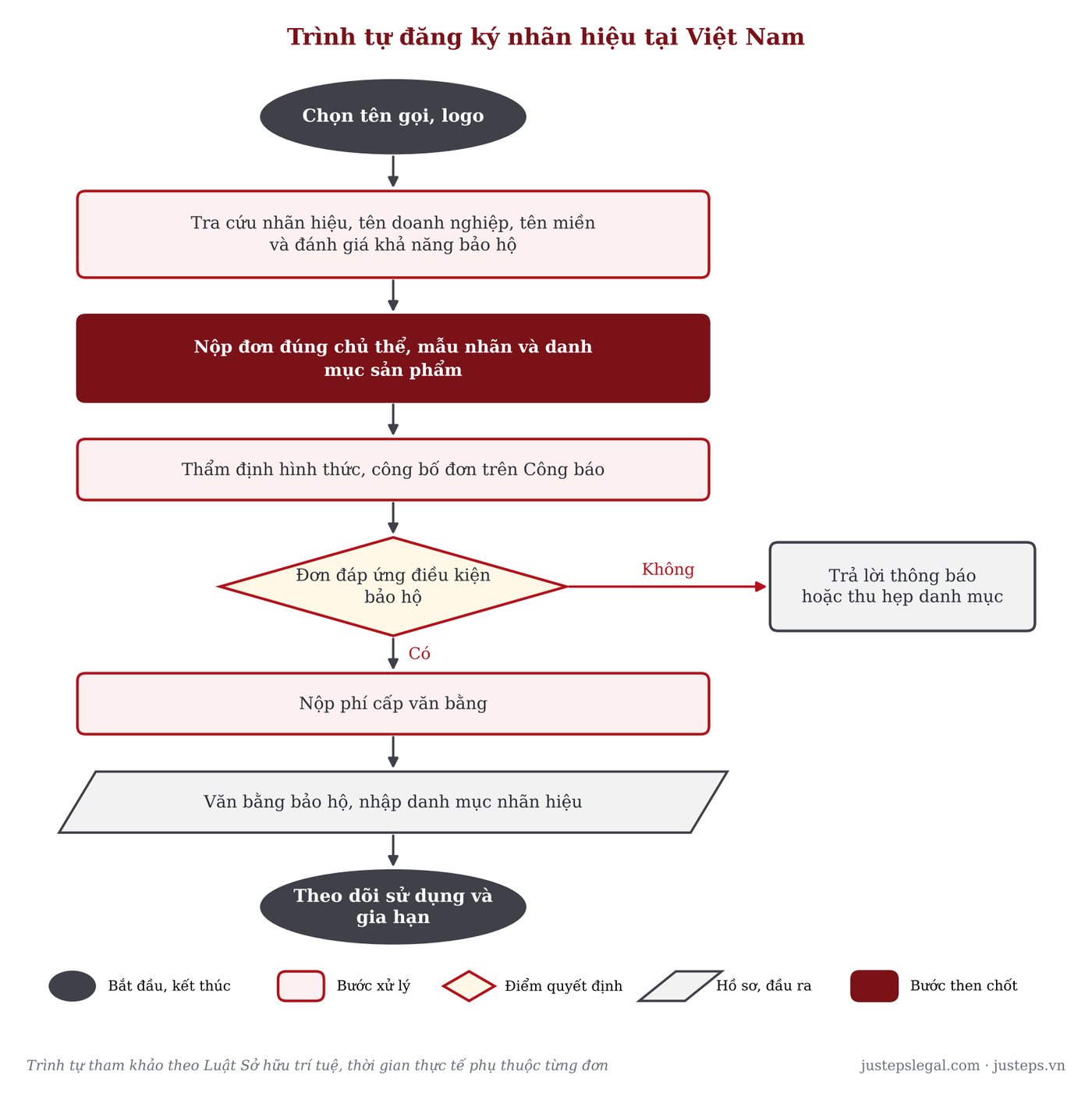
Sequence for registering a trade mark from searching to grant of the certificate
Under the law, formal examination takes place within one month of the filing date, a valid application is published in the Industrial Property Official Gazette, and substantive examination takes no more than nine months from publication, excluding time taken by the applicant to amend or supplement the application[10]. In practice, the whole process usually takes longer than the statutory period, so businesses should build this time into their product launch plans. From 1 April 2026, an applicant may request expedited substantive examination within three months, but only in the cases specified by the Government, and this does not apply to every ordinary trade mark application. When it receives a notification of intended refusal, the business must respond on time with arguments and evidence, for example by showing how the mark differs from the cited mark or by narrowing the list of goods, because missing the deadline means the application will be refused.
Once the application is published, any third party has the right to oppose the grant of the certificate, and the business likewise has the right to oppose another party’s application that conflicts with its own mark[11]. An effective practice is to assign someone to monitor the Industrial Property Official Gazette regularly to identify similar applications early, because opposing at the application stage costs far less than seeking to invalidate a registration after grant. Every notification from the Intellectual Property Office, together with the application number, filing date and response deadline, should be entered immediately in the business’s trade mark portfolio register.
Maintaining validity, renewal and proper use of the mark
A trade mark registration certificate is valid from the date of grant until the end of 10 years from the filing date and may be renewed for successive periods of 10 years each[12]. To renew, the holder files a renewal request and pays the fee within the six months before the certificate expires; the request may be filed late within six months after expiry, subject to an additional late renewal fee. After the late filing period, the certificate lapses and the business must file a new application, by which time another party may already have filed for the mark.
Because the expiry date runs from the filing date rather than the date of grant, many businesses miscalculate the renewal deadline. The timeline below summarises the main milestones in the life cycle of a trade mark registration.
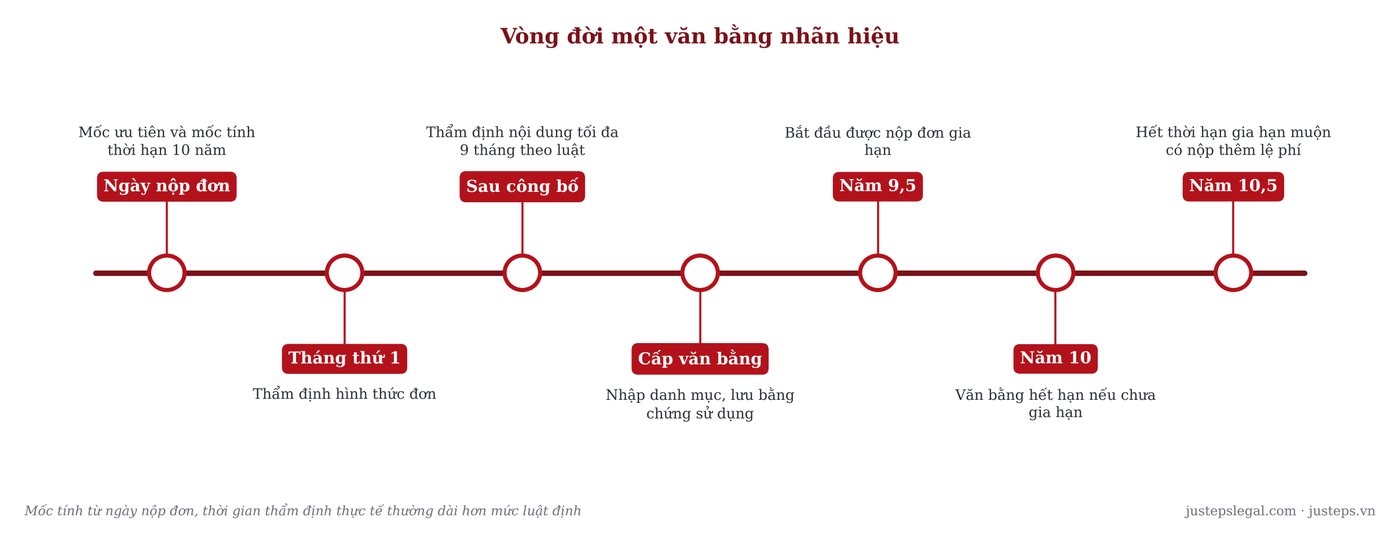
Main milestones in the life cycle of a trade mark registration in Vietnam
The filing date is the starting point, determining both priority over other applications and the start of the 10-year term. After the certificate is granted, the business moves to monitoring use, and from year nine and a half a six-month window opens for filing the renewal request. Six months after the expiry date is the final limit for saving the certificate through late renewal, so the trade mark portfolio register needs two layers of reminders, one before the expiry date and one after it.
Besides renewal, the owner must make genuine use of the mark. The validity of a certificate may be terminated at the request of another party if the mark has not been used by the owner or a licensee for five consecutive years without a legitimate reason[13]. Businesses should keep annual evidence of use such as sales invoices, images of packaging and advertising materials showing the mark exactly as registered, because use of a variant that departs significantly from the registered form may not count as use of the mark. When the business changes its name or address, including changes resulting from the reorganisation of administrative units, it should apply to record the amendment to the certificate so that the owner’s details match the enterprise registration certificate[14].
Assignment, licensing and capital contribution in the form of a trade mark
An assignment of trade mark rights must be made by written contract and takes effect only upon registration with the competent state authority[15]. The assignment must not cause confusion as to the characteristics or origin of the goods or services bearing the mark, and the assignee must satisfy the conditions for being entitled to register that mark. In business acquisitions or group restructurings, trade marks are often left off the list of assets to be transferred, with the result that the new company operates the brand while the certificate remains in the name of the old company.
A trade mark licence agreement takes effect between the parties as agreed, but has legal effect against third parties only once it has been registered[15]. The agreement should set out clearly the territory, product classes, term, the right to grant sub-licences, quality control obligations and royalties. In a group structure where the mark is registered in the name of the parent company and used by subsidiaries, a written licence agreement also provides the basis for accounting for costs, filing tax returns and evidencing use of the mark. Businesses may wish to consider Justeps’ commercial contract drafting and review service when preparing or reviewing these agreements.
Intellectual property rights, including rights in a trade mark, are assets that may be contributed as capital to an enterprise when valued by the founding members or shareholders or by a valuation organisation[16]. After the contribution, the contributor must complete the procedure for transferring ownership of the mark to the enterprise, failing which the capital contribution is not regarded as fully paid. The register of intellectual property rights under Decree 100/2026/ND-CP, with information on creation costs, exploitation status and estimated value, provides a useful basis for valuation in such transactions[5].
Detecting and dealing with trade mark infringement
Infringement of trade mark rights includes using a sign identical to a protected mark for identical goods or services, and using an identical or similar sign for identical or similar goods or services where such use is likely to cause confusion as to origin[17]. The most serious form is counterfeit trade mark goods, meaning goods bearing a sign identical to, or indistinguishable from, a protected mark without the owner’s permission. Businesses should regularly monitor the main sales channels such as e-commerce marketplaces, social media, wholesale markets and the Industrial Property Official Gazette in order to detect infringement at an early stage.
On discovering infringement, the owner has the right to protect itself by requiring the infringer to cease the infringing act, apologise, publish a correction and pay compensation, or to request the competent state authorities to take administrative, civil or criminal action[18]. From 1 April 2026, the owner may also request the removal or concealment of, or blocking of access to, content, accounts, websites and applications connected with the infringement, and digital platform providers are required to cooperate[4]. Each remedy suits a different objective, as summarised in the following table:
| Remedy | When it is suitable | What to prepare |
|---|---|---|
| Cease and desist letter | The infringer is clearly identified, operates on a small scale and is likely to stop once warned. | The registration certificate, evidence of the infringing act and a specific deadline for ceasing it. |
| Online takedown | The infringement takes place on an e-commerce marketplace, social media or a website and needs swift action. | Links to the infringing content, time-stamped screenshots and documents proving ownership. |
| Administrative action | Infringing goods are sold in large quantities and the authorities need to seize them and impose penalties. | A request for action, evidence, product samples and possibly an expert assessment. |
| Border control | Infringing goods are imported or exported through border gates. | An application to the customs authority and information for identifying genuine and suspected goods. |
| Civil proceedings | Damage is substantial, compensation must be enforced or ownership is in dispute. | Evidence of damage and reasonable costs, and an authorised representative chosen by the business to handle the case. |
Criminal measures apply only to intentional infringement on a commercial scale that meets the thresholds for illicit profit, damage or value of infringing goods under the Criminal Code[19]. As regards administrative measures, the Law on Intellectual Property permits penalties only for certain groups of acts, such as infringement causing damage to the owner, consumers or society and the production or trading of counterfeit trade mark goods, with specific fines set by the decree on penalties in the field of industrial property[20]. For a quick comparison of the remedies, businesses can look at three criteria, namely speed, cost and effort, and the prospect of recovering compensation.
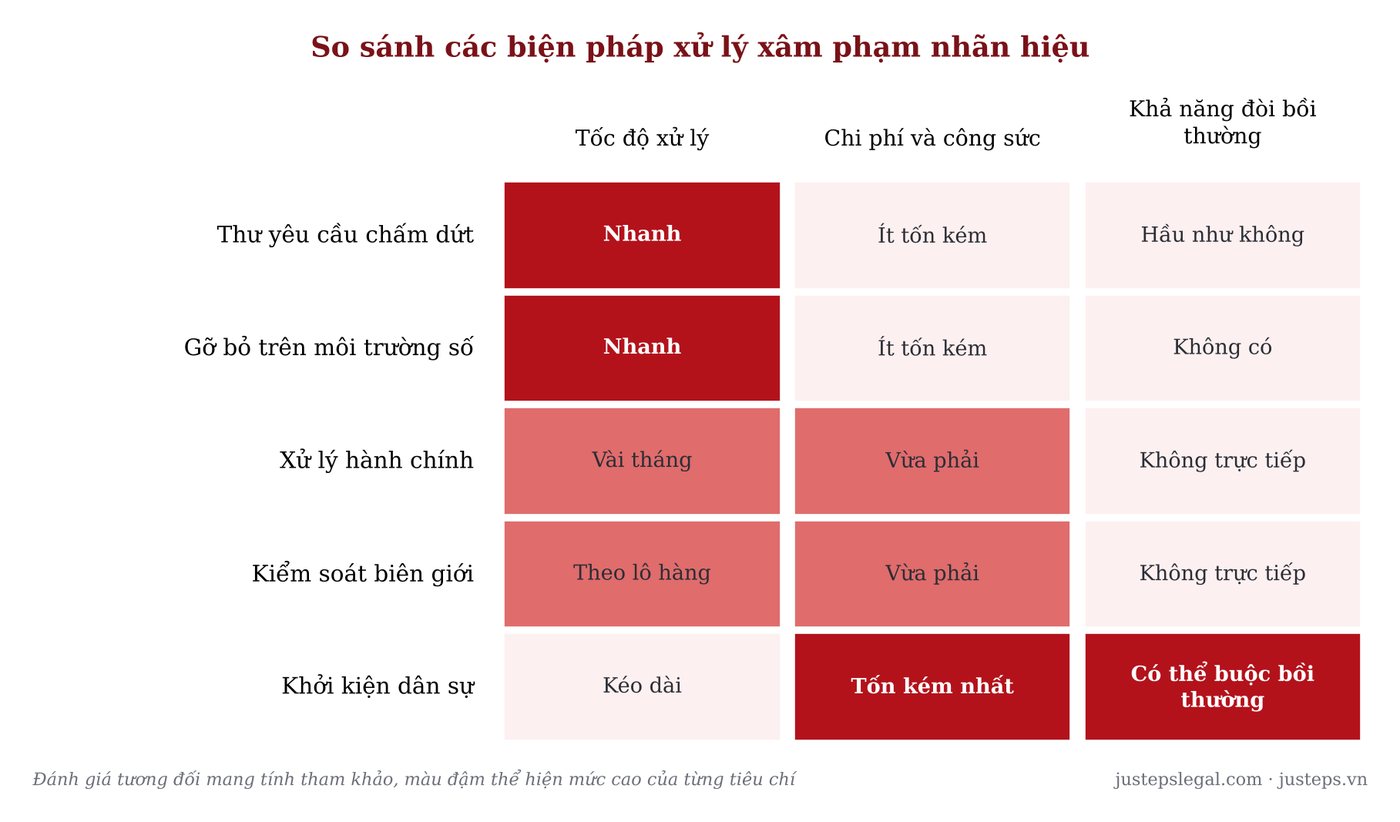
Relative comparison of remedies against trade mark infringement on three criteria
On this indicative assessment, cease and desist letters and online takedown requests are fast and inexpensive but yield almost no compensation. Administrative action and border control are suitable where infringing goods need to be stopped on the market, while civil proceedings take the most time and effort but are the main route to enforcing compensation. In civil cases, where compensation cannot be determined on the basis of lost profits or the price of a licence, the court sets the amount according to the damage suffered, up to a maximum of VND 500 million[21]. Businesses often combine several remedies, starting with a letter and an online takedown and moving to stronger measures if the infringement continues.
Whichever remedy is chosen, evidence determines the outcome. Businesses should purchase samples of infringing goods with an invoice or proof of payment, take time-stamped screenshots of sales pages, have a bailiff’s record of events drawn up where necessary and consider requesting an industrial property expert assessment to obtain a professional opinion on whether infringement has occurred[22]. Justeps assists businesses in assessing the case, reviewing evidence, drafting cease and desist letters and requests for action, and preparing files for the business to pursue itself or to hand over to a licensed practitioner of its choice.
Organising trade mark management within the business
Trade marks are managed well only where there is one person responsible and a single register that is updated continuously. In small and medium-sized enterprises, the responsible person may be the in-house legal team or an assistant to the board of directors, working with the marketing department, which knows which marks are in use and which are about to be launched. The trade mark portfolio register should be kept for each certificate or application and include the following information:
- The representation of the mark, the application number, the certificate number, the filing date, the grant date and the owner named on the certificate.
- The list of protected classes of goods and services and any foreign markets in which the mark has been registered.
- The expiry date, the date from which the renewal request may be filed and the last date for late renewal.
- Related assignment, licence and franchise agreements and the registration status of each agreement.
- Evidence of use for each year and any disputes or infringement cases that have been or are being handled.
The register should be reviewed at least quarterly and updated whenever changes occur, such as before a new product launch, before expanding into an export market, when signing a distribution or franchise agreement and when the business changes its name, address or ownership structure. Businesses should also issue internal rules on how the mark is to be displayed on packaging, advertising materials and distributors’ sales channels, and should require official domain names and social media accounts to be held in the name of the business rather than individual employees. To set up this system from scratch or review an existing portfolio, businesses may wish to consider Justeps’ intellectual property and trade mark protection service.
How Justeps can help
Justeps assists businesses in managing their trade marks throughout the life cycle of this asset through the following services:
- Intellectual property and trade mark protection. Justeps searches marks, assesses registrability, prepares and monitors applications and manages renewal deadlines for businesses.
- Technology transfer and protection of digital intellectual assets. Justeps compiles registers of intellectual assets and advises on transfers and on protecting trade marks in the digital environment.
- Commercial contract drafting and review. Justeps drafts trade mark assignment and licence agreements, logo design contracts and trade mark clauses in distribution agreements.
- In-house training. Justeps trains marketing and legal teams on searching, using marks in their registered form and recognising infringement.
Frequently asked questions
Is a brand name that a business has used for many years without registration protected?
An ordinary trade mark is protected only once a certificate has been granted, so length of use does not create rights by itself, unless the mark can be shown to be well known[1]. The business should file immediately, because whoever files first will have priority for the grant[3].
Should the director or the company be named as the applicant for a trade mark?
A mark used in the company’s business should be registered in the company’s name. If an individual is already named as the owner, an assignment agreement should be signed and registered so that the rights vest in the company[15].
How long after expiry can a trade mark registration still be renewed?
The holder may file a late renewal request within six months after expiry and must pay an additional late renewal fee[12]. After this period, the certificate lapses and the business must file a new application.
Does a registered trade mark lose protection if its use is suspended?
If the mark is not used for five consecutive years without a legitimate reason, another party may request termination of the certificate[13]. Businesses should maintain use of the mark and keep evidence of use for each year.
Is an agreement needed for a subsidiary to use the parent company’s trade mark?
There should be a written licence agreement, registered so that it has effect against third parties[15]. The agreement also provides the basis for accounting for royalties and evidencing use of the mark.
What should a business do first on finding a shop on an e-commerce marketplace selling counterfeit goods under its mark?
The business should preserve evidence, purchase samples and send a takedown request to the platform together with documents proving ownership[4]. If the infringement is large in scale or repeated, it may request the competent authority to take administrative action or consider other remedies.
Does a trade mark registered in Vietnam enjoy protection abroad?
A certificate granted by Vietnam is effective only within the territory of Vietnam. Exporters need to register in each country or file an international application under the Madrid system, and may claim priority if filing within six months of the first filing date[3].
Related articles
- What a software development contract should provide on acceptance, warranty and ownership of source code
- How an exclusive distribution agreement should deal with sales targets, territory and inventory on termination
- How a company should respond to a counterparty’s breach of contract before taking the dispute to court or arbitration
- Selling on e-commerce marketplaces in Vietnam and the rules on invoices, tax, returns and complaints
Notes
[1] Point a, Clause 3 of Article 6 of the Law on Intellectual Property No. 50/2005/QH11 dated 29 November 2005, as amended and supplemented by Laws No. 36/2009/QH12, 42/2019/QH14, 07/2022/QH15 and 131/2025/QH15.
[2] Article 72 of the Law on Intellectual Property No. 50/2005/QH11, as amended and supplemented.
[3] Articles 90 and 91 of the Law on Intellectual Property No. 50/2005/QH11, as amended and supplemented; Paris Convention for the Protection of Industrial Property.
[4] Law No. 131/2025/QH15 amending and supplementing a number of articles of the Law on Intellectual Property, passed by the National Assembly on 10 December 2025, effective from 1 April 2026.
[5] Decree No. 100/2026/ND-CP dated 31 March 2026 amending and supplementing Decree No. 65/2023/ND-CP detailing the Law on Intellectual Property regarding industrial property; Circular No. 10/2026/TT-BKHCN.
[6] Article 74 of the Law on Intellectual Property No. 50/2005/QH11, as amended and supplemented.
[7] Article 73 and Clause 2 of Article 74 of the Law on Intellectual Property No. 50/2005/QH11, as amended and supplemented.
[8] Article 39 of the Law on Intellectual Property No. 50/2005/QH11, as amended and supplemented.
[9] Article 87 of the Law on Intellectual Property No. 50/2005/QH11, as amended and supplemented.
[10] Article 119 of the Law on Intellectual Property No. 50/2005/QH11, as amended and supplemented by Law No. 131/2025/QH15.
[11] Articles 112 and 112a of the Law on Intellectual Property No. 50/2005/QH11, as amended and supplemented.
[12] Clause 6 of Article 93 and Article 94 of the Law on Intellectual Property No. 50/2005/QH11, as amended and supplemented; Decree No. 65/2023/ND-CP, as amended by Decree No. 100/2026/ND-CP.
[13] Point d, Clause 1 of Article 95 of the Law on Intellectual Property No. 50/2005/QH11, as amended and supplemented.
[14] Article 97 of the Law on Intellectual Property No. 50/2005/QH11, as amended and supplemented.
[15] Articles 138, 139, 141 and 148 of the Law on Intellectual Property No. 50/2005/QH11, as amended and supplemented.
[16] Articles 34, 35 and 36 of the Law on Enterprises No. 59/2020/QH14, as amended and supplemented by Law No. 76/2025/QH15.
[17] Clause 1 of Article 129 and Article 213 of the Law on Intellectual Property No. 50/2005/QH11, as amended and supplemented.
[18] Articles 198 and 199 of the Law on Intellectual Property No. 50/2005/QH11, as amended and supplemented.
[19] Article 226 of the Criminal Code No. 100/2015/QH13, as amended and supplemented by Law No. 12/2017/QH14.
[20] Article 211 of the Law on Intellectual Property No. 50/2005/QH11, as amended and supplemented; Decree No. 99/2013/ND-CP on administrative penalties in the field of industrial property, as amended by Decree No. 126/2021/ND-CP and Decree No. 186/2026/ND-CP.
[21] Articles 204 and 205 of the Law on Intellectual Property No. 50/2005/QH11, as amended and supplemented.
[22] Article 201 of the Law on Intellectual Property No. 50/2005/QH11, as amended and supplemented.
This article is for reference and reflects the regulations in force at the time of publication. Please consult Justeps for advice tailored to your company’s records and situation.
For further information, please contact:
📩 Email: info@justeps.vn
🌐 Website: https://justepslegal.com · https://justeps.vn
🌐 Page: Justeps
☎️ Hotline (Zalo): 096 172 2607
📍 Thanh Xuan Office: 12th Floor, Licogi 13 Tower, 164 Khuat Duy Tien Street, Thanh Xuan Ward, Hanoi, Vietnam
📍 Ha Dong Office: LK06B, No.10, Dong Dua Area, Ha Dong Ward, Hanoi, Vietnam
📍 Ho Chi Minh City Branch: 528 Le Van Sy, Ho Chi Minh City, Vietnam
📍 Hai Phong Office: Truong Thinh Village, Ha Dong Commune, Hai Phong, Vietnam
📍 Quang Ninh Office: Van Don Special Zone, Quang Ninh Province, Vietnam





