
Key takeaways
- A group organisation chart shows only functional reporting lines; the legal entity in Vietnam must still have every position required by the Law on Enterprises, the Law on Accounting and its charter.
- A foreign-invested company must always have at least one legal representative residing in Vietnam, and must grant a written letter of authorisation whenever that person leaves the country[5].
- A representative office may only perform liaison, market research and promotion functions; once its staff negotiate, close orders or collect payments, the structure has gone beyond the scope of its licence[1].
- Justeps designs a two-layer structure, consisting of a legal-entity layer compliant with Vietnamese law and a functional layer that follows the group, together with an authority matrix and a set of bilingual letters of authorisation.
When a foreign group enters Vietnam, its organisation chart is usually carried over from head office, with the country manager reporting to the region and each department head reporting directly to the functional lead abroad. This arrangement suits global management, but it often lacks the positions that Vietnamese law makes mandatory, such as a legal representative residing in Vietnam, a Company Chairman or Members' Council, a controller and a chief accountant. These gaps usually only come to light when a bank asks who has signing authority, when the tax authority asks who decides selling prices, or when the legal representative stays abroad for too long.
This page introduces the organisational structure design service that Justeps provides to foreign-invested enterprises (FDI enterprises) and to representative offices of foreign traders (representative offices). It focuses on choosing the form of presence, filling the statutory positions, fitting in the group reporting lines, the working process, the deliverables and the factors that affect fees. Operating regulations, ongoing legal advisory, and labour and payroll matters are covered on separate service pages in the same group.
Organisational structure starts with the form of presence
The first question in designing a structure is what the legal entity in Vietnam is permitted to do, because the scope of activities determines which departments are needed. A representative office is a dependent unit of the foreign trader; it may act as a liaison office, research the market and promote investment and business opportunities, but it may not directly carry out profit-generating activities in Vietnam[1]. The operation of a representative office is also governed in detail by Decree No. 07/2016/ND-CP, from the content of the licence and the term of operation to the annual reporting obligation[2].
An FDI enterprise is different, because it is a Vietnamese legal entity that may sign contracts, issue invoices and recruit staff within the scope of its registered business lines. The Law on Investment No. 143/2025/QH15, effective from 1 March 2026, allows foreign investors to establish an economic organisation before applying for an Investment Registration Certificate, provided that the market access conditions are met[3]. As a result, many investors now set up their company earlier, so the organisational structure also needs to be settled in the incorporation file rather than left until the project becomes operational. Businesses preparing their application can combine this work with the service for establishing a foreign-invested enterprise so that the charter and the structure are drafted together.
The table below compares the two common forms of presence on the points that directly affect how the organisation is staffed and arranged.
| Item | Representative office | FDI enterprise |
|---|---|---|
| Scope of activities | Liaison, market research and promotion; no sale or service contracts to earn revenue in Vietnam. | Business within the registered business lines and project, with the right to sign contracts and issue invoices. |
| Head of the entity | Chief representative, acting under a letter of authorisation from the foreign trader. | Legal representative, Company Chairman or Members' Council, and Director or General Director. |
| Minimum functions | Chief representative and a few liaison, administrative and internal bookkeeping staff. | Management bodies under the Law on Enterprises, a chief accountant and the sales and operations functions. |
| Typical risk | Staff do the work of a sales department, exceeding the licence and creating tax exposure. | Statutory positions are left vacant, or the holders have no real decision-making power. |
Statutory positions a Vietnamese legal entity must have
Most FDI enterprises are organised as single-member limited liability companies owned by the parent company. Under this model, the owner decides on the charter and appoints the Company Chairman or the members of the Members' Council and the controller, while the Company Chairman or the Members' Council appoints or hires the Director or General Director[4]. The holders of these positions may be foreign nationals, but they must be appointed by a decision of the owner in the proper form, and that decision must be kept at the company.
The legal representative and the letter of authorisation
The Law on Enterprises requires a company to always have at least one legal representative residing in Vietnam, and where the sole legal representative leaves the country, that person must authorise another resident of Vietnam in writing[5]. Many FDI enterprises register only one legal representative, a foreign General Director who travels frequently across the region, so tax filings, contracts and documents for state authorities are signed late. The legal representative also bears personal liability for damage caused to the company by a breach of the duties of honesty and due care[6], so the person given this position needs decision-making power that matches the liability rather than merely signing on behalf of head office.
Chief accountant and controller
An accounting unit must appoint a chief accountant, and the appointee must meet the professional, certification and practical experience requirements of the Law on Accounting[7]. An FDI enterprise may engage a qualified organisation to provide chief accountant services, but it should not leave the position vacant or assign it to a regional finance director abroad, because that person usually does not meet the requirements and is not present when the tax authority holds a meeting. Where the owner appoints a controller, the controller should be given a clear supervisory remit and a direct reporting line to the owner, so as not to overlap with the group internal audit function.
Seconded staff and concurrent roles within the group
It is common for one person to be the director in Vietnam while holding a position in another group company. In designing the structure, it must be decided whether that person works under a labour contract with the Vietnamese entity or under a secondment arrangement, because the choice affects the work permit, the place where salary is paid and personal income tax. Rules on foreign employees are currently set out in Decree No. 219/2025/ND-CP, which will be replaced by Decree No. 393/2026/ND-CP from 5 December 2026, with specific experience requirements for managers, executive directors and experts[8]. If the person actually running the business is based abroad but regularly makes decisions on behalf of the Vietnamese entity, the company must also consider the risk of a permanent establishment and how costs are allocated between group companies[9].
Fitting group reporting lines into the legal-entity chart
The solution Justeps usually proposes is a two-layer structure. The first layer is the legal-entity layer, showing the owner, the Company Chairman or Members' Council, the General Director, the chief accountant and the departments accountable under Vietnamese law. The second layer is the functional layer, showing how the heads of finance, human resources and sales in Vietnam report on functional matters to their regional leads. The two layers are linked by an authority matrix, under which the opinion of the region is an internal consultation step, while legally effective decisions are still issued by the positions of the Vietnamese entity.
The example below shows the role of each level in some common decisions at a single-member limited liability company owned by a foreign parent, following the Company Chairman and General Director model.
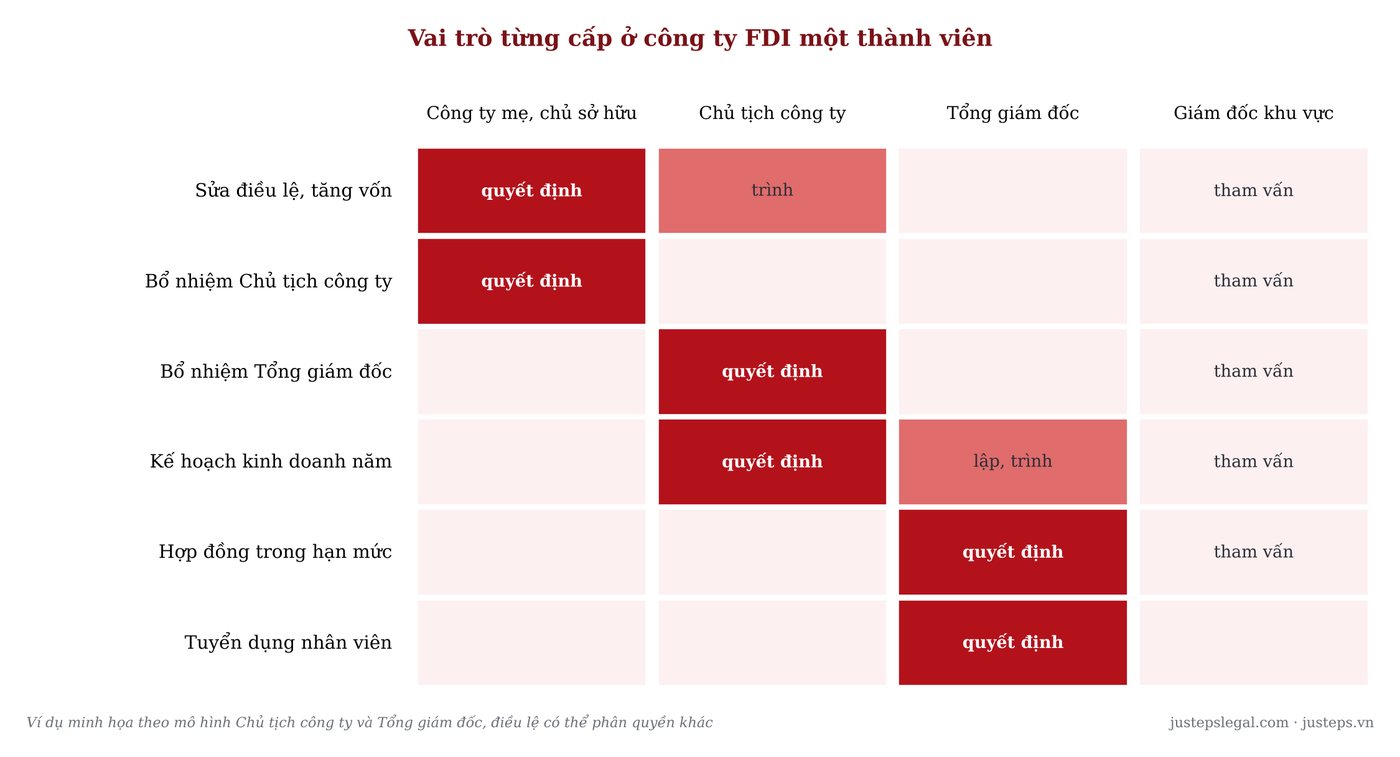
Role of each level in selected decisions at a single-member FDI company
The matrix shows that the group regional director holds no decision box at all, even though in practice this person is often the first to approve. Amending the charter, increasing capital and appointing the Company Chairman fall to the owner, so they require a written decision of the parent company rather than just an approval email, while the General Director is appointed by the Company Chairman under the charter. Ordinary contracts and recruitment fall to the General Director within set limits, and the region is only consulted before signing. When the matrix is issued by the competent body, banks, business partners and state authorities have a clear basis for determining who may sign and up to what level.
How Justeps supports businesses
The Justeps organisational structure design service consists of workstreams that can be carried out as a full package or separately, depending on whether the business is preparing to incorporate, already operating, or preparing to convert a representative office into a company. The main workstreams are as follows:
- Justeps assesses the form of presence against actual activities, identifying any work the representative office is doing beyond its functions and proposing how to deal with it.
- Justeps proposes the management model of the Vietnamese entity and the holder of each statutory position, including a solution where the legal representative is often abroad.
- Justeps prepares a bilingual two-layer organisation chart and a statement of the functions and duties of each department and each management position.
- Justeps builds an authority matrix by type of decision and value threshold, consistent with the charter and with the group approval policy.
- Justeps drafts the amended charter, appointment decisions, letters of authorisation and the registration file where the new structure changes registered details.
- Justeps reviews the arrangements for foreign, seconded and concurrently appointed staff so that they are consistent with contracts, work permits and internal cost allocation.
Once the structure has been approved, operating regulations such as the financial regulation, the procedure for payments to foreign parties and the internal labour regulations should be drafted next to match the new structure. Businesses can combine this with the service for building internal procedures and regulations for FDI enterprises and representative offices so that both workstreams share one set of terminology and one authority matrix.
Service delivery process
An organisational structure design project for an FDI enterprise with a single legal entity usually takes about six to eight weeks, most of which is spent on review rounds between the executive team in Vietnam and group head office. The indicative sequence is as follows.
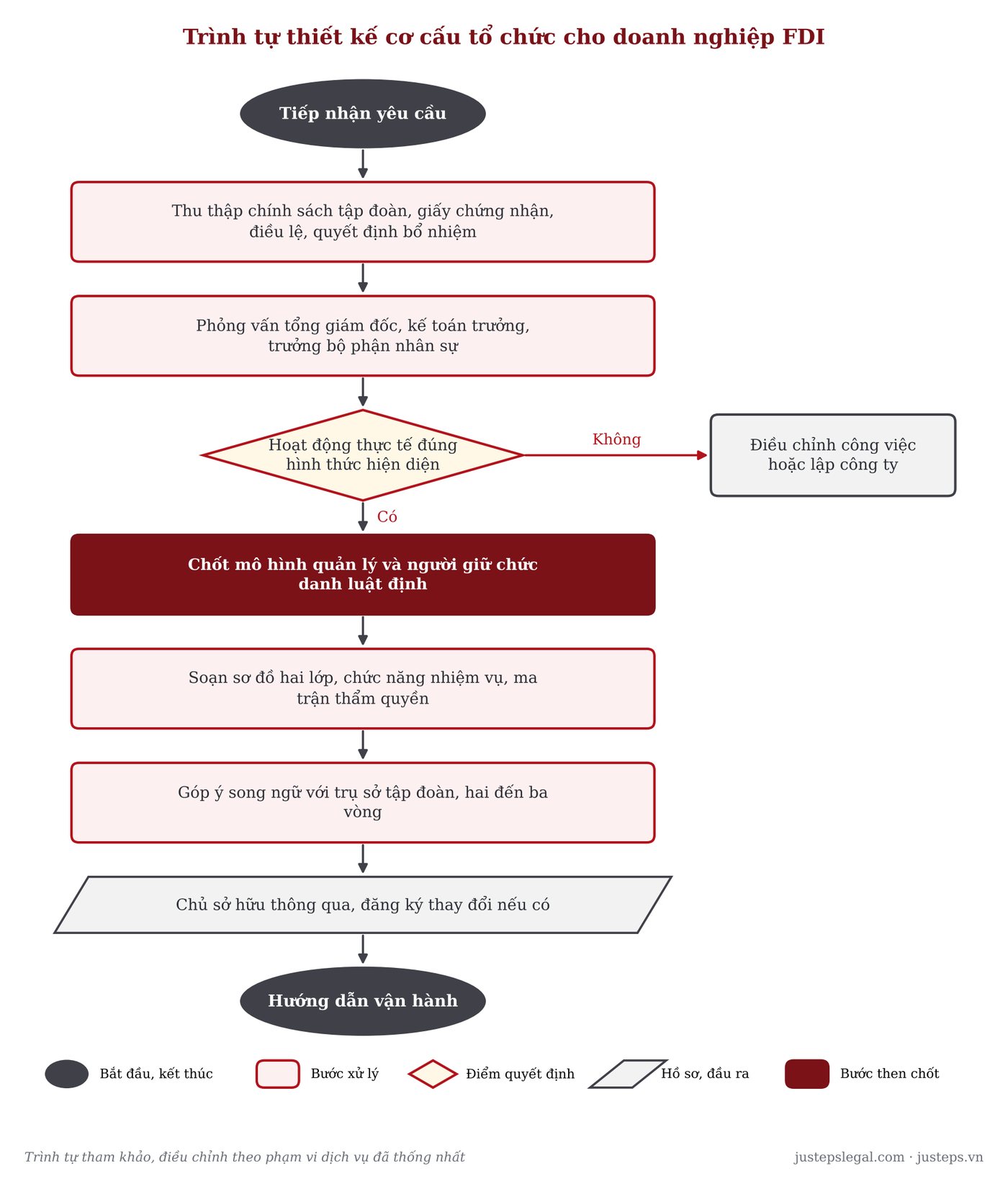
Sequence of an organisational structure design project for an FDI enterprise
In the first two weeks, Justeps reads the group organisation and approval policies, the Investment Registration Certificate, the Enterprise Registration Certificate or representative office licence, the charter and the appointment decisions, and then holds discussions with the General Director, the chief accountant and the head of human resources. The most important decision point is whether actual activities still fall within the scope of the form of presence. If the representative office has been doing the work of a sales department, Justeps proposes adjusting the work immediately or sets out a roadmap for establishing a company before the detailed design begins.
From the third week, the two sides settle the management model and the holders of each position, after which Justeps finalises the chart, the statement of functions and duties, the authority matrix and the legal documents through two to three bilingual review rounds. Approval is given by the owner in the proper form, and Justeps prepares the documents and any registration file required. The final week is a briefing session for the executive team, accounting and administration on how to operate under the new structure.
Deliverables and application by size
At the end of the project, the business receives an assessment report on the form of presence and the management model, a bilingual two-layer organisation chart, the statement of functions and duties, the authority matrix, the amended charter, appointment decisions, a set of letters of authorisation and, where applicable, the registration file for changes. The documents are delivered in editable form so that the human resources department can update them when personnel change, together with signed copies of the documents that require approval.
The level of detail varies with size and sector. A small representative office usually only needs job descriptions that match its functions, a letter of authorisation for the chief representative and an internal rule on what staff may not do. A trading or services company should focus on the relationship between a foreign General Director and the Vietnamese management team. A factory in an industrial park needs additional positions in charge of occupational safety, environment and fire prevention, while sectors with market access conditions such as retail, logistics, education and healthcare need personnel who meet their specific sector requirements.
Factors that determine the service fee
Justeps quotes a fixed fee in writing after the initial discussion, once it understands the form of presence and the existing group policies. The main factors are the number of legal entities and locations to be designed, the complexity of the group organisation policy, whether documents are bilingual or require a third language, the number of working rounds with the overseas head office, and whether registration procedures for changes are included. The service proposal sets out the deliverables, the timeline and the work outside the scope so that the business can plan its budget.
How Justeps can help
Once the organisational structure has been approved, FDI enterprises and representative offices can combine it with the following Justeps services:
- Internal procedures and regulations for FDI enterprises and representative offices. Justeps turns group policies into bilingual regulations that are effective in Vietnam and consistent with the new structure and authority matrix.
- Labour, payroll and insurance services for FDI enterprises and representative offices. Justeps handles work permits, contracts and insurance for foreign staff placed under the new structure.
- Establishing a foreign-invested enterprise. Justeps prepares the investment and enterprise registration files together with the charter and management structure from the outset.
- Financial regulations and delegation of authority. Justeps builds approval limits for spending, signing and payment that are consistent with group policy.
Frequently asked questions
When should a representative office convert into a company?
Once actual activities include negotiating commercial terms, closing orders, delivering goods or collecting payment from Vietnamese customers, the representative office has gone beyond its permitted functions[1]. The longer this continues, the greater the risk of penalties and tax assessments, so the business should plan a roadmap for establishing a company early.
Must the legal representative of an FDI company be a Vietnamese national?
The law does not require Vietnamese nationality, but the company must always have at least one legal representative residing in Vietnam[5]. The company may register several legal representatives and divide their powers in the charter to avoid disruption when one of them is absent.
Can the chief accountant be a member of the parent company's staff abroad?
The appointee must meet the requirements for a chief accountant under the Law on Accounting[7]. Parent company finance staff usually do not meet these requirements, so the business may recruit someone in Vietnam or engage chief accountant services from a qualified organisation.
Can the standard group organisation chart be used in Vietnam?
The group chart can still be used for internal management, but a legal-entity layer with the statutory positions must be added. Justeps usually prepares a two-layer chart to show both the line of legal accountability in Vietnam and the functional reporting line within the group.
Does a change of General Director have to be registered with the authorities?
If the General Director is the legal representative, the company must register the change in its enterprise registration details. If not, the company still needs an appointment decision by the competent body, updated letters of authorisation and notices to banks and business partners.
May the chief representative of a representative office sign contracts?
The chief representative may only sign within the scope of the letter of authorisation from the foreign trader and the functions of the office, for example an office lease or labour contracts. Contracts for the sale of goods or the supply of services for profit must be signed by the foreign trader or by a legal entity with the relevant functions.
Related articles
- Setting up a foreign-invested company, the IRC and ERC route, the capital account and post-licensing reporting
- Opening a representative office of a foreign trader in Vietnam, application file, scope of activities and annual reporting
- Authority of the General Director, delegation of management powers and limits under the charter and internal regulations
- A minimum set of internal governance regulations for businesses with 50 to 200 staff
Notes
[1] Articles 17 and 18 of the Commercial Law No. 36/2005/QH11 dated 14 June 2005.
[2] Decree No. 07/2016/ND-CP dated 25 January 2016 detailing the Commercial Law on representative offices and branches of foreign traders in Vietnam.
[3] Law on Investment No. 143/2025/QH15 dated 11 December 2025, effective from 1 March 2026, on the procedure for foreign investors to establish an economic organisation.
[4] Articles 76, 79 and 82 of the Law on Enterprises No. 59/2020/QH14 dated 17 June 2020, as amended and supplemented by Law No. 03/2022/QH15 and Law No. 76/2025/QH15.
[5] Clause 3 of Article 12 of the Law on Enterprises No. 59/2020/QH14 dated 17 June 2020, as amended and supplemented by Law No. 03/2022/QH15 and Law No. 76/2025/QH15.
[6] Article 13 of the Law on Enterprises No. 59/2020/QH14 dated 17 June 2020, as amended and supplemented by Law No. 03/2022/QH15 and Law No. 76/2025/QH15.
[7] Articles 52 and 54 of the Law on Accounting No. 88/2015/QH13 dated 20 November 2015.
[8] Decree No. 219/2025/ND-CP dated 7 August 2025 on foreign employees working in Vietnam; Decree No. 393/2026/ND-CP dated 20 October 2026 replacing that Decree, effective from 5 December 2026.
[9] Law on Corporate Income Tax No. 67/2025/QH15 on permanent establishments of foreign enterprises; Decree No. 132/2020/ND-CP dated 5 November 2020 on tax administration for enterprises with related-party transactions.
This article is for reference and reflects the regulations in force at the time of publication. Please consult Justeps for advice tailored to your company’s records and situation.
For further information, please contact:
📩 Email: info@justeps.vn
🌐 Website: https://justepslegal.com · https://justeps.vn
🌐 Page: Justeps
☎️ Hotline (Zalo): 096 172 2607
📍 Thanh Xuan Office: 12th Floor, Licogi 13 Tower, 164 Khuat Duy Tien Street, Thanh Xuan Ward, Hanoi, Vietnam
📍 Ha Dong Office: LK06B, No.10, Dong Dua Area, Ha Dong Ward, Hanoi, Vietnam
📍 Ho Chi Minh City Branch: 528 Le Van Sy, Ho Chi Minh City, Vietnam
📍 Hai Phong Office: Truong Thinh Village, Ha Dong Commune, Hai Phong, Vietnam
📍 Quang Ninh Office: Van Don Special Zone, Quang Ninh Province, Vietnam





