
Key takeaways
- There is no organisational model that is right for every software business, because the project model suits the early stage while the matrix model only pays off once the business has several hundred engineers and many projects running in parallel.
- A dedicated development centre for a single customer may be seen as labour sub-leasing, a conditional business line[1], if the engineers in practice take instructions from and are managed directly by the customer.
- The information security unit should not report to the person under pressure to meet delivery deadlines, because that is the person most likely to accept security exceptions.
- A business that processes personal data on behalf of customers must designate a data protection unit or officer, or engage an outside service[3], and this position needs to be placed on the chart from the start.
Software businesses rarely grow steadily. A master agreement with a Japanese or European customer can double the number of engineers in a year, and the organisation is assembled in a hurry around each customer’s demands, with every project team having its own way of managing, assessing staff and handling security. When the next customer sends a questionnaire asking who is in charge of information security, how data is separated between projects and who decides on reassigning engineers, the business realises that the organisational chart on paper does not match the way it actually operates.
This page introduces Justeps’ service of designing the organisational structure of software outsourcing businesses, businesses operating development centres for foreign customers and companies with their own software products. The focus is on choosing the model, positioning the control functions, dividing authority and structuring legal entities. The regulations written for each division once the organisation is in place are described under the internal procedures and regulations service for software technology and outsourcing businesses.
Three common organisational models
Justeps usually encounters three models in Vietnamese software businesses, and most businesses are in transition between two of them. The table below summarises when each model is suitable and the weakness that needs to be addressed through organisational design.
| Model | Suitable when | Weakness to address |
|---|---|---|
| Project-based | The business has fewer than about 100 people, few projects, and project managers also manage staff. | Engineers easily end up waiting for work when a project ends, and working rules differ between teams. |
| Dedicated development centre | The customer wants a stable team for many years working with its processes and tools. | Dependence on one customer and a risk of being seen as labour sub-leasing. |
| Matrix | The business has several hundred engineers, many parallel projects and frequent reassignment of staff. | Two management lines decide on the same engineer unless authority is divided in detail. |
In the matrix model, the delivery division is responsible to the customer and for project results, while competence centres organised by technology such as Java, .NET, mobile or data are responsible for recruiting, training, assessing and planning the careers of engineers. The advantage is that engineers have a long-term home and the business can easily move people between projects. The drawback is that every decision about people has two people wanting to make it, so the matrix works only with a clear authority table as described below. Justeps does not recommend moving to a matrix simply because large groups do so, but only when the cost of engineers waiting for work and the cost of duplicated recruitment across projects have become large enough.
Dedicated development centres and the line with labour sub-leasing
In a dedicated development centre (ODC), the business assigns a team of engineers to work long term for one customer, often using the customer’s tools, processes and sometimes even its task management system. Legally, this is a contract for the provision of software services as long as the business itself manages and directs the engineers and is responsible for the results. The risk arises when the engineers in practice take work directly from the customer’s staff and are timed, assessed and selected to stay on the team by the customer, because the relationship then shows signs of labour sub-leasing, which is a conditional business line permitted only for certain jobs[1].
The law amending and supplementing the Labour Code passed by the National Assembly in November 2026 moves labour sub-leasing from a licensing regime to a deposit and notification regime with effect from 1 March 2027[2], but the activity remains conditional and carries specific obligations for the sub-leasing party. The structure of a dedicated development centre must therefore keep the team leader, the right to assign work, the right to assess and the right to discipline engineers on the business’s side. Justeps draws the centre’s reporting lines clearly, sets out which matters the customer may require and which it may only request through the team leader, and reviews the contract with the customer so that its clauses do not describe the engineers as the customer’s personnel.
Where information security, data protection and the legal function sit
The most common mistake is placing the information security unit under the delivery director. A person under pressure to deliver on time will tend to allow an engineer to use a personal computer or to open broader access than necessary in order to meet the schedule. Justeps proposes that this unit report directly to the General Director or to a member of the executive board who is not in charge of delivery, with the power to stop an activity that breaches the regulations and a say in whether to accept a customer’s security requirement.
A business that processes personal data must designate a unit or staff member with sufficient competence to protect data, or engage an organisation or individual providing that service[3], and the person in that role must meet the qualification and experience standards set out in the implementing decree[4]. Small businesses and start-ups may choose not to perform this obligation for 5 years, except in certain cases such as providing personal data processing services or processing sensitive data[5]. An outsourcing business that processes data on behalf of foreign customers should create this position proactively even while it enjoys that option, because customers almost always ask for the name and contact details of the person in charge.
The legal function in a software business usually starts with one person doing it part-time in the administration or accounting department. Once the number of new master agreements and annexes each month exceeds what a part-time person can handle, the business needs a legal point of contact independent of the sales division, with the power to require contracts to be reviewed before signing and to keep all commitments to customers in one place.
Dividing authority in the matrix model
The authority table sets out, for each important decision, who decides, who proposes and who is only consulted. The matrix below is an example Justeps prepared for an outsourcing business with about 400 engineers.
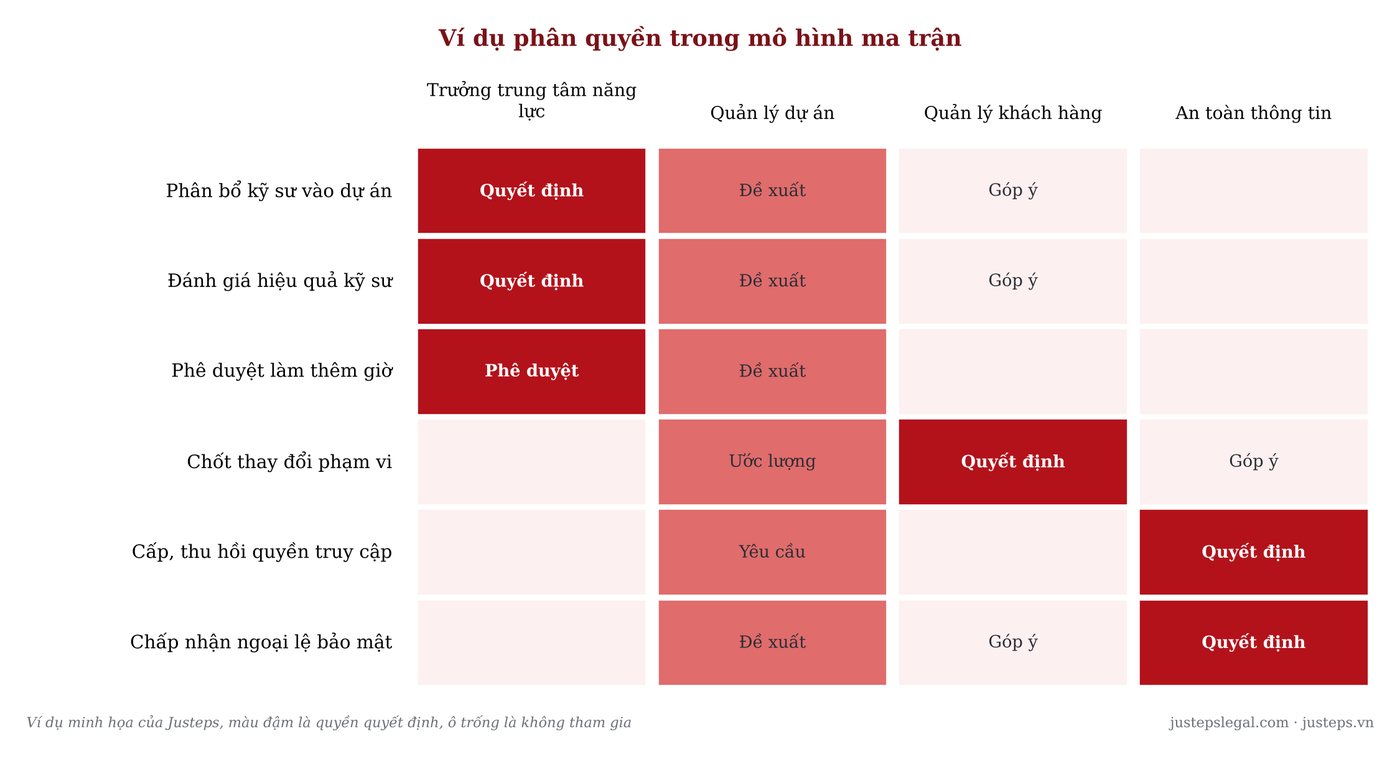
Example of the division of authority between four management positions in the matrix model
In this example, the head of the competence centre decides on assigning engineers, assessing performance and approving overtime, while the project manager proposes and supervises day-to-day work. The account manager is the only person who may agree scope changes with the customer, after the project manager has estimated the effort. The information security unit decides on granting and revoking access and on every security exception, while the project manager may only make requests. Placing the authority to approve overtime with the competence centre rather than with the project gives one person a view of each engineer’s total overtime hours when that engineer works on several projects at once.
Legal entities, branches and companies abroad
Many software businesses open a sales company in Japan, Singapore or the United States before they think about a group structure, sometimes in the founder’s personal name. This easily leads to money collected from customers sitting in a legal entity not owned by the Vietnamese company, or to the Vietnamese company transferring capital abroad without completing outward investment procedures under the Law on Investment[6]. When the company abroad and the Vietnamese company have the same owner, the price of services between them is also subject to the rules on related-party transactions, so the functions of each entity must match its transfer pricing documentation.
Justeps reviews all legal entities, branches and business locations in Vietnam, identifies which entity signs contracts with customers, which entity employs the engineers and which entity holds the rights to the products, and then proposes a structure that fits the new organisational design. For a branch in another city, the structure needs to determine whether the branch is a competence centre, a delivery centre or merely a place of work, because this affects the authority of the branch director and how tax and insurance are declared.
The technical founder and successors
In many software businesses the technical founder is at once a major shareholder, the person who holds the system architecture and the direct manager of the most important customers. When that person leaves, falls ill for a long period or disagrees with the other shareholders, the business loses both its technical capability and its governance stability at the same time. The organisational structure should separate the shareholder role from the executive role, have a chief architect and a successor team leader for each important system, and give the executive manager the power to issue internal management regulations within the limits permitted by the charter[7]. A detailed succession plan can be prepared with the succession planning and executive handover service.
Structure changes with size
As the business grows, the share of engineers in total staff falls gradually while the project management, quality, information security and legal functions grow. The chart below illustrates staff structure by function at three sizes of business.
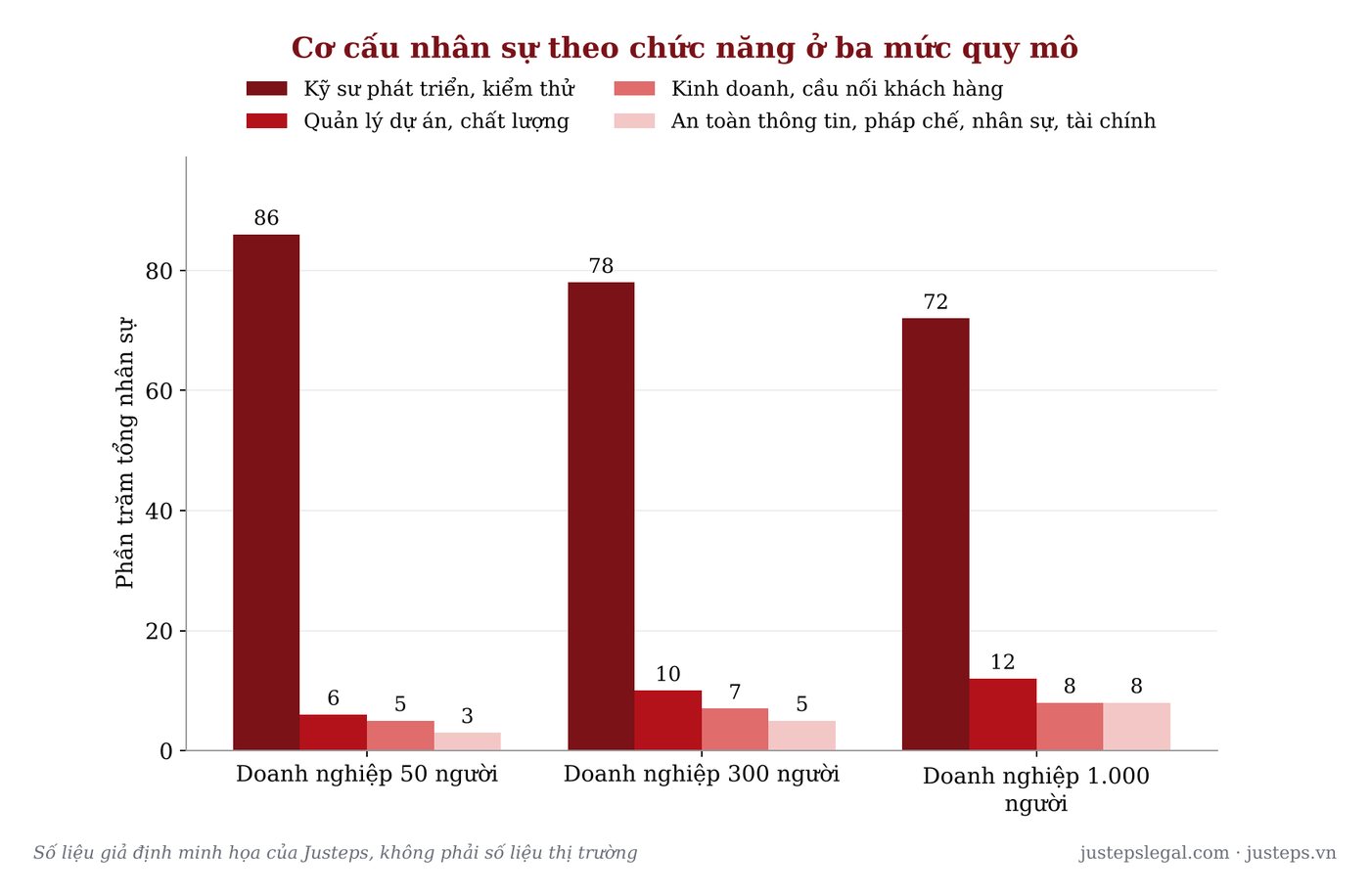
Example of staff structure by function at three sizes of software business
In the example, development and testing engineers make up 86% of staff in a business of 50 people, 78% in a business of 300 people and 72% in a business of 1,000 people. Conversely, the group made up of information security, legal, human resources and finance rises from 3% to 5% and then 8%, while project management and quality rise from 6% to 12%. Justeps uses this view to determine when to add each function, instead of setting up every department while the business is still small. Businesses working for Japanese customers usually need a bridge and technical interpreting unit earlier, while businesses working for European customers need a data protection position earlier.
Implementation process, deliverables and fees
An organisational structure design project usually takes eight to nine weeks and is rolled out in phases so as not to disrupt projects that are already running.
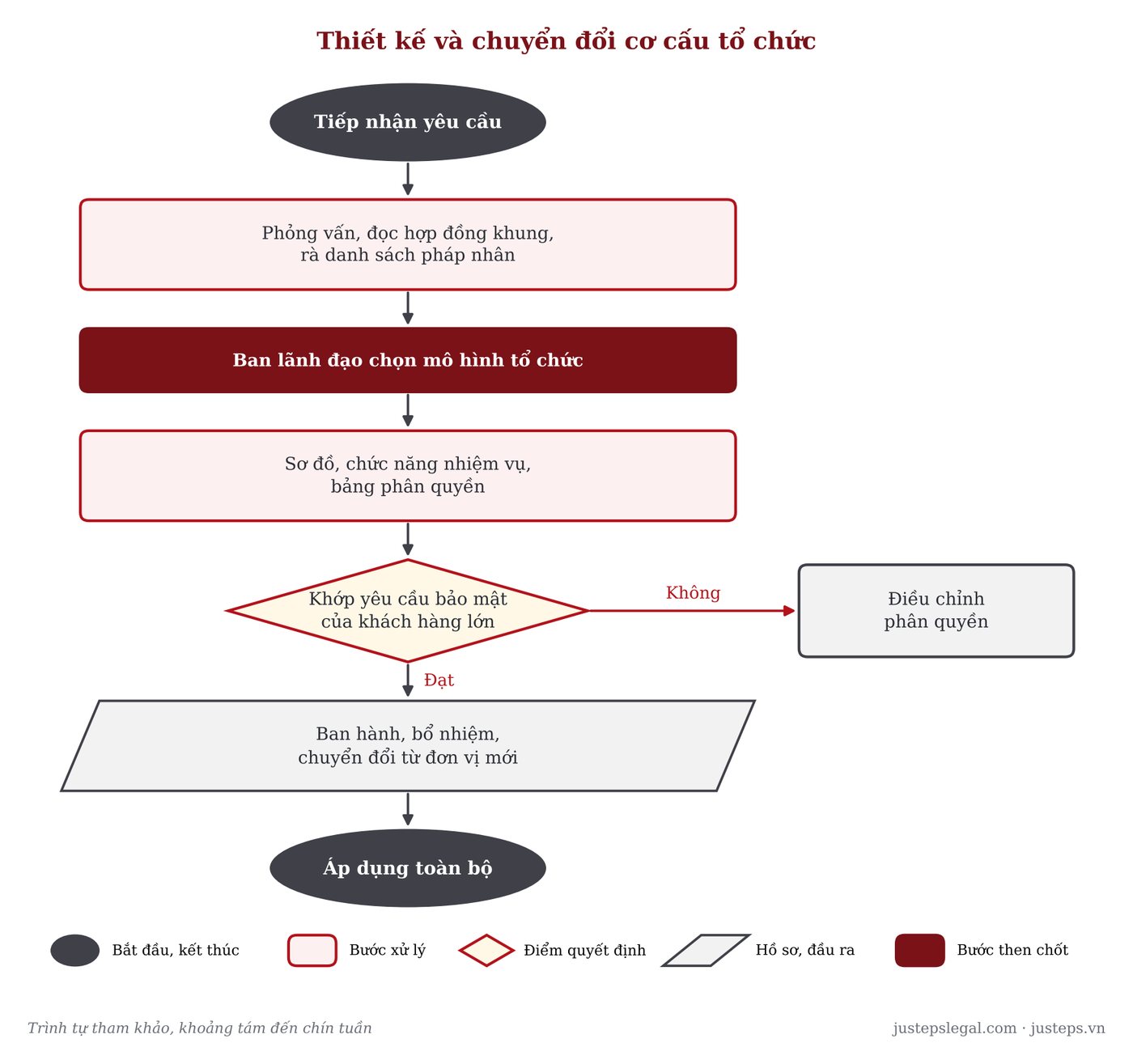
Sequence for designing and transitioning the organisational structure of a software business
In the first two weeks Justeps interviews management, unit heads and a number of engineers and reads the important master agreements and the list of legal entities. The third week is a working session with management to choose the model, after which Justeps drafts the chart, the functions and duties and the authority table, and checks them against the security requirements of major customers before they are issued. The transition should start with new units or new projects before being applied to existing teams. The deliverables include the following documents:
- A report assessing the current model and a phased transition roadmap.
- The organisational chart and the functions and duties of the delivery division, competence centres, project management, information security, legal and human resources.
- An authority table between the management lines for decisions on people, projects, contract scope and access rights.
- A report reviewing the structure of legal entities in Vietnam and abroad.
- Draft decisions issuing the structure, decisions appointing key positions and internal communication materials.
The project fee is quoted by Justeps as a fixed fee in writing after the initial meeting, depending on headcount, the number of units, the number of legal entities in Vietnam and abroad, the complexity of the authority table, any need for bilingual documents and whether the business needs Justeps alongside it during the transition. Salary scales, career paths and contracts for each new position can then be implemented through the labour, wages and social insurance service for software technology and outsourcing businesses.
How Justeps can help
Alongside organisational structure design, software technology and outsourcing businesses may combine the following Justeps services:
- Internal procedures and regulations for software technology and outsourcing businesses. Justeps writes regulations on information security, intellectual property and customer data for each division once the organisation has been settled.
- Labour, wages and social insurance services for software technology and outsourcing businesses. Justeps turns the new positions into contracts, salary scales and overtime policies suited to each group of engineers.
- KPI and performance assessment system. Justeps builds consistent assessment criteria for competence centres and project managers in the matrix model.
- Succession planning and executive handover. Justeps prepares succession plans for the technical founder and the positions that hold the system architecture.
Frequently asked questions
When should a business move to the matrix model?
Usually when it has several hundred engineers, many projects running in parallel and significant costs from engineers waiting for work or duplicated recruitment across projects. Before moving, the business needs a detailed authority table between the competence centres and project managers.
Is a dedicated development centre the same as labour sub-leasing?
Not automatically. If the business still manages and directs the engineers and is responsible for the results, it is a software services contract. The risk arises when engineers in practice work under the direct direction of the customer[1].
Is it mandatory to have a person in charge of personal data protection?
A business that processes personal data must designate a unit or staff member, or engage a data protection service[3]. Small businesses and start-ups may choose not to do so for 5 years except in certain cases, but outsourcing businesses should create this position proactively.
To whom should the information security unit report?
It should report directly to the General Director or to a member of the executive board who is not in charge of delivery. This positioning helps keep security decisions free from schedule pressure.
Should the business set up a subsidiary in Japan or the United States?
This depends on customers’ requirements, costs and tax planning. The business needs to compare a representative office, a branch and a subsidiary, and to complete outward investment procedures before transferring capital[6].
What should foreign-invested businesses bear in mind?
The structure needs to be checked against the parent company’s policies, group reporting requirements and the price of services provided to the parent company. Titles set by the parent company must still match the authority under the charter and Vietnamese law.
Related articles
- Organisational structure of a technology start-up
- Authority of the General Director, delegation of executive powers and limits under the charter and internal regulations
- The minimum set of internal governance regulations for businesses with 50 to 200 staff
- Building internal procedures and regulations for software technology and outsourcing businesses around the project life cycle
Notes
[1] Clause 2 of Article 52 of the Labour Code No. 45/2019/QH14 dated 20 November 2019.
[2] The Law amending and supplementing a number of articles of the Labour Code, the Law on Archives, the Law on Gender Equality, the Law on Red Cross Activities and the Law on Employment, passed by the National Assembly on 21 November 2026, effective from 1 March 2027.
[3] Clause 2 of Article 33 of the Law on Personal Data Protection No. 91/2025/QH15, effective from 1 January 2026.
[4] Clause 2 of Article 13 of Government Decree No. 356/2025/ND-CP detailing a number of articles of and measures to implement the Law on Personal Data Protection, effective from 1 January 2026.
[5] Clause 2 of Article 38 of the Law on Personal Data Protection No. 91/2025/QH15, effective from 1 January 2026.
[6] The Law on Investment No. 143/2025/QH15, effective from 1 March 2026.
[7] Point d of Clause 2 of Article 63 of the Law on Enterprises No. 59/2020/QH14 dated 17 June 2020, as amended and supplemented by Law No. 76/2025/QH15.
This article is for reference and reflects the regulations in force at the time of publication. Please consult Justeps for advice tailored to your company’s records and situation.
For further information, please contact:
📩 Email: info@justeps.vn
🌐 Website: https://justepslegal.com · https://justeps.vn
🌐 Page: Justeps
☎️ Hotline (Zalo): 096 172 2607
📍 Thanh Xuan Office: 12th Floor, Licogi 13 Tower, 164 Khuat Duy Tien Street, Thanh Xuan Ward, Hanoi, Vietnam
📍 Ha Dong Office: LK06B, No.10, Dong Dua Area, Ha Dong Ward, Hanoi, Vietnam
📍 Ho Chi Minh City Branch: 528 Le Van Sy, Ho Chi Minh City, Vietnam
📍 Hai Phong Office: Truong Thinh Village, Ha Dong Commune, Hai Phong, Vietnam
📍 Quang Ninh Office: Van Don Special Zone, Quang Ninh Province, Vietnam





