
Key takeaways
- A wedding studio sells a day that cannot be repeated, collects most of the price in advance and delivers a product that is both a creative work and personal data, so the organisation needs a named person responsible for the schedule, the deposits and the image archive.
- A deposit secures the date and the crew and is not yet revenue; tracking and refunding deposits should sit with the finance function rather than with the salesperson who earns commission on the package[2].
- Photographs and films created by employees in the course of assigned duties belong to the business, whereas work produced by freelance collaborators belongs to the studio only if the collaboration contract expressly transfers the rights[5].
- A showroom in another area may only need to be registered as a business location, but once it has a manager with delegated authority, its own bank account and its own books, a branch is worth considering[6].
Most wedding studios start with one skilled photographer and a few friends working alongside. The founder shoots as lead photographer, advises clients on packages, collects deposits and keeps every hard drive holding the original images. Once the studio adds a showroom, a video crew, a bridal gown rental line and corporate advertising video work, relying on one person starts to produce very specific errors: two couples promised the same date, a client asking for a deposit back when nobody knows where it was recorded, or a client’s photographs appearing on a freelance photographer’s page without the client’s consent.
This page introduces Justeps’ organisational structure design service for photo studios, wedding studios and small and medium-sized video production companies. It moves from the features that make this sector need a different organisation from ordinary service businesses, through the common mistakes, what Justeps does, the process and the deliverables, to how the service applies to each business model. The main legal basis is the Law on Enterprises No. 59/2020/QH14 as amended and supplemented, most recently by Law No. 76/2025/QH15[1], together with the rules on deposits, copyright and personal data protection.
Three features that set a studio’s organisation apart from ordinary service businesses
The first feature is that the product is tied to a fixed date that cannot be moved. A restaurant can apologise and serve the guest again the next day, but a missed wedding cannot be photographed again. The authority to confirm that a date is free, to change the crew and to cancel a booking must therefore rest with a single point of contact who sees the whole picture, instead of each consultant making promises to clients from memory.
The second feature is that cash arrives first and the work comes later, sometimes many months later. Under the Civil Code, where a contract is not entered into or not performed through the fault of the party receiving the deposit, that party must return the deposit together with an amount equal to it, unless otherwise agreed[2]. A deposit is therefore an obligation hanging over the studio’s books, and the person tracking it should be independent of the person who earns commission when the package is closed.
The third feature is that what the client receives is at once a photographic or cinematographic work protected by copyright law and the image and personal data of the client[3]. The Law on Personal Data Protection No. 91/2025/QH15, effective from 1 January 2026, places responsibility on the data controller and processor, which is the studio itself[4]. Who may download original images to a personal device, who may delete them and who may post them on the studio’s showcase page are organisational questions before they are technical ones.
Common mistakes when studios build their own organisation
The founder holds every line of responsibility
In many studios the founder is the lead photographer and also closes deals, takes the money and holds the passwords to the image archive. When that person is shooting three weekends in a row in wedding season, every other decision piles up, clients’ calls go unanswered and the crew has to improvise. This dependence also makes the studio hard to value or to bring in new investors, because almost all of the business’s value sits with one individual.
Nobody is assigned to manage image data
Original images are often scattered across memory cards, each photographer’s hard drives, the retoucher’s computer and cloud storage accounts registered in individuals’ names. When someone leaves, the studio cannot be sure it still holds all of its clients’ photographs, nor can it control whether that person keeps using them. Without a designated person for data, the studio cannot show that it applied protective measures when images are leaked.
Opening showrooms and renting gowns without legal separation
A studio opens a client reception point in another district or province without registering it, or registers it in the wrong form, so it is unclear which entity the invoices, contracts and staff at that point belong to. The rental of wedding gowns, ao dai and costumes often shares stock and staff with the photography business, yet it has its own customers, assets and risks. Without separate books, or a separate legal entity where needed, the owner struggles to know which line is really profitable and to deal with disputes over damaged costumes.
How Justeps designs the organisational structure of a studio
Justeps does not start from a template chart but from the studio’s own operating data, including the calendars of recent wedding seasons, the deposit ledger, the list of people working on each shoot and the way images are currently stored. From there, Justeps proposes a structure built around functional units. A unit need not be a department; in a small studio one person may cover two units, provided each unit has exactly one person responsible, recorded in writing.
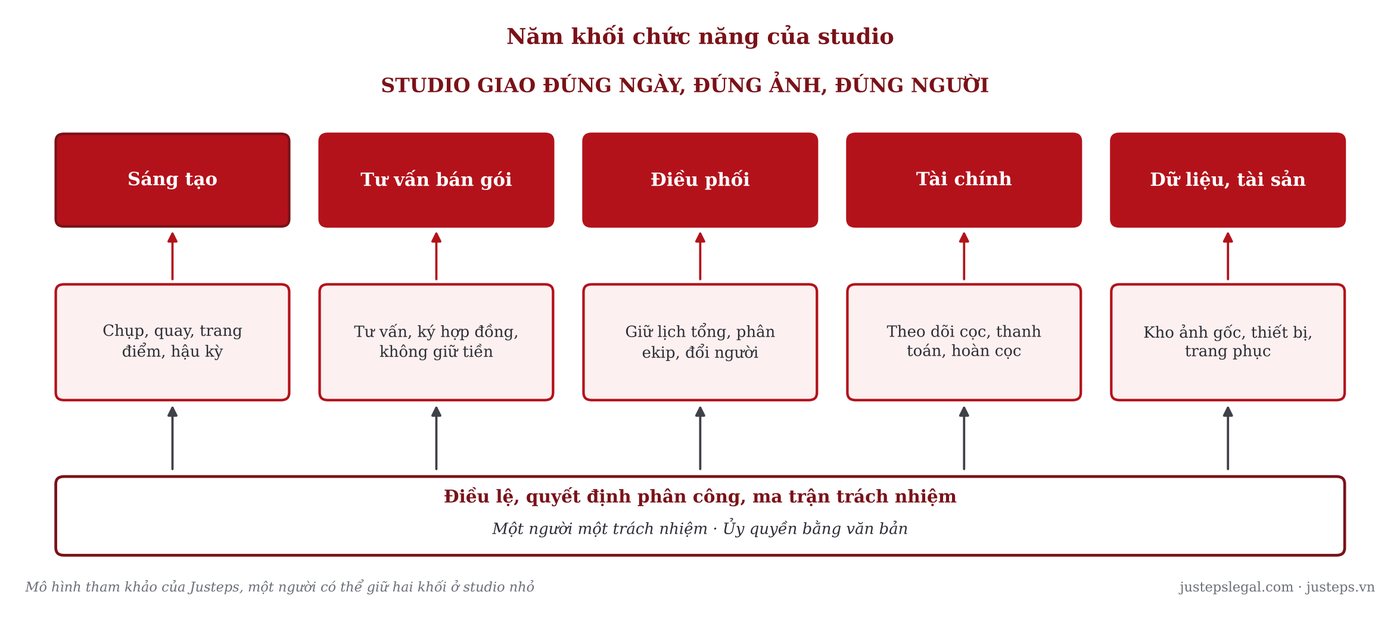
Five core functional units of a wedding photo and video production studio
In this model, the creative unit covers photographers, videographers, make-up artists and post-production, and is responsible for product quality. The consulting and sales unit works with clients up to signing the contract but does not confirm dates on its own and does not hold money. The coordination unit holds the master schedule, assigns crews and decides on replacements when something goes wrong. The finance unit tracks deposits and later instalments and proposes refunds. The data and assets unit keeps the archive of original images, the equipment and the costumes. The common foundation of the five units is the charter, the assignment decisions and the responsibility matrix.
Core staff and per-shoot crews
Wedding season can require twice as many people as the low season, and the extra headcount is usually photographers, videographers and make-up artists engaged per shoot. The organisational structure must state which positions belong to the core staff working on a regular basis, which are engaged per shoot, and who in the coordination unit assigns work to each group. This boundary directly affects the type of contract to be signed. Detailed classification, contracts and insurance are handled by Justeps in its labour, payroll and insurance service for studios.
Who owns the photographs and films created by the crew
Under the Law on Intellectual Property, an organisation that assigns a task to an author who is its employee owns the copyright in the work created under that task, unless otherwise agreed; a work created under a contract belongs to the party contracting with the author as agreed[5]. The organisational structure must therefore be linked to job descriptions that state that shooting, filming and editing are assigned duties, while collaboration contracts must include a clause transferring economic rights and limiting the use of images in personal portfolios.
A responsibility matrix for decisions that easily lead to disputes
Once the functional units are settled, Justeps prepares a responsibility matrix for the decisions that studios usually make out of habit. The matrix shows who proposes, who decides and who is only informed, so that consultants, coordinators and the director do not tread on one another’s authority.
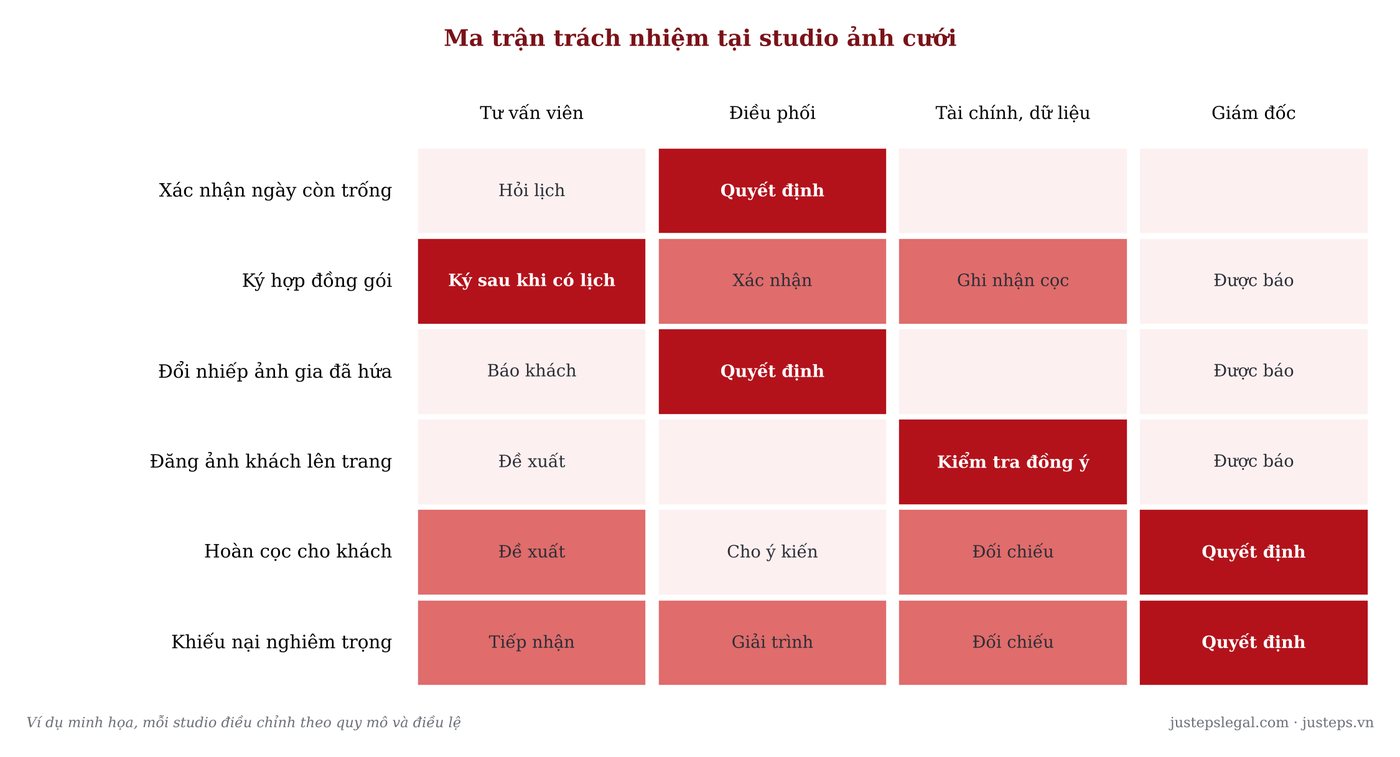
Example division of roles between consultants, coordination, finance and the director
In this example, a consultant may sign a contract only after coordination has confirmed that the date is free, and replacing a photographer who was promised to the client is decided by coordination. Posting a client’s images on the showcase page must first go through the person responsible for data, who checks the client’s written consent. Refunding deposits and resolving serious complaints fall within the authority of the director or a person authorised in writing, on the basis of a proposal from finance. A studio can adjust the cells of the matrix, but it should not let one person both propose and decide a refund.
Choosing the legal form for showrooms and side businesses
The Law on Enterprises allows a business to set up branches, representative offices and business locations, each with different functions and procedures[6]. A showroom that only receives clients, holds trial shoots and signs contracts on templates issued by the head office is usually suited to a business location. Where a showroom has a manager authorised to sign contracts, its own crew, its own bank account and needs its results tracked separately, a branch allows responsibilities to be allocated more clearly.
For the costume rental line, Justeps assesses the size of the assets, the share of customers who rent without booking a shoot and the expansion plans. If most gown renters are also photography clients, separate accounting within the same company is usually enough. If the line has its own customers, a large stock or plans for franchising, setting up a separate company isolates the risk and makes it easier to bring in partners as investors.
Implementation process and deliverables
A project usually takes about seven weeks and should be completed before wedding season, so that the crew has time to get used to the new division of roles. The flowchart below shows the sequence, in which the key decision point is whether the studio needs to separate a showroom or a side business into its own unit.
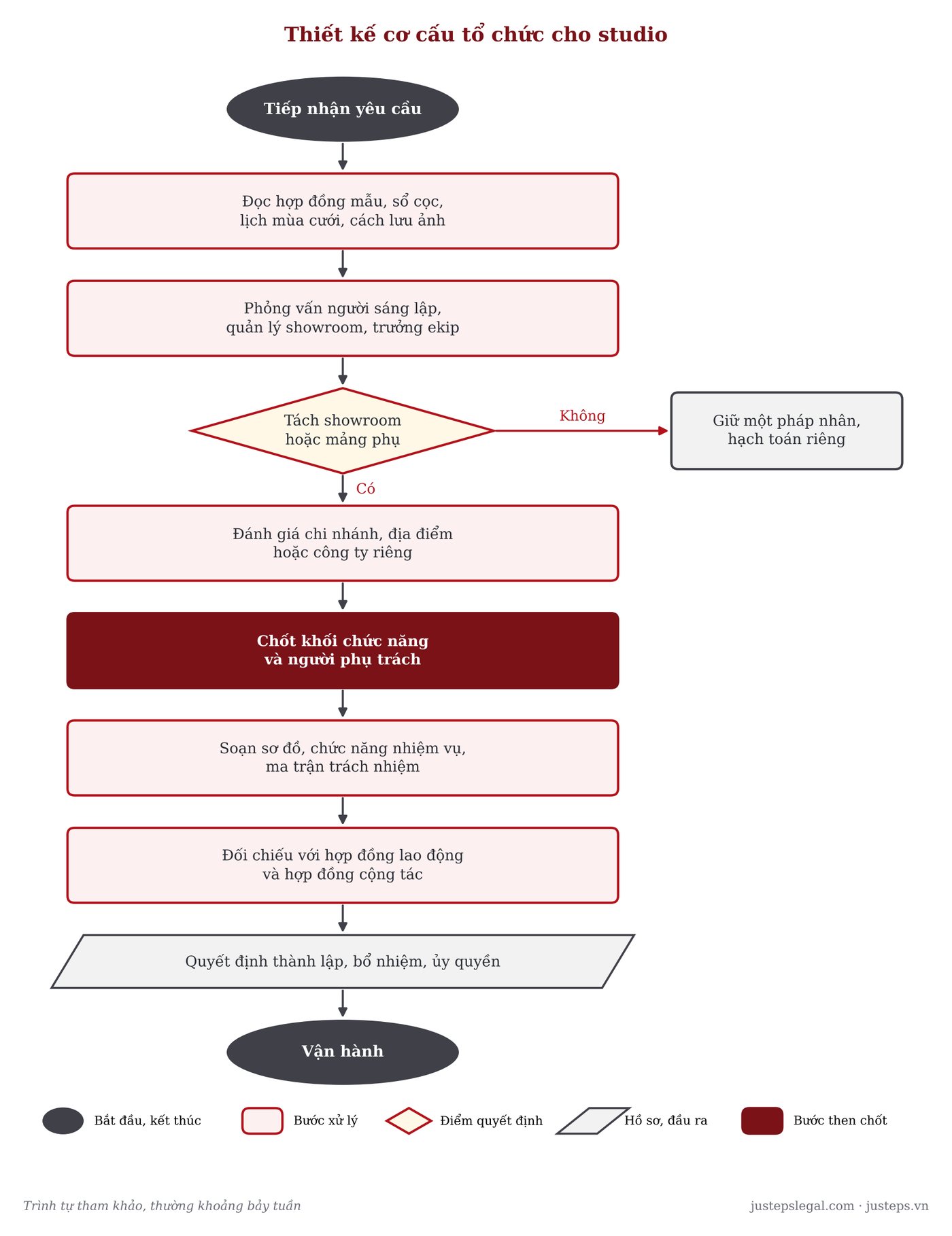
Sequence for designing the organisational structure of a studio
In the first two weeks, Justeps’ consultants read the template contracts, the deposit ledger, the wedding season calendar and the image storage arrangements, and interview the founder, the showroom manager and the crew leaders. Week three is a working session with the founder to settle the model. Weeks four and five are for drafting documents and collecting comments, week six checks the structure against the employment contracts and collaboration contracts in use, and the final week finalises the decisions for issue. The deliverables comprise the following documents:
- An organisation chart with an explanation of why the model was chosen and the options considered.
- A statement of functions and duties for each unit and job standards for key positions.
- A responsibility matrix for the schedule, crew changes, deposits, refunds, complaints and posting client images.
- A classification of core staff and per-shoot crews with recommendations on contract types.
- An assessment of legal options for the showroom, the costume rental line and the corporate video line.
- Draft decisions establishing units, appointment decisions and letters of authorisation to sign contracts.
Once the organisation has taken shape, the next step is to write the procedures for selling packages, coordination, post-production, delivery and data management, so that every unit works to the same standard. This work falls under the service for building internal procedures and regulations for photo studios and video production and can begin immediately after the structure project.
Application by business model and service fees
A studio with fewer than fifteen people usually needs only three groups, creative, post-production and consulting, with the founder also acting as manager and one person combining schedule coordination and data. A company producing advertising videos and corporate films also needs a producer responsible for budgets, timelines and filming permits, plus a content review step before delivery to the client. A studio working at tourist sites or heritage sites needs a point of contact for dealing with the site management board and for controlling the use of drones for photography.
Fees are quoted as a fixed package in writing after the initial discussion. The main factors are the number of product lines such as wedding photography, family photography and corporate video, the number of showrooms, the size of the core staff and per-shoot crews, whether a separate legal entity is needed and how much contract standardisation is included. Justeps’ proposal sets out the scope, deliverables, timeline and the work outside the scope, so that the studio owner can plan the budget.
How Justeps can help
Alongside organisational structure design, photo studios and video production companies can combine the following Justeps services:
- Building internal procedures and regulations for photo studios, wedding photography and video production. Justeps writes procedures for selling packages, schedule coordination, post-production and delivery, and image data regulations that match the new structure.
- Labour, payroll and insurance services for photo studios, wedding photography and video production. Justeps classifies employees and per-shoot collaborators and drafts contracts and pay arrangements that fit wedding season.
- Personal data protection and cybersecurity. Justeps prepares data processing records and consent templates for clients’ photographs and films under the Law on Personal Data Protection.
- Business model and corporate structure advisory. Justeps assesses options for separating the costume rental line, the corporate video line or a chain of showrooms into separate units.
Frequently asked questions
Does a studio with only five or six people need an organisation chart?
Yes, but in a compact form. What matters most is to record who is responsible for confirming dates, who holds deposits and who keeps the archive of original images, even when one person covers several roles.
Should the wedding gown rental line be set up as a separate company?
It depends on size and customer base. If most gown renters are also photography clients, separate accounting within the same company is enough; if the line has its own customers, a large stock or plans for franchising, a separate company is worth considering.
What form of registration does a showroom in another district need?
If the showroom only receives clients and signs contracts on the head office’s templates, registering a business location is usually appropriate. Where the showroom has an authorised manager, its own crew and its own bank account, the business should consider setting up a branch[6].
Who should have the authority to decide on refunding a client’s deposit?
The director or a person authorised in writing, on the basis of the consultant’s proposal and the finance function’s view. The person earning commission on that package should not decide the refund alone.
May a freelance photographer use the studio’s images in a personal portfolio?
Only if the collaboration contract allows it and the clients appearing in the images have consented to that use[3]. The organisational structure should give the person responsible for data control over these cases.
Does a studio need a dedicated person responsible for data?
The studio should have a point of contact appointed in writing, who may hold the role alongside other duties. This is the first step for the studio to show that it has organised the performance of its obligations to protect clients’ personal data[4].
Related articles
- Building internal procedures and regulations for wedding photo studios and video production, from taking deposits to delivering the final product
- Labour, payroll and insurance services for wedding photo studios and video production companies working by season and by shoot
- Managing seasonal workers and freelance collaborators in line with the true nature of the contract and contribution obligations
- Personal data protection in the HR department under the 2025 Law on Personal Data Protection
Notes
[1] Law on Enterprises No. 59/2020/QH14 dated 17 June 2020, as amended and supplemented by Law No. 03/2022/QH15 and Law No. 76/2025/QH15.
[2] Article 328 of the Civil Code No. 91/2015/QH13 dated 24 November 2015.
[3] Article 32 of the Civil Code No. 91/2015/QH13 dated 24 November 2015 on the rights of individuals to their images.
[4] Law on Personal Data Protection No. 91/2025/QH15, effective from 1 January 2026.
[5] Articles 37 and 39 of the Law on Intellectual Property No. 50/2005/QH11, as amended and supplemented by Law No. 36/2009/QH12, Law No. 42/2019/QH14, Law No. 07/2022/QH15 and Law No. 131/2025/QH15 (effective from 1 April 2026).
[6] Articles 44 and 45 of the Law on Enterprises No. 59/2020/QH14 dated 17 June 2020, as amended and supplemented by Law No. 03/2022/QH15 and Law No. 76/2025/QH15.
This article is for reference and reflects the regulations in force at the time of publication. Please consult Justeps for advice tailored to your company’s records and situation.
For further information, please contact:
📩 Email: info@justeps.vn
🌐 Website: https://justepslegal.com · https://justeps.vn
🌐 Page: Justeps
☎️ Hotline (Zalo): 096 172 2607
📍 Thanh Xuan Office: 12th Floor, Licogi 13 Tower, 164 Khuat Duy Tien Street, Thanh Xuan Ward, Hanoi, Vietnam
📍 Ha Dong Office: LK06B, No.10, Dong Dua Area, Ha Dong Ward, Hanoi, Vietnam
📍 Ho Chi Minh City Branch: 528 Le Van Sy, Ho Chi Minh City, Vietnam
📍 Hai Phong Office: Truong Thinh Village, Ha Dong Commune, Hai Phong, Vietnam
📍 Quang Ninh Office: Van Don Special Zone, Quang Ninh Province, Vietnam





