
Key takeaways
- The organisational structure of a trading and distribution company must separate the person managing the flow of goods from the person managing the flow of cash in the same transaction, because this is where most losses occur.
- Storekeepers, cashiers and persons buying and selling goods may not also act as accountants, except in certain types of small business excluded by accounting law.
- Headcount should be calculated from the workload, such as the number of outlets, orders per day and credit customers, rather than copying another company’s chart.
- Selling prices, discounts, credit limits, inventory adjustments and acceptance of returned goods are five decisions that need clear value thresholds and approvers.
- An organisational chart only works when it is issued together with the functions and duties of each department, job descriptions, an authority matrix and letters of authorisation.
A consumer goods distributor has annual revenue of about one hundred and twenty billion dong, yet every discount outside the policy is approved by the director over the telephone. Sales staff promise same-day delivery to dealers without knowing that the delivery fleet is fully booked, while the storekeeper both holds the goods and enters the stock figures into the software himself. At the year-end stocktake, physical stock differs from the books by nearly three hundred million dong, and nobody can say at which stage the discrepancy arose. The director first assumed the cause lay in staff capability, but on review the problem was that the company’s organisational structure had remained the same as when revenue was only a few tens of billions of dong.
This article explains how to build the organisational structure of a trading and distribution company, from the operating characteristics of the sector, the departments required and how to set headcount by scale, to the allocation of authority for sensitive decisions and the set of documents to be issued. It focuses on domestic distribution and wholesale businesses that have warehouses, a sales force and a network of dealers or retail outlets. The main readers are business owners, managing directors, chief accountants and HR managers of companies with annual revenue ranging from a few tens to a few hundred billion dong.
Operating characteristics of a trading and distribution company
A distributor’s profit does not come from making products but from three factors, namely buying at a good price, turning over inventory quickly and collecting cash on time. Gross margins in the sector are usually modest, so a few percentage points of discount beyond the policy, a batch of goods near expiry that cannot be sold or one bad debt can wipe out a whole month’s profit. The organisational structure of a distributor must therefore be designed around controlling three flows, namely the flow of goods from the supplier through the warehouse to the customer, the flow of cash from the customer into the company’s account, and the flow of information on prices, orders, inventory and receivables.
The fundamental principle is that the person managing the flow of goods does not manage the flow of cash in the same transaction. Sales staff take orders and look after customers but do not collect cash directly from dealers, the storekeeper holds the goods but does not adjust stock figures in the system himself, and accountants keep the books but do not release goods directly. When one person controls both goods and cash, or both goods and books, errors and fraud are very hard to detect because there is no second person carrying out an independent reconciliation. A small business without enough staff to separate roles completely can still apply this principle by having the director or chief accountant periodically reconcile the stages where duties are combined.
The departments required and their main functions
The sales division
The sales division is usually divided by sales channel, namely the traditional channel through dealers and grocery stores, the modern channel through supermarkets and convenience store chains, and the business customer channel such as restaurants, hotels and industrial canteens. Each channel has its own way of selling, payment terms and discount policy, so it needs its own head who is responsible for the channel’s sales and receivables. Below the channel head are sales supervisors and route sales staff, together with a sales support team that enters orders, tracks promotional programmes and reconciles sales with accounting. In Justeps’ experience, a traditional-channel salesperson usually covers about one hundred and twenty to two hundred outlets when visiting each outlet once a week, and a supervisor can effectively manage about six to ten salespeople.
Purchasing and category management
The purchasing department negotiates prices and terms with suppliers, tracks the sales support and volume rebates committed by the brands, and plans orders based on sales velocity and safety stock. In a distributor carrying many brands, each category should have a manager who monitors gross profit, slow-moving goods and goods close to their expiry date. When the company buys goods from a supplier worth five million dong or more per purchase, the expense must be supported by non-cash payment documents to be treated as a deductible expense in determining taxable income for corporate income tax[1], so the purchasing department needs to coordinate with accounting from the stage of agreeing the payment method.
Warehousing and logistics
The warehousing and logistics department comprises storekeepers, loading staff, delivery dispatchers and the vehicle fleet or outsourced carriers. When the company opens an additional warehouse or outlet at an address other than its head office and conducts business there, it needs to notify the business registration authority of the establishment of a business location within ten days from the date of the decision to establish it[2]. The storekeeper directly holds high-value assets, so the company should sign a liability contract or state clearly in the internal labour regulations the liability to compensate for loss of or damage to goods placed in the storekeeper’s care[3]. The delivery dispatcher should be the single point of contact confirming delivery schedules with the sales department, to avoid several salespeople promising the same vehicle to customers.
Accounting and receivables control
For a distributor, receivables accounting is a position that should be separated early, because the company usually sells on credit to hundreds of customers with different payment terms. The person in this position tracks the receivables of each customer, sends monthly confirmations, prepares ageing reports and flags customers exceeding their limits before the sales department accepts new orders. Accounting law does not allow persons acting as managers or executives, storekeepers, cashiers or persons buying and selling assets in the same accounting unit to work as accountants, except in private enterprises, single-member limited liability companies owned by an individual and certain micro-enterprises[4][5]. If the company uses electronic invoices, accounting is also the focal point for ensuring that invoices are issued at the time of delivery as required by the invoicing rules[6], because late invoices or invoices with incorrect information are a frequent error in companies making many deliveries each day.
Trade marketing and administration and HR
The trade marketing department is responsible for in-store displays, implementing the promotional programmes of the brands and of the company, and tracking the cost-effectiveness of each programme. Promotional programmes and dealer policies must be designed in line with commercial law, which has just been amended and supplemented by a law passed by the National Assembly on 13 November 2026[7]. The administration and HR department manages recruitment, employment contracts, timekeeping, piece-rate pay and commissions for the sales team, as well as vehicles, equipment and office supplies. When the company has ten or more employees, it must issue written internal labour regulations and register them with the provincial specialised labour agency[3], and these should include specific rules on safekeeping goods, collecting cash and using company vehicles.
Headcount by revenue scale
Headcount should be calculated from the actual workload, including the number of outlets to be served, orders per day, delivery trips and credit customers, rather than copying the chart of another company in the same sector. Two companies with the same revenue may need very different numbers of people if one sells through a few large supermarkets while the other sells through thousands of small grocery stores. The table below suggests a reference headcount at three revenue levels for a consumer goods distributor selling mainly through the traditional channel, excluding the board of management.
| Department | Revenue below VND 50 billion | Revenue VND 50 to 200 billion | Revenue above VND 200 billion |
|---|---|---|---|
| Sales | About 6 people, one supervisor and five route salespeople. | About 18 people in two channels, with a sales support team. | About 45 people in three channels, each with a channel head. |
| Warehousing and logistics | About 5 people, the storekeeper also dispatches, transport outsourced. | About 14 people, with a separate dispatcher and part of the fleet owned. | About 32 people, several warehouses, with a head of logistics. |
| Accounting and receivables | About 3 people, including one receivables accountant. | About 6 people, with a chief accountant and an inventory accountant. | About 12 people, with a separate receivables control unit. |
| Purchasing, administration and HR | About 2 people, the director negotiates directly with brands. | About 5 people, purchasing separated from HR. | About 11 people, with category managers. |
The chart below shows the same headcount figures for four groups of departments, with purchasing combined with administration and HR, to show which department grows fastest as the business expands. The figures are illustrative and need to be adjusted to each business’s sales network, degree of outsourcing and level of automation.
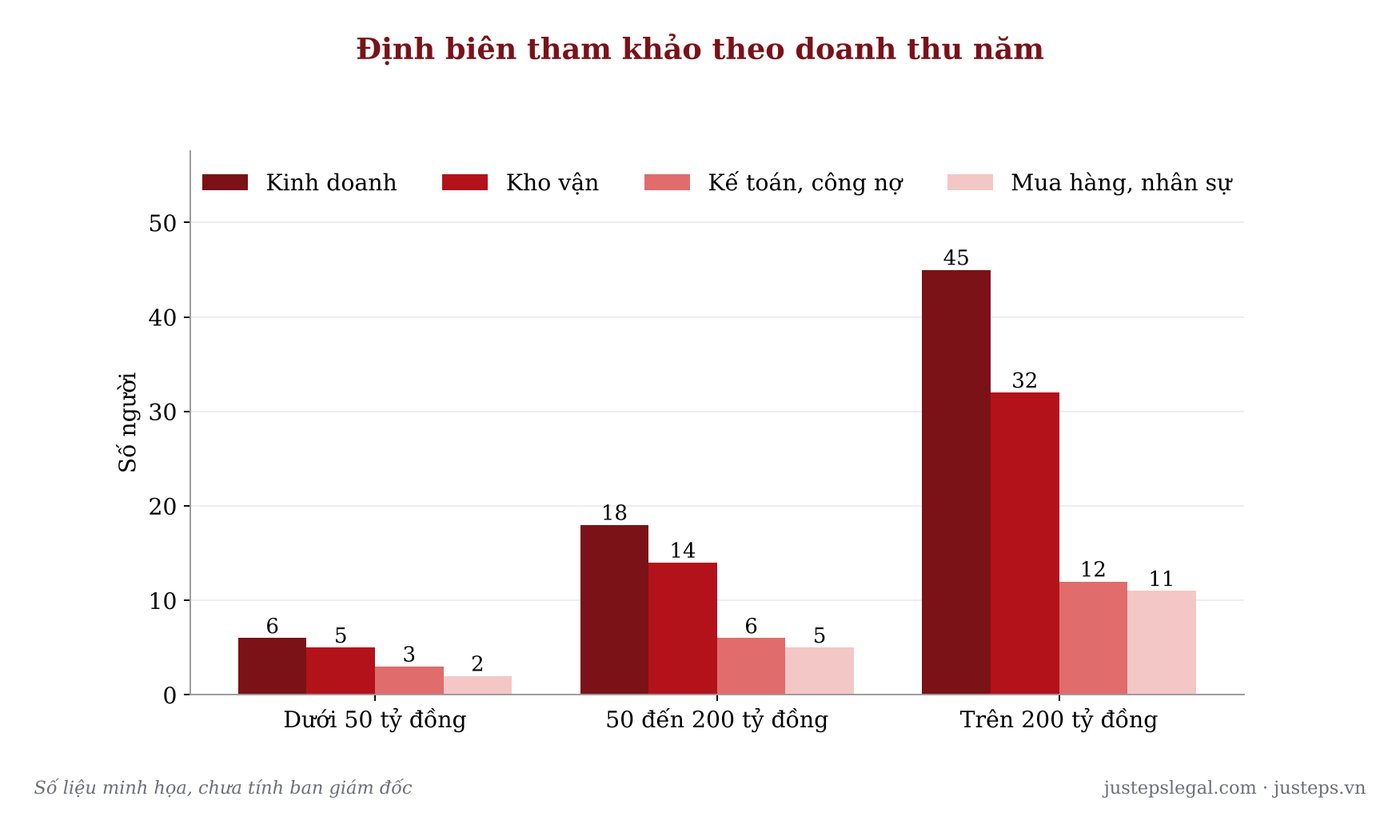
Reference headcount by department and revenue scale
In this example, total headcount excluding the board of management rises from about sixteen people at below fifty billion dong to about forty-three people at fifty to two hundred billion dong and about one hundred people above two hundred billion dong. Sales and logistics account for most of the people and grow almost in proportion to the number of outlets, while accounting and the support functions grow more slowly thanks to sales management software and electronic invoices. Before hiring more salespeople, a business should check whether stagnant sales are caused by stock-outs, late deliveries or an overly tight credit policy, because adding salespeople does not solve these causes.
Allocating authority for sensitive decisions
In a distribution company, the five types of decision most prone to losses are selling prices outside the price list, discounts beyond the policy, granting or raising credit limits, adjusting stock figures after a stocktake and accepting goods returned by customers. Each decision needs a specific value threshold and a corresponding approver, and the person proposing must not be the final approver. The matrix below is an example of how roles can be allocated between the sales supervisor, the head of sales, the chief accountant and the director for six types of decision.
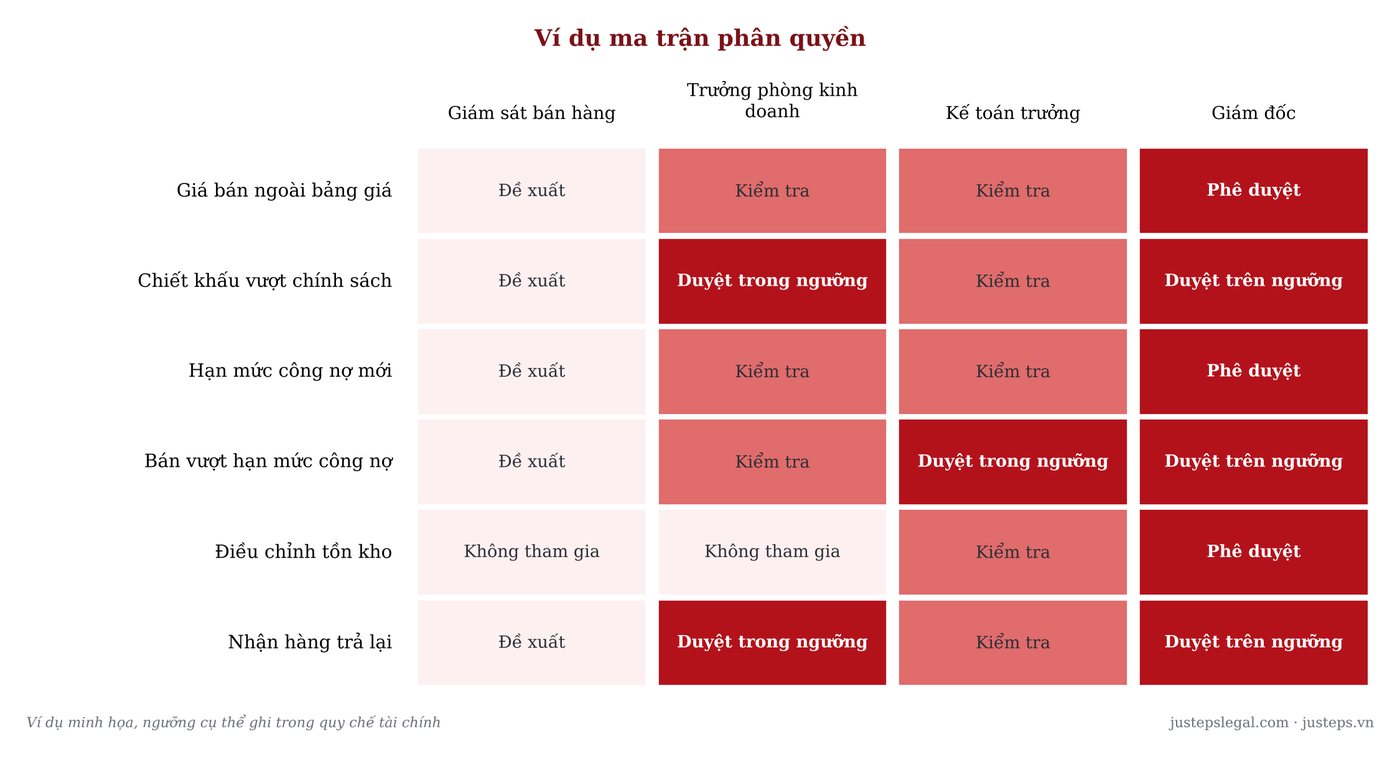
Example allocation of proposing, checking and approving roles for sensitive decisions
According to the matrix, the sales supervisor mainly proposes, the head of sales may approve discounts and returned goods within the threshold, while the chief accountant acts as an independent checker for most decisions affecting receivables and inventory. The director only approves cases above the threshold or those that change policy, such as selling prices outside the price list, new credit limits and inventory adjustments, and therefore does not have to approve each small order. For sales exceeding the credit limit specifically, the chief accountant may approve within the threshold because he or she knows the customer’s payment history best, while the director approves larger cases. Specific value thresholds should be written into the financial regulations and updated when revenue changes, and the business may consider Justeps’ service of financial regulations and delegation of authority.
When the head of sales or a branch director is assigned to sign contracts with customers, the company must issue a letter of authorisation stating the type of contract, the maximum value and the term. The Civil Code provides that a representative may not establish or perform civil transactions with himself or with a third party of whom he is also the representative, unless otherwise provided by law[8]. This rule needs particular attention when a salesperson or a relative of theirs also owns a second-tier dealer buying goods from the company, because this is a common conflict of interest in the distribution sector.
The sales and collection process linked to the structure
An organisational structure only works when its departments are connected by a clear process in which each step has a person responsible and a document as evidence. The flowchart below describes the process from receiving an order to collecting payment, divided between three departments, namely sales, receivables accounting and logistics.
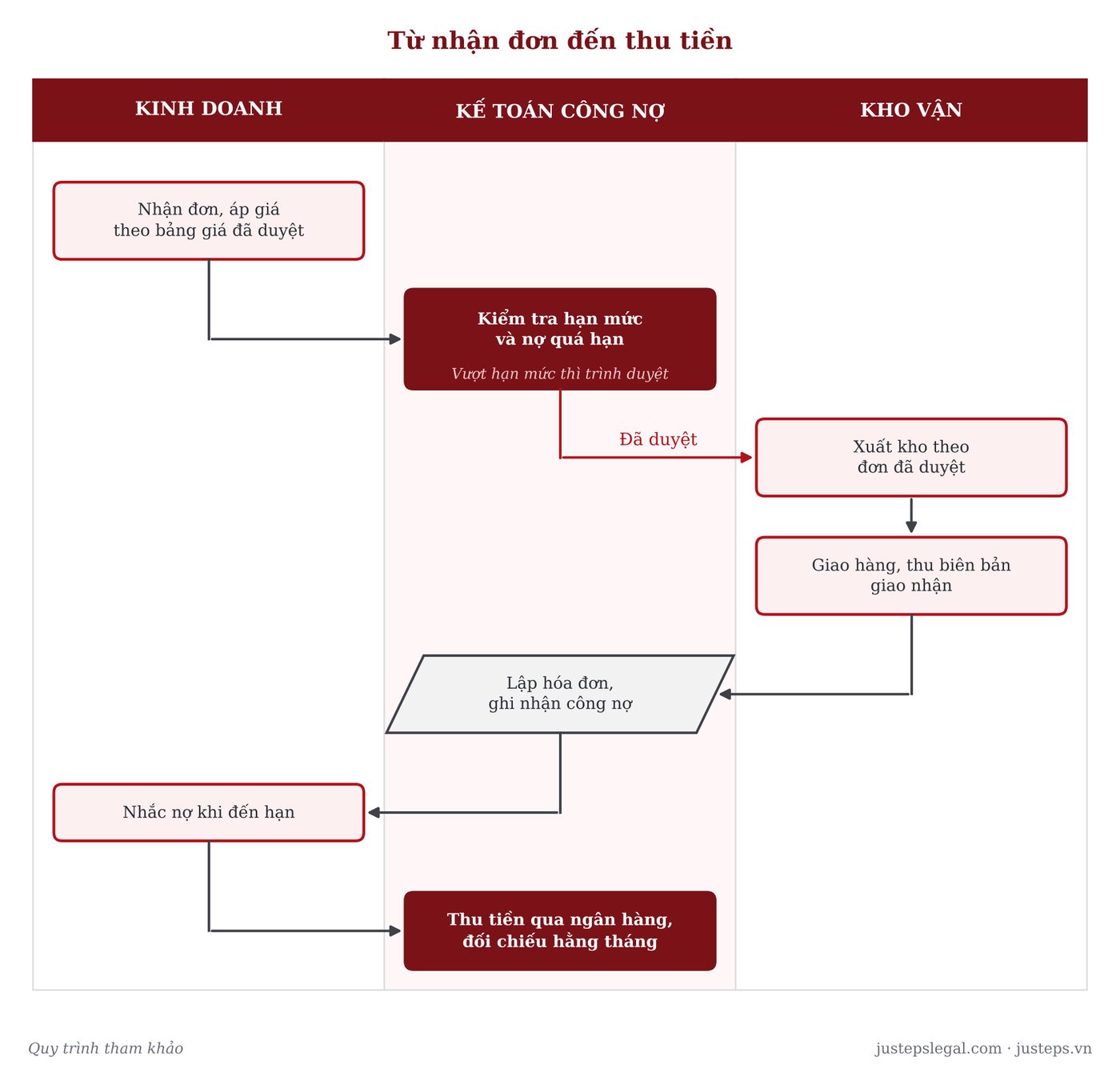
The process from order to cash divided between three departments
According to the flowchart, the sales department receives the order and applies the approved price list, then passes it to receivables accounting to check the credit limit before the warehouse is allowed to release goods. An order exceeding the limit is not blocked outright but is submitted to the competent person under the authority matrix, and only approved orders are passed to the warehouse. The warehouse releases goods according to the order, delivers them and collects a delivery note confirmed by the customer, then passes the documents to accounting to issue the invoice and record the receivable. Sales staff remind customers when payments fall due, but the money is collected through the company’s bank account and accounting reconciles receivables with customers every month, so that the flow of goods and the flow of cash are always controlled by two different departments.
If the company still has to collect cash at outlets, the process should specify the collector, a serially numbered receipt form, the deadline for paying the money into the cash fund on the same day and a reconciliation between receipts and receivables in the software. The receivables accountant should send balance confirmations directly to customers, not through the salesperson in charge, so as to detect early any case where money has been collected but not yet paid in to the company. A business wishing to design consistent control points across this process may consider Justeps’ service of financial internal control systems.
Common mistakes and the set of documents to be issued
Across the distribution businesses that Justeps has helped review their organisation, certain structural mistakes recur quite frequently and are usually only discovered after a stocktake or when a large bad debt arises:
- Sales staff also collect cash from dealers without independent reconciliation of receivables, so the money collected is held for several days before being paid in to the company.
- The storekeeper also keeps the inventory accounting records, which both breaches the rules on combined duties and prevents stocktake discrepancies from being detected.
- The company hires more salespeople when the real cause of falling sales is stock-outs or late deliveries.
- An organisational chart is issued without job descriptions, so departments blame each other when orders are late or wrong.
- All approval authority is concentrated in the director, so sales grind to a halt whenever the director is travelling.
To put the organisational structure into operation, the company should issue a consistent set of documents comprising the decision issuing the organisational chart, the rules on the functions and duties of each department, job descriptions for each position, the approval authority matrix, the sales and debt collection procedure, the goods receipt, issue and stocktaking procedure, the piece-rate pay and commission regulations, the registered internal labour regulations and the letters of authorisation. These documents should use a common numbering system and state their effective date and the person responsible for updating them. The business should review its structure once a year, or earlier when revenue grows by more than fifty per cent, a new sales channel is opened or distribution of a major brand is taken on.
How Justeps can help
Justeps helps trading and distribution companies build their organisation, allocate authority and control the flow of goods and cash through the following services:
- Organisational structure design for trading and import-export businesses. Justeps surveys operations and designs the chart, headcount and functions and duties of each department for trading and distribution businesses.
- Financial regulations and delegation of authority. Justeps builds the authority matrix for selling prices, discounts, credit limits and inventory adjustments, and the letters of authorisation to sign contracts.
- Financial internal control systems. Justeps designs control points in the sales, collection, goods receipt and issue and stocktaking processes.
- Salary scales and pay and bonus regulations. Justeps drafts piece-rate pay and commission regulations for the sales team linked to sales for which cash has been collected.
- KPI systems and performance appraisal. Justeps builds indicators for each sales channel, logistics and receivables to assess the effectiveness of the organisation.
Frequently asked questions
When should a distributor make receivables accounting a separate position?
In Justeps’ experience, a dedicated person is needed when the company has about fifty or more credit customers or when overdue receivables start to rise. This person tracks limits, reconciles monthly and gives warnings before new orders are accepted.
May the storekeeper also act as cashier?
From a management perspective, the company should not let one person hold both goods and cash. Under accounting law, neither storekeepers nor cashiers may work as accountants, except in certain types of small business that are excluded[4][5].
Should the company run its own fleet or outsource transport?
Companies with revenue below about fifty billion dong usually find outsourcing more flexible, because delivery volumes are not yet enough to run vehicles at full capacity. When the number of trips is stable and demand for fast delivery grows, the company can combine its own fleet for main routes with outsourcing for distant routes.
Must a warehouse at an address other than the head office be registered?
If the company conducts business at that address, it must give notice of the establishment of a business location within ten days from the date of the decision to establish it[2]. The business should be clear whether the warehouse is used only for storage or also for sales transactions in order to choose the appropriate procedure.
Can purchases paid to suppliers in cash be treated as expenses?
Expenses of five million dong or more per payment must be supported by non-cash payment documents to be treated as deductible expenses[1]. The company should specify the payment method in the purchase contract itself.
Is there a breach if a salesperson owns a second-tier dealer?
If that employee is authorised to sign contracts on behalf of the company, he or she may not transact with himself or herself[8]. Even without such authority, the company should require a declaration of conflict of interest and assign another person to approve prices and discounts for that dealer.
How often should the organisational structure be reviewed?
The business should review it once a year, or earlier when revenue grows by more than fifty per cent, a new sales channel is opened or distribution of a major brand is taken on. Each review should update the chart, job descriptions and authority matrix together.
Related articles
- Exclusive distribution agreements, sales targets, territory, termination and unsold stock
- Building the organisational structure of a small manufacturing company with clear reporting lines for control positions
- Structuring a sales department to fit the company’s size and sales model
- Managing accounts receivable through a credit policy, ageing reports and rigorous reconciliation records
Notes
[1] Point c, Clause 1, Article 9 of Government Decree No. 320/2025/ND-CP dated 15 December 2025 detailing and guiding the implementation of the Law on Corporate Income Tax.
[2] Article 45 of the Law on Enterprises No. 59/2020/QH14 dated 17 June 2020, as amended and supplemented by Law No. 76/2025/QH15.
[3] Labour Code No. 45/2019/QH14 dated 20 November 2019 (provisions on internal labour regulations and liability to compensate for damage), as amended and supplemented by the Law amending and supplementing a number of articles of the Labour Code and certain laws passed by the National Assembly on 21 November 2026.
[4] The Law on Accounting No. 88/2015/QH13 (provisions on persons who may not work as accountants), as amended and supplemented by the law passed by the National Assembly in November 2026.
[5] Clause 3, Article 19 of Government Decree No. 174/2016/ND-CP dated 30 December 2016 detailing a number of articles of the Law on Accounting.
[6] Government Decree No. 254/2026/ND-CP dated 30 June 2026 on electronic invoices and electronic documents.
[7] The Commercial Law No. 36/2005/QH11, as amended and supplemented by the law passed by the National Assembly on 13 November 2026.
[8] Clause 3, Article 141 of the Civil Code No. 91/2015/QH13 dated 24 November 2015.
This article is for reference and reflects the regulations in force at the time of publication. Please consult Justeps for advice tailored to your company’s records and situation.
For further information, please contact:
📩 Email: info@justeps.vn
🌐 Website: https://justepslegal.com · https://justeps.vn
🌐 Page: Justeps
☎️ Hotline (Zalo): 096 172 2607
📍 Thanh Xuan Office: 12th Floor, Licogi 13 Tower, 164 Khuat Duy Tien Street, Thanh Xuan Ward, Hanoi, Vietnam
📍 Ha Dong Office: LK06B, No.10, Dong Dua Area, Ha Dong Ward, Hanoi, Vietnam
📍 Ho Chi Minh City Branch: 528 Le Van Sy, Ho Chi Minh City, Vietnam
📍 Hai Phong Office: Truong Thinh Village, Ha Dong Commune, Hai Phong, Vietnam
📍 Quang Ninh Office: Van Don Special Zone, Quang Ninh Province, Vietnam





