
Key takeaways
- Shares for key employees should be granted gradually according to length of service and performance, usually over four years with the first milestone after 12 months, rather than all at once when the person joins.
- A limited liability company may not issue shares, so it must choose between admitting the employee as a capital-contributing member, paying cash bonuses based on share value or converting into a joint stock company.
- The company’s right to buy back shares when the recipient leaves is only robust when it is set out in the charter, in the agreement signed with each person and on the share certificate at the same time.
- Issuing shares to employees below market price requires the General Meeting of Shareholders to approve the discount, and the change in charter capital must be registered once the issue is completed.
- The value of bonus shares and the discount received when buying shares are treated as income from salaries and wages, so the business should calculate the recipient’s personal income tax obligations in advance.
Start-ups often need people who are strong in technology, sales or finance very early on, when they cannot yet afford to pay market salaries. The promise of shares becomes a common way to attract and retain these people, but many promises are made only verbally or by text message, without stating the percentage, conditions or timeframe. When the recipient leaves after a few months or when the company is preparing to raise capital, the parties realise that each of them understood the promise differently, and disputes over ownership cause investors to walk away from the deal.
This article analyses how to design a share programme for key employees in the order in which it is implemented, from setting objectives and the size of the pool, choosing a form suited to the type of company, the vesting schedule and the buy-back mechanism on departure, to approval authority, tax obligations and the documents required. The content applies to non-public joint stock companies and limited liability companies operating in Vietnam. The main readers are founders, members of the Board of Directors and those in charge of human resources at start-ups.
Objectives and limits when granting shares to employees
The objective of the programme is to align the long-term interests of key employees with the value of the business, usually over a period of three to five years, so that they have a reason to stay and contribute to growth. For this reason, shares should be granted according to length of service and performance, and should not all be granted as soon as the employment contract is signed. In practice, the shares reserved for employees (Employee share pool), usually linked to an employee stock option plan (ESOP), account for about 10% to 15% of charter capital and are allocated over several rounds.
The programme also has limits that founders need to understand clearly before making promises. Issuing additional shares reduces the ownership percentage of existing shareholders, and recipients become shareholders with full statutory rights to attend meetings, vote and inspect the books. Once a person is a shareholder, the shares can only be recovered through a buy-back transaction with a proper basis, so if nothing has been agreed in advance, the company has almost no way to compel a departed employee to return the shares.
The right time to implement a programme is usually when the company needs to recruit senior positions but cannot yet pay market salaries, when someone holds core technology or customer relationships, or when investors require an employee share pool before a funding round. Conversely, a business should not implement one when the founding shareholders have not yet agreed on their own percentages, when there is no basic valuation method, or when the management team is still changing constantly. In these cases, performance-linked cash bonuses are usually safer in the early stage.
Choosing a form of award suited to the type of company
Three common forms in a joint stock company
A joint stock company can choose between bonus shares, options to buy shares at a preferential price and phantom shares. The first two forms make the recipient a real shareholder, while phantom shares are merely a commitment to pay cash based on the value of the shares at a specified time. The table below compares the nature of each form and the situations to which it is suited:
| Form | Nature and recipient’s rights | Suitable when |
|---|---|---|
| Bonus shares | The recipient pays nothing and becomes a shareholder as soon as the shares are entered in the register of shareholders. | The joint stock company is established and wishes to recognise the past contributions of a small number of people. |
| Preferential purchase options | The recipient may buy shares at a price fixed before the vesting milestone and benefits from any subsequent increase in value. | The start-up has a clear plan for increasing value through funding rounds. |
| Phantom shares | The recipient receives a cash bonus calculated on the value of the shares, without shareholder status or voting rights. | The company wishes to keep a tidy ownership structure or is not yet a joint stock company. |
| Capital contribution | The recipient becomes a member of the limited liability company with voting rights in proportion to their capital. | The limited liability company has few members and accepts an enlarged Members’ Council. |
The choice of form depends first on the type of company and then on whether the employee needs voting rights. The selection sequence can be pictured as follows.
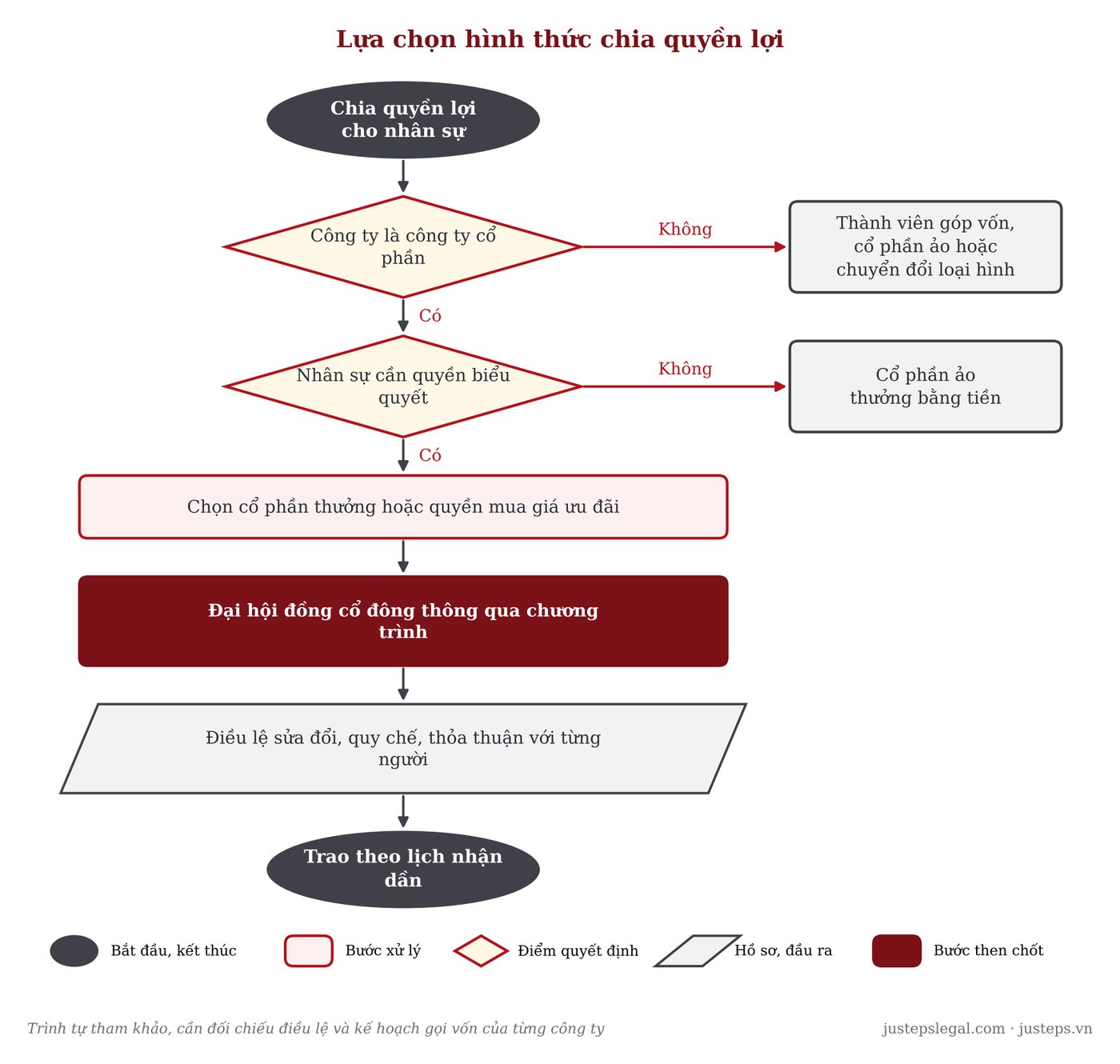
Sequence for choosing the form of award for key employees
The first question is whether the company is a joint stock company, because only this type of company may issue shares. If the company is a joint stock company, the business then considers whether the employee genuinely needs voting rights or only needs to benefit from the increase in value, since in the latter case phantom shares can be used to avoid expanding the list of shareholders. Once real shares have been chosen, the programme must be approved by the General Meeting of Shareholders and documented in a set of papers comprising the amended charter, the programme rules and an agreement with each person.
Limited liability companies
A limited liability company may not issue shares, except where it converts into a joint stock company[1]. The company may admit an employee as a new member by increasing capital or by having an existing member transfer part of their capital contribution, but when transferring to an outsider, the capital must first be offered to the remaining members in proportion to their holdings[2]. Each new member also has voting rights in the Members’ Council, so this approach is only suitable when there are very few recipients and the founders accept sharing decision-making power.
Where the company expects many employees to receive awards or is preparing to raise capital, the more suitable route is usually to convert into a joint stock company before implementing the programme[3]. If it does not yet wish to convert, the company can use phantom shares, that is, a commitment to pay cash bonuses under a formula linked to the value of the business, set out in the bonus regulations or contract. The choice of model should be made together with the fundraising plan, and businesses may refer to Justeps’ business model and corporate structure advisory service to evaluate the options.
Vesting schedules and performance conditions
The vesting schedule sets out how much of the award the recipient is entitled to after each period of service. A common approach is to spread vesting over four years, with the first milestone after 12 months, meaning that a person who leaves before this milestone receives nothing, while on completing 12 months they immediately vest one quarter of the total award. After the first milestone, the remainder vests evenly quarterly or annually until 100% is reached. The following chart illustrates the cumulative percentage vested according to length of service.
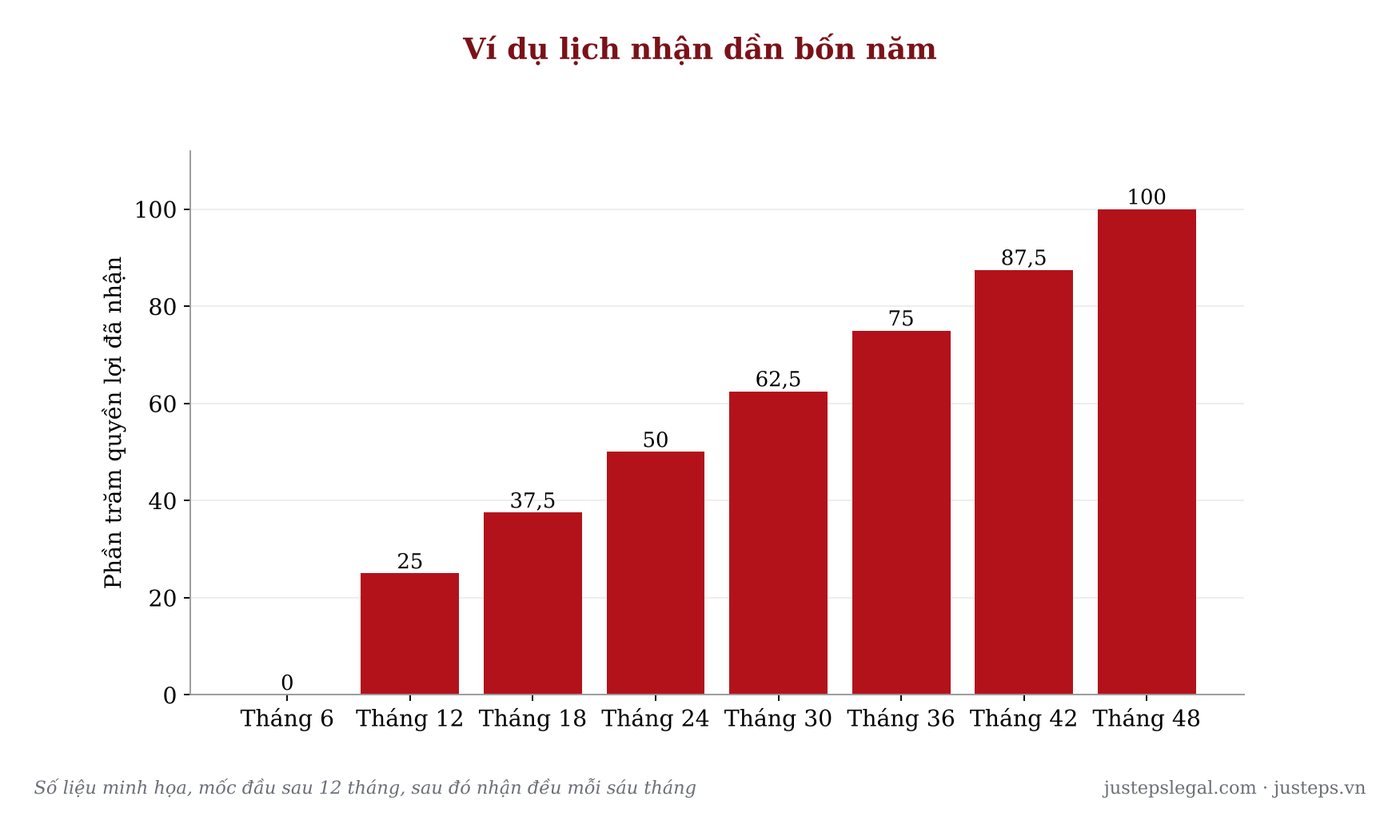
Example of the cumulative percentage vested under a four-year vesting schedule with the first milestone after 12 months
Under this example, a person who works for 11 months and then leaves has no entitlement to any shares, while a person who completes 24 months has vested half. The 12-month milestone helps the company avoid a situation where someone who joined only a few months ago becomes a shareholder, and it is also a long enough period to assess fit. The business may add performance conditions, for example granting a year’s tranche only when the recipient achieves a certain appraisal rating, but the criteria must be measurable and set out in the rules to avoid later disputes.
From a legal standpoint, shares that have not yet vested do not yet belong to the employee, so the safe approach is to issue or transfer shares only when the person has reached the milestone, rather than issuing everything and then clawing back the portion that has not vested. With preferential purchase options, the recipient only pays and becomes a shareholder when exercising the option after each milestone. The agreement should also specify what happens to unvested portions if the company is sold or merged, for example allowing full or partial accelerated vesting, as this is a point that investors and employees often negotiate.
Handling departures of recipients
The leaver provisions determine whether the programme actually protects the business. The agreement needs to distinguish between people who leave for legitimate reasons such as health, family circumstances or restructuring, and those who are dismissed for disciplinary reasons, disclose trade secrets or move to a competitor. The treatment of vested and unvested portions can be summarised as follows:
| Situation | Vested portion | Unvested portion |
|---|---|---|
| Legitimate departure | The recipient keeps it; the company or other shareholders have the right to buy it back at market price within the agreed period. | Lapses and returns to the employee share pool to be granted to others. |
| Serious breach | The company or designated shareholders have the right to buy it back at original cost or par value. | Lapses immediately, without compensation. |
| Death or incapacity | Heirs may keep it or sell it back to the company at market price. | Usually lapses, unless the rules allow partial accelerated vesting. |
| Sale of the company | The recipient sells alongside other shareholders under the tag-along provisions. | Full or partial accelerated vesting may apply as agreed. |
The company’s buy-back right must comply with the limits under the Law on Enterprises. A joint stock company may only buy back up to 30% of the total ordinary shares sold, and the Board of Directors may only decide to buy back up to 10% of the total shares of each class sold within 12 months, with anything above that requiring a decision of the General Meeting of Shareholders[4]. The company may also only make payment if it can still pay its debts and other property obligations in full afterwards, so for a loss-making start-up, the agreement should also designate the founding shareholders as alternative purchasers.
Transfer restrictions and buy-back rights must be set out in the charter, and under the Law on Enterprises, transfer restrictions in the charter are only effective when they are clearly stated on the share certificate for the relevant shares[5]. If the provisions appear only in a separate agreement between the company and the employee, the recipient can still sell the shares to a third party, and the company is left only with a contractual claim for damages. In addition, the share agreement is a transaction separate from the employment contract, so the company may not deduct wages or impose fines on the employee in order to exercise its buy-back right[6].
Approval authority and the issuance procedure in a joint stock company
For a non-public joint stock company, issuing shares to employees is a form of private placement of shares[7]. The General Meeting of Shareholders decides on the classes and total number of shares authorised for offering and on amendments to the charter, while the Board of Directors decides on offerings within the number of shares authorised and on the offering price[8]. In principle, the offering price may not be lower than the market price or the most recent book value, except in certain cases, including where the discount has been approved by the General Meeting of Shareholders[9]. The resolution of the General Meeting of Shareholders should therefore clearly state the total number of shares in the pool, the pricing principles and the discount, the eligible participants and the agreement of existing shareholders to waive their pre-emptive rights in respect of these shares.
If founders wish to transfer some of their own shares rather than have the company issue new ones, they should note that during the first three years from the date of issue of the enterprise registration certificate, the ordinary shares of founding shareholders may only be transferred to persons who are not founding shareholders with the approval of the General Meeting of Shareholders[10]. Where the employees receiving shares are foreign nationals, the business must also consider the procedures for capital contribution and share purchases by foreign investors and the market access conditions for its business lines[11]. The issuance sequence and the role of each party are shown in the diagram below.
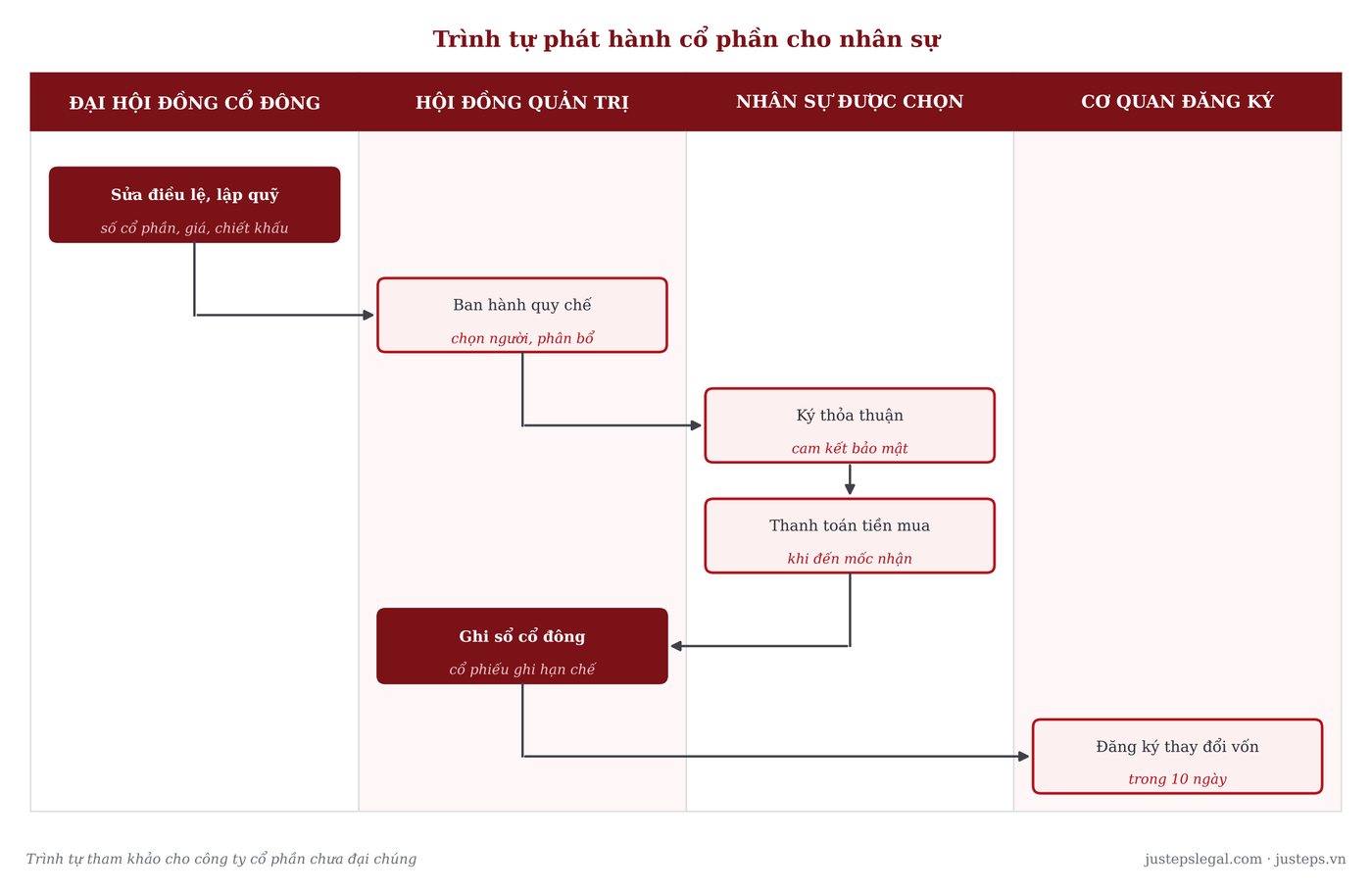
Sequence for issuing shares to key employees in a non-public joint stock company
Under this sequence, the General Meeting of Shareholders begins by amending the charter and approving the pool, the Board of Directors issues the rules and decides on the list of recipients, and then each employee signs an agreement and pays on reaching the vesting milestone. After receiving payment, the company enters the recipient’s name in the register of shareholders, issues a share certificate noting the transfer restrictions and registers the change in charter capital with the business registration authority within 10 days from the date the issue is completed[12]. Skipping the registration step or failing to update the register of shareholders is a common error, leaving employees unable to prove ownership and causing investors to find discrepancies during due diligence.
Personal income tax obligations and costs for the business
The 2025 Law on Personal Income Tax took effect on 1 July 2026, and Decree 253/2026/ND-CP guiding its implementation has clarified how income from bonus shares and shares issued to employees is determined[13]. Accordingly, the value of bonus shares and the discount employees receive when buying shares are treated as income from salaries and wages. The income is determined at the time of the bonus or issue, based on the cost the business records for the employee or on the difference between the par value and the amount the employee actually pays, and where there is no difference, no taxable income arises. The new guidance also defers the time for paying tax on this income until the employee transfers the shares received.
Because the new rules have only just taken effect, businesses should check the original texts before granting shares in order to determine precisely who withholds the tax, when it must be declared and what documents are needed to prove the value. When the employee later sells the shares, any gain may also be subject to tax on income from capital transfers or securities transfers under separate rules. The share agreement should state clearly that the recipient bears any personal income tax arising and that the company may withhold tax where required by law, to avoid any misunderstanding that the company will pay it on the employee’s behalf.
With phantom shares, the cash bonus paid to the employee is income from salaries and wages and is subject to withholding under the progressive tax schedule at the time of payment. For the business, the bonus is only deductible when the conditions and amount of the bonus are set out in the employment contract, collective labour agreement or the company’s bonus regulations[14]. The phantom share rules should therefore be issued before any payment is made and referred to in the recipient’s employment contract.
Required documents and common mistakes
A share programme for key employees is considered complete when there is a consistent set of documents in which the papers do not contradict each other on percentages, conditions or timeframes. The minimum set of documents usually comprises the following:
- An amended charter containing provisions on the employee share pool, transfer restrictions and the buy-back rights of the company and shareholders.
- A resolution of the General Meeting of Shareholders approving the programme, the total number of shares, the pricing principles and the discount.
- Programme rules setting out eligibility, selection criteria, the vesting schedule and how departures of recipients are handled.
- A share agreement signed with each person, together with undertakings on confidentiality and non-solicitation of staff and customers.
- The Board of Directors’ issuance decision, payment records, share certificates noting transfer restrictions and an updated register of shareholders.
- The application to register the change in charter capital and the personal income tax withholding and declaration records, where applicable.
The most common mistakes are making promises verbally or by text message without any written document, granting all the shares as soon as the person joins, and lacking a buy-back provision on departure. Another group of mistakes concerns percentages, when founders promise a percentage of the current capital without taking into account that this percentage will fall after funding rounds, leaving employees feeling deceived when they receive less than they expected. The ownership structure below illustrates a company after its first funding round with an employee share pool in place.
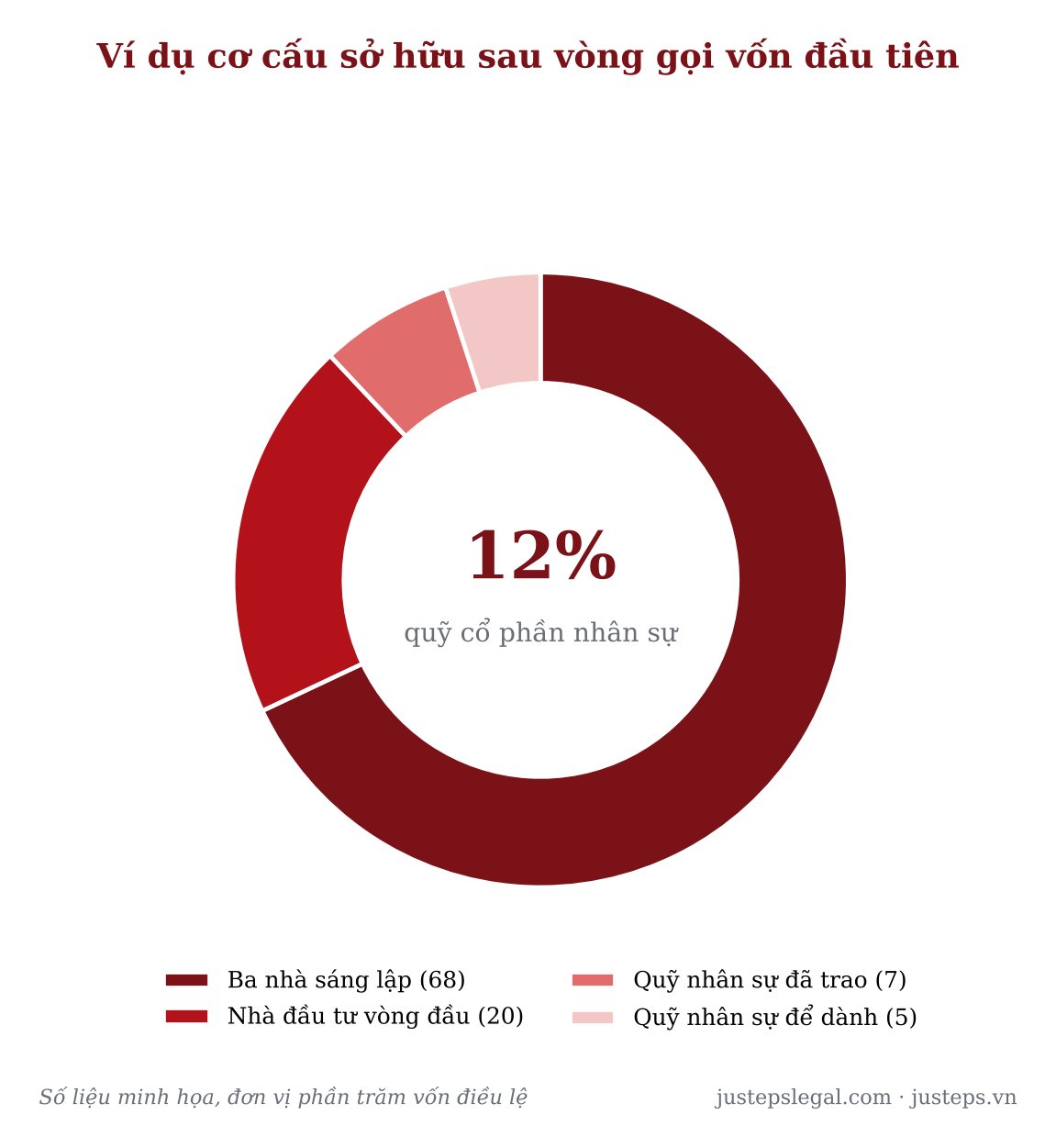
Example of the ownership structure after the first funding round with a 12% employee share pool
In the example, the three founders retain 68%, the first-round investor holds 20% and the employee share pool accounts for 12%, of which 7% has been granted to current employees and 5% is reserved for future hires. Promises to employees should therefore be expressed as a specific number of shares or as a percentage of the pool, with an explanation that the percentage of total capital may fall when the company issues more shares. When raising capital, investors usually require the pool to be created before they invest, so the dilution caused by the pool is borne mainly by existing shareholders.
The final mistake is ignoring approval authority and procedures, for example relying only on a decision of the director without a resolution of the General Meeting of Shareholders, or failing to register the change in charter capital. These omissions may lead to disputes over the validity of the issue, and they are usually discovered precisely when the company undergoes due diligence for fundraising. Justeps helps businesses draft the charter, programme rules and agreements consistently through its shareholders’ agreements and founders’ capital contributions service, so that the documents match from the outset.
How Justeps can help
Justeps helps start-ups design and implement share programmes for key employees through the following services:
- Shareholders’ agreements and founders’ capital contributions. Justeps drafts the programme rules, the share agreement with each person and buy-back provisions consistent with the charter.
- Business model and corporate structure advisory. Justeps evaluates the option of converting a limited liability company into a joint stock company or using phantom shares before making awards.
- Fundraising and private placement of shares. Justeps prepares the resolutions, issuance documents and registration of the change in charter capital for share issues to employees.
- Development of salary scales and pay and bonus regulations. Justeps links the share programme to pay and bonus policy and drafts phantom share rules so that bonuses qualify as deductible expenses.
Frequently asked questions
Can a limited liability company grant shares to employees?
A limited liability company may not issue shares unless it converts into a joint stock company[1]. The company can admit employees as capital-contributing members or use phantom shares paid as cash bonuses.
What percentage of capital should be set aside for the employee share pool?
In practice, about 10% to 15% of charter capital is usually set aside and allocated over several rounds. Part of it should be kept back for positions to be filled later.
Is an employee who leaves required to sell back their shares?
The recipient is only required to sell back when the charter, the share agreement and the share certificate state the buy-back right and transfer restrictions[5]. Without these provisions, the person remains a shareholder after leaving.
Does an employee share programme need to be approved by the General Meeting of Shareholders?
Usually yes, because the programme changes the total number of shares authorised for offering and the charter, and may involve a discounted price[8][9]. The Board of Directors only decides on offerings within the scope already approved.
Must employees who receive bonus shares pay personal income tax?
The value of bonus shares is treated as income from salaries and wages under the new rules[13]. The business should check the guiding documents to determine when to declare and who withholds the tax.
Are phantom shares legally binding?
Phantom shares bind the parties when they are set out in a valid contract or bonus regulations, but they do not confer shareholder status. The bonus is deductible when the bonus conditions are set out in the employment contract or regulations[14].
Can founders transfer their own shares to employees?
During the first three years, founding shareholders may only transfer ordinary shares to persons who are not founding shareholders with the approval of the General Meeting of Shareholders[10]. After that period, transfers follow the charter and the shareholders’ agreement.
Related articles
- Setting up a tech start-up, capital structure, ESOP and ownership of source code
- Founders’ shareholders’ agreement, governance provisions, vesting, veto rights and exit mechanisms
- Private placement of shares by a non-public joint stock company, internal procedures and registration of changes
- Preparing for an IPO two to three years before listing by standardising governance, accounting and disclosure
Notes
[1] Clause 4 of Article 46 and Clause 4 of Article 74 of the Law on Enterprises No. 59/2020/QH14 dated 17 June 2020, as amended and supplemented by Law No. 76/2025/QH15.
[2] Articles 52 and 68 of the Law on Enterprises No. 59/2020/QH14.
[3] Article 202 of the Law on Enterprises No. 59/2020/QH14.
[4] Articles 133 and 134 of the Law on Enterprises No. 59/2020/QH14.
[5] Clause 1 of Article 127 of the Law on Enterprises No. 59/2020/QH14.
[6] Article 21 and Clause 2 of Article 127 of the Labour Code No. 45/2019/QH14 dated 20 November 2019.
[7] Articles 123 and 125 of the Law on Enterprises No. 59/2020/QH14.
[8] Clause 2 of Article 138 and Clause 2 of Article 153 of the Law on Enterprises No. 59/2020/QH14.
[9] Clause 1 of Article 126 of the Law on Enterprises No. 59/2020/QH14.
[10] Clause 3 of Article 120 of the Law on Enterprises No. 59/2020/QH14.
[11] Law on Investment No. 143/2025/QH15, effective from 1 March 2026, and guiding documents on capital contribution and share purchases by foreign investors.
[12] Article 30 of the Law on Enterprises No. 59/2020/QH14; Decree No. 168/2025/ND-CP on enterprise registration, as amended and supplemented by Decree No. 296/2026/ND-CP.
[13] Law on Personal Income Tax No. 109/2025/QH15, effective from 1 July 2026; Government Decree No. 253/2026/ND-CP detailing its implementation, effective from 1 July 2026.
[14] Law on Corporate Income Tax No. 67/2025/QH15 and Government Decree No. 320/2025/ND-CP, provisions on deductible expenses.
This article is for reference and reflects the regulations in force at the time of publication. Please consult Justeps for advice tailored to your company’s records and situation.
For further information, please contact:
📩 Email: info@justeps.vn
🌐 Website: https://justepslegal.com · https://justeps.vn
🌐 Page: Justeps
☎️ Hotline (Zalo): 096 172 2607
📍 Thanh Xuan Office: 12th Floor, Licogi 13 Tower, 164 Khuat Duy Tien Street, Thanh Xuan Ward, Hanoi, Vietnam
📍 Ha Dong Office: LK06B, No.10, Dong Dua Area, Ha Dong Ward, Hanoi, Vietnam
📍 Ho Chi Minh City Branch: 528 Le Van Sy, Ho Chi Minh City, Vietnam
📍 Hai Phong Office: Truong Thinh Village, Ha Dong Commune, Hai Phong, Vietnam
📍 Quang Ninh Office: Van Don Special Zone, Quang Ninh Province, Vietnam





