
Key takeaways
- The law does not prescribe a mandatory template for management reports, but the figures must be drawn from the same accounting ledgers as the financial statements so that the two sets of numbers do not contradict each other.
- A useful monthly management report needs only about 10 to 15 indicators, each with a consistent calculation method, a budget figure for comparison, an alert threshold and a person responsible.
- A report that arrives on time with reasonable accuracy is worth more for running the business than a perfect report that arrives three weeks late; the release date should be fixed by working days of the following month.
- Compliance indicators such as non-cash payment evidence, unreconciled invoices and tax and insurance obligations falling due should appear in the monthly report so that they are dealt with before the annual finalisation.
- Every variance above the threshold must lead to an action with an owner and a deadline; otherwise the report becomes merely a document to be read.
In many small and medium-sized enterprises, the Board of Management only receives last month’s figures in the middle or at the end of the following month, by which time necessary decisions have already been delayed. The figures that arrive are usually a trial balance or an income statement prepared under the accounting regime, which are designed for filing with the tax authority and for audit rather than for answering operational questions such as which customers are paying late, which products are loss-making or how many weeks the cash will last. Meanwhile, the sales, warehouse and HR departments report in their own formats, with figures that do not match accounting, so the monthly meeting spends most of its time arguing about which number is correct.
This article explains how to build a monthly management report that is short, on time and compared against the budget, proceeding from its distinction from the financial statements, design principles, the indicator set, report structure, closing calendar and division of roles, to reporting to owners and a roadmap for standardisation. In each part, the article sets out the relevant requirements of Vietnamese law, particularly accounting, tax and enterprise law. The main readers are directors, chief financial officers, chief accountants and heads of department of limited liability companies and unlisted joint stock companies, including foreign-invested enterprises that must report to a parent company.
How management reports differ from financial statements and how far the law governs them
The Law on Accounting distinguishes financial accounting, which provides information through financial statements to those who need to use it, from management accounting, which collects, processes, analyses and provides economic and financial information as required for management and decision-making within the entity[1]. A monthly management report is a product of management accounting combined with operational data from the departments (Management report). The Ministry of Finance has issued general guidance on management accounting in enterprises, under which an enterprise decides for itself the content, form and frequency of its management reports to suit its own management needs[2]. Consequently, there is no mandatory management report template, and the business has full discretion to design its set of indicators.
However, freedom of form does not mean that management reports sit outside the accounting system. From 1 January 2026, enterprises apply the accounting regime under Circular No. 99/2025/TT-BTC, which replaces Circular No. 200/2014/TT-BTC[3], and the revenue, expense and receivables and payables figures in the management report should be drawn from the same ledgers. When the management report shows a profit that is markedly different from the financial statements without explanation, this is usually a sign that the books are recognising items in the wrong period or that there are off-book transactions, and it is also a risk when the tax authority or auditors carry out reconciliations. The table below compares the two types of report so that the business can correctly identify the role of each.
| Criterion | Financial statements | Monthly management report |
|---|---|---|
| Purpose | Provide information to state authorities, banks, investors and auditors. | Help the Board of Management detect problems early and make operational decisions. |
| Basis of preparation | Accounting standards and regime, using mandatory templates. | Designed by the business itself, but with figures drawn from the same accounting ledgers. |
| Period and deadline | Prepared annually; some businesses also prepare them quarterly or half-yearly. | Prepared monthly and released within about 5 to 10 working days of the following month. |
| Scope of data | Financial data for the business as a whole. | Combines financial data with operational data by product, customer, branch and department. |
| Level of accuracy | Must be complete and accurate after period-end adjustments. | Accepts reasonable estimates for certain items to ensure timeliness. |
Management reports and the documents used to prepare them are accounting documents used for the management and operation of the business, so they must be retained for at least 5 years[4]. In addition, monthly reports often contain information on cost of sales, profit by customer and individual salaries, so they should be classified as confidential internal documents with a restricted list of recipients. HR data linked to specific individuals is also personal data and should only be included in reports in aggregated form unless genuinely necessary[5].
Four principles for designing a useful management report
The first principle is that everything important must fit on a single overview page. The Board of Management needs to see within a few minutes the key indicators, which ones are on target and which have crossed the alert threshold, and only then read the detail on the indicators that have problems. A twenty-page report without an overview page is rarely read in full, and a problem on page fifteen will be overlooked.
The second principle is that every figure must have a point of comparison, usually the monthly budget, the same period last year or the previous month. Revenue of VND 12 billion on its own says nothing about whether performance is good or bad, but revenue of VND 12 billion against a budget of VND 14 billion and VND 13 billion in the same period last year immediately reveals an issue that needs explaining. A business therefore needs to prepare an annual budget broken down by month before it can run management reporting meaningfully.
The third principle is to put timeliness ahead of absolute precision. A report released on the seventh working day with some expenses reasonably estimated is worth far more than a report accurate to the last dong that reaches the Board of Management at the end of the month. Any estimate used must be clearly noted and adjusted in the following month’s report, so that readers know how reliable each figure is.
The fourth principle is that each indicator has one person responsible, meaning the person who explains when the indicator deviates from the budget and proposes corrective measures. Accounting is responsible for the correctness of the figures, while the heads of sales, warehouse and HR are responsible for the substance of the indicators within their departments. All definitions, formulas, data sources and responsible persons for each indicator should be recorded in an indicator dictionary issued together with the financial regulations, so that nobody changes the calculation method from one month to the next.
The indicators the Board of Management needs to see each month
The specific indicators vary by industry, but most businesses need to monitor six groups, namely business results, cash flow, working capital, customers, people and compliance. A small business can start with six indicators, one per group, and add more gradually as its data systems stabilise. The table below suggests the key indicator and an indicative alert threshold for each group.
| Indicator group | Key indicator and calculation | Indicative alert threshold |
|---|---|---|
| Business results | Net revenue, gross profit margin and profit before tax against the monthly budget. | Revenue or gross profit more than 10% below budget. |
| Cash flow | Cash balance at month end and net cash flow from operating activities during the month. | Cash covers less than eight weeks of fixed costs. |
| Working capital | Average days sales outstanding, days inventory outstanding and days payable outstanding. | Days sales outstanding up by more than 10 days on the previous month. |
| Customers | Revenue from the ten largest customers and receivables more than 90 days overdue. | A single customer accounts for more than 30% of revenue, or overdue receivables keep rising. |
| People | Average headcount, personnel cost to revenue and staff turnover rate. | Monthly turnover above 3%, or personnel costs rising faster than revenue. |
| Compliance | Payments of VND 5 million or more without non-cash payment evidence, and tax and insurance obligations falling due. | Any payment lacking evidence or any overdue obligation not yet paid. |
Why the monthly report needs compliance indicators
The compliance group is often overlooked, yet it is the group that helps a business avoid losses that can be foreseen. Under Decree No. 320/2025/ND-CP guiding the Law on Corporate Income Tax, purchases of goods and services with invoices of VND 5 million or more are only deductible for tax purposes if there is evidence of non-cash payment, save for certain exemptions provided by regulation[6]. If the business only discovers a series of cash payments at year end, those expenses will be disallowed at tax finalisation and are almost impossible to remedy. Monitoring this indicator monthly allows accounting to require the purchasing team to change the payment method as soon as the issue arises.
Similarly, the monthly report should list input invoices that cannot yet be reconciled with e-invoice data, as well as taxes and social insurance contributions falling due in the coming month together with their payment status. From 1 July 2026, e-invoicing is governed by Decree No. 254/2026/ND-CP[7], so the first months under the new rules are a time to monitor adjusted or replacement invoices closely. Late tax payment incurs late payment interest calculated daily, while late social insurance contributions lead both to penalties and to an impact on employees’ entitlements, so these items need to be visible before they fall due, not afterwards.
The structure of a monthly management report
A monthly management report for a small or medium-sized enterprise should be kept to around 6 to 10 pages, comprising six parts arranged from overview to detail. The first is the overview page showing the key indicators, actual figures, budget, variance and an on-target or alert signal. The second part covers business results by product, sales channel or branch, the third covers actual and forecast cash flow, and the fourth covers receivables, payables and inventory by age. The fifth part covers people, and the final part is the list of issues and proposals, in which each issue has an owner and a deadline for resolution.
A chart comparing actual results with the budget is the most visual tool on the overview page, because it lets readers see the trend over several months instead of a single number. The chart below illustrates a business’s actual revenue against budget over six months.
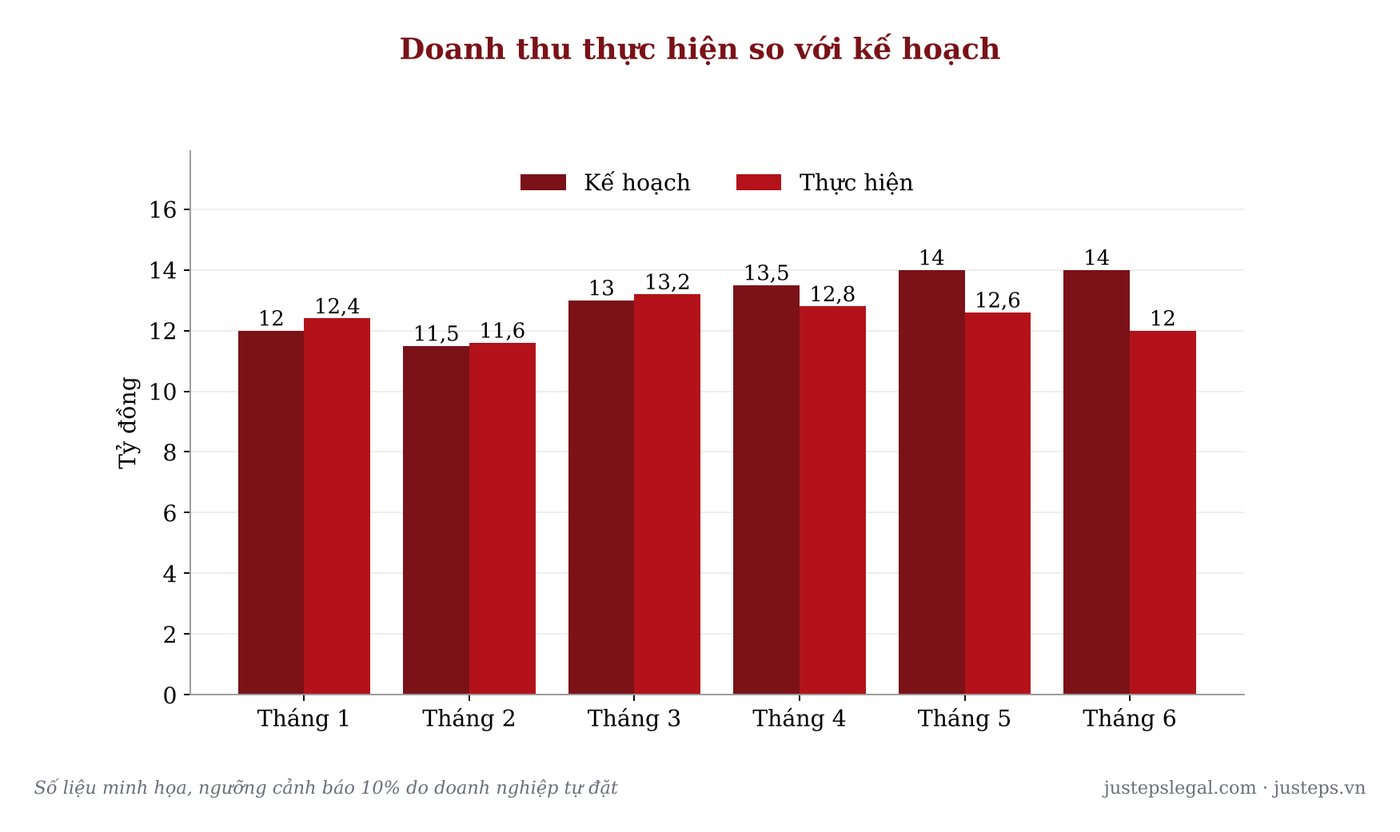
Example of actual revenue against budget over six months on the overview page of a management report
In this example, revenue in the first three months met or exceeded budget, but from the fourth month revenue began to fall below budget and by the sixth month it was about 14% lower, exceeding the 10% alert threshold. Looking only at the sixth month, the Board of Management might think this is a temporary fluctuation, but a trend over three consecutive months points to a systemic problem, such as the loss of a major customer or selling prices that are no longer competitive. The accompanying explanation must therefore analyse the causes by volume, selling price and product mix, rather than simply stating that revenue fell because the market was difficult.
Alongside the monthly report, the business should maintain a 13-week cash flow forecast updated weekly. The profit report shows whether the business is making money, while the cash flow forecast shows whether it will have enough cash to pay wages, pay suppliers and pay taxes over the next three months. Many businesses that are profitable on paper still struggle to make payments because customers pay late, and only a cash flow forecast detects this early enough.
The closing calendar and division of roles between accounting, departments and the Board of Management
A business’s accounting periods comprise annual, quarterly and monthly periods[8], and the monthly management report is only on time when the monthly close is organised to a fixed calendar. This calendar should be set by working days of the following month, for example the first, third and fifth working days, rather than calendar dates, so that it is not affected by public holidays. The diagram below illustrates an indicative closing calendar and division of roles for a small or medium-sized enterprise.
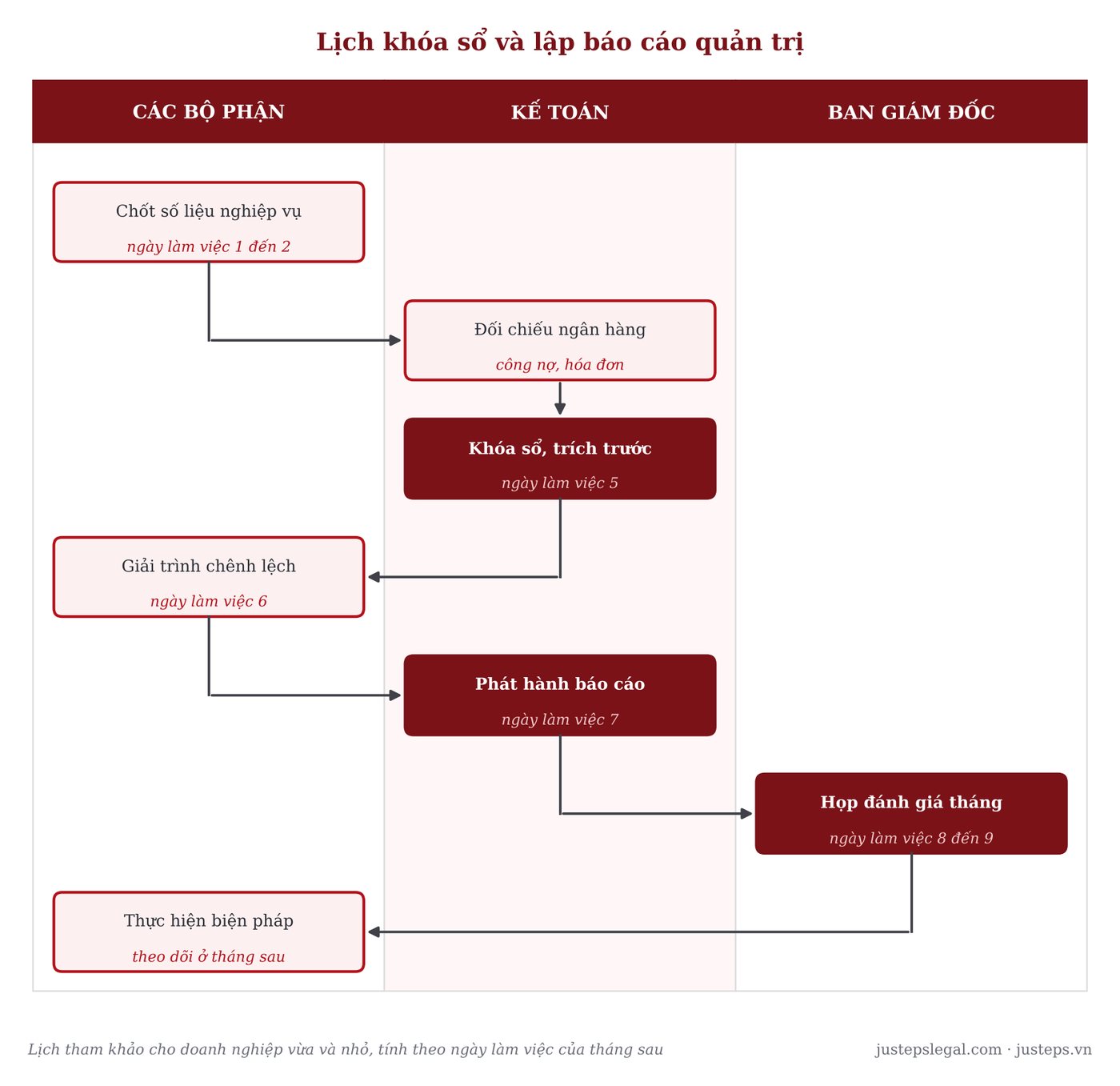
Calendar for closing the books and preparing the management report by working days of the following month, across departments, accounting and the Board of Management
In the first two working days, the sales, warehouse and HR departments submit their finalised operational data, such as sales by customer, stocktake records and timesheets, while accounting reconciles bank accounts, receivables and payables, and invoices. By the fifth working day, accounting completes the close, records accruals and prepares a draft report; heads of department then have two days to explain variances within their remit. The final report is released on the seventh working day and the Board of Management holds its review meeting on the eighth or ninth day, with conclusions recorded in minutes containing an action list. This calendar should be issued together with the financial regulations so that it is binding on every department rather than depending on the goodwill of individual heads of department; businesses may refer to Justeps’ financial regulations and delegation of authority service.
The person responsible for compiling the report is usually the chief accountant or the chief financial officer. In businesses that have separated the finance function from accounting, accounting is responsible for the recorded figures, while finance is in charge of analysis, forecasting and presentation. Report preparation must also not depend on a single person, because when that person leaves, the business loses both the calculation methods and the history of the data; procedures, the indicator dictionary and calculation files must be stored on a shared system.
Reporting to the Board of Directors, the Members’ Council and the Supervisory Board
The Board of Management’s monthly management report is usually the main source for periodic reports to the owners. In a joint stock company, the Director or General Director runs the day-to-day business and is subject to supervision by the Board of Directors, and members of the Board of Directors have the right to require the Director, Deputy Directors and managers of units to provide information and documents on the company’s financial position and business operations[9]. The Supervisory Board also has the right to be provided with reports and documents and to access the company’s records in order to perform its supervisory duties[10]. In a limited liability company with two or more members, members of the Members’ Council have the right to inspect and examine the company’s accounting books, financial statements and other documents[11].
A business should therefore specify in its charter or internal regulations which reports are sent to the Board of Directors or the Members’ Council, how often and within what time limit. Reports to owners are usually a quarterly summary of the monthly reports, focusing on results against the approved budget, cash flow, major risks and the implementation of resolutions. Where the figures sent to owners differ from those the Board of Management uses to run the business, managers may be regarded as having been dishonest in providing information, a personal liability risk that many directors have not fully anticipated.
In foreign-invested enterprises, the parent company usually requires monthly reports in the group’s format and under international financial reporting standards. In that case, the business should build a mapping table from the chart of accounts under the Vietnamese accounting regime to the group’s format, so that one set of source data can serve both domestic reporting and reporting to the parent company. Sending reports containing employees’ personal data abroad must also comply with the conditions for cross-border transfer of personal data[5].
Common mistakes and a roadmap for standardising management reports
The most common mistake is putting too many indicators into the report, so that readers cannot tell which ones matter. The second mistake is the lack of a budget for comparison, so the report merely describes without evaluating. The third mistake is looking only at profit while ignoring cash flow and working capital, even though most businesses run into difficulty because they run out of cash rather than because they make losses. In addition, inconsistent indicator definitions between departments and reports that do not lead to concrete action gradually rob the monthly meeting of its purpose.
For the report to lead to action, each indicator that crosses the alert threshold should be handled according to a fixed sequence, from explaining the cause to deciding on measures and following up on the results the next month. The flowchart below illustrates that sequence.
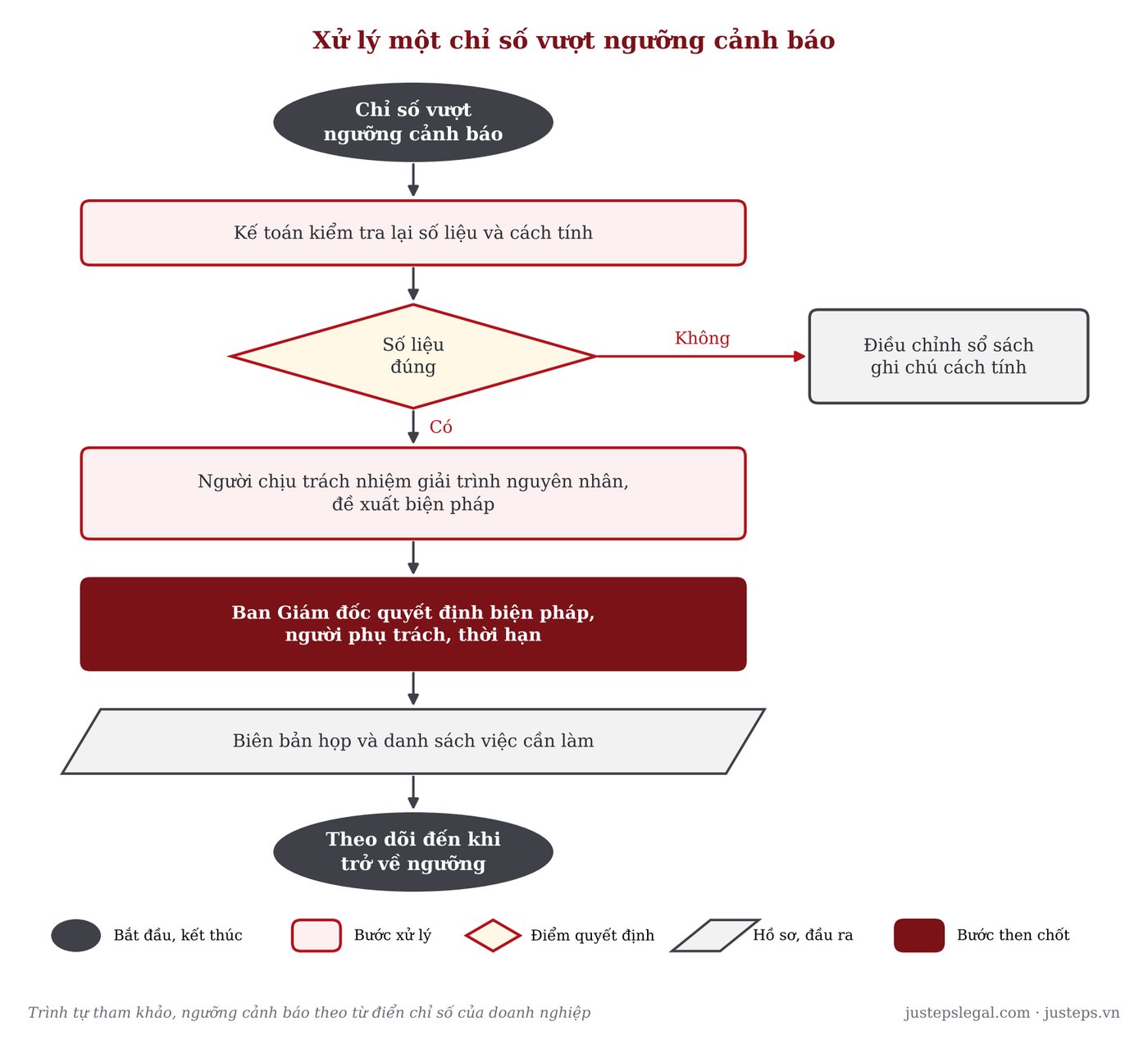
Sequence for handling an indicator that crosses the alert threshold in the monthly management report
When an indicator crosses the threshold, accounting first re-checks the data to rule out errors in recording or calculation. If the data is correct, the person responsible for the indicator must explain the cause and propose measures before the meeting; if the data is wrong, accounting makes the correction and notes it to avoid a recurrence. At the meeting, the Board of Management decides on the measures, assigns an owner and a deadline, and the results are then tracked in the issue list of the following month’s report until the indicator returns within the threshold.
A business should standardise its management reporting when reports are regularly released late, sales and accounting figures do not match, the business opens new branches, prepares to raise capital or borrow from banks, or switches to new accounting software. The roadmap usually takes about three months, comprising one month to survey needs and design the indicator set, one month to build the report template, indicator dictionary and closing calendar, and one month of parallel running before formal adoption. The minimum set of templates comprises the indicator dictionary, the overview page template, the annual budget by month, the 13-week cash flow forecast, the ageing reports for receivables and inventory, the variance explanation template and the closing calendar. The report structure should be reviewed once a year when preparing the new annual budget and linked to the internal financial control system so that input data is controlled right from the source documents.
How Justeps can help
Justeps supports businesses in building and running monthly management reporting through the following services:
- Financial regulations and delegation of authority. Justeps drafts financial regulations containing the indicator dictionary, closing calendar, reporting regime and division of roles between accounting and other departments.
- Internal financial control system. Justeps designs controls over source documents, payments and reconciliations so that the data feeding the management report is reliable.
- Finance, accounting and internal control. Justeps surveys the Board of Management’s information needs and designs an indicator set and report template suited to the size of the business.
- Reading financial statements and management reports for managers. Justeps trains directors and heads of department in reading indicators, explaining variances and making decisions from the monthly report.
Frequently asked questions
Does the law prescribe a mandatory template for management reports?
The law does not prescribe a mandatory template; the business decides for itself the content, form and frequency of its management reports[2]. Even so, the figures should be drawn from the same accounting ledgers as the financial statements to avoid contradictions.
How many indicators should a small business start with?
A small business can start with six indicators, namely revenue, gross profit, cash balance, overdue receivables, personnel costs and one compliance indicator. Once the data has been stable for a few months, the business can gradually add other indicators.
Who is responsible for preparing the monthly management report?
The chief accountant or chief financial officer is usually responsible for compiling the report and ensuring the correctness of the figures. Heads of department are responsible for explaining the indicators within their remit.
Does a business with fewer than 100 staff need specialised software to prepare management reports?
A business of this size can use spreadsheets linked to data exported from its accounting software. What matters is having an indicator dictionary, fixed templates and files stored on a shared system so that reporting does not depend on one person.
Must management reports be retained, and for how long?
Management reports are accounting documents used for management and operations, so they must be retained for at least 5 years[4]. The business should keep both the source data files and the released reports.
Do members of the Board of Directors have the right to see the monthly management report?
Members of the Board of Directors have the right to require managers to provide information and documents on the company’s financial position and business operations[9]. The business should specify the types of report, their frequency and the deadline for sending them in its internal regulations.
How often should the structure of the management report be reviewed?
The business should review it once a year when preparing the new annual budget, and immediately whenever it changes its business model, opens a branch or changes its accounting software.
Related articles
- Building internal financial regulations for a limited liability company, spending norms, approvals, advances and settlement
- Legal liability of directors, board members and chief accountants in a company
- Preparing for an IPO two to three years before listing by standardising governance, accounting and disclosure
- Authority of the General Director, delegation of management powers and limits under the charter and internal regulations
Notes
[1] Article 3 of the Law on Accounting No. 88/2015/QH13 dated 20 November 2015.
[2] Circular No. 53/2006/TT-BTC dated 12 June 2006 of the Ministry of Finance guiding the application of management accounting in enterprises.
[3] Circular No. 99/2025/TT-BTC dated 27 October 2025 of the Ministry of Finance guiding the enterprise accounting regime, effective from 1 January 2026.
[4] Article 41 of the Law on Accounting No. 88/2015/QH13; Article 12 of Government Decree No. 174/2016/ND-CP dated 30 December 2016.
[5] Law on Personal Data Protection No. 91/2025/QH15 and Decree No. 363/2026/ND-CP.
[6] Article 9 of Government Decree No. 320/2025/ND-CP dated 15 December 2025 detailing the Law on Corporate Income Tax No. 67/2025/QH15.
[7] Government Decree No. 254/2026/ND-CP dated 30 June 2026 on e-invoices and electronic documents, effective from 1 July 2026.
[8] Article 12 of the Law on Accounting No. 88/2015/QH13.
[9] Articles 159 and 162 of the Law on Enterprises No. 59/2020/QH14, as amended and supplemented by Law No. 76/2025/QH15.
[10] Articles 170 and 171 of the Law on Enterprises No. 59/2020/QH14, as amended and supplemented by Law No. 76/2025/QH15.
[11] Article 49 of the Law on Enterprises No. 59/2020/QH14, as amended and supplemented by Law No. 76/2025/QH15.
This article is for reference and reflects the regulations in force at the time of publication. Please consult Justeps for advice tailored to your company’s records and situation.
For further information, please contact:
📩 Email: info@justeps.vn
🌐 Website: https://justepslegal.com · https://justeps.vn
🌐 Page: Justeps
☎️ Hotline (Zalo): 096 172 2607
📍 Thanh Xuan Office: 12th Floor, Licogi 13 Tower, 164 Khuat Duy Tien Street, Thanh Xuan Ward, Hanoi, Vietnam
📍 Ha Dong Office: LK06B, No.10, Dong Dua Area, Ha Dong Ward, Hanoi, Vietnam
📍 Ho Chi Minh City Branch: 528 Le Van Sy, Ho Chi Minh City, Vietnam
📍 Hai Phong Office: Truong Thinh Village, Ha Dong Commune, Hai Phong, Vietnam
📍 Quang Ninh Office: Van Don Special Zone, Quang Ninh Province, Vietnam





