
Key takeaways
- A branch has no legal personality, so every obligation arising from the branch’s activities is borne by the company with all of its assets.
- A subsidiary is an independent legal entity liable only to the extent of its own assets, but this boundary loses its effect if the parent company intervenes beyond its authority and causes loss to the subsidiary.
- A new business line that needs a partner to contribute capital, carries a substantially different risk or may be sold in the future is usually better suited to a subsidiary than to a branch.
- Losses of a branch are offset within the company’s overall results, whereas losses of a subsidiary cannot be offset against the parent company’s profits for corporate income tax purposes.
- Transactions between a parent company and its subsidiary must be conducted at arm’s length, approved by the competent body and supported by pricing documentation under the rules on related-party transactions.
When a business that is operating steadily wishes to add a new business line, for example an equipment distributor adding maintenance services or a trading company opening a factory in another province, the first question management usually asks is whether to register a branch or to establish a new company. Many businesses choose a branch because the procedure is quick, only to find a few years later that they must spin it off into a separate company when a partner wants to invest or when the new line becomes embroiled in a major dispute. Converting late brings the costs of transferring assets, re-signing contracts with customers and terminating and re-concluding employment contracts, so the initial decision deserves careful consideration.
This article analyses the differences between a branch and a subsidiary in terms of legal status, liability for assets, capital and ownership, tax and accounting, labour and intra-group transactions, and then proposes a decision-making process and describes common mistakes in implementation. It applies to limited liability companies and joint stock companies established under the Law on Enterprises 2020 as amended in 2025, and is written mainly for owners, Boards of Directors, Members’ Councils, directors and the finance and legal teams of businesses.
Branches and subsidiaries differ in legal status and liability for assets
A branch is a dependent unit of the company
Under the Law on Enterprises, a branch is a dependent unit of an enterprise that performs all or part of the enterprise’s functions, including the function of authorised representation, and the branch’s lines of business must match those of the enterprise[1]. The Civil Code also provides that a branch is not a legal entity, and that the legal entity holds the civil rights and obligations arising from transactions established and performed by the branch[2]. Accordingly, when a branch signs a contract with a customer, borrows money or causes damage, the party liable to third parties is the company, and creditors may claim payment from all of the company’s assets, including assets unrelated to the branch’s activities.
The head of a branch has authority only within the scope that the company delegates, so the letter of authorisation is the most important governance tool in this model. The letter of authorisation should state clearly the types of contract that may be signed, the value limits, the authority to recruit and sign employment contracts, the authority to open and operate bank accounts and the matters that must be referred to the company. Where the head of a branch signs beyond the scope of authorisation, the transaction may still bind the company if the company knew and did not object or if the company was at fault in leaving the other party unaware of the limit, so the company should notify its partners and banks of the scope of authorisation.
A subsidiary is an independent legal entity
A company is regarded as the parent company of another company when it owns more than 50% of the charter capital or of the total ordinary shares, has the right to appoint a majority or all of the members of the Board of Directors, the Director or the General Director, or has the right to decide on amendments to that company’s charter[3]. A subsidiary has its own assets, charter, management bodies and legal representative, and is liable for its obligations only to the extent of its own assets. The parent company, as a member or shareholder, bears risk only to the extent of the capital it has contributed, so this model creates a risk barrier between the new business line and the existing business.
However, this barrier is effective only when the parent company respects the independence of its subsidiary. The Law on Enterprises provides that where a parent company intervenes beyond the authority of an owner, member or shareholder and compels the subsidiary to carry out activities contrary to normal business practice or unprofitable activities without reasonable compensation, causing loss to the subsidiary, the parent company is liable for that loss[4]. In practice, a parent company director instructing the subsidiary’s accountant directly to transfer money, or forcing the subsidiary to sell goods to the parent below cost, are signs that the boundary between the legal entities is being disregarded.
When opening a branch is a sensible choice
A branch is suitable when the new business line is in substance an extension of the geographical reach or the capacity of an existing line, sharing the same brand, customers, management systems and professional staff. Typical examples are a Hanoi service company opening a branch in Ho Chi Minh City to serve customers in the South, or a manufacturer opening a branch as a sales point in a province with many major customers. In such cases, the branch’s risks largely coincide with those of the company, so separating the legal entity brings little benefit and only increases governance costs.
As to procedure, the enterprise submits the application for registration of the branch’s operation to the business registration authority where the branch is located within 10 days of the decision to establish it, and that authority issues the certificate of registration of the branch’s operation within 03 working days of receiving a complete and valid application[5]. A branch needs no charter, charter capital or management bodies of its own, so it can begin operating within a few weeks if premises and staff are already in place. The procedure, application documents and registration of changes to the branch’s operating details are set out in detail in the decree on enterprise registration[6].
An often overlooked advantage of a branch is the flexibility it offers on exit. If the new business line does not meet expectations, the company need only decide to terminate the branch’s operation, settle the related tax and labour obligations and notify the business registration authority, without going through the dissolution of a legal entity with its requirement to pay off all debts. In addition, sub-licences issued to the company can usually be used by the branch within the permitted scope, provided the licence is not tied to a specific location. Businesses wishing to implement this model may consider Justeps’ service on setting up branches, representative offices and business locations.
When a new company should be established
A new company, usually in the form of a subsidiary, is more suitable when the new business line has at least one of the following three characteristics. First, there is a strategic partner, investor or key employee who wishes to own part of the capital of the new line alone, without participating in the whole of the existing company. Second, the legal or financial risk of the new line is markedly different, for example construction, transport, food or financial services, which may give rise to large compensation claims. Third, the business anticipates the possibility of selling, raising capital separately for or spinning off this line within the next few years.
In the first case, a branch has no charter capital of its own, so ownership cannot be shared with a partner within the branch alone. Any mechanism for sharing a branch’s profits with outsiders can only be implemented through a business cooperation contract or a bonus policy, neither of which creates ownership rights and both of which are difficult to protect in a dispute. With a subsidiary, the partner contributes capital directly and has voting rights, the right to receive profits and the right to transfer its capital under the charter and the agreement between members or shareholders.
In the third case, transferring the capital or shares of a subsidiary is much simpler than transferring a branch. When selling a branch, the business must transfer each asset, each contract with customers and suppliers and each licence, and reach agreement with each employee, whereas selling a subsidiary changes only the owner, while the legal entity, its contracts and its employees remain unchanged. A buyer will also find it easier to conduct due diligence on a subsidiary with its own financial statements than on a division whose figures are mixed into the parent company’s books.
In addition, a subsidiary must comply with certain specific restrictions. A subsidiary may not contribute capital to or buy shares in its parent company, and subsidiaries of the same parent company may not jointly contribute capital or buy shares so as to cross-own one another[7]. Where the parent company is a foreign-invested enterprise, establishing a subsidiary may require investment procedures as for a foreign investor if it falls within the cases specified in the Law on Investment 2025[8], so this step must be added to the preparation time.
Comparing tax, accounting and labour
The difference between the two models is most evident in tax obligations, the organisation of accounting and employment relations. The table below summarises the points a business should consider before choosing a model:
| Item | Branch | Subsidiary |
|---|---|---|
| Tax code and filing | Is issued a tax code as a dependent unit and may file certain taxes in the locality where the branch is located. | Has its own tax code and files and finalises all taxes itself as an independent enterprise. |
| Profits and losses | The branch’s results are added to the overall results, and its losses are offset against the profits of other lines. | The subsidiary’s losses may only be carried forward to its own later years and are not offset against the parent’s profits. |
| Financial statements | Figures are consolidated into the company’s financial statements, with no separate statements filed with state authorities. | Prepares its own financial statements, and the parent company must also prepare consolidated financial statements. |
| Employer | The company is the employer, and the head of the branch signs contracts under a letter of authorisation. | The subsidiary is an independent employer with its own insurance records, internal labour regulations and wage scale. |
| Profits to the owner | Profits already form part of the company’s results, so no distribution procedure arises. | Profits reach the parent through profit distributions or dividends after the subsidiary has met its tax obligations. |
The point most often overlooked is loss offsetting. A new business line usually makes losses in its first one to three years, and if it is organised as a branch, these losses reduce the taxable income of the whole company in the year they arise. Conversely, if it is organised as a subsidiary, the losses can only be carried forward against the subsidiary’s own income within the period permitted by law, while the parent company still pays tax in full on its own profits under the Law on Corporate Income Tax 2025[9]. Accordingly, for a line with a long investment phase, the difference in tax cash flow between the two models may be significant and should be estimated in concrete figures.
On labour, a branch and the company share the same employer, so moving staff between the head office and the branch is more flexible, but the minimum wage must be applied according to the area where the employee actually works. From 1 January 2027, the monthly minimum wage is VND 5,700,000 in Region I, VND 5,080,000 in Region II, VND 4,450,000 in Region III and VND 4,040,000 in Region IV[10], so a branch located in a different wage region from the head office needs its own wage scale. Where the company has registered its internal labour regulations and has a branch in another province, it must send the registered regulations to the provincial labour authority where the branch is located[11].
With a subsidiary, employees cannot be moved from the parent company by a transfer decision, because these are two different employers. The parties must agree to terminate the employment contract with the parent company and conclude a new contract with the subsidiary, while also settling how working time is counted for severance allowance, the remaining days of annual leave and the transfer of social insurance records. The subsidiary is also responsible for its own obligations to declare its use of labour, register for insurance and issue internal labour regulations once the conditions are met.
Transactions between a parent company and its subsidiary and the constraints to anticipate
A new business line rarely operates entirely separately from its parent company. The parent company often leases offices to the subsidiary, lends it working capital, sells it goods, provides accounting and HR services or permits it to use trade marks. With a branch, these flows are merely internal transfers within the same legal entity, requiring no contract and generating no revenue. With a subsidiary, each flow is a transaction between two legal entities and must satisfy three layers of requirements, namely independence, approval authority and transaction pricing.
The first layer is the principle of independence. Contracts, transactions and other relations between a parent company and its subsidiary must be established and performed independently and on an equal footing, under the conditions applicable to independent legal persons[12]. This means that each transaction needs a contract, an invoice, payment documents and an acceptance record, just as when dealing with an external customer.
The second layer is approval authority. The Law on Enterprises requires certain contracts and transactions between a company and its related persons, including its parent company, to be approved by the Members’ Council, the owner, the Board of Directors or the General Meeting of Shareholders, depending on the type of company and the value of the transaction[13]. A contract not approved by the competent body may be declared invalid, and the representative who signed it must compensate for the resulting loss. The subsidiary should issue a framework resolution covering recurring transactions with the parent company during the year, with value limits, rather than seeking approval for each transaction.
The third layer is the tax administration of related-party transactions. Decree No. 255/2026/ND-CP, effective from 1 July 2026 and replacing Decree No. 132/2020/ND-CP, sets out the principle that prices between related parties must be consistent with market prices, together with obligations to declare and to prepare transfer pricing documentation[14]. Where prices are not consistent, the tax authority may reassess taxable income, and service fees charged by the parent company without evidence of actual benefit may be disallowed as deductible expenses. These constraints are a real compliance cost of the subsidiary model and should be built into the plan from the outset, for example through Justeps’ service on corporate restructuring and tax optimisation.
The decision-making process and preparation of documents
To avoid a decision based on instinct or on the speed of the procedure alone, a business should go through a short process comprising a description of the new business line, a legal review, scoring against criteria and preparation of documents. The following flowchart shows this sequence and the main decision points.
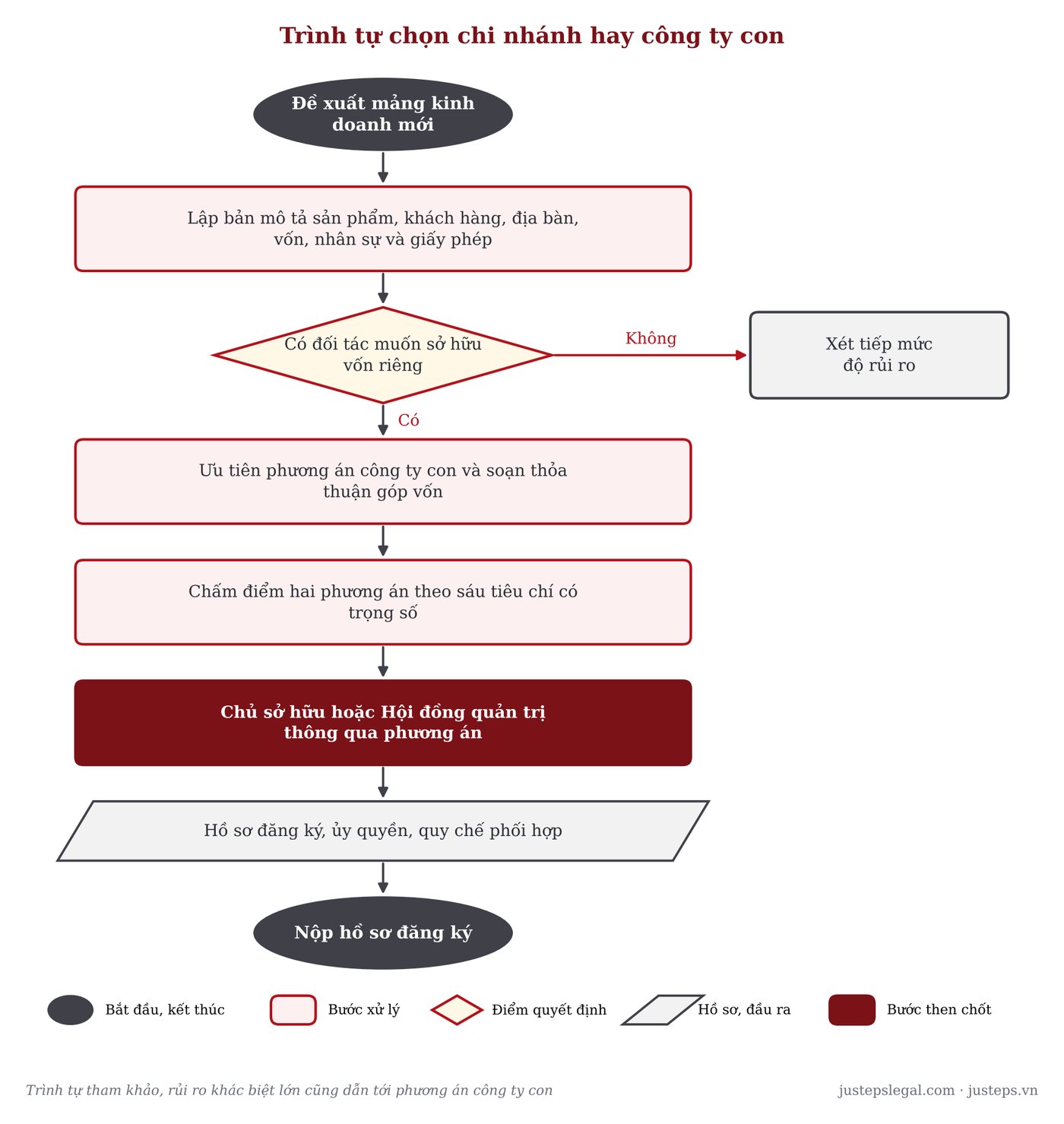
Sequence for choosing between a branch and a subsidiary for a new business line
The first step is to describe the new business line in a short memorandum covering products, customers, location, capital needs, staffing and the licences required. Two screening questions are then asked in turn, namely whether a partner wishes to own capital in the new line alone, and whether the risk of the new line differs substantially from that of current operations. If either answer is yes, the subsidiary option is almost the default choice, while if both are no, the business moves on to detailed scoring. The decisive step is submitting the option to the owner or the Board of Directors for adoption by resolution, because the decision to establish a subsidiary or a branch falls within the authority of that level under the charter.
At the scoring step, the business assesses each model against criteria such as speed of implementation, annual governance costs, risk isolation, ability to raise capital, tax efficiency during the loss-making phase and the ability to exit or sell. Each criterion is scored from 1 to 3 and may be multiplied by a weighting reflecting the owner’s priorities. The following chart illustrates the scoring result for a trading company planning to open a factory in another province.
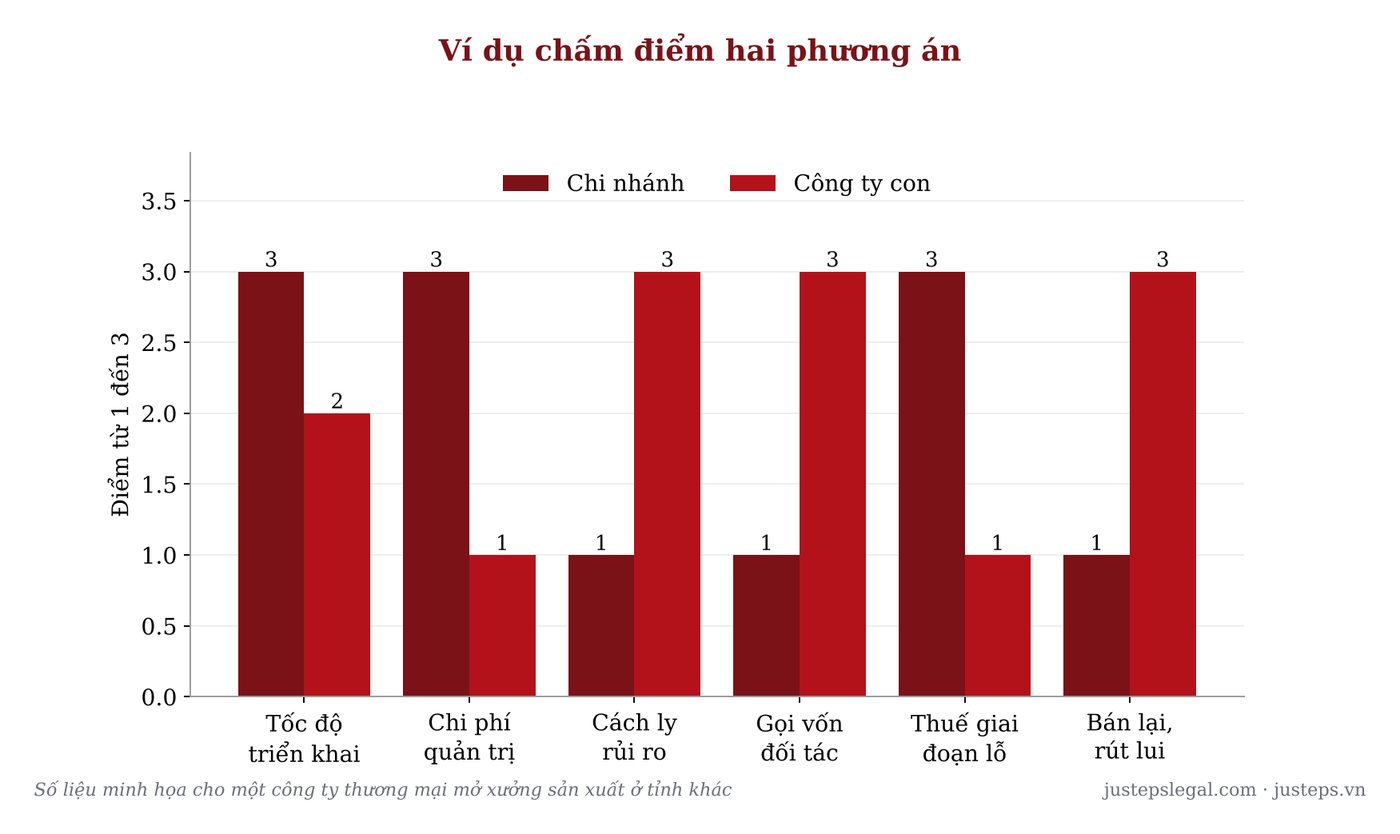
Example of scoring a branch and a subsidiary against six criteria
In this example, the branch has a clear advantage in speed, governance costs and tax efficiency while the factory is still making losses in its early stage. The subsidiary is superior in isolating production risk, attracting partners to invest and the ability to sell the factory in the future. If the owner gives a high weighting to risk isolation and fundraising, the result tips towards the subsidiary, even though the raw total scores of the two options are almost equal. Presenting the choice in this way helps members of management see clearly what they are trading off, instead of debating the merits of each model in general terms.
Once the model has been chosen, the internal documents to be prepared differ considerably. For a branch, the company needs a decision on establishment, a decision appointing the head of the branch, a letter of authorisation stating the scope and limits, rules on the management of the seal and bank accounts, and a choice between dependent and independent accounting. For a subsidiary, in addition to the enterprise registration documents, the parties need a charter, a capital contribution agreement or shareholders’ agreement if there is a partner, a resolution appointing the representative of the parent company’s capital, coordination rules between the parent company and the subsidiary, and framework contracts for intra-group transactions. The expected time for each group of tasks is shown in the timeline below.
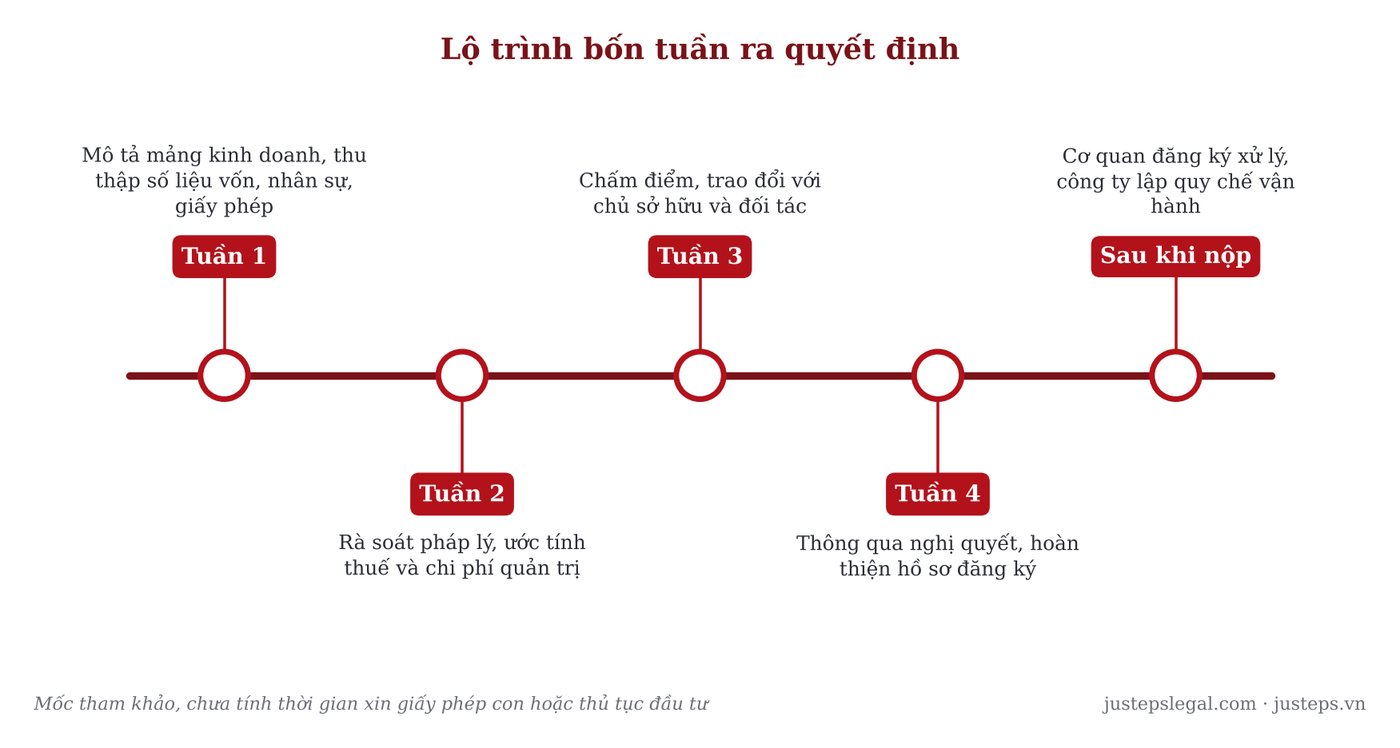
Four-week roadmap from describing the new business line to filing the application
The four-week roadmap is a reference for a business that already has premises and key staff and does not need to apply for new sub-licences. The first week is for describing the business line and collecting data, the second for the legal and tax review and cost estimates, and the third for scoring and discussions with the owner and partners. The fourth week is when the resolution is adopted and the registration application is finalised, after which the processing time of the state authority is counted separately. For a conditional business line or one involving foreign investment, the roadmap must allow additional time for licences and investment procedures.
Common mistakes and how to convert when the model no longer fits
The most common mistake is choosing a branch solely because the procedure is quick, after which the new business line grows, a partner demands to invest and the business is forced to spin it off. The law provides no procedure for converting a branch directly into a subsidiary, so the business must establish a new company, transfer assets, assign contracts with the consent of the counterparties, agree with employees on signing new contracts, apply again for licences and then terminate the branch’s operation. This process usually takes several months and gives rise to tax obligations on the value of the assets transferred, so it should be planned as a separate project.
The second mistake is running a subsidiary as if it were a department of the parent company. Typical signs include sharing bank accounts, the parent company’s accountant approving the subsidiary’s payments directly, transferring money back and forth without a loan agreement, or the parent company charging a management fee at a fixed percentage of revenue without any specific service. These practices both weaken the liability barrier and create a risk that the tax authority will adjust related-party prices and disallow expenses.
The third mistake lies in managing a branch remotely. Companies often forget to register changes when the head or the address of the branch changes, apply the head office wage scale to employees working in a different wage region, or fail to send the internal labour regulations to the labour authority where the branch is located. The preventive measure is to include the branch’s obligations in the company’s general compliance calendar, with one person at head office responsible for monitoring and the head of the branch reporting periodically.
Conversely, when a subsidiary is performing poorly or no longer needs a separate legal entity, the business may consider merging the subsidiary into the parent company, after which the parent establishes a branch in the former location if operations still need to continue. This option reduces governance costs but makes the parent company inherit all of the subsidiary’s rights and obligations, so outstanding debts, disputes and tax obligations should be thoroughly examined before it is carried out. Whichever direction is chosen, the decision on the organisational model should be reviewed whenever the business line changes significantly in scale, partners or risk.
How Justeps can help
Justeps helps businesses choose and implement the right model for a new business line through the following services:
- Setting up branches, representative offices and business locations. Justeps prepares the branch registration application and drafts the decision on establishment, the letter of authorisation and the branch management rules.
- Company formation and corporate foundations. Justeps drafts the charter, the capital contribution agreement and the documents for establishing a subsidiary, including where a partner co-invests.
- Corporate restructuring and tax optimisation. Justeps estimates the tax impact of each option and designs the mechanism for intra-group transactions between the parent company and the subsidiary.
- Corporate governance. Justeps drafts coordination rules, resolutions approving related-party transactions and rules for capital representatives.
- Labour, payroll and insurance. Justeps builds region-specific wage scales for branches and lawful plans for moving employees to a subsidiary.
Frequently asked questions
Can a branch sign contracts with customers?
A branch may sign contracts through its head, within the scope of the company’s authorisation. The rights and obligations under such contracts belong to the company, because a branch is not a legal entity[2].
Can a branch be converted into a subsidiary?
The law provides no direct conversion procedure. The business must establish a new company, transfer the assets, contracts and employees to it and then terminate the branch’s operation.
May a subsidiary invest capital back into its parent company?
No. A subsidiary may not contribute capital to or buy shares in its parent company, and subsidiaries of the same parent company may not cross-own one another[7].
Can a branch’s losses be deducted from the company’s profits?
Yes, because a branch’s accounts are included in the company’s overall business results. A subsidiary’s losses, by contrast, may only be carried forward to the subsidiary’s own later years and are not offset against the parent company’s profits[9].
Which minimum wage applies to a branch in another province?
The minimum wage applies according to the area where the employee actually works, not the area of the company’s head office[10]. The company should prepare a separate wage scale for the branch if the branch is in a different wage region.
Does a loan from a parent company to its subsidiary require any formalities?
The loan should have a contract and an interest rate consistent with the market, and be approved under the rules on transactions with related persons[13]. Interest between the two parties is also subject to the rules on related-party transactions[14].
How long does branch registration take?
The business registration authority issues the certificate of registration of the branch’s operation within 03 working days of receiving a complete and valid application[5]. Internal preparation, such as the decisions on establishment and appointment and the letter of authorisation, usually takes longer than processing the application.
Related articles
- Managing branches and representative offices remotely through delegation of authority, reporting and controls
- What to do in the first 90 days after setting up a business so that no obligation or deadline is missed
- Corporate restructuring with lawful tax optimisation and the risks to anticipate
- Merging two subsidiaries within a group and the sequence for handling staff, contracts and tax
Notes
[1] Clause 1 of Article 44 of the Law on Enterprises No. 59/2020/QH14 dated 17 June 2020, as amended and supplemented by Law No. 76/2025/QH15.
[2] Clauses 1 and 6 of Article 84 of the Civil Code No. 91/2015/QH13 dated 24 November 2015.
[3] Clause 1 of Article 195 of the Law on Enterprises No. 59/2020/QH14.
[4] Clause 3 of Article 196 of the Law on Enterprises No. 59/2020/QH14.
[5] Article 45 of the Law on Enterprises No. 59/2020/QH14.
[6] Government Decree No. 168/2025/ND-CP dated 30 June 2025 on enterprise registration, as amended and supplemented by Decree No. 296/2026/ND-CP.
[7] Clause 2 of Article 195 of the Law on Enterprises No. 59/2020/QH14.
[8] The Law on Investment No. 143/2025/QH15, effective from 1 March 2026.
[9] The Law on Corporate Income Tax No. 67/2025/QH15 and its guiding documents on loss carry-forward.
[10] Government Decree No. 399/2026/ND-CP on the minimum wage for employees working under employment contracts, applicable from 1 January 2027.
[11] Clause 4 of Article 119 of the Labour Code No. 45/2019/QH14 dated 20 November 2019.
[12] Clause 2 of Article 196 of the Law on Enterprises No. 59/2020/QH14.
[13] Articles 67, 86 and 167 of the Law on Enterprises No. 59/2020/QH14, as amended and supplemented by Law No. 76/2025/QH15.
[14] Government Decree No. 255/2026/ND-CP on tax administration for enterprises with related-party transactions, effective from 1 July 2026.
This article is for reference and reflects the regulations in force at the time of publication. Please consult Justeps for advice tailored to your company’s records and situation.
For further information, please contact:
📩 Email: info@justeps.vn
🌐 Website: https://justepslegal.com · https://justeps.vn
🌐 Page: Justeps
☎️ Hotline (Zalo): 096 172 2607
📍 Thanh Xuan Office: 12th Floor, Licogi 13 Tower, 164 Khuat Duy Tien Street, Thanh Xuan Ward, Hanoi, Vietnam
📍 Ha Dong Office: LK06B, No.10, Dong Dua Area, Ha Dong Ward, Hanoi, Vietnam
📍 Ho Chi Minh City Branch: 528 Le Van Sy, Ho Chi Minh City, Vietnam
📍 Hai Phong Office: Truong Thinh Village, Ha Dong Commune, Hai Phong, Vietnam
📍 Quang Ninh Office: Van Don Special Zone, Quang Ninh Province, Vietnam





