
Key takeaways
- An outsourced legal function works best where the volume of legal work does not yet justify a full-time employee but arises steadily every month, typically in companies with between a few dozen and around 200 staff.
- Outsourcing does not transfer legal responsibility; the legal representative and the managers remain accountable for the company’s decisions and transactions.
- The service contract should clearly define the work included in the package, response times, confidentiality obligations, the processing of personal data, limitation of liability and the duty to hand over files on termination.
- Performance should be measured each quarter using a small set of indicators, namely response time, missed compliance deadlines, the proportion of contracts using standard templates and the average cost per request.
Many small and medium-sized enterprises deal with legal matters as and when they arise. Contracts are signed on the counterparty’s template, changes to the enterprise registration are handled by an accountant on top of other duties, and internal rules are usually drafted only when a regulator or an investor asks for them. As the company grows, this approach leaves gaps that are hard to see until a contract dispute, a labour inspection or a fundraising round exposes several errors at once. Hiring a full-time in-house legal officer is costly and may not provide enough work, so an outsourced legal function becomes an option that many boards of management consider.
This article analyses the outsourced legal function from a corporate governance perspective, covering when to use it, which work to delegate and which to keep, how the service contract should be drafted, how day-to-day coordination should be organised and how performance should be measured. It is written mainly for business owners, Directors or General Directors, chief accountants and heads of administration and HR at limited liability companies and non-public joint stock companies, including foreign-invested enterprises operating in Vietnam.
What an outsourced legal function is and how it differs from ad hoc advice
An outsourced legal function is an arrangement under which a company engages an external consulting firm to carry out, on a regular basis, the work of a legal department according to a predetermined list of tasks and fees (Outsourced Legal Function). In legal terms, the relationship is a service contract, under which the service provider performs work for the client and the client pays the service fee[1]. The provider is not an employee of the company, is not subject to its internal labour rules and has no authority to make decisions on behalf of the management.
The difference from ad hoc advice lies in continuity. When a company engages an adviser on a matter-by-matter basis, it makes contact only when there is a major contract or an incident, and the adviser has to learn about the company from scratch each time. With an outsourced legal function, the same team of specialists follows the company over many months and becomes familiar with its charter, ownership structure, ongoing contracts and calendar of recurring obligations, so it can flag issues before a risk materialises instead of dealing with them only after the damage has been done.
Current law requires only certain entities, mainly state-owned enterprises, to set up a legal department under the specific regulations on legal affairs units[2]. Private companies and foreign-invested enterprises are free to decide whether to establish a legal department and how large it should be. Accordingly, the choice between an in-house legal team, an outsourced legal function or a combination of the two is a management decision that should be based on the volume of work, the level of specialisation required and cost.
When a company should use an outsourced legal function
Signs that a company needs a regular point of contact for legal matters
A company should consider a regular point of contact for legal matters when it signs five to ten significant contracts each month, employs several dozen workers or more, or has members or shareholders who are not involved in day-to-day management. At this size, recurring obligations such as registering changes to the enterprise registration details, updating internal labour rules and adjusting social insurance contributions when regional minimum wages change begin to overlap. Another sign is when the management notices the same type of error recurring, for example contracts lacking a penalty clause or meeting minutes that do not meet the conditions for passing resolutions, without anyone in the company being assigned to monitor them.
An outsourced legal function is particularly suitable at three stages. The first is after incorporation, when the company needs to build its operating records but does not yet have enough work for a dedicated employee. The second is before raising capital or selling part of the business, when records need to be standardised within a short time. The third is when the in-house legal officer leaves and the company needs someone to take over immediately while a replacement is recruited.
When a company should have an in-house legal team
Conversely, a company should have at least one in-house legal officer when the workload justifies a full-time position, when the work is closely tied to daily operations such as negotiating directly with customers at stores or construction sites, or when a conditional business line requires someone to monitor licences continuously. In these cases, an external provider will struggle to be present quickly enough and to engage deeply enough, while hourly outsourcing costs may exceed the cost of an in-house position. Where the workload is large but not closely tied to daily operations, a combined model is usually better balanced, with in-house staff acting as the point of contact and handling routine matters, while the outsourced provider takes on specialised and high-value work and acts as an independent reviewer.
The process of choosing a model can be pictured as two successive questions about the volume of work and the nature of the work, as shown in the flowchart below.
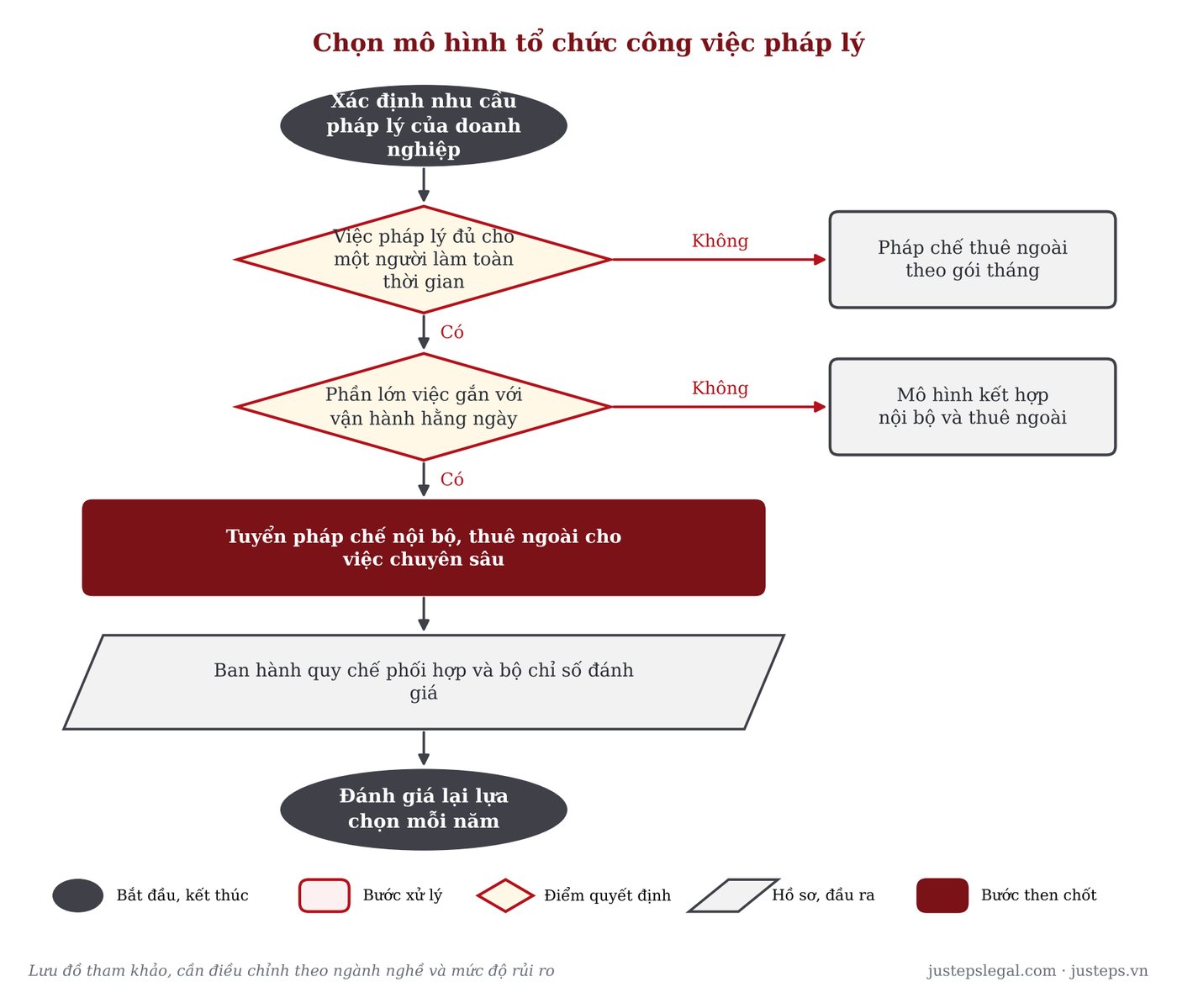
Two questions that help a company choose between an outsourced legal function, an in-house legal team and a combined model
The first question is whether the volume of legal work is enough for one full-time person. If not, the most economical and stable option is to outsource on a monthly package. If it is, the second question is whether most of the work is tied to daily operations. If so, the company should hire in-house legal staff and outsource only specialised work; if not, a combined model usually strikes a better balance between cost and quality. Whichever model is chosen, the company needs coordination rules and a set of performance indicators, and should revisit its choice every year because its size and the nature of its work change over time.
Each model has its own strengths and limitations, so the company should compare them against the same set of criteria rather than simply comparing fees. The table below compares the two models against the criteria that management usually weighs:
| Criterion | In-house legal team | Outsourced legal function |
|---|---|---|
| Cost | Fixed costs including salary, compulsory insurance, training and research tools, incurred even when there is little work. | A monthly package fee plus fees for work outside the package, adjustable to the actual volume of work. |
| Knowledge of the company | Knows the people, processes and transaction history well and can respond within the day. | Needs an initial familiarisation period and depends on the information the company provides. |
| Expertise | Usually strong in a few familiar areas and finds it hard to keep up with every change in the law. | Has a team of specialists in several areas such as labour, tax, contracts and corporate governance. |
| Continuity | Disrupted when staff leave, and files are easily lost without a handover procedure. | More stable when personnel change, but depends on the term and provisions of the service contract. |
| Independence | More exposed to pressure from a line manager when raising risks in a transaction. | Gives a more independent opinion and is well suited to acting as a second reviewer. |
On cost, a fair comparison must include all the hidden costs of the in-house model, namely the thirteenth-month salary, the employer’s share of compulsory insurance, training costs, legal research software and the cost of outsourcing specialised work that in-house staff cannot yet handle. The following chart illustrates the annual cost structure of the three models for a company with around 100 staff.
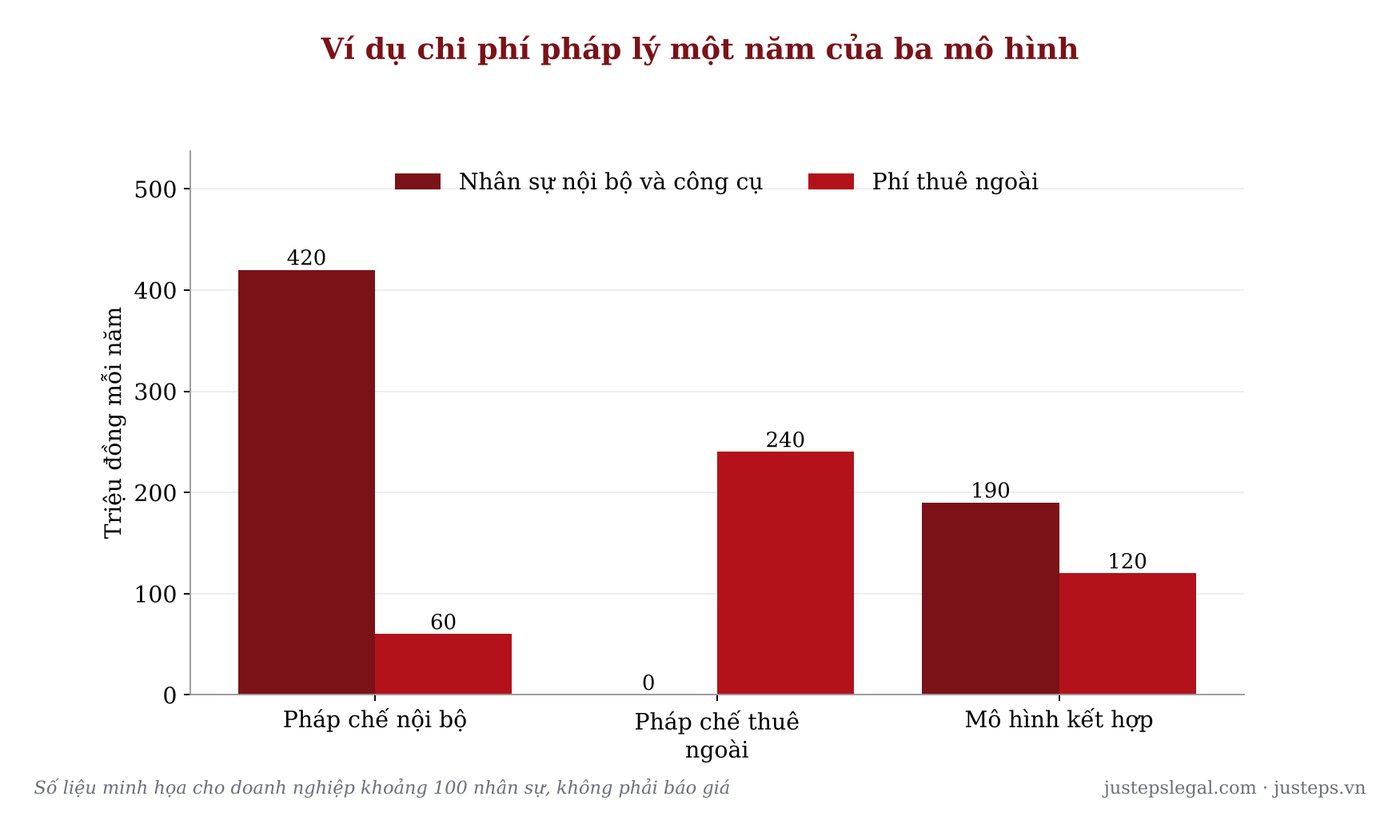
Example of the annual legal costs of three models at a company with around 100 staff
In the example, the in-house model is the most expensive because the fixed cost of one legal officer already stands at around VND 420 million a year, while the company still has to spend a further VND 60 million or so on outsourcing specialised matters. The outsourced model has the lowest total cost but relies entirely on an external provider, while the combined model uses a legal administrative officer as the point of contact and halves the outsourcing fees. The figures are for illustration only; companies should make their own calculations based on local market salaries and actual quotations before deciding.
Which work to delegate and which work the company must keep
Work suitable for an outsourced legal function
The most suitable work is repetitive, has clear quality standards and requires up-to-date knowledge of the law. The tasks commonly included in an outsourced legal package are as follows:
- Reviewing sale, service, lease and agency contracts before signing and building a set of standard templates for recurring transactions.
- Drafting minutes, resolutions and decisions of the Members’ Council, the Board of Directors and the General Meeting of Shareholders and checking that the conditions for passing them are met.
- Monitoring the calendar of recurring obligations and preparing filings for changes to the enterprise registration details and periodic reports required by law.
- Reviewing employment contracts, internal labour rules, pay and bonus policies and disciplinary files.
- Tracking new legislation that affects the company and proposing the adjustments required.
- Answering routine legal queries from departments within the agreed response times.
For procedures that must be filed with state authorities, the outsourced provider may act on behalf of the company only under a valid written authorisation that clearly defines its scope and duration[3]. The company should grant authorisations procedure by procedure rather than a general authorisation, so that it can keep track of what has been filed and when. Registration of changes to the enterprise registration details must be made within 10 days of the change[4], which makes this the type of work most likely to be overdue if nobody monitors the calendar.
Work the company cannot delegate
Outsourcing transfers the work but not the responsibility. The legal representative must still exercise the rights and perform the duties assigned honestly, prudently and in the lawful interests of the company, and is personally liable for any loss caused by breach of these duties[5]. Accordingly, the decision whether to sign a contract or accept a risk or a penalty always rests with the company’s authorised person; the opinion of the outsourced legal function is a basis for that decision and does not replace it.
The company must also keep control of its seal, digital signatures, original contracts and legal records itself, because the law places the obligation to retain documents on the company[6]. The outsourced provider can maintain a register and send reminders of deadlines, but the originals must remain in the company’s own archive. Related-party transactions, such as contracts between the company and a member, a major shareholder or a manager, must be approved by the competent corporate body under a specific procedure[7]; the outsourced legal function is responsible for identifying and flagging them, while approval remains a matter for the Members’ Council, the Board of Directors or the General Meeting of Shareholders.
In disputes, Justeps and similar consulting firms only assess the matter, review evidence, draft notices of breach, advise on negotiation and mediation options and prepare the case file. Proceedings before a court or arbitral tribunal are brought by the company itself or by a licensed practitioner of the company’s choosing, so the outsourced legal function contract should state clearly that this work falls outside its scope and how files will be handed over when needed.
What the outsourced legal function contract should provide
The contract is the only tool the company has to control service quality, so it should be drafted as carefully as any other important service contract. Under the Civil Code, the service provider must perform the work to the agreed quality, quantity and timeline, may not delegate it to another person without the client’s consent, and must keep confidential the information it learns while performing the work where so agreed or required by law[1]. Because the duty of confidentiality arises only by agreement or by law, the company should not leave this clause in general terms.
Scope of services and response times
The scope of services should be set out as a list of tasks with limits, for example the number of contracts reviewed each month, the number of advisory hours and the number of meetings attended in person. Each type of request should have its own response time, such as the same working day for urgent matters, three working days for a standard contract review and ten days for drafting internal rules. Work beyond the limits or outside the list should be quoted in writing in advance, to avoid disputes over fees at the end of the period.
Confidentiality, personal data and conflicts of interest
To do its job, the outsourced legal function usually has access to employment contracts, payroll, shareholder lists and customer information, which means both trade secrets and personal data. Information is protected as a trade secret only if the owner has applied the necessary measures to keep it confidential[8], so a confidentiality undertaking from the outsourced provider also serves as evidence that the company has applied such measures. With regard to the personal data of employees and customers, the outsourced provider acts as a data processor, so the contract must specify the purpose and scope of processing, the protective measures, the deletion or return of data on termination and the obligation to give notice of any incident[9].
The contract should also require the outsourced provider to give immediate notice of any conflict of interest, for example when a counterparty or a direct competitor of the company asks it to advise on the same transaction. In that case, the parties should agree in advance how the conflict will be handled, such as declining the new engagement or separating the teams of specialists, rather than waiting until the conflict has arisen.
Liability, penalties, termination and handover of files
The parties are free to agree on contractual penalties and damages, but in a commercial contract the total penalty for multiple breaches may not exceed 8% of the value of the part of the obligation that was breached[10]. Consulting firms usually propose capping their liability at the total fees received over a given period; the company may accept such a cap but should carve out breaches of confidentiality and wilful misconduct. The client may unilaterally terminate the contract if continuing it is no longer in its interest, but must give reasonable notice and pay for the work already performed[1].
The clause most often overlooked is handover on termination. The contract should require the outsourced provider to hand over all files, drafts, request logs and the calendar of open obligations within a specific period, together with a handover record, so that the successor provider or in-house staff can take over without interruption. Companies may refer to the way Justeps organises its task list, response times and handover arrangements in its outsourced corporate legal services.
Organising coordination between the company and the outsourced legal function
Most cases in which an outsourced legal function fails to deliver can be traced back to the company itself, where requests are sent piecemeal through several channels, documents are missing and nobody follows up on the outcome. The company should appoint an internal point of contact, usually the Director’s assistant, the head of administration or the chief accountant, to receive, classify and forward requests. This person also keeps the request log, sends reminders of deadlines and compiles the data for periodic reviews.
The intake procedure for a legal request should pass through three parties in the fixed sequence shown below, so that every request has an owner, a deadline and a recorded outcome.
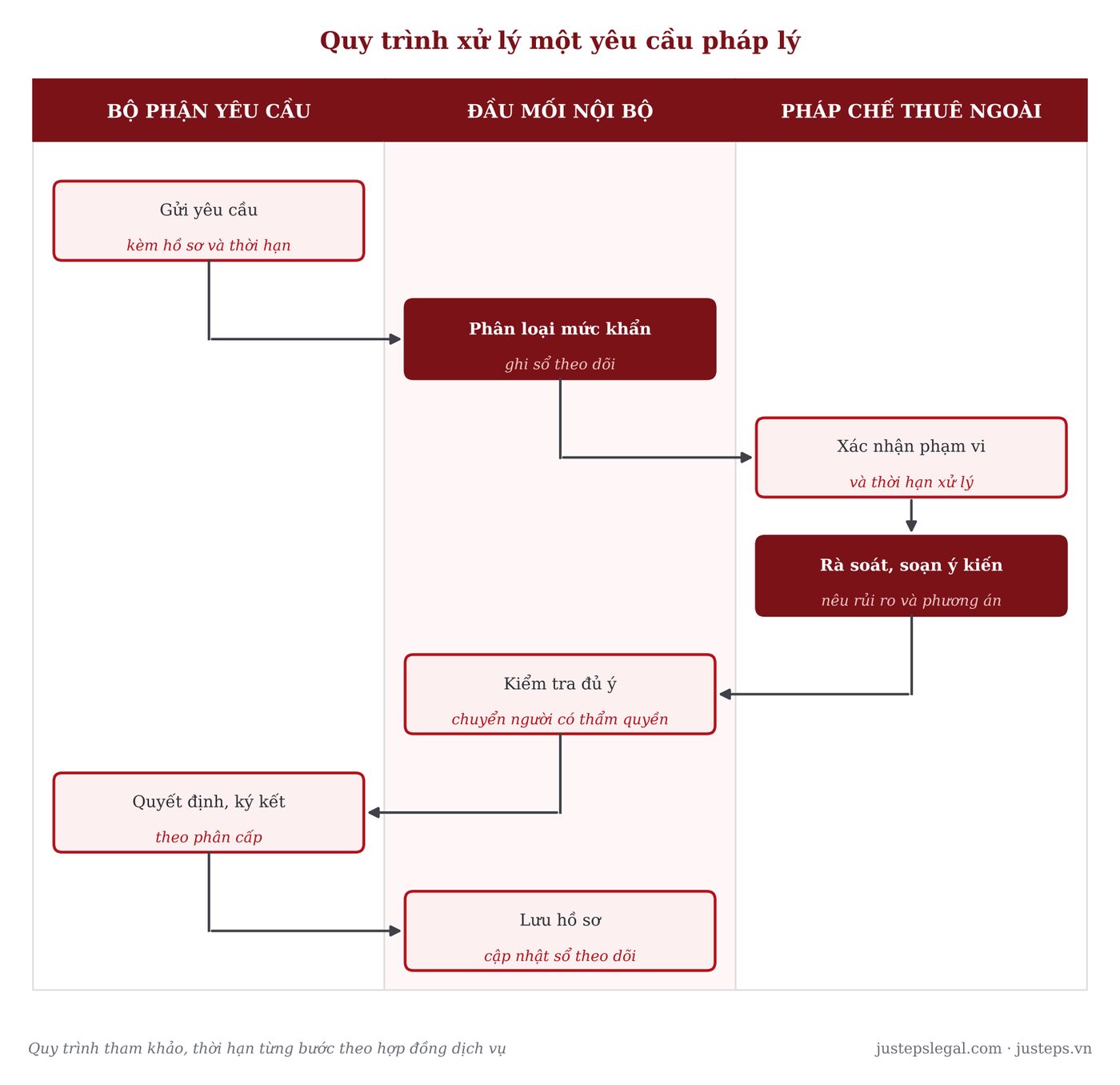
Procedure for receiving and handling a legal request between the requesting department, the internal point of contact and the outsourced legal function
The department with the need, for example the sales department wanting to sign a contract with a new customer, sends the request together with the documents and the desired deadline. The internal point of contact classifies its urgency, enters it in the log and forwards it to the outsourced legal function, which confirms the scope and timeline before starting the review. The legal opinion goes back to the point of contact, who checks that the question has been fully answered before passing it to the person with authority to decide under the delegation of authority. The final step is to file the records and update the log, because this is the source of data for measuring performance at the end of the quarter.
Besides the procedure for handling individual requests, the two sides should hold a short monthly meeting to review upcoming obligations, contracts that are about to expire and changes in the law that affect the company. Once a year, the outsourced provider should carry out a comprehensive review of the company’s legal records, such as a periodic corporate legal review, to identify accumulated errors that the request-by-request procedure cannot detect.
Which indicators to use to measure the performance of an outsourced legal function
The performance of a legal function is hard to measure because the best outcome is usually that nothing goes wrong. The practical approach is to choose a small set of indicators that can be measured from the request log and the company’s records, and then compare them quarter by quarter rather than setting absolute targets from the outset. The set of indicators should measure speed, quality, prevention and cost, as suggested in the following table:
| Indicator | How to measure | Suggested level |
|---|---|---|
| Response time | The proportion of requests answered within the agreed time, taken from the request log. | At least 90% of requests answered on time. |
| Missed compliance deadlines | The number of registration, reporting and filing obligations that became overdue during the quarter. | No obligation becomes overdue. |
| Standard templates | The proportion of contracts signed during the quarter using a reviewed standard template. | A rising trend, aiming for most recurring contracts. |
| Risks identified in advance | The number of unfavourable clauses amended or removed before signing. | Monitor the trend without setting a fixed target. |
| Cost per request | Total fees for the quarter divided by the number of requests handled. | A falling trend as templates and procedures stabilise. |
| Satisfaction | A short survey of the heads of the departments that submitted requests. | A stable or rising average score from quarter to quarter. |
Hours worked should not be used as the main indicator, because it encourages work to be drawn out rather than resolved. Nor should performance be judged by the number of opinions issued, since a good set of standard templates will reduce the number of requests, and that is a positive sign. The results of each quarterly review should be recorded in short minutes stating what went well, what needs improvement and who on each side is responsible for the improvement.
On the financial side, outsourced legal fees are deductible for corporate income tax purposes if they are actually incurred, relate to the business, are supported by lawful invoices and documents and, for payments of VND 5 million or more, are paid by non-cash means[11]. The accounts team should keep the contract, the quotation annexes for work outside the package and the monthly or quarterly acceptance records together with the invoices, to prove that the services were actually provided if the tax authority carries out an inspection.
Roadmap for implementing an outsourced legal function in the first 90 days
The first three months largely determine the quality of the whole engagement, because this is when the outsourced provider gets to know the company and the two sides agree on how to work together. In the first month, the company should provide its charter, enterprise registration certificate, register of members or shareholders, the most recent meeting minutes, a list of ongoing contracts, its internal labour rules and its pay policy. The outsourced provider uses these records to prepare a status report, identify errors that need immediate correction and draw up a calendar of recurring obligations for the next twelve months.
The second month is devoted to remedying priority errors, such as supplementing missing meeting minutes, registering changes that have not been updated or amending internal labour rules that conflict with new regulations. In parallel, the two sides build a set of standard templates for the most frequent transactions and agree on the request intake procedure. The third month is a trial run, ending with the first review against the chosen indicators so that the scope of the package and the response times can be adjusted if necessary.
After this stage, the company should provide brief training for heads of department on how to submit requests, which types of contract must be reviewed and the thresholds up to which they may sign standard templates themselves. Once departments understand the role of the legal function correctly, the number of urgent requests falls, the quality of the files they send improves and the average cost per request falls as well.
How Justeps can help
Justeps helps companies organise and make effective use of an outsourced legal function through the following services:
- Outsourced corporate legal services. Justeps acts as the company’s legal department on a monthly package, with a defined task list, response times and quarterly performance reports.
- Periodic corporate legal review. Justeps carries out an annual comprehensive review of legal records and prepares a status report and a list of items to be remedied.
- Drafting and review of commercial contracts. Justeps builds sets of standard contract templates and reviews high-value contracts before the company signs them.
- Corporate secretarial services and periodic review. Justeps monitors the calendar of obligations and drafts meeting minutes, resolutions and filings for changes to the enterprise registration.
- In-house training. Justeps trains heads of department on submitting legal requests, using standard templates and recognising common risks.
Frequently asked questions
Is a private company required to have a legal department?
Current law does not require private companies or foreign-invested enterprises to set up a legal department; the rules on legal affairs units apply mainly to state agencies and state-owned enterprises[2]. Each company decides on the model that suits its size and risk profile.
If the outsourced legal function gives wrong advice, who is responsible to counterparties and the authorities?
Towards counterparties and state authorities, the company and its legal representative remain responsible for its transactions and obligations[5]. The company can only claim compensation from the outsourced provider under the service contract, within the limitation of liability agreed between the parties.
May the outsourced legal function sign contracts on behalf of the company?
The outsourced provider may sign or file documents on behalf of the company only under a valid written authorisation[3]. As a rule, the company should not authorise a consulting firm to sign commercial contracts, but only to carry out specific administrative procedures.
Should the company require the outsourced legal function to sign a separate confidentiality undertaking?
The company should include a detailed confidentiality clause in the contract or obtain a separate undertaking, because the service provider’s duty of confidentiality arises where it is agreed or required by law[1]. The undertaking also helps the company prove that it has applied the necessary measures to protect its trade secrets[8].
When a dispute has to go to court, how far can the outsourced legal function support the company?
Justeps does not handle litigation and only assesses the matter, reviews evidence, advises on negotiation and mediation and prepares the case file. If proceedings are needed, the company brings them itself or passes the file to a licensed practitioner of its choosing.
Are outsourced legal fees deductible when finalising corporate income tax?
The fees are deductible if they are actually incurred, serve the business, are supported by lawful invoices and documents and, for payments of VND 5 million or more, are paid by non-cash means[11]. The company should also keep periodic service acceptance records.
What term should an outsourced legal function contract have?
A one-year term is common, being long enough for the provider to get to know the company and short enough for the company to reassess. The contract should include a right of early termination with reasonable notice and an obligation to hand over all files.
Related articles
- How should a business choose an annual retainer for ongoing legal advice, and how can it get the most out of it
- An annual periodic legal review covering 12 areas that companies should check themselves
- How far the legal liability of directors, members of the Board of Directors and chief accountants extends within a company
- How to design an annual in-house legal training programme for a company
Notes
[1] Articles 513, 517 and 520 of the Civil Code No. 91/2015/QH13 dated 24 November 2015.
[2] Decree No. 55/2011/ND-CP dated 4 July 2011 on the functions, duties, powers and organisational structure of legal affairs units, as amended and supplemented by Decree No. 56/2024/ND-CP dated 18 May 2024.
[3] Articles 138 and 562 of the Civil Code No. 91/2015/QH13.
[4] Article 30 of the Law on Enterprises No. 59/2020/QH14 dated 17 June 2020, as amended and supplemented by Law No. 76/2025/QH15; Decree No. 168/2025/ND-CP on enterprise registration, as amended by Decree No. 296/2026/ND-CP.
[5] Articles 12 and 13 of the Law on Enterprises No. 59/2020/QH14, as amended and supplemented by Law No. 76/2025/QH15.
[6] Article 11 of the Law on Enterprises No. 59/2020/QH14.
[7] Articles 67 and 167 of the Law on Enterprises No. 59/2020/QH14.
[8] Article 84 of the Law on Intellectual Property No. 50/2005/QH11, as amended and supplemented.
[9] Law on Personal Data Protection No. 91/2025/QH15 and Decree No. 363/2026/ND-CP.
[10] Articles 300 and 301 of the Commercial Law No. 36/2005/QH11 dated 14 June 2005.
[11] Law on Corporate Income Tax No. 67/2025/QH15; Clause 1 of Article 9 of Government Decree No. 320/2025/ND-CP dated 15 December 2025.
This article is for reference and reflects the regulations in force at the time of publication. Please consult Justeps for advice tailored to your company’s records and situation.
For further information, please contact:
📩 Email: info@justeps.vn
🌐 Website: https://justepslegal.com · https://justeps.vn
🌐 Page: Justeps
☎️ Hotline (Zalo): 096 172 2607
📍 Thanh Xuan Office: 12th Floor, Licogi 13 Tower, 164 Khuat Duy Tien Street, Thanh Xuan Ward, Hanoi, Vietnam
📍 Ha Dong Office: LK06B, No.10, Dong Dua Area, Ha Dong Ward, Hanoi, Vietnam
📍 Ho Chi Minh City Branch: 528 Le Van Sy, Ho Chi Minh City, Vietnam
📍 Hai Phong Office: Truong Thinh Village, Ha Dong Commune, Hai Phong, Vietnam
📍 Quang Ninh Office: Van Don Special Zone, Quang Ninh Province, Vietnam





