
Key takeaways
- Inventory management in a small trading business starts with roles, because the person holding the goods should not also keep the accounting records and decide on purchases, except where accounting law permits.
- Grouping items by revenue helps the business focus its control on the roughly one fifth of item codes that generate most of its revenue, rather than checking every item at the same frequency.
- The reorder point, safety stock and maximum stock level should be calculated for each item group and updated at least quarterly, based on sales velocity and suppliers’ actual delivery times.
- Every receipt and issue must have a document prepared on the same day, and every discrepancy between the books and physical stock must have minutes, a cause and an approver before the books are adjusted.
- The year-end stocktake is an obligation under the Law on Accounting, while weekly reconciliation and random counts are management tools that detect discrepancies before they accumulate.
A household goods distributor with about twenty-five staff has a warehouse on the outskirts of the city and sells through dealers and two stores on e-commerce platforms. At the end of the quarter, the accountant’s reconciliation shows that stock in the software differs from physical stock for nearly one hundred item codes, some in surplus and some in shortage. At the same time, best-selling items repeatedly run out at weekends, while several batches bought during a supplier’s promotion have been sitting in the warehouse for more than eight months. Nobody can say where the discrepancies arose, because the storekeeper both holds the goods and enters the figures into the software himself, and issue notes for dealers are usually added at the end of the month.
This article guides small trading businesses in reorganising inventory management in the order of implementation, covering when to standardise, the allocation of roles between departments, item grouping and stock limits, the goods receipt and issue procedures, periodic reconciliation, handling discrepancies and material liability, and the related accounting and tax requirements. The main readers are business owners, directors, chief accountants and warehouse managers of distribution, wholesale and retail companies with a few dozen to a few hundred item codes and one to three storage locations. The year-end stocktake is covered briefly, because Justeps has a separate article on the stocktaking process.
When a business needs to standardise inventory management
In the early stages, many trading businesses manage their warehouse through the owner’s memory or a simple spreadsheet, and this still works while the number of item codes is small and the warehouse is next to the office. As the business grows, the cost of uncontrolled inventory rises faster than revenue, because cash is tied up in slow-moving goods while revenue is lost when best-sellers run out. Inventory is usually the largest current asset of a trading business, so discrepancies here directly affect profit, cash flow and the figures in the financial statements.
Justeps’ experience shows that a business should standardise inventory management when any of the following signs appear:
- Stock in the software or spreadsheet differs from physical stock for many item codes and nobody can explain why.
- Some items repeatedly run out, while other items have had no issues for six months or more.
- The business opens a second warehouse, adds sales outlets or starts selling on e-commerce platforms.
- The number of item codes exceeds what one person can remember, usually from about one hundred codes upwards.
- Accounting has to spend several days at the end of each month adding receipt and issue notes that the warehouse has not prepared.
- Banks, investors or auditors start asking about the value and quality of inventory.
Standardising does not mean immediately buying expensive warehouse management software. For a business with fewer than about one hundred item codes and one warehouse, a spreadsheet may still be sufficient if every receipt and issue is documented and recorded on the same day. What needs to change first is the allocation of roles, a uniform item list and the document procedure, and only then the tools. Good software cannot fix a storekeeper releasing goods first and preparing the note later.
Roles of purchasing, sales, warehouse and accounting
The core principle of inventory control is to separate the person holding the goods from the person keeping the books and the person deciding on purchases and sales. The Law on Accounting provides that persons acting as storekeepers, cashiers, persons buying and selling assets and managers or executives may not work as accountants, except in certain types of business permitted by law[1]. The Decree guiding the Law on Accounting lists the exceptions, namely private enterprises, single-member limited liability companies owned by an individual and micro-enterprises without State capital[2]. Thus, even in a small business that does not fall within an exception, the storekeeper and the accountant must be two different people.
In a business that falls within an exception, the fact that the law permits combined duties does not remove the management risk. When one person both holds the goods and keeps the books, discrepancies can be adjusted without anyone noticing, even if that person is entirely honest but makes a recording error. A business in this situation should compensate with other controls, for example having the owner personally take part in random monthly counts, or engaging an outside accounting service to check documents.
| Department | Tasks | Duties not to combine |
|---|---|---|
| Purchasing | Raise purchase orders within approved stock limits and track suppliers’ delivery progress. | Does not receive goods into the warehouse or record the quantities actually received. |
| Sales | Raise issue requests based on customer orders and check credit limits before sending them. | Does not take goods out of the warehouse, including samples or customer gifts. |
| Warehouse | Count goods on receipt, issue goods against approved notes, update stock cards and storage locations. | Does not keep accounting records or adjust stock figures when discrepancies arise. |
| Accounting | Prepare receipt and issue notes, keep the detailed goods ledger, reconcile with stock cards periodically. | Does not manage the warehouse or hand over and receive goods directly. |
| Director | Approve stock limits and the handling of discrepancies and slow-moving goods. | Does not take goods outside the procedure, including for gifts. |
The role allocation above should be written into the warehouse management procedure issued by the director, with specific job titles and deputies for absences. Stating which duties must not be combined is as important as stating the tasks, because most losses in small businesses occur in the gaps between departments, for example salespeople taking samples themselves, or the storekeeper correcting stock figures to match the software. A business wishing to design authority and internal control consistently with its financial procedures may consider Justeps’ service of finance, accounting and internal control.
Grouping items and setting stock limits
Grouping items by revenue
A business does not have the resources to control every item code with the same rigour. The usual approach is to rank item codes by revenue for the past twelve months from highest to lowest, then divide them into three groups. Group A comprises the codes that together account for about seventy per cent of revenue, group B the next twenty per cent or so, and group C the remainder. The chart below illustrates the grouping result at a distributor with four hundred item codes.
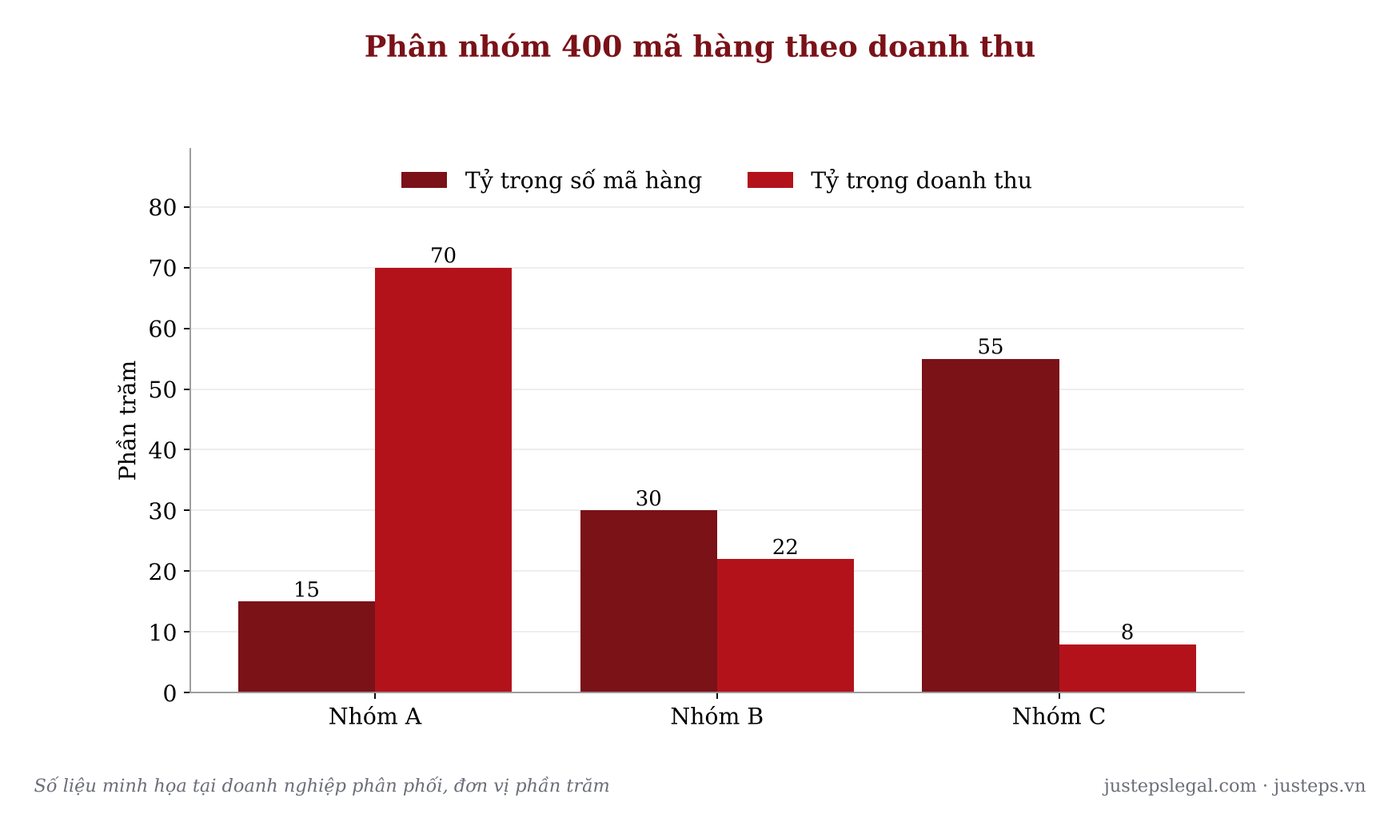
Share of item codes and revenue by groups A, B and C
In the example, group A comprises only sixty codes, or fifteen per cent of item codes, but generates seventy per cent of revenue. Group B comprises one hundred and twenty codes, thirty per cent of codes and twenty-two per cent of revenue. Group C comprises two hundred and twenty codes, fifty-five per cent of codes but only eight per cent of revenue. On this basis, the business reviews limits and counts group A weekly, group B monthly and group C quarterly; the figures are illustrative and actual proportions depend on each business’s product mix.
Safety stock and the reorder point
Safety stock is the buffer that prevents the business from running out when a supplier delivers late or demand rises suddenly. A simple calculation is average daily sales multiplied by the number of buffer days, usually two to five days depending on how reliable the supplier is. The reorder point equals average daily sales multiplied by the supplier’s delivery lead time, plus safety stock. For example, if a rice cooker item sells an average of fifteen cartons a day, the supplier delivers in ten days and the business keeps a three-day buffer, safety stock is forty-five cartons and the reorder point is one hundred and ninety-five cartons.
When stock reaches the reorder point, purchasing raises a purchase order without waiting for the director’s opinion, provided the quantity ordered is within the approved limit. This makes purchasing decisions data-driven rather than based on intuition, and reduces the number of small orders the director has to approve. The parameters should be updated at least quarterly, and immediately when there is a major change such as a supplier changing its delivery time or the business running a promotion.
Maximum stock levels and slow-moving goods
The maximum stock level limits how much cash the business is prepared to tie up in one item code. For group A, the maximum level is usually equivalent to thirty to forty-five days of sales; for group C, the business may choose to buy only against orders or keep a very low level. Buying above the maximum level to obtain a supplier discount should only be done with the director’s approval after comparing the benefit of the discount with storage costs and the risk of goods going out of fashion. Goods with no issues for ninety days should be flagged as slow-moving and placed on a monthly handling list.
For accounting purposes, inventory is measured at cost, and where net realisable value is lower than cost it must be measured at net realisable value[3]. When goods are slow-moving, out of fashion or their selling price falls, the business considers making a provision for inventory write-down under the Ministry of Finance’s rules on making and handling provisions[4]. The monthly list of slow-moving goods therefore not only supports clearance decisions but also serves as a record for accounting to assess the value of inventory at the end of the period.
Goods receipt and issue procedures
Goods receipt
The goods receipt procedure starts from an approved purchase order, because this is the basis for the storekeeper to check quantity, specification and unit price on receipt. When the goods arrive, the storekeeper counts them together with the delivery person, checks the condition of the packaging and the expiry date where relevant, and compares them with the purchase order. Shortages, surpluses or damaged goods must be recorded in minutes signed by the delivery person at the time of receipt, because once the delivery person has left it is very hard for the business to claim against the supplier. The flowchart below describes the receipt sequence and how to handle goods that do not match the purchase order.
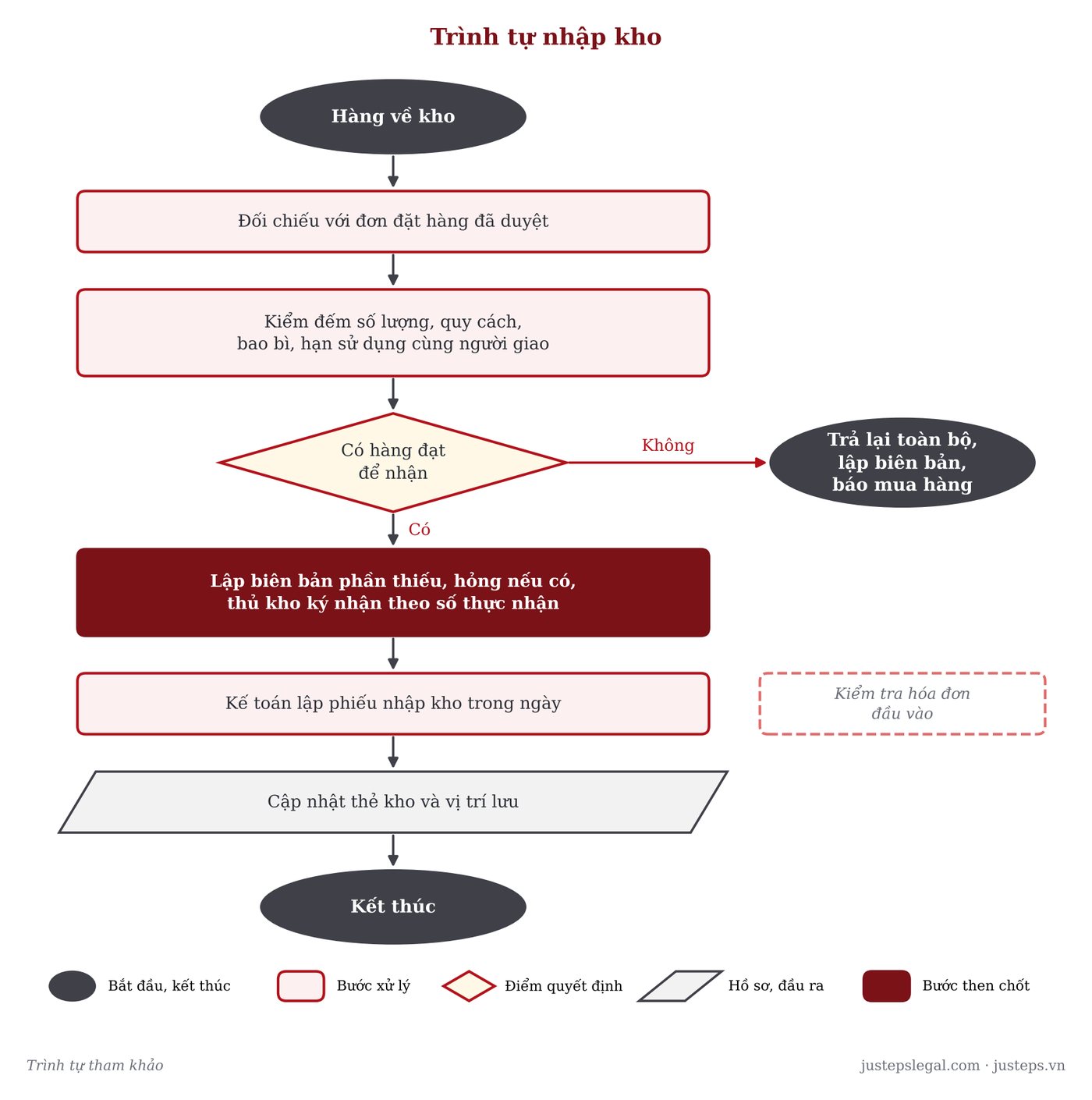
Goods receipt sequence and handling of goods not matching the purchase order
According to the flowchart, after checking and counting, the storekeeper determines whether any part of the consignment meets the requirements for acceptance. If the whole consignment fails, the storekeeper prepares minutes with the delivery person, returns the goods and informs purchasing to deal with the supplier, and the receipt procedure ends there. If some goods pass, the storekeeper prepares minutes for any shortage or damage and signs for the quantity actually received, after which accounting prepares the goods receipt note on the same day and the storekeeper updates the stock card and storage location. The goods receipt note must record the quantity actually received, not the quantity on the supplier’s invoice where the two differ.
Purchased goods need valid invoices and documents, both as a basis for recording and to prove their lawful origin when inspected by the authorities. Trading in goods without invoices or documents proving their origin may incur administrative penalties in commercial activities[5]. From 1 July 2026, the issue, management and use of electronic invoices follow the new decree on electronic invoices and electronic documents[6], so accounting should verify input invoices on the tax authority’s system before paying suppliers.
Goods issue
Issuing goods for sale follows three separate steps. Sales raises an issue request based on the customer’s order; accounting checks the credit limit and payment terms and then prepares the goods issue note; the storekeeper releases goods against the approved note, giving priority to the first-in first-out batch, and the recipient signs the delivery note. For orders on e-commerce platforms, issue requests can be generated automatically from the sales system, but the warehouse still only releases goods against an issue note or an order list confirmed by accounting on the same day.
Besides issues for sale, trading businesses often have other types of issue, such as samples, gifts to customers, promotional goods, goods for internal use and goods returned to suppliers. Each type needs its own request form, its own approver and a reason code on the issue note, so that at the end of the period accounting knows where the goods went. Under the invoicing rules, goods given away, donated, used for promotions or consumed internally usually also require an invoice or an appropriate document, so accounting must be informed as soon as such issues occur. Templates for goods receipt notes, goods issue notes, stock cards and detailed goods ledgers can be based on the current enterprise accounting regime[7], or on the accounting regime for small and medium-sized enterprises if the business applies that regime[8].
Periodic reconciliation and stocktaking
Reconciliation means comparing data from three sources, namely the documents, the storekeeper’s stock cards and accounting’s detailed goods ledger, and then comparing them with the physical goods. Each day, accounting reconciles the receipt and issue notes prepared with the list of goods actually received and delivered that day, so that no transaction is left until the end of the month. Each week, the storekeeper and accountant reconcile the stock of about ten to twenty randomly selected group A codes, with a third person present if possible. Each month or quarter, the business counts all of group A and part of group B, depending on the size of the warehouse.
The year-end stocktake is an obligation of the accounting unit. Under the Law on Accounting, the accounting unit must take stock of its assets at the end of the annual accounting period and in other cases as prescribed, and must prepare a summary report of the stocktake results reflecting the differences between the physical count and the accounting records and deal with them before preparing the financial statements[9]. When weekly and monthly reconciliations have been carried out regularly, the year-end stocktake becomes a confirmation step rather than a hunt for discrepancies accumulated over the year. The Law on Accounting has just been amended by the National Assembly in November 2026, so businesses need to review the guiding regulations when the amending law takes effect.
The chart below illustrates the number of item codes with differences between the books and physical stock at the business in the opening example, over four quarters after introducing role separation, same-day documents and weekly reconciliation.
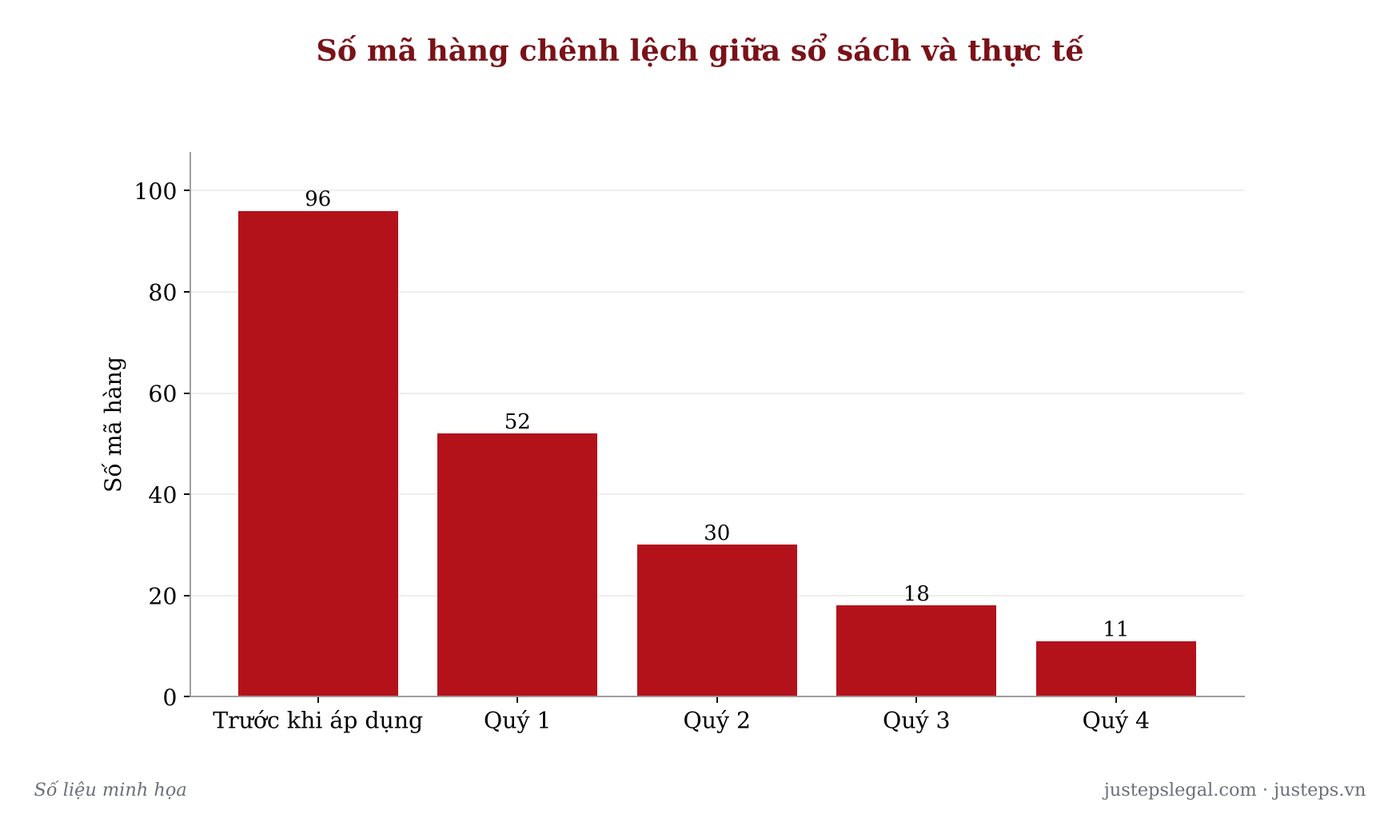
The number of item codes with discrepancies falls after the new procedure is applied
In the first quarter, the number of item codes with discrepancies fell from ninety-six to fifty-two, mainly thanks to the requirement to prepare issue notes for dealers on the same day. By the fourth quarter, only eleven codes had discrepancies, mostly due to confusion between carton and unit packaging. The net value of discrepancies also fell, from about 1.2 per cent of the value of inventory to below 0.2 per cent. The figures are illustrative, but the trend is consistent with Justeps’ experience in helping trading businesses reorganise their warehouses.
Handling discrepancies and material liability
Every discrepancy found during reconciliation or stocktaking must be recorded in minutes before the books are adjusted. The minutes state the item code, the quantity per the books, the physical quantity, the value of the difference, the persons counting and the initial cause. Accounting only adjusts the books after the director or an authorised person approves the handling, such as recording it as a specification error, claiming compensation from the supplier, holding an individual responsible or charging it to expenses. This distinguishes recording errors clearly from real losses and creates an audit trail for the tax authority and auditors when needed.
For shortages or damage caused by an employee’s fault, the Labour Code allows the employer to claim compensation under material liability, while limiting the monthly deduction from salary and exempting liability where damage is caused by natural disasters, fire or force majeure[10]. Compensation must follow a procedure, including asking the employee for a written explanation, giving at least five working days’ notice of the meeting, preparing minutes and issuing a compensation decision stating the extent of the damage, the cause and the amount and form of compensation[11]. The business should sign a material liability handover document with the storekeeper stating the scope of goods entrusted to him or her, and prepare warehouse handover minutes whenever the person in charge changes.
For tax purposes, the value of lost goods is only treated as a deductible expense when it meets the conditions and is supported by records under the law on corporate income tax[12]. Shortages with no identified cause, or for which an individual, supplier or insurer has paid compensation, are usually not fully deductible. Discrepancy minutes, handling decisions and compensation documents should therefore be kept with the accounting records of the period in which they arise. Expired or damaged goods that must be destroyed also require a handling committee, destruction minutes and photographic evidence.
Records and common mistakes
An inventory management system only runs smoothly when the documents are formally issued and new staff can take over without depending on their predecessors. The minimum record set for a small trading business includes the following documents:
- A warehouse management procedure issued by the director, stating roles, deadlines for documents and approval thresholds.
- A uniform item list with units of measure, conversion factors, groups A, B and C and stock limits.
- Goods receipt notes, goods issue notes, stock cards and delivery minutes for shortages, surpluses and damage.
- Weekly reconciliation reports and year-end stocktake minutes signed by the stocktake committee.
- A monthly list of slow-moving goods and the director’s handling decisions.
- A document assigning material liability to the storekeeper and handover minutes when the person changes.
Through its reviews, Justeps has noted certain mistakes that recur in many small trading businesses. The most common is that goods are released first and the note prepared later, and by the end of the month some notes are forgotten. Next, the same item is declared under several names or codes, so stock is fragmented and stock-out reports are wrong. In addition, managers take goods as gifts or samples without informing the warehouse, and the business takes stock only once a year for the financial statements without using the results to improve the procedure.
All of these mistakes can be remedied through three measures, namely same-day documents, a single item list and a person who does not hold the goods being responsible for reconciliation. The business should start with group A, because this is where discrepancies cause the greatest damage, and then gradually extend to groups B and C. When the warehouse procedure needs to be issued together with the financial regulations, purchasing regulations and approval delegation, the business may consider Justeps’ service of building and implementing an internal regulation system.
How Justeps can help
Justeps helps small trading businesses organise inventory management, internal control and related records through the following services:
- Finance, accounting and internal control. Justeps designs role allocation, receipt and issue document procedures and inventory reconciliation mechanisms suited to the size of the business.
- Building and implementing an internal regulation system. Justeps drafts the warehouse management procedure, purchasing regulations and approval delegation, and guides departments in applying them.
- Retail, e-commerce and FMCG. Justeps advises on operations for businesses selling through dealers and e-commerce platforms, including order flows and goods issue.
- Internal labour regulations and disciplinary handling. Justeps adds material liability provisions to the internal regulations and prepares compensation files when shortages arise.
Frequently asked questions
Can a small business manage its warehouse with a spreadsheet?
A business with fewer than about one hundred item codes and one warehouse can use a spreadsheet if every receipt and issue is documented and recorded on the same day. When the number of codes grows or there are several outlets, the business should move to software linked to the accounting ledger.
May the storekeeper also act as accountant?
In principle, a storekeeper may not work as an accountant[1]. Exceptions apply to private enterprises, single-member limited liability companies owned by an individual and micro-enterprises without State capital[2], but the business should still add other controls.
How often must inventory be counted?
The business must take stock of its assets at the end of the annual accounting period and in other cases as prescribed[9]. For management purposes, it should reconcile its high-revenue item group weekly and count that whole group monthly or quarterly.
May the storekeeper’s salary be deducted when stock is short?
The business may only claim compensation after establishing fault through the material liability procedure[11], and the monthly deduction from salary is limited under the Labour Code[10]. A shortage with no identified cause is not sufficient grounds for an immediate salary deduction.
How should goods held for a long time with falling selling prices be treated in the books?
Inventory is recorded at cost, or at net realisable value if this is lower[3]. The business considers making a provision for inventory write-down under the Ministry of Finance’s rules[4].
Do issues of customer gifts or samples need documents?
Yes. Every issue of samples, gifts or promotional goods needs an issue note with a reason code and an approver. Accounting must be informed so as to determine the invoicing obligation under the current rules on electronic invoices[6].
Can damaged goods that must be destroyed be treated as expenses?
The value of lost goods is only treated as a deductible expense when it meets the conditions and is supported by records under the law on corporate income tax[12]. The business should set up a handling committee, prepare destruction minutes and keep photographic evidence.
Related articles
- The year-end stocktaking process for businesses, from planning to handling discrepancies
- The purchasing procedure and supplier selection, from purchase request to acceptance and payment
- Managing fixed assets and tools in a business, from the asset register and issue to stocktaking and compensation
- Building the organisational structure of a trading and distribution company around goods flow, cash flow and scale
Notes
[1] The Law on Accounting No. 88/2015/QH13 dated 20 November 2015, as amended and supplemented, including by the Law amending and supplementing a number of articles of the Law on Accounting and the Law on Independent Audit passed by the National Assembly in November 2026 (provisions on persons who may not work as accountants).
[2] Clauses 2 and 3, Article 19 of Government Decree No. 174/2016/ND-CP dated 30 December 2016 detailing a number of articles of the Law on Accounting.
[3] Vietnamese Accounting Standard No. 02 on Inventories issued together with Decision No. 149/2001/QD-BTC dated 31 December 2001 of the Minister of Finance.
[4] Circular No. 48/2019/TT-BTC dated 8 August 2019 of the Ministry of Finance guiding the making and handling of provisions, announced as remaining in force under Decision No. 1760/QD-BTC dated 1 July 2026 of the Ministry of Finance.
[5] Government Decree No. 98/2020/ND-CP dated 26 August 2020 on administrative penalties in commercial activities, production and trading of counterfeit and prohibited goods and consumer protection, as amended and supplemented by Decree No. 24/2025/ND-CP.
[6] Government Decree No. 254/2026/ND-CP dated 30 June 2026 on electronic invoices and electronic documents.
[7] Circular No. 99/2025/TT-BTC dated 27 October 2025 of the Ministry of Finance guiding the enterprise accounting regime, applicable from 1 January 2026.
[8] Circular No. 133/2016/TT-BTC dated 26 August 2016 of the Ministry of Finance guiding the accounting regime for small and medium-sized enterprises.
[9] The Law on Accounting No. 88/2015/QH13 dated 20 November 2015, as amended and supplemented, including by the Law amending and supplementing a number of articles of the Law on Accounting and the Law on Independent Audit passed by the National Assembly in November 2026 (provisions on stocktaking of assets).
[10] Labour Code No. 45/2019/QH14 dated 20 November 2019, as amended and supplemented by the Law amending and supplementing a number of articles of the Labour Code and certain laws passed by the National Assembly on 21 November 2026 (provisions on salary deductions and material liability).
[11] Article 71 of Government Decree No. 145/2020/ND-CP dated 14 December 2020 detailing and guiding the implementation of a number of articles of the Labour Code on working conditions and labour relations.
[12] The Law on Corporate Income Tax No. 67/2025/QH15, as amended and supplemented by the law passed by the National Assembly on 20 November 2026, and Government Decree No. 320/2025/ND-CP dated 15 December 2025 detailing the Law on Corporate Income Tax.
This article is for reference and reflects the regulations in force at the time of publication. Please consult Justeps for advice tailored to your company’s records and situation.
For further information, please contact:
📩 Email: info@justeps.vn
🌐 Website: https://justepslegal.com · https://justeps.vn
🌐 Page: Justeps
☎️ Hotline (Zalo): 096 172 2607
📍 Thanh Xuan Office: 12th Floor, Licogi 13 Tower, 164 Khuat Duy Tien Street, Thanh Xuan Ward, Hanoi, Vietnam
📍 Ha Dong Office: LK06B, No.10, Dong Dua Area, Ha Dong Ward, Hanoi, Vietnam
📍 Ho Chi Minh City Branch: 528 Le Van Sy, Ho Chi Minh City, Vietnam
📍 Hai Phong Office: Truong Thinh Village, Ha Dong Commune, Hai Phong, Vietnam
📍 Quang Ninh Office: Van Don Special Zone, Quang Ninh Province, Vietnam





