
Key takeaways
- A founding shareholders’ agreement binds only those who sign it, whereas the charter binds the company and all shareholders, so any provision the company needs to enforce must be written into the charter.
- The contribution schedule, the method of valuing contributed assets and the consequences if a shareholder fails to contribute in full should be settled before the incorporation file is submitted.
- The list of matters requiring unanimous consent must be narrow enough that a minority shareholder cannot paralyse every routine decision.
- The mechanism for buying back the shares of a departing founder needs a clear pricing formula and should distinguish good leavers from leavers in breach.
- Transfer restrictions set out in the charter take effect only when they are clearly stated on the share certificate, so shareholder records must be updated in line with the agreement.
Most conflicts between the people who set up a company together do not arise on opening day but two or three years later, once each person’s role has changed. A founding shareholder stops managing the business but still holds 30% of the shares and opposes every capital increase; two shareholders each holding 50% cannot agree on who should be Director; an investor wants to buy the whole company but a minority shareholder refuses to sell. The company charter usually sets out only the governance structure within the framework of the Law on Enterprises and is not detailed enough to resolve these situations.
This article analyses the provisions a founding shareholders’ agreement should contain, in order from capital contribution, governance, transfer and exit to deadlock resolution, and identifies which provisions must be written into the charter to be effective against the company. It applies mainly to joint stock companies that have just been incorporated or are preparing for incorporation; for a limited liability company with two or more members, the equivalent document is an agreement among the members, and most of the analysis below still applies. It is written mainly for founders, the people assigned to prepare the incorporation file and angel investors joining at an early stage.
The legal standing of a founding shareholders’ agreement compared with the charter
A founding shareholder is a shareholder who owns at least one ordinary share and signs the list of founding shareholders of a joint stock company[1]. On registering incorporation, the founding shareholders must together subscribe for at least 20% of the total number of ordinary shares authorised for offering[2]. The Law on Enterprises contains no specific provisions on shareholders’ agreements, so such a document is treated as a civil contract between its signatories, valid as long as it does not breach the prohibitions of law and is not contrary to social ethics[3]. The direct consequence is that the agreement binds the parties that have signed it but does not bind the company as a legal entity, nor shareholders who buy shares later unless they sign a deed of adherence.
By contrast, the charter is a document filed with the business registration authority and binds the company, the Board of Directors, the Director and all shareholders. Where the agreement and the charter differ, state authorities, banks and the company itself will rely on the charter, while the party in breach of the agreement can only be required to pay a contractual penalty or compensation. Before drafting each provision, therefore, the founders need to determine whether it requires enforcement by the company or merely a commitment between the shareholders, and then place it in the right document.
The agreement should be signed before the incorporation file is submitted, because at that point all parties have an incentive to complete the process and no interests have yet become fixed. If it is signed after the company has started operating, writing the key provisions into the charter will require a resolution of the General Meeting of Shareholders passed by the statutory voting threshold, and the shareholder with the stronger position is often unwilling to make concessions. Businesses needing to draft both documents consistently may consider Justeps’ service on shareholders’ agreements and founders’ capital contributions.
Capital contribution, the contribution schedule and the consequences of a shortfall
Shareholders must pay in full for the shares they have subscribed for within 90 days of the date of issue of the Enterprise Registration Certificate, unless the charter or the share subscription agreement provides for a shorter period[4]. If the period expires without payment, the shareholder ceases to be a shareholder in respect of the unpaid portion, those shares are deemed unsold and the Board of Directors may sell them; the company must register the adjustment of its charter capital within 30 days of the end of the payment period. The shareholders’ agreement should add the details the law does not provide, including a schedule of instalments if the parties contribute in several tranches, the account for receiving funds and the pre-emptive right of the remaining shareholders to buy the unpaid shares before they are offered to outsiders.
Where a founder contributes capital in the form of assets such as machinery, software, a trade mark or a technology process, the asset must be valued in Vietnamese dong. At incorporation, the valuation is carried out by the founding shareholders by consensus or by a valuation organisation; if the asset is valued above its actual value, the founding shareholders are jointly liable to contribute the difference and jointly liable for any resulting loss[5]. Because this liability is joint, the agreement should state the valuation method, who bears the cost of valuation and the internal reimbursement obligations between shareholders should the valuation later prove wrong.
Where the asset is an intellectual property right, the shareholder must complete the procedure to transfer ownership to the company rather than merely permit the company to use it[6]. Many technology companies discover only at a funding round that the core source code still belongs to an individual founder, and the investor will then usually require the transfer to be completed before disbursement. The agreement should list each contributed asset, the deadline for completing the transfer and the supporting documents, and should set out the rights of the other shareholders if the transfer is not completed on time.
Nomination rights and the matters requiring consent
Nominating members of the Board of Directors and executives
Under the Law on Enterprises, a shareholder or group of shareholders holding 10% or more of the total ordinary shares, or a lower percentage set by the charter, has the right to nominate candidates to the Board of Directors and the Supervisory Board[7]. Members of the Board of Directors are elected by cumulative voting unless the charter provides otherwise[8], so the outcome depends on how shareholders allocate their votes and not merely on the right to nominate. To ensure that each group obtains the number of seats agreed, the agreement needs a voting undertaking under which each party undertakes to vote for the candidates nominated by the other and to vote together for removal when the nominating party so requests.
The Director or General Director of a joint stock company is appointed by the Board of Directors, so a group of shareholders’ right to nominate an executive takes effect only through the undertakings of the Board members nominated by the parties[9]. The agreement commonly provides that one group may nominate the Director while the other may nominate the chief accountant or the person in charge of finance, creating cross-checks. The parties should also set evaluation criteria and the circumstances in which the nominating party must replace its nominee, to avoid a situation in which an underperforming executive cannot be replaced for reasons of balance of power.
The list of reserved matters and the limits of veto rights
A resolution of the General Meeting of Shareholders on classes of shares, business lines, the management structure, investments in or sales of assets worth 35% or more of total asset value, reorganisation or dissolution of the company is passed when shareholders holding 65% or more of the total votes of the shareholders attending the meeting vote in favour, unless the charter sets a different threshold[8]. Because the law allows the charter to adjust this threshold, minority shareholders can negotiate a higher threshold for sensitive matters and thereby obtain a de facto right of veto. The chart below illustrates how shareholding percentages determine which groups of shareholders have enough votes to pass important matters.
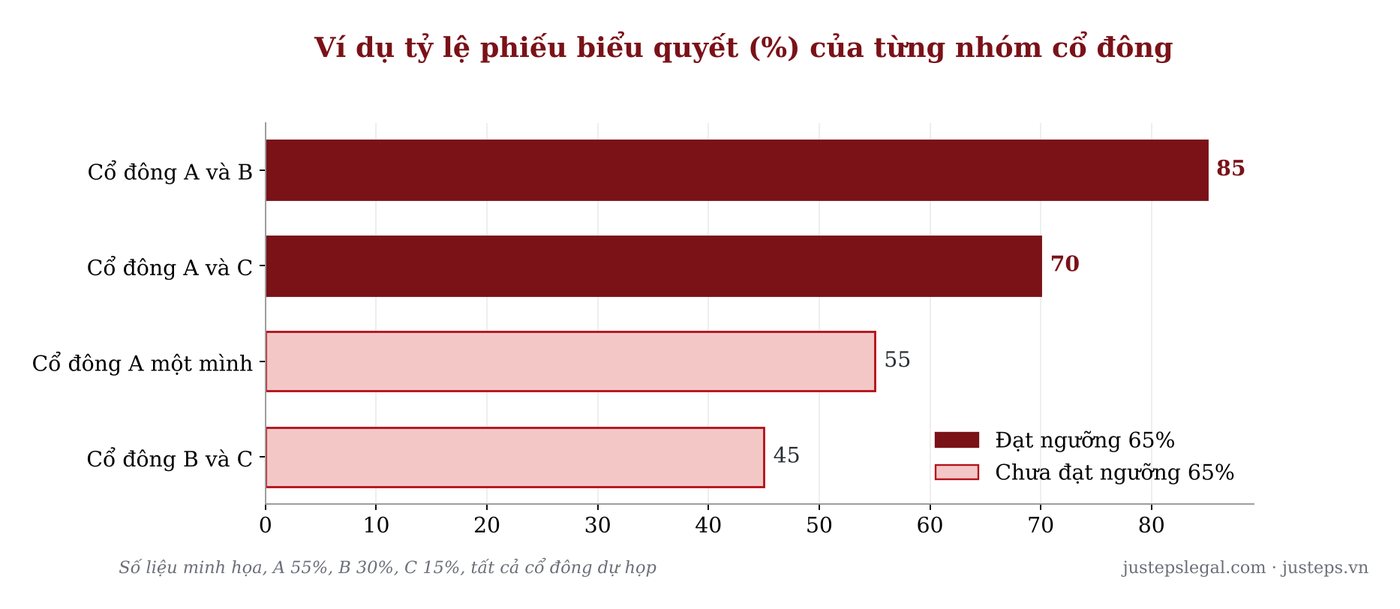
Example of the combined voting percentage of each group of shareholders compared with the 65% threshold
In the example, the company has three founding shareholders holding 55%, 30% and 15% of the shares respectively, and all of them attend the meeting. With the default threshold of 65%, the largest shareholder cannot pass important matters alone but needs only the support of the smallest shareholder, so the shareholder holding 30% has no right of veto. If the charter raises the threshold to 75%, the largest shareholder must obtain the consent of the 30% shareholder, and the support of the 15% shareholder is no longer enough. The choice of voting threshold is therefore in substance a decision about who holds a veto, and must be considered at the same time as the shareholding percentages.
In addition to the matters within the authority of the General Meeting of Shareholders, the agreement often adds a list of reserved matters at Board level, such as capital increases, issuing shares to new persons, borrowing or guarantees above a set limit, changes to the annual budget and transactions with related persons[10]. However, an overly broad list allows a minority shareholder to block even routine decisions such as signing purchase contracts or hiring a department head. A balanced approach is to limit veto rights to matters that change the ownership structure, the level of debt or the business direction, and to attach a specific value threshold to each matter.
Restrictions on share transfers and protective rights when a buyer appears
Within three years of the date of issue of the Enterprise Registration Certificate, founding shareholders may freely transfer their ordinary shares to other founding shareholders, but may transfer them to persons who are not founding shareholders only with the approval of the General Meeting of Shareholders, and the shareholder proposing to transfer has no vote on that matter[2]. Once the three-year period expires, the statutory restrictions on founding shareholders’ shares end, so any restriction intended to last longer must be set out in the charter. Under the Law on Enterprises, transfer restrictions set out in the charter take effect only when clearly stated on the share certificate for the shares concerned[11], so the company must issue share certificates or update existing certificates accordingly.
Shareholders’ agreements commonly use three mechanisms to supplement the statutory restrictions. A right of first refusal allows existing shareholders to buy first, on the same terms, when a shareholder wishes to sell to an outsider. A tag-along right protects minority shareholders by allowing them to sell the same proportion at the same price when a majority shareholder sells shares to a new buyer. A drag-along right protects majority shareholders by allowing them to require the remaining shareholders to sell as well when a buyer offers to acquire the whole company at a price meeting the agreed conditions. A drag-along right binds only those who have signed, so the agreement must require every new shareholder to sign a deed of adherence before being entered in the register of shareholders.
When a transfer takes place, the company must update the register of shareholders and, where the change concerns founding shareholders or foreign shareholders, complete the notification procedure under the enterprise registration rules. Since 2025, businesses have also been required to collect, keep and update information on their beneficial owners[12]. If the agreement gives an individual the power to control the appointment of a majority of the Board or the passing of important decisions, that individual may be identified as a beneficial owner even with a small shareholding, so the records must be updated accordingly.
Departing founders and vesting arrangements
The situation most likely to cause a dispute is a founder who stops working for the company but keeps all the shares allotted at the outset, while those who remain continue to create value. International practice deals with this through a mechanism under which shares are earned progressively over the period of service (vesting), for example over four years at 25% per year. Vietnamese law has no concept of unvested shares, because fully paid shares belong to the shareholder, so this mechanism must be implemented as a right of the remaining shareholders to buy back the portion of shares corresponding to the period of service not yet completed.
The agreement needs to distinguish between two types of departure. A good leaver departure includes leaving for health reasons, being removed through no fault of one’s own or leaving after completing the minimum period of service, and the buy-back price is usually fair value under a formula agreed in advance. A departure in breach includes breaching a non-compete undertaking, disclosing trade secrets or causing serious harm to the company, and the buy-back price may be the par value or the capital originally contributed. The pricing formula should be based on verifiable measures, such as net asset value in audited financial statements, the price of the most recent funding round or the result of a valuation organisation chosen jointly by the parties.
The buyer should be the remaining shareholders or persons they nominate, because a company’s ability to buy back its own shares is limited. The company may, on its own decision, buy back no more than 30% of the total ordinary shares sold, and may pay only if, immediately afterwards, it remains able to pay its debts and other property obligations in full[13]. The procedure to be followed when a founding shareholder departs may be designed as in the flowchart below.
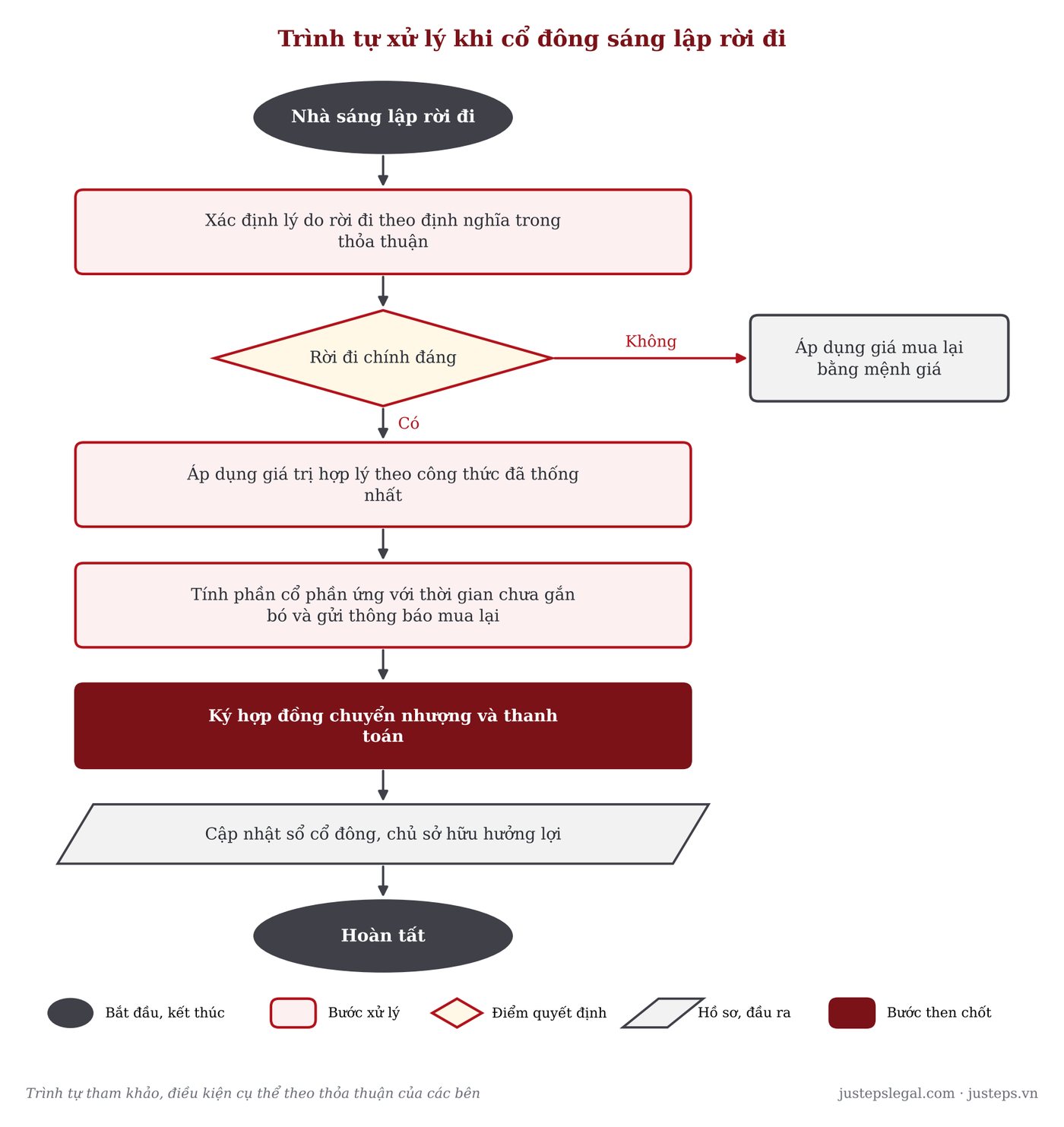
Procedure for dealing with shares when a founding shareholder ceases to take part in management
The procedure begins by determining the reason for departure, as this decides which pricing formula applies. The parties then calculate the portion of shares corresponding to the unserved period, send a notice exercising the buy-back right within the agreed time limit and give the departing shareholder the opportunity to request an independent valuation if they disagree with the calculation. The key step is signing the transfer agreement and making payment, after which the company updates the register of shareholders and the beneficial ownership information and completes the notification procedure where required. If a party does not cooperate, the others have grounds to demand performance of the obligation or to apply the contractual penalty under the agreement.
Non-competition, confidentiality, intellectual property and dividend policy
The agreement should include a non-compete undertaking for as long as the person is a shareholder and for a reasonable period after departure, together with an undertaking not to solicit the company’s employees and customers. The scope of the undertaking should be limited by business line, territory and duration, because an overly broad undertaking risks being regarded as an unreasonable restriction on the freedom to do business and is unlikely to be upheld by the dispute resolution body. For a founder who is also an employee, confidentiality obligations and the protection of trade secrets may also be agreed in the employment contract under the Labour Code[14].
All intellectual output created by a founder while working for the company, such as software, designs, domain names and marketing content, should be committed as belonging to the company. This commitment should appear both in the shareholders’ agreement and in the founder’s employment or services contract, because the author is an individual and the company becomes the owner only where there is a valid basis of commissioning or assignment. The company’s domain names and social media accounts should also be registered in the company’s name from the outset, to avoid a departing founder keeping these assets.
At the early stage, founders often agree to retain profits for reinvestment, but if this is not recorded in writing, conflict easily arises once the company starts making a profit. The agreement may set a minimum proportion of profits to be retained during the first three years and the conditions for starting to pay dividends. Whatever the agreement says, the company may pay dividends only after fulfilling its tax and other financial obligations, setting aside the required funds and offsetting previous losses, and only if, immediately after payment, it can still pay its debts as they fall due[15].
Resolving deadlock and breaches and aligning the agreement with the charter
Deadlock occurs when shareholders hold equal stakes or when a party with a right of veto disagrees with a decision necessary for the company’s operations. The agreement should set out an escalation ladder in order, comprising direct negotiation between the principals within a set time, mediation through a neutral third party and, if the matter is still unresolved, an exit mechanism. For a company with two shareholders each holding 50%, a common exit mechanism is for one party to name a price per share and for the other party to choose either to buy all of the offering party’s shares or to sell all of its own shares at exactly that price.
To give the agreement binding force, the parties should agree on a contractual penalty and an obligation to compensate for loss, as the Civil Code allows parties to agree the amount of penalties in civil contracts[16]. The parties also need to choose a method of dispute resolution, which may be commercial arbitration or the courts[17]. However, certain disputes relating to the internal affairs of the company, such as disputes over the validity of a resolution of the General Meeting of Shareholders, may fall within the jurisdiction of the courts[18], so the dispute resolution clause must be drafted carefully and differentiated by type of dispute. Once a conflict has arisen, businesses may use Justeps’ service on resolving internal disputes among shareholders and members to have the matter assessed, prepare the documents and receive advice on negotiation and mediation.
Most of the risk in a shareholders’ agreement lies in provisions placed in the wrong document, so that the company cannot apply them when needed. The table below suggests how groups of provisions may be allocated between the charter and the shareholders’ agreement:
| Group of provisions | Where it should be placed | Reason |
|---|---|---|
| Transfer restrictions | The charter, also stated on the share certificate, with procedural details in the agreement. | Restrictions are effective against the company and buyers only when they appear in the charter and on the certificate. |
| Voting thresholds | The charter for the passing thresholds, the agreement for voting undertakings. | The company applies only the thresholds in the charter when counting votes. |
| Nomination rights | The charter for the nomination percentage, the agreement for the number of seats per group. | The election method is decided by the charter, whereas the allocation of seats is a commitment between shareholders. |
| Buy-back price and vesting | The shareholders’ agreement. | These are private rights and obligations between shareholders and do not need to be made public. |
| Tag-along and drag-along | The agreement, with the general principle possibly included in the charter. | The mechanism must bind future shareholders as well through a deed of adherence. |
| Non-competition and confidentiality | The shareholders’ agreement and the employment contract. | The content is personal and tied to the role of each founder. |
Drafting and signing the agreement should follow a clear roadmap, starting with the founders discussing their expectations and ending once the shareholder records have been fully updated.
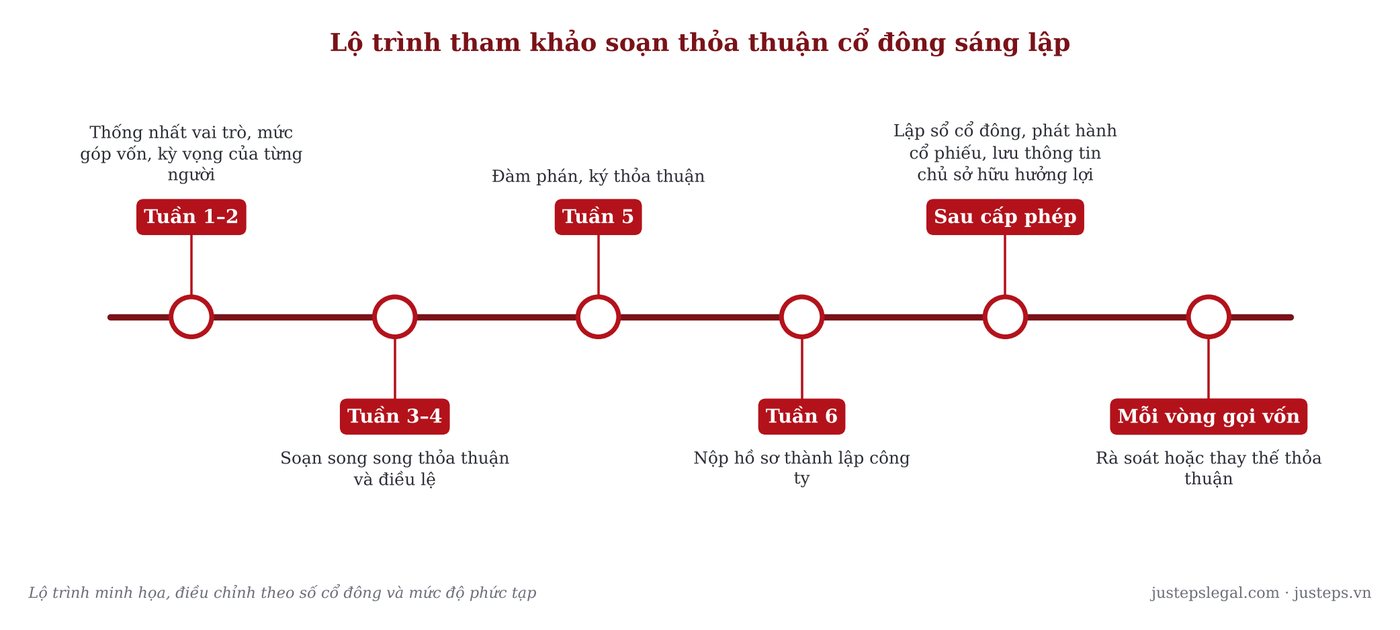
Indicative roadmap from agreeing the principles to completing the shareholder records
The first two weeks are spent on each founder setting out their role, capital contribution, time commitment and expectations about fundraising or a sale of the company, as these are the source of almost every later provision. Next, the draft agreement and the charter are prepared in parallel to ensure consistency, after which the parties negotiate and sign before submitting the incorporation file. Once the Enterprise Registration Certificate has been issued, the company sets up the register of shareholders, issues share certificates stating the transfer restrictions and records the beneficial ownership information. The agreement should be reviewed whenever there is a funding round or a new shareholder, as investors commonly require a new shareholders’ agreement to replace the founders’ version.
How Justeps can help
Justeps helps founders draft a shareholders’ agreement and a charter that are consistent and easy to enforce through the following services:
- Shareholders’ agreements and founders’ capital contributions. Justeps drafts founding shareholders’ agreements, vesting arrangements, buy-back pricing formulas and deadlock resolution mechanisms.
- Company formation and enterprise registration. Justeps drafts a charter consistent with the agreement and prepares the incorporation file for a joint stock company.
- Resolving internal disputes among shareholders and members. Justeps assesses the conflict, reviews the documents and advises on negotiation and mediation between shareholders.
- Fundraising and private placement of shares. Justeps reviews the existing agreement and negotiates shareholder terms when the company brings in a new investor.
Frequently asked questions
Must a founding shareholders’ agreement be filed with the business registration authority?
A shareholders’ agreement is not part of the enterprise registration file, so it does not have to be filed. Only the charter and the documents required by the enterprise registration rules are filed, so any provision the company needs to enforce must be written into the charter.
Does the agreement bind people who buy shares later?
The agreement binds only those who have signed it. To bind new shareholders, the agreement should require any transferee to sign a deed of adherence before being entered in the register of shareholders.
May a founding shareholder sell shares to an outsider in the first three years?
A founding shareholder may transfer ordinary shares to a person who is not a founding shareholder only with the approval of the General Meeting of Shareholders[2]. The shareholder proposing to transfer has no vote on that approval.
Should the agreement be signed before or after the company is incorporated?
It should be signed before the incorporation file is submitted so that the charter is drafted consistently from the outset. If it is signed later, amendments to the charter must be passed by the General Meeting of Shareholders at the statutory threshold[8].
Can the company itself buy back the shares of a departing founder?
The company may buy them back, but it is limited to no more than 30% of the total ordinary shares sold and may pay only if it remains able to pay its debts in full[13]. For this reason, the agreement usually gives the buy-back right to the remaining shareholders.
What happens when a shareholder breaches a non-compete undertaking?
The agreement should provide for a contractual penalty, an obligation to compensate and the right of the other shareholders to buy back the shares of the party in breach at a lower price[16]. These measures must be set out specifically to provide a basis for enforcement.
Must a company with two shareholders each holding 50% change the split?
The law does not require the split to be changed. However, the agreement and the charter need a clear deadlock resolution mechanism, such as mediation through a third party and a mechanism under which one party names a price and the other chooses to buy or sell.
Related articles
- What a founders’ shareholders agreement should provide on governance, vesting, veto rights and exit
- How to grant shares to key employees so as to retain them without giving rise to disputes
- Setting up a technology start-up company, from capital structure and employee shares to ownership of source code
- Setting up the organisation of a newly incorporated company with fewer than 10 staff so that roles, authority and cash flow are under control
Notes
[1] Clause 4 of Article 4 of the Law on Enterprises No. 59/2020/QH14 dated 17 June 2020, as amended and supplemented by Law No. 76/2025/QH15.
[2] Clauses 2 and 3 of Article 120 of the Law on Enterprises No. 59/2020/QH14.
[3] Articles 117 and 385 of the Civil Code No. 91/2015/QH13 dated 24 November 2015.
[4] Clauses 1 and 3 of Article 113 of the Law on Enterprises No. 59/2020/QH14.
[5] Clause 2 of Article 36 of the Law on Enterprises No. 59/2020/QH14.
[6] Article 35 of the Law on Enterprises No. 59/2020/QH14.
[7] Article 115 of the Law on Enterprises No. 59/2020/QH14.
[8] Article 148 of the Law on Enterprises No. 59/2020/QH14.
[9] Article 162 of the Law on Enterprises No. 59/2020/QH14.
[10] Article 167 of the Law on Enterprises No. 59/2020/QH14.
[11] Clause 1 of Article 127 of the Law on Enterprises No. 59/2020/QH14.
[12] Law No. 76/2025/QH15 dated 17 June 2025 amending and supplementing a number of articles of the Law on Enterprises; Decree No. 168/2025/ND-CP dated 30 June 2025 on enterprise registration, as amended and supplemented by Decree No. 296/2026/ND-CP.
[13] Articles 133 and 134 of the Law on Enterprises No. 59/2020/QH14.
[14] Clause 2 of Article 21 of the Labour Code No. 45/2019/QH14 dated 20 November 2019.
[15] Clause 2 of Article 135 of the Law on Enterprises No. 59/2020/QH14.
[16] Article 418 of the Civil Code No. 91/2015/QH13.
[17] The Law on Commercial Arbitration No. 54/2010/QH12 dated 17 June 2010.
[18] Clause 4 of Article 30 of the Civil Procedure Code No. 92/2015/QH13 dated 25 November 2015.
This article is for reference and reflects the regulations in force at the time of publication. Please consult Justeps for advice tailored to your company’s records and situation.
For further information, please contact:
📩 Email: info@justeps.vn
🌐 Website: https://justepslegal.com · https://justeps.vn
🌐 Page: Justeps
☎️ Hotline (Zalo): 096 172 2607
📍 Thanh Xuan Office: 12th Floor, Licogi 13 Tower, 164 Khuat Duy Tien Street, Thanh Xuan Ward, Hanoi, Vietnam
📍 Ha Dong Office: LK06B, No.10, Dong Dua Area, Ha Dong Ward, Hanoi, Vietnam
📍 Ho Chi Minh City Branch: 528 Le Van Sy, Ho Chi Minh City, Vietnam
📍 Hai Phong Office: Truong Thinh Village, Ha Dong Commune, Hai Phong, Vietnam
📍 Quang Ninh Office: Van Don Special Zone, Quang Ninh Province, Vietnam





