
Key takeaways
- The name of a contract does not determine the nature of the relationship, because an agreement involving paid work under the management, direction and supervision of one party is still treated as an employment contract[1].
- Paying low wages and making up the difference with shares does not change the obligation to pay the regional minimum wage, which will rise to VND 5,700,000 per month in Region I from 1 January 2027[6].
- Unfulfilled insurance and tax obligations in respect of collaborators and remote workers often become a hidden liability that investors require to be resolved before disbursement.
- Justeps reviews staff, contracts and insurance contribution data over about five weeks and then monitors them monthly, so that each new hire is engaged under the correct type of relationship from the start.
A start-up with twenty people may be using five types of staffing relationship at the same time, namely permanent employees, collaborators paid monthly fees, project-based freelancers, interns and a few people working remotely in other provinces or abroad. Founding teams often opt for collaboration contracts to save on insurance costs and retain flexibility, while many collaborators actually work full time, to set hours and under management just like employees. When investors carry out due diligence, the gap between the name of the contract and the actual working arrangements is converted into amounts of insurance, tax and late payment interest that need to be remedied.
This page introduces Justeps’ labour, payroll and insurance service for start-ups and innovative start-up enterprises. It covers common mistakes, the new minimum wage levels, the risks arising on fundraising or restructuring, the scope of the service, the process and the deliverables. The main legal bases are the Labour Code No. 45/2019/QH14, the Law on Social Insurance No. 41/2024/QH15, the Law on Employment No. 74/2025/QH15 on unemployment insurance and the legislation on personal income tax.
Collaborator or employee
The Labour Code defines an employment contract by its content rather than its name. Where the parties sign an agreement under a different name but its content shows paid work, wages and management, direction and supervision by one party, it is still treated as an employment contract[1]. A developer who signs a collaboration contract but works office hours, uses the company’s equipment and accounts, takes assignments from a team lead and receives a fixed monthly payment is likely to be regarded as an employee.
The consequences of misclassification go beyond insurance. A misclassified worker may claim entitlements to annual leave, overtime pay and severance on termination, while the company may face retrospective collection of social, health and unemployment insurance contributions together with late payment interest and penalties. Justeps classifies each case according to the sequence shown in the flowchart below.
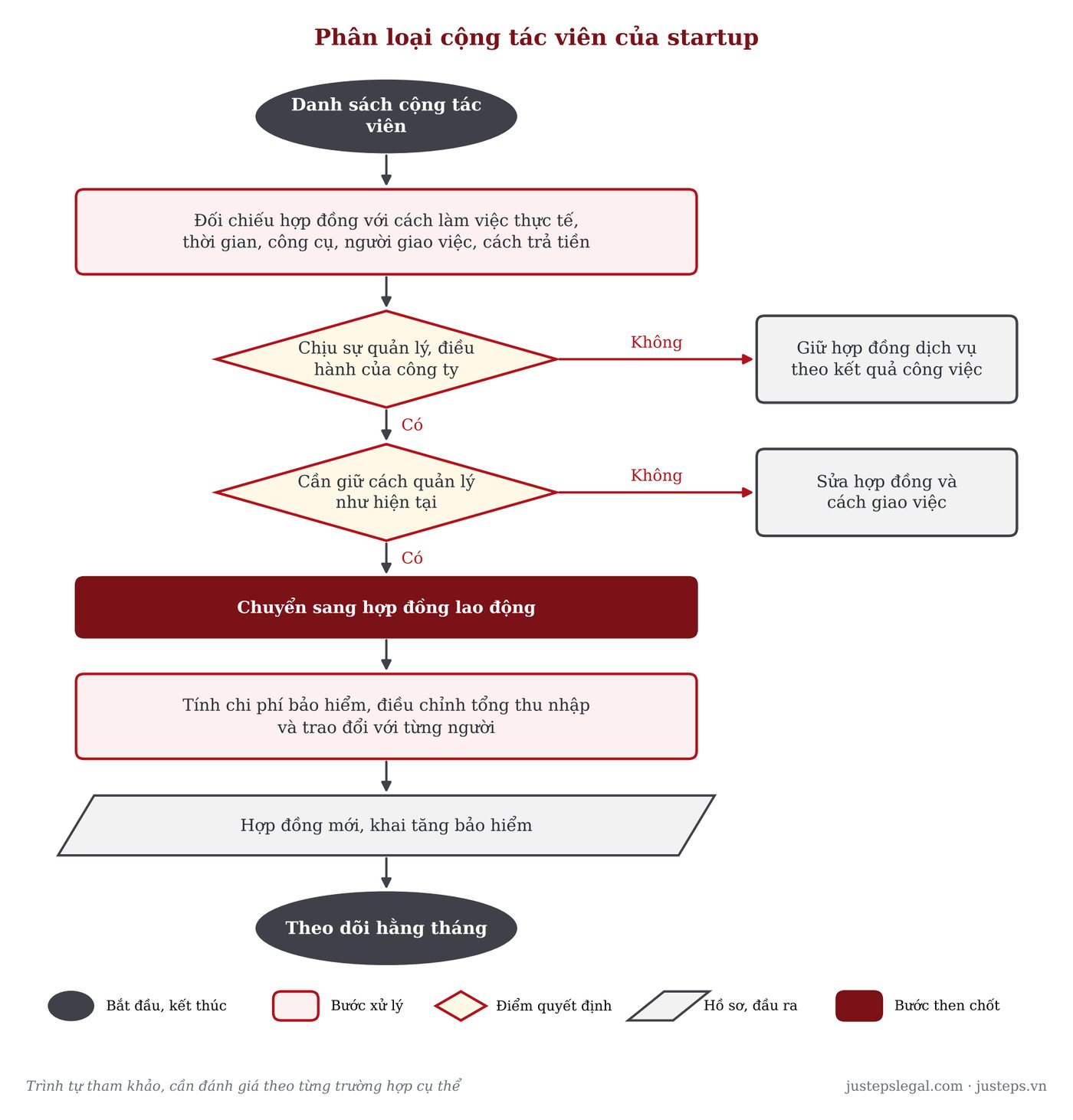
Sequence Justeps follows to decide whether a collaborator should remain on a service contract or move to an employment contract
The first question is whether the person is subject to management and direction as to working time, working methods and place of work; if not, an independent service contract remains appropriate provided that it is written around deliverables. If so, the next question is whether the business needs to keep the current management arrangements; if not, the contract and the way work is assigned are revised so that the person is genuinely independent, for example by paying per deliverable and leaving the person to choose their own time and tools. Where the company still needs to manage the person as an employee, Justeps recommends moving to an employment contract and calculating the resulting insurance cost, because this is the lower-risk option when investors carry out due diligence.
Other common mistakes
Excessive or repeated probation
Start-ups often impose a three-month probation for every position, or put an employee on probation a second time when they cannot yet decide. The Labour Code permits only one probation period for any given job, with a maximum duration depending on qualifications and position as shown in the table below, and probationary pay of at least eighty-five per cent of the wage for that job[2].
| Position or qualification | Maximum probation period |
|---|---|
| Enterprise managers | No more than 180 days, applicable to managerial titles under the Law on Enterprises. |
| College degree or higher | No more than 60 days, which covers most technical and product positions in a start-up. |
| Intermediate level, technical workers and professional staff | No more than 30 days. |
| Other jobs | No more than 6 working days. |
Accordingly, a three-month probation for a developer with a university degree exceeds the maximum of sixty days. Probation does not apply to employment contracts with a term of less than one month. Justeps redrafts the probation contract templates for each group of positions and schedules assessments before the expiry date so that the company can make a decision in time.
Low wages offset by shares
Many start-ups pay key staff below market rates and compensate with a promise of shares. This is lawful provided that wages are still not below the regional minimum and the share entitlement is set out in separate regulations, but it becomes a breach when the wage stated in the contract is below the minimum or when the shares are never actually granted. The wage stated in the contract is also the basis for insurance contributions, so stating a low wage to reduce insurance costs needs careful consideration. The employee share regulations are drafted under the service for building internal procedures and regulations for start-ups, and the employment contract simply refers to those regulations so that the two documents do not conflict.
Founders and remote workers
Under the Law on Social Insurance of 2024, enterprise managers who receive salaries are subject to compulsory social insurance[3]. A founder who receives no salary does not yet have this obligation, but once the founder starts drawing a salary from the company, participation in insurance should begin from the very first month. For remote workers, the contract must state the actual place of work, because it determines the applicable regional minimum wage, the place of insurance registration and liability in the event of an accident during working hours[4]. Start-ups can enter into electronic employment contracts under Decree No. 337/2025/ND-CP in order to sign with remote staff without meeting in person[5].
Regional minimum wages from 2027 and staff costs
Decree No. 399/2026/ND-CP adjusts the monthly minimum wage applicable from 1 January 2027, replacing the levels under Decree No. 293/2025/ND-CP that apply during 2026[6]. The figure below compares the two sets of levels across the four regions.
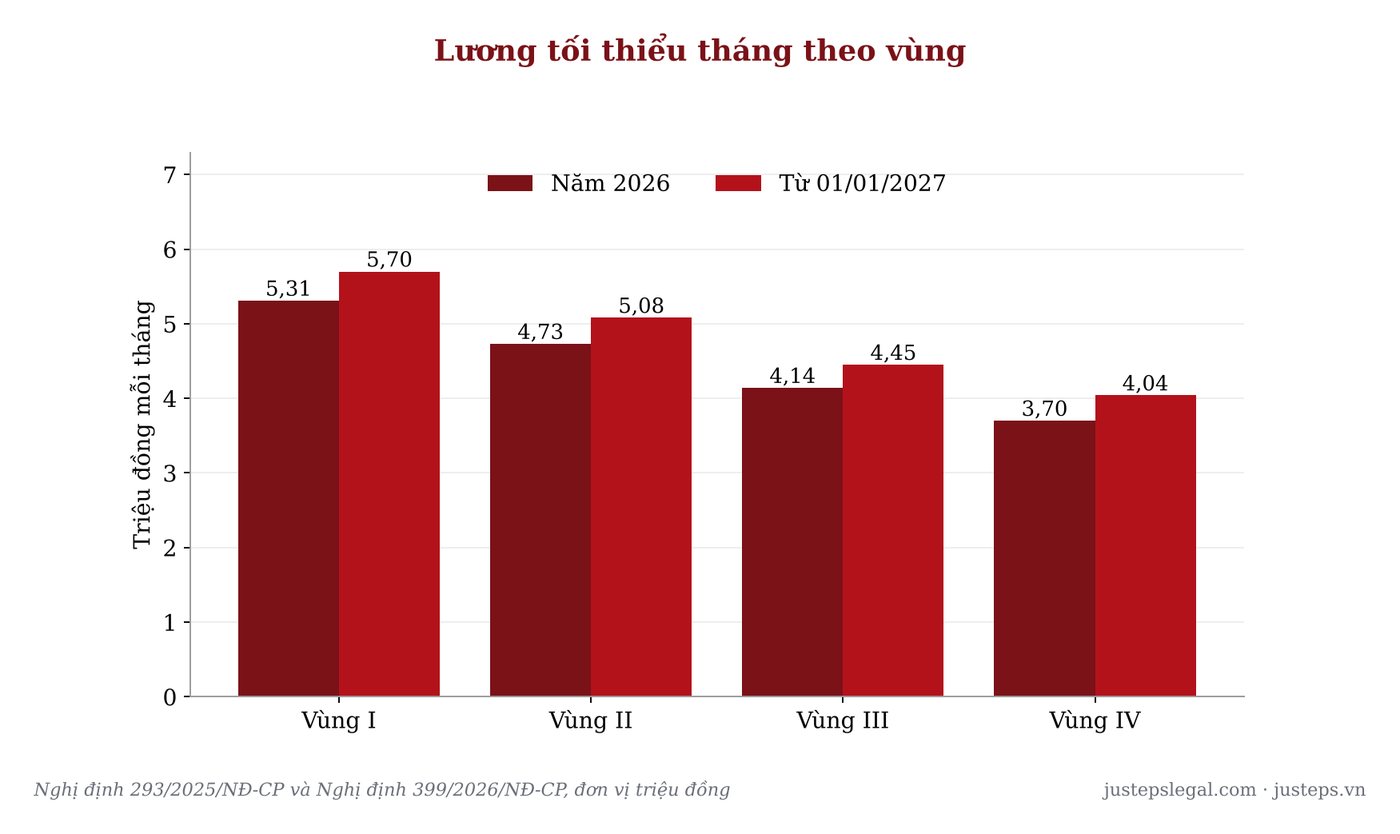
Monthly minimum wages by region in 2026 and from 1 January 2027
The increase in Region I is VND 390,000 per month, from VND 5,310,000 to VND 5,700,000. Most of a start-up’s technical staff earn well above this level, but customer support staff, paid interns and staff in lower-wage regions need to be reviewed. The minimum wage is also the floor for the wage on which insurance contributions are calculated, so this change increases the cost of positions currently contributing at a low level. Justeps prepares a staff cost table by position, covering wages, the employer’s insurance contributions and allowances, for the founding team to build into its cash flow plan.
Risks on fundraising or restructuring
During due diligence, investors usually compare the staff list with insurance contribution data and personal income tax returns. Every discrepancy is converted into a hidden liability, which may be deducted from the valuation, made a condition precedent to disbursement or covered by an indemnity required from the founders. Recipients of collaboration fees, freelancers and recipients of bonus shares each give rise to different personal income tax obligations, and withholding under the wrong category of income is also a point frequently raised in due diligence reports.
When a start-up downsizes or changes its product direction, dismissing a number of employees because of structural or technological change must be accompanied by a labour utilisation plan, consultation with the employee representative organisation where one exists and advance notice to the labour authority[7]. Employees who lose their jobs in this case are entitled to a job loss allowance equal to one month’s wages for each year of service, but no less than two months’ wages[8]. Start-ups often skip these steps because of their small size, and it is precisely these cases that tend to lead to prolonged complaints.
Scope of the service and delivery process
The service has two phases, a standardisation phase lasting about five weeks and a monthly monitoring phase. During the standardisation phase, Justeps carries out the following work:
- Justeps reviews the staff list, contracts, payroll for the last three to six months and insurance contribution data to identify discrepancies.
- Justeps reclassifies each collaborator and freelancer and reports the estimated insurance and tax amounts that need to be remedied.
- Justeps drafts templates for employment contracts, probation contracts, collaboration contracts, remote work annexes and confidentiality and intellectual property undertakings.
- Justeps provides guidance on adjusting insurance declarations and on withholding personal income tax for each category of income.
- Justeps prepares a template labour utilisation plan and termination documents for restructuring scenarios.
The second week is the most sensitive step, when the classification results and the amounts to be remedied are presented to the founders. When collaborators move to employment contracts, their take-home pay may fall because of the insurance contributions payable by employees, so Justeps prepares a plan for adjusting total remuneration and talking points for discussions with each person. Detailed pay scales, payrolls and pay and bonus regulations can be prepared together with the service for developing salary scales and pay and bonus regulations. After the standardisation phase, Justeps monitors monthly changes in headcount, probation deadlines, contracts nearing expiry and changes in the law.
Deliverables, application by size and fees
The enterprise receives a labour and insurance review report with a remediation roadmap, a set of standardised contract templates, pay scales and payrolls, a staff cost table by position, guidance on personal income tax withholding and template restructuring documents. A start-up with fewer than ten people must still sign the correct type of contract, pay insurance in full and establish pay scales, while one with ten or more workers also needs registered internal labour rules. A start-up with staff in several provinces or with foreign employees also needs to deal with different wage regions and work permits. Fees comprise a fixed fee for the standardisation phase and a monthly fee for the monitoring phase, depending on headcount, the number of types of employment relationship, the extent of the discrepancies to be remedied, the need to handle foreign staff and any plans for fundraising or restructuring.
How Justeps can help
In addition to labour, payroll and insurance services, start-ups and innovative start-up enterprises may combine the following Justeps services:
- Building internal procedures and regulations for start-ups and innovative start-up enterprises. Justeps drafts regulations on employee shares, intellectual property, labour rules and remote work so that employment contracts refer to them consistently.
- Ongoing legal advisory for start-ups and innovative start-up enterprises. Justeps answers monthly questions on staffing, contracts and tax, including tax incentives for experts working at innovative start-up enterprises.
- Salary scales and pay and bonus regulations. Justeps develops pay scales, payrolls and bonus regulations kept separate from share entitlements.
- Labour, payroll and insurance. Justeps supports labour, insurance and work permit procedures as the start-up scales up.
Frequently asked questions
Does a start-up with fewer than ten people have to pay social insurance?
Yes. The obligation to pay insurance depends not on the number of employees but on the type and term of the contract[3]. Having fewer than ten people only affects whether written internal labour rules are mandatory.
Can a collaboration contract replace an employment contract?
Only where the person genuinely works independently, decides their own time and methods and is paid by results. Where there are wages and management, direction and supervision by the company, the relationship is still treated as an employment relationship[1].
Can probation be repeated if the assessment is not yet complete?
No, each job may be subject to probation only once[2]. The company should schedule the assessment before the probation ends and decide in time whether to sign an employment contract or terminate.
Must a founder who is General Director but receives no salary pay insurance?
Enterprise managers are subject to compulsory insurance when they receive a salary[3]. If no salary is received, the obligation does not yet arise, but there should be a clear decision that the position is unpaid so that it can be explained on inspection.
Which wage region applies to a remote worker in another province?
The regional minimum wage is usually determined by the area where the employee actually works as stated in the contract. The contract of a remote worker should therefore state the place of work clearly rather than only the company’s head office address[4].
Does moving a collaborator to an employment contract reduce their income?
Take-home pay may fall because of the insurance contributions payable by the employee, even though they gain insurance benefits. Justeps usually proposes a plan for adjusting total remuneration so that employees accept the change.
Related articles
- Managing seasonal workers and freelance collaborators in line with the true nature of the contract and contribution obligations
- Probation under the Labour Code 2019, its duration, wages and the end of the probation period
- Regional minimum wages from 1 January 2027 and reviewing pay scales, contracts and insurance
- A monthly procedure for managing social insurance
Notes
[1] Clause 1 of Article 13 of the Labour Code No. 45/2019/QH14 dated 20 November 2019.
[2] Articles 24, 25 and 26 of the Labour Code No. 45/2019/QH14 dated 20 November 2019.
[3] Article 2 of the Law on Social Insurance No. 41/2024/QH15 dated 29 June 2024, effective from 1 July 2025.
[4] Article 21 of the Labour Code No. 45/2019/QH14 dated 20 November 2019, on the contents of employment contracts.
[5] Decree No. 337/2025/ND-CP of the Government on electronic employment contracts.
[6] Decree No. 399/2026/ND-CP on minimum wages applicable from 1 January 2027; Decree No. 293/2025/ND-CP on minimum wages applicable until 31 December 2026.
[7] Articles 42 and 44 of the Labour Code No. 45/2019/QH14 dated 20 November 2019.
[8] Article 47 of the Labour Code No. 45/2019/QH14 dated 20 November 2019.
This article is for reference and reflects the regulations in force at the time of publication. Please consult Justeps for advice tailored to your company’s records and situation.
For further information, please contact:
📩 Email: info@justeps.vn
🌐 Website: https://justepslegal.com · https://justeps.vn
🌐 Page: Justeps
☎️ Hotline (Zalo): 096 172 2607
📍 Thanh Xuan Office: 12th Floor, Licogi 13 Tower, 164 Khuat Duy Tien Street, Thanh Xuan Ward, Hanoi, Vietnam
📍 Ha Dong Office: LK06B, No.10, Dong Dua Area, Ha Dong Ward, Hanoi, Vietnam
📍 Ho Chi Minh City Branch: 528 Le Van Sy, Ho Chi Minh City, Vietnam
📍 Hai Phong Office: Truong Thinh Village, Ha Dong Commune, Hai Phong, Vietnam
📍 Quang Ninh Office: Van Don Special Zone, Quang Ninh Province, Vietnam





