MANAGEMENT CONSULTING FOR TECHNOLOGY COMPANIES, PROJECT MANAGEMENT, OKRS, TALENT RETENTION AND COSTS
Technology companies grow fast with young teams and often run in a start-up spirit. Once headcount passes a few dozen, management problems appear: projects run late and over budget, team goals diverge, strong engineers leave with product knowledge, and staff costs take most of revenue yet are hard to measure.
This article analyses management areas specific to technology companies, including agile project management, OKR goal setting, talent retention, pay, bonus and employee share programmes, and cost control by project and product, linked to related legal requirements in force as of November 2026. It includes an OKR cycle, a cost structure chart, an attrition trend and a risk matrix.
The objectives and key results management cycle
Technology companies need a mechanism for dozens of teams working in parallel to aim at one goal. OKRs, developed by Andy Grove at Intel and popularised by Google, consist of a qualitative objective and three to five measurable key results, usually set quarterly.[1]
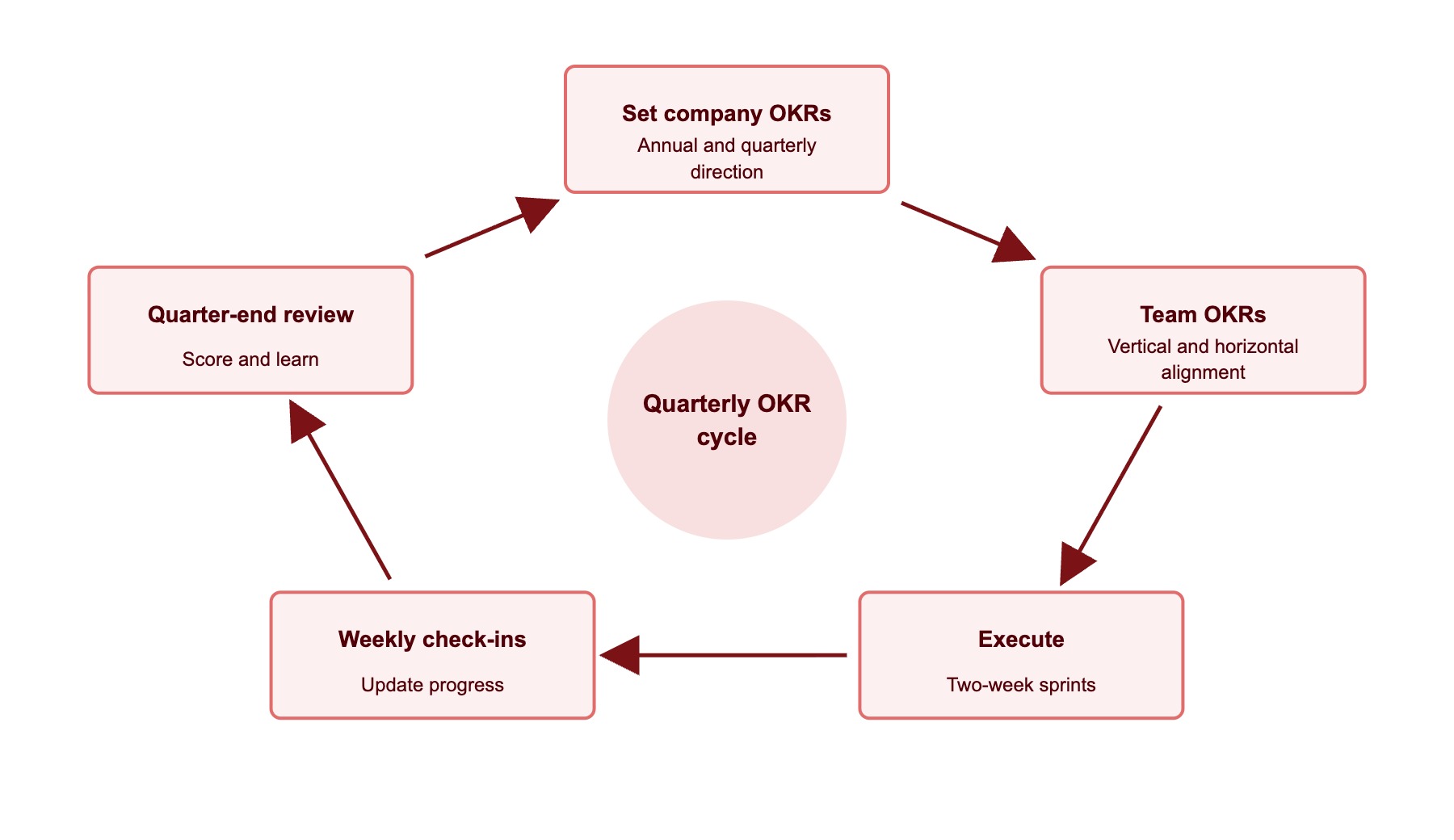
OKRs work only when reasonably separated from pay decisions, so teams dare to set ambitious goals.
Common management issues and solutions
| Area | Common issues | Solution | Deliverables |
|---|---|---|---|
| Project management | Delays, constantly changing requirements | Scrum or Kanban process, scope change management | Project procedure, report templates |
| Goals | Teams follow their own priorities | OKRs aligned between company and teams | OKR framework, review calendar |
| Organisation | Overlapping product and engineering management | Product-based or matrix organisation | Organisation chart, role table |
| Talent | High turnover among key staff | Career paths, competency framework, shares | Competency framework, retention policy |
| Pay and bonus | Uncompetitive salary scales, subjective bonuses | Market pay survey, bonus regulation | Salary scale, bonus regulation |
| Costs | No profit view by project or product | Project timesheets, cost allocation | Project profit reports |
Businesses should prioritise areas most affecting delivery and retention.
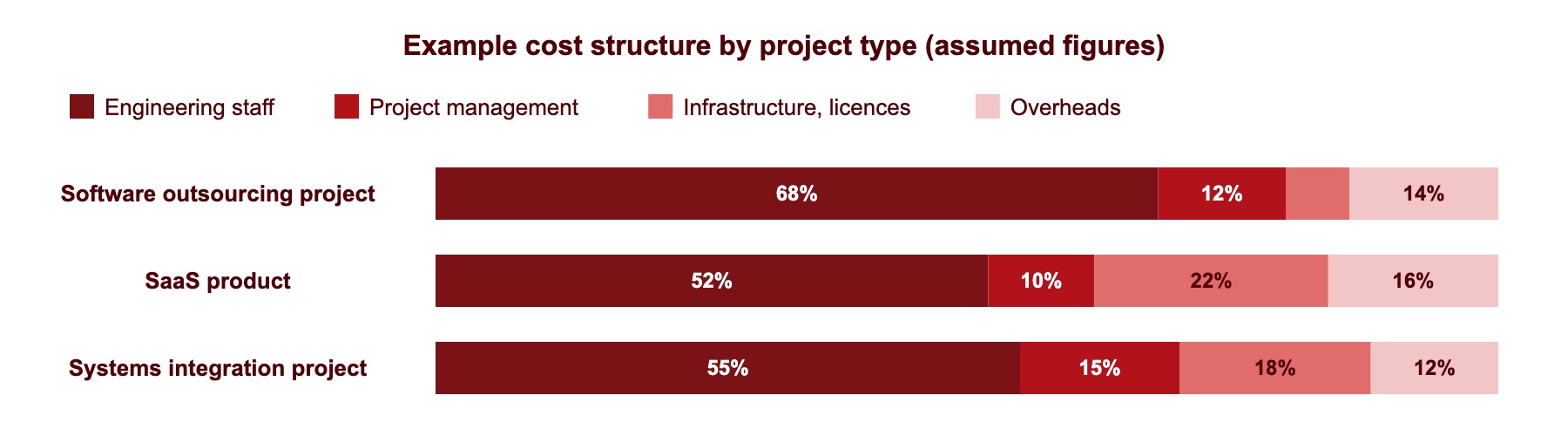
For technology companies, staff cost is the largest item and must be viewed by project.
Cost control and profit by project and product
When staff costs make up most of total costs, project timesheets are the only way to know which projects are profitable. This data also helps price future contracts more realistically.
| Indicator | How to measure | Meaning |
|---|---|---|
| Billable hours ratio | Hours on revenue projects divided by total hours | Resource utilisation |
| Project margin | Project revenue minus direct costs, divided by revenue | Profitability per project |
| Velocity | Work items completed per sprint | Team delivery capacity |
| Post-release defect rate | Critical defects per release | Product quality |
Choose indicators suited to an outsourcing or product model.
Cost is one side; the other is keeping the people who create value.
Talent retention, pay and employee shares
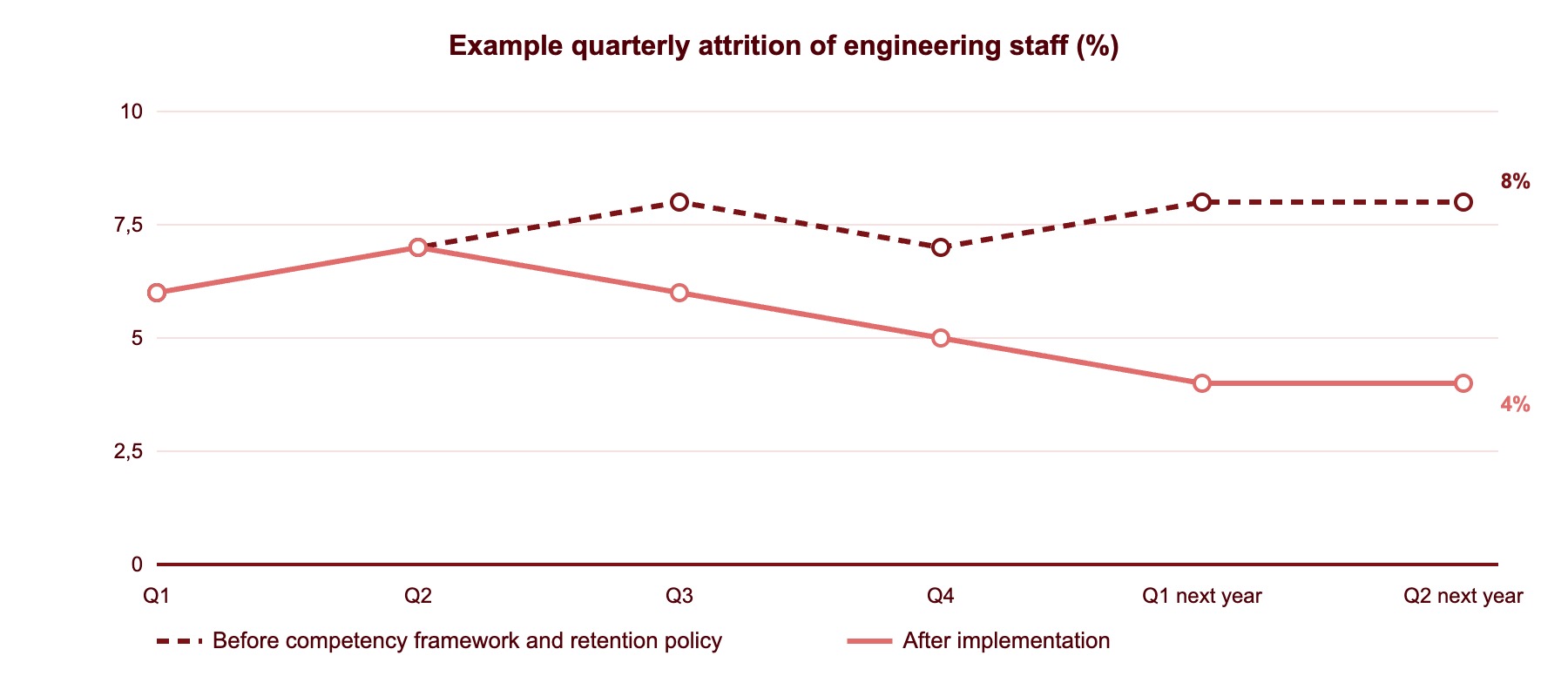
- Competency framework and career paths. Parallel tracks for technical experts and managers, so strong engineers need not become managers to earn more.
- Competitive salary scales. Built under Article 93 of the Labour Code with reference to market levels.[2]
- Transparent bonus regulation. Clear conditions and amounts so bonuses are deductible under Decree 320/2025/ND-CP.[3]
- Employee shares. For joint stock companies, issuing shares to employees must follow the authority of the general meeting and board of directors and the private placement procedure under the Law on Enterprises and the charter; vesting periods and buy-back conditions on departure should be set.[4]
Real cases show how closely these areas are linked.
Case analysis of technology company management
Case one, outsourcing projects keep overrunning
Clients change requirements without a scope change process. A change request process assessing cost and schedule impact, confirmed by the client before work, is needed.
Case two, a lead engineer leaves with system knowledge
There is no architecture documentation or handover procedure. Technical documentation, handover rules and a key staff retention policy are needed.
Case three, OKRs turn into pay-scoring KPIs
Teams set low goals to be sure of meeting them. OKR scoring should be separated from the bonus formula, using OKRs for direction and overall capability assessment.
Case four, unconditional shares for a co-founder
A co-founder leaves early but keeps a large stake. A shareholders' agreement with vesting and buy-back clauses is needed.
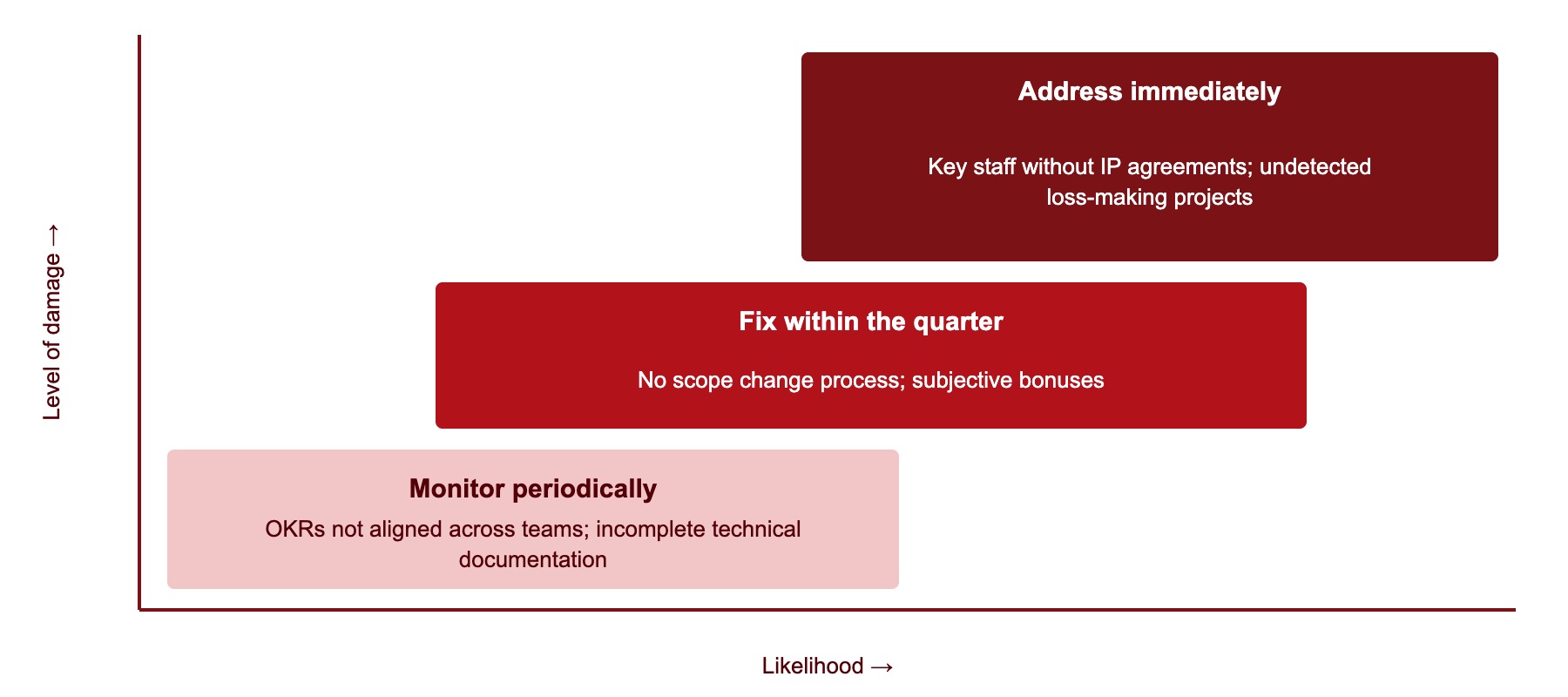
Risks of technology company management without a system
- Delivery risk. Delays, overruns, loss of strategic clients.
- Talent risk. High turnover, loss of product knowledge.
- Financial risk. No visibility of project profit, mispriced contracts.
- Legal risk. Bonuses and shares without proper procedure; intellectual property not owned by the company for lack of agreements.
Suggested management consulting roadmap for technology companies
| Phase | Content | Deliverables | Suggested timing |
|---|---|---|---|
| Diagnosis | Project profit, attrition, project processes | Diagnostic report | Month 1 |
| Goals, organisation | OKR framework, product-based organisation | OKR set, organisation chart | Month 2 |
| Projects, costs | Project process, project timesheets | Procedures, project reports | Months 2 to 3 |
| Talent | Competency framework, salary scale, bonus regulation, shares | HR policy set | Months 3 to 4 |
| Measurement | Project profit and attrition reports | Management report set | From month 5 |
Suggested roadmap; adjust to an outsourcing or product model.
Related articles and templates
- Business consulting for technology companies on intellectual property, software contracts, personal data and labour
- Business management consulting, when it is needed, scope, process and how to measure results
- Template regulation on Lunar New Year bonus 2027
- Management standardisation
How Justeps supports businesses
Justeps helps technology companies build OKR frameworks, product-based organisations, project and scope change processes, project timesheets and profit reports, competency frameworks, salary scales, bonus regulations and employee share programmes.
→ Learn about Justeps business management consulting services
Notes and references
- Doerr, J., Measure What Matters, Portfolio, 2018; Grove, A., High Output Management, 1983.
- Article 93 of the Labour Code No. 45/2019/QH14.
- Article 9 and Clause 8, Article 10 of Decree No. 320/2025/ND-CP dated 15/12/2025.
- Law on Enterprises No. 59/2020/QH14 (as amended) on offering authority and private placement of shares.
This article is for research and reference only, reflects regulations in force at the time of publication (11/2026) and does not replace advice for specific cases.
For more information, please contact:
📩 Email: info@justeps.vn
🌐 Website: https://justepslegal.com · https://justeps.vn
🌐 Page: Justeps
☎️ Hotline (Zalo): 096 172 2607
📍 Thanh Xuan Office: 12th Floor, Licogi 13 Tower, 164 Khuat Duy Tien Street, Thanh Xuan Ward, Hanoi, Vietnam
📍 Ha Dong Office: LK06B, No.10, Dong Dua Area, Ha Dong Ward, Hanoi, Vietnam
📍 Ho Chi Minh City Branch: 528 Le Van Sy, Ho Chi Minh City, Vietnam
📍 Hai Phong Office: Truong Thinh Village, Ha Dong Commune, Hai Phong City, Vietnam
📍 Quang Ninh Office: Van Don Special Zone, Quang Ninh Province, Vietnam