MANAGEMENT CONSULTING FOR CONSTRUCTION COMPANIES, PROJECT CONTROL, SITE COSTS AND CASH FLOW
A construction company can win many tenders and grow revenue strongly yet still lack cash for wages and suppliers. The cause is often not construction capability but management: site costs exceeding budget go unnoticed, slow acceptance documentation delays payment, subcontractors are not controlled, and site managers decide every expense without the office knowing.
This article analyses management areas specific to construction companies, including project-by-project management, construction budgets and cost control, subcontractor and materials management, cash flow linked to acceptance, occupational safety and delegation between office and site, reflecting regulations in force as of November 2026. It includes a flowchart, a site profit bridge chart, a sample schedule and a risk matrix.
Overview flowchart of managing a construction project
Each project has its own budget, schedule and risks. The two most important control points are preparing the construction budget before groundbreaking and periodic acceptance and payment.
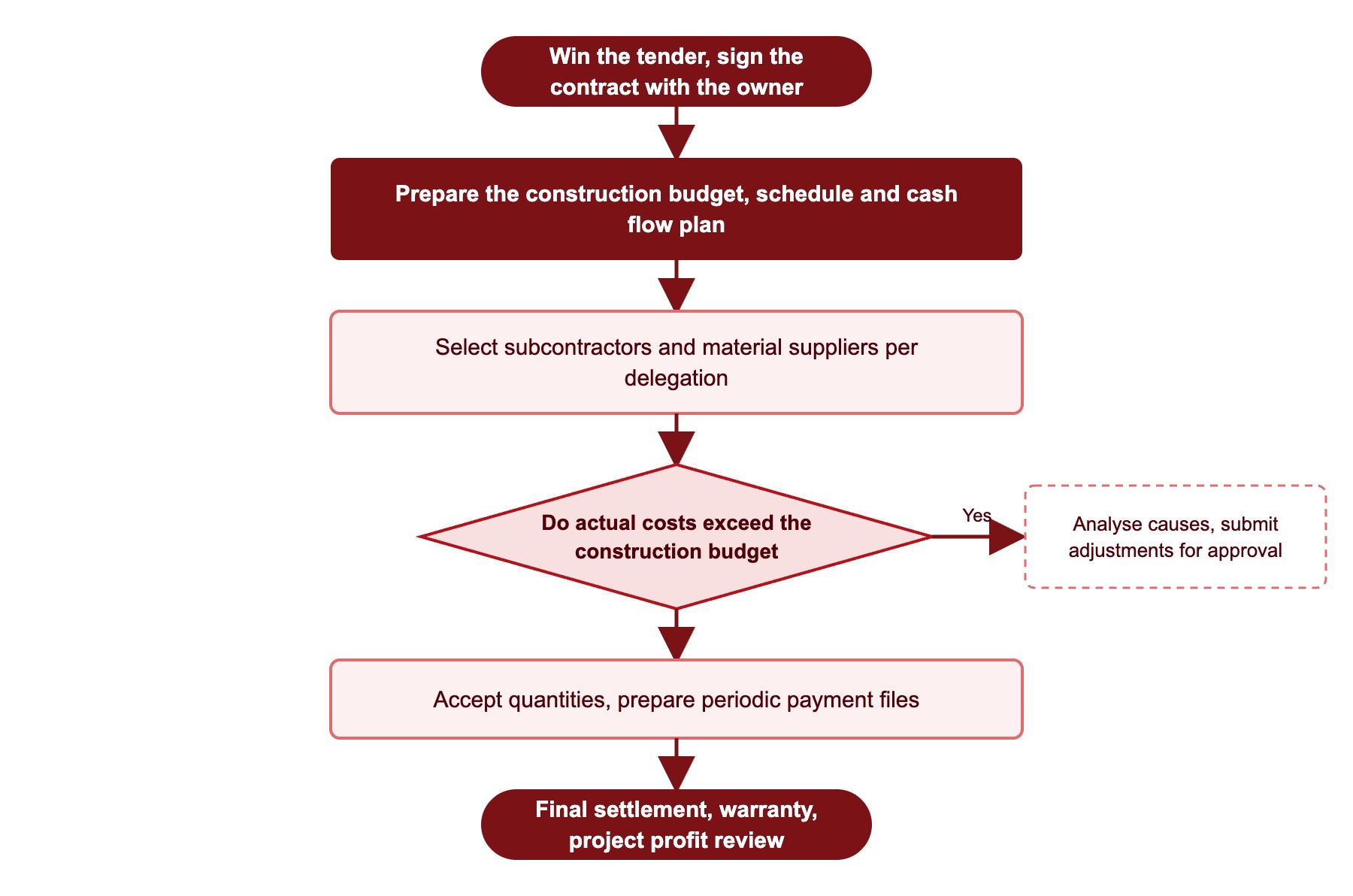
Managing by project requires a consistent project management framework.
Theoretical basis of construction project management
The PMBOK body of knowledge treats scope, schedule and cost as the three main project constraints.[1] Earned value management compares the value of work completed with actual and planned cost, helping detect early whether a project is over budget or behind schedule.[2]
| Indicator | Formula | Meaning |
|---|---|---|
| Cost variance (CV) | Earned value minus actual cost | Negative means over budget |
| Schedule variance (SV) | Earned value minus planned value | Negative means behind schedule |
| Cost performance index (CPI) | Earned value divided by actual cost | Below 1 means inefficient |
| Schedule performance index (SPI) | Earned value divided by planned value | Below 1 means delayed |
Indicators should be calculated monthly for each project.
These indicators are only meaningful when the construction budget is prepared and controlled tightly.
Construction budgets and site cost control
A construction budget differs from the winning bid price. It is a detailed internal budget for materials, labour, equipment, subcontractors and overheads, used for assigning work and controlling costs. Without it, a company only learns of profit or loss at final settlement.
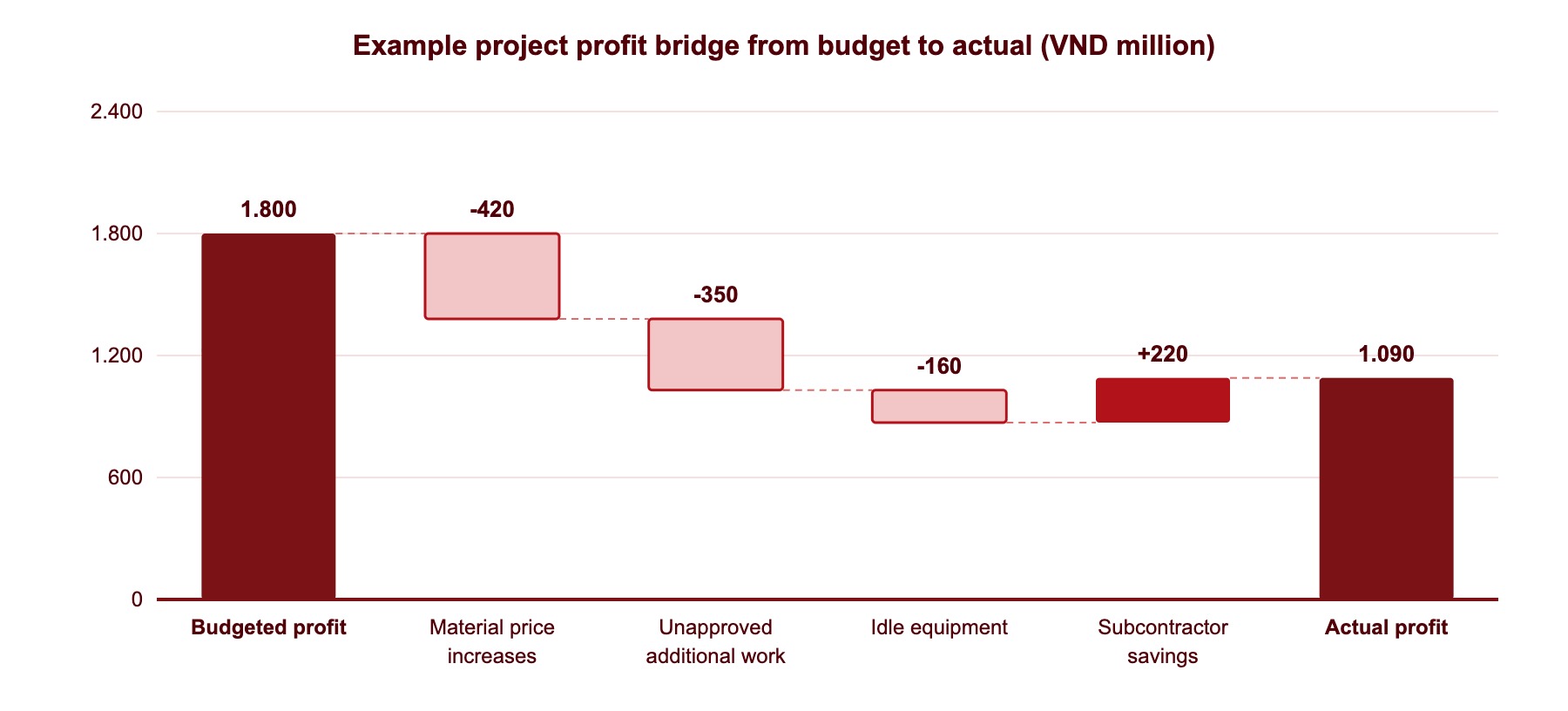
| Item | Common causes of overruns | Control measures |
|---|---|---|
| Materials | Wastage, small purchases at high prices, site losses | Material norms, central purchasing, periodic stocktakes |
| Labour, subcontractors | Unclear quantities, payment before acceptance | Lump-sum contracts based on accepted quantities |
| Equipment | Idle machines, poor deployment | Equipment scheduling across projects |
| Variations | Additional work before owner approval | Written variation confirmation procedure |
| Site overheads | Site spending without limits | Spending limits per project, approval delegation |
Measures should be recorded in the project management regulation.
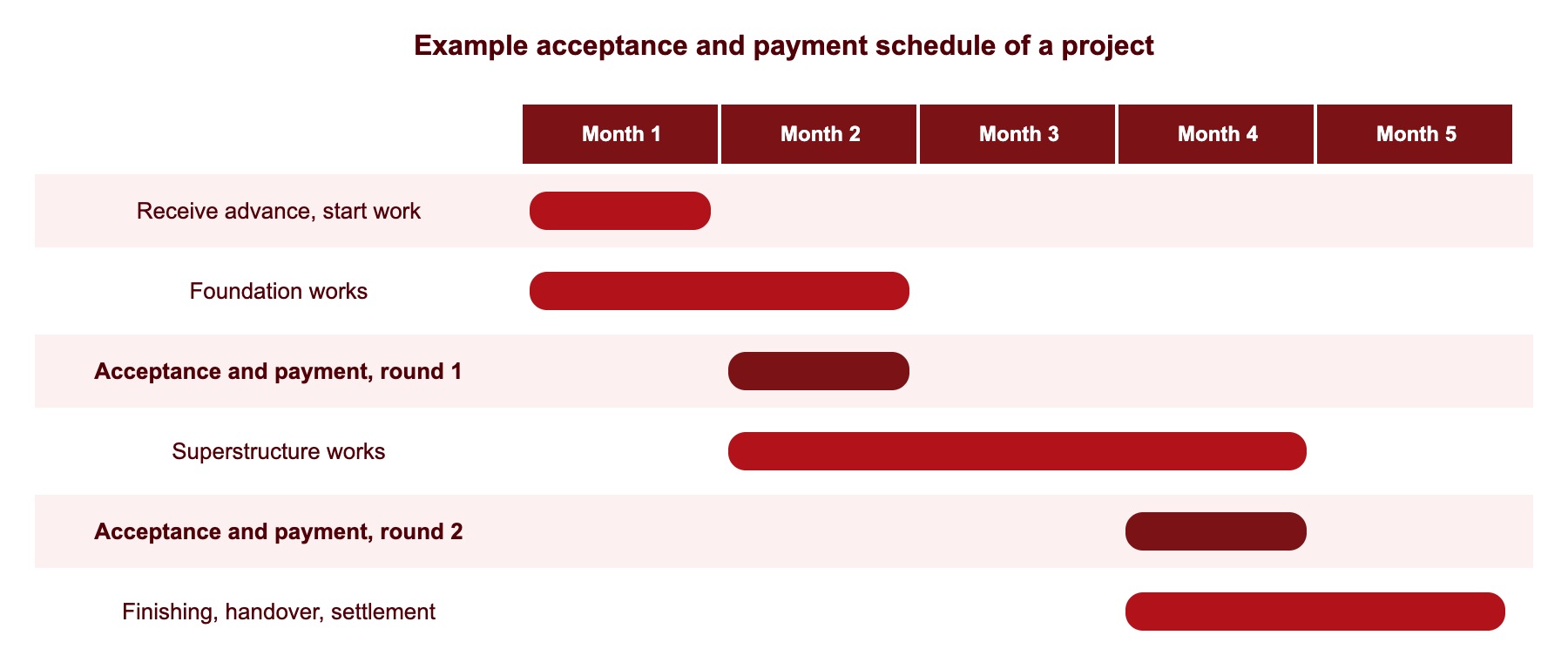
A construction company's cash flow depends directly on the speed of acceptance.
Cash flow tied to acceptance and subcontractor management
Owners usually pay for accepted quantities after deducting advances and retaining part of the value for warranty. Meanwhile, the company must pay wages, materials and subcontractors monthly. A delay of a few weeks in acceptance files can force short-term borrowing at high interest.
Controlling subcontractors
- Select by capability. Check construction capacity conditions appropriate to the assigned work.
- Subcontracts mirror the main contract. Schedule, quality, warranty and penalty clauses no looser than those with the owner.
- Pay on acceptance. Pay only for accepted quantities and retain corresponding warranty amounts.
- Safety and labour responsibility. Subcontractors must insure their workers and follow site safety rules.
Alongside money and schedule, occupational safety is the biggest site risk.
Occupational safety, site labour and delegation
The 2015 Law on Occupational Safety and Health requires employers to provide safety training, personal protective equipment and safe working conditions; construction is a sector with a high rate of occupational accidents.[3] Under the Law on Social Insurance No. 41/2024/QH15, employees with labour contracts of one full month or more are subject to compulsory social insurance, including project-based workers.[4]
Delegation between office and site
Site managers need enough authority to handle urgent matters, but all spending must be within budget and limits. The delegation matrix should distinguish spending within budget, spending over budget, additional quantities and contracting with subcontractors.
These issues are clear in real cases.
Case analysis of construction company management
Case one, revenue grows but cash runs short
The company takes on many projects at once and acceptance files pile up. The solution is a dedicated documentation team, an acceptance schedule tied to the cash flow plan and receivables reports by owner.
Case two, additional work not paid
The site carries out extra work at the verbal request of the owner's representative. At settlement, the quantities are not recognised. The regulation should require written variation confirmation before work.
Case three, a subcontractor abandons the project
A subcontractor receives a large advance but abandons the work. Advances should require guarantees, payment should follow acceptance, and the right to replace subcontractors should be reserved.
Case four, retention money recovered late
Warranty retention is often forgotten after handover. A register of warranty periods per project and a timely release request procedure are needed.
Risks of construction company management without a system
- Financial risk. Overruns not detected early, working capital shortages due to slow acceptance.
- Contract risk. Unpaid variations, delay penalties, disputes over retention money.
- Safety risk. Occupational accidents causing harm to people, property and legal liability.
- Tax risk. Site costs without proper invoices and documents disallowed at finalisation.
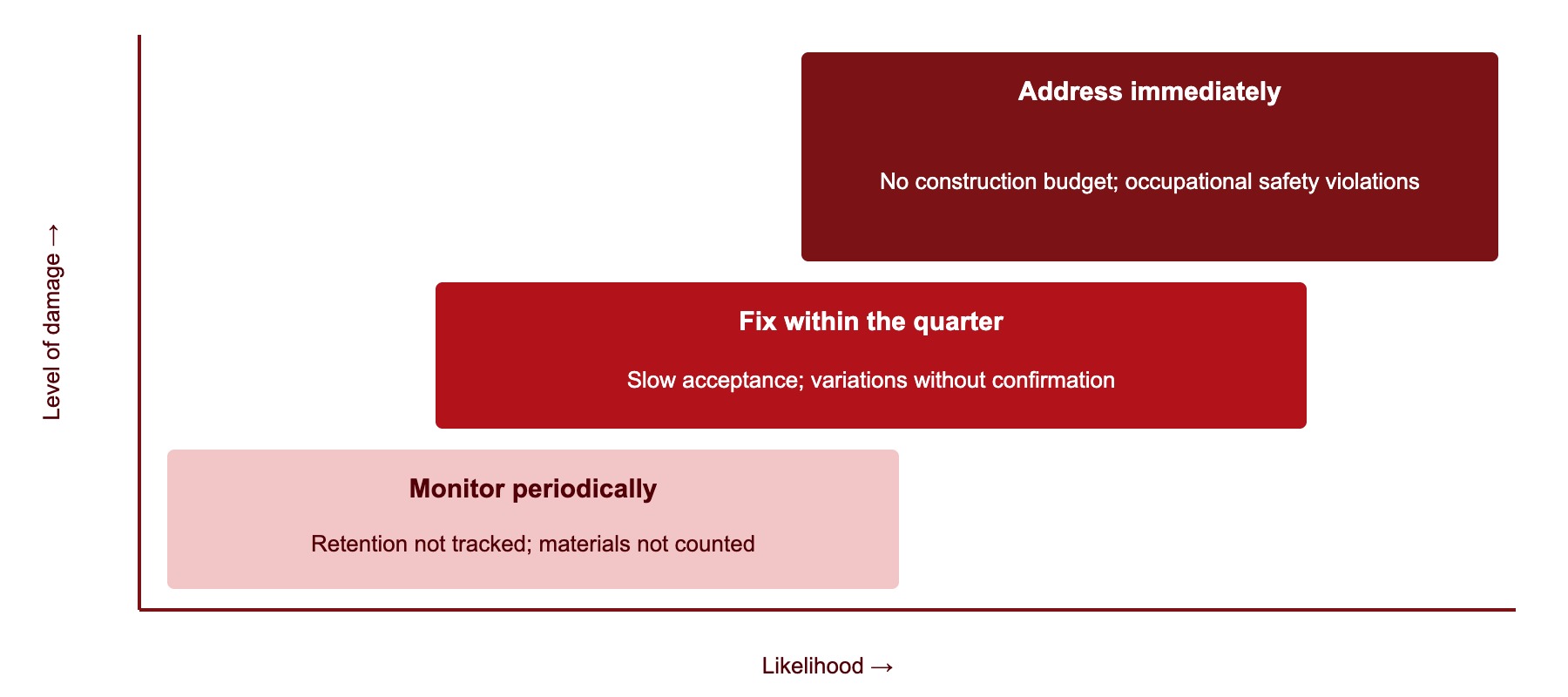
Suggested management consulting roadmap for construction companies
| Phase | Content | Deliverables | Suggested timing |
|---|---|---|---|
| Diagnosis | Assess profit or loss per project, current procedures | Diagnostic report | Month 1 |
| Design | Project management regulation, construction budget, delegation | Regulations, delegation matrix | Month 2 |
| Cash flow | Acceptance, payment and warranty tracking procedures | Acceptance schedule, cash flow report | Months 2 to 3 |
| Subcontractors, safety | Template subcontracts, safety procedures | Contract set, procedures | Month 3 |
| Measurement | Monthly CPI and SPI reports | Project management reports | From month 4 |
Suggested roadmap; adjust to the number of projects under construction.
Related articles and templates
- Business consulting for construction companies on contracts, payment, subcontractors and occupational safety
- Business management consulting, when it is needed, scope, process and how to measure results
- Template approval authority matrix for expenses, procurement and payments
- Budget, cash flow and management reporting
How Justeps supports businesses
Justeps helps construction companies diagnose profit by project, build project management regulations, construction budgets, delegation matrices between office and site, acceptance and payment procedures, subcontractor management and earned value management reports.
→ Learn about Justeps business management consulting services
Notes and references
- Project Management Institute, A Guide to the Project Management Body of Knowledge (PMBOK Guide).
- Earned Value Management, ANSI/EIA-748.
- Law on Occupational Safety and Health No. 84/2015/QH13.
- Law on Social Insurance No. 41/2024/QH15.
This article is for research and reference only, reflects regulations in force at the time of publication (11/2026) and does not replace advice for specific cases.
For more information, please contact:
📩 Email: info@justeps.vn
🌐 Website: https://justepslegal.com · https://justeps.vn
🌐 Page: Justeps
☎️ Hotline (Zalo): 096 172 2607
📍 Thanh Xuan Office: 12th Floor, Licogi 13 Tower, 164 Khuat Duy Tien Street, Thanh Xuan Ward, Hanoi, Vietnam
📍 Ha Dong Office: LK06B, No.10, Dong Dua Area, Ha Dong Ward, Hanoi, Vietnam
📍 Ho Chi Minh City Branch: 528 Le Van Sy, Ho Chi Minh City, Vietnam
📍 Hai Phong Office: Truong Thinh Village, Ha Dong Commune, Hai Phong City, Vietnam
📍 Quang Ninh Office: Van Don Special Zone, Quang Ninh Province, Vietnam