MANAGEMENT CONSULTING FOR LOGISTICS COMPANIES, FLEET, WAREHOUSING, KPIS AND COST CONTROL
Logistics companies operate around the clock with hundreds of orders, trips and transactions every day. Margins per trip are usually thin, so a high empty-running rate, fuel leakage or damaged goods without accountability can wipe out a month's profit. Many companies still dispatch by phone, messages and spreadsheets, leaving data scattered and hard to control.
This article analyses management areas specific to logistics companies, including order processes, fleet dispatch, warehouse management, operating KPIs, fuel and trip cost control, delegation and data, linked to related legal obligations in force as of November 2026. It includes a flowchart, an order funnel, a KPI chart and a risk matrix.
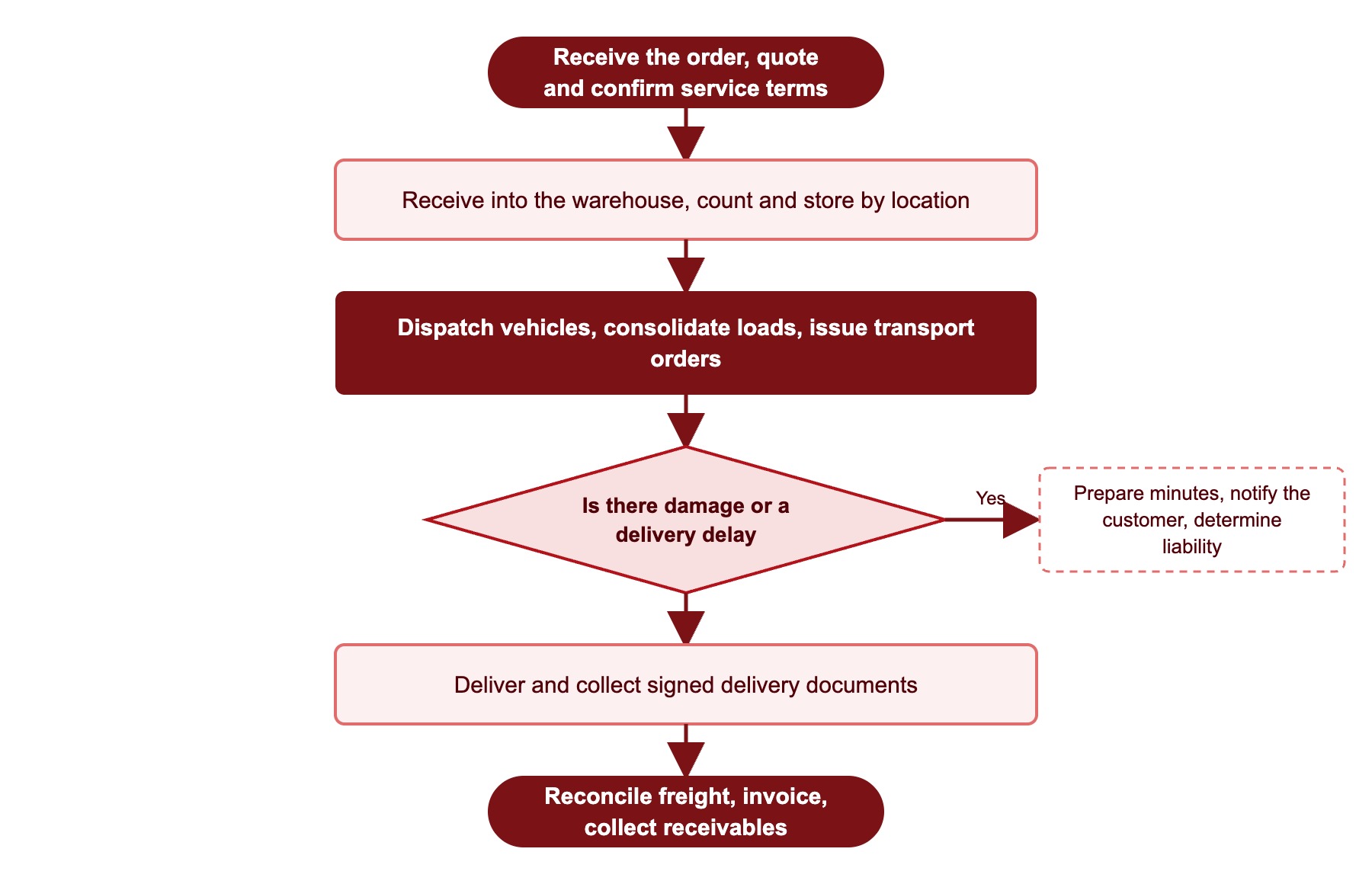
Overview flowchart of handling a logistics order
A logistics order passes through sales, dispatch, warehouse, fleet and accounting. The most important control point is dispatch, which determines trip cost and on-time delivery.
Measuring this chain requires a consistent set of indicators.
Theoretical basis of supply chain management and operating indicators
The SCOR supply chain reference model assesses logistics by reliability, responsiveness, agility, cost and asset efficiency.[1] On-time in-full (OTIF) delivery directly reflects customer experience, while vehicle utilisation and inventory turnover reflect asset efficiency.
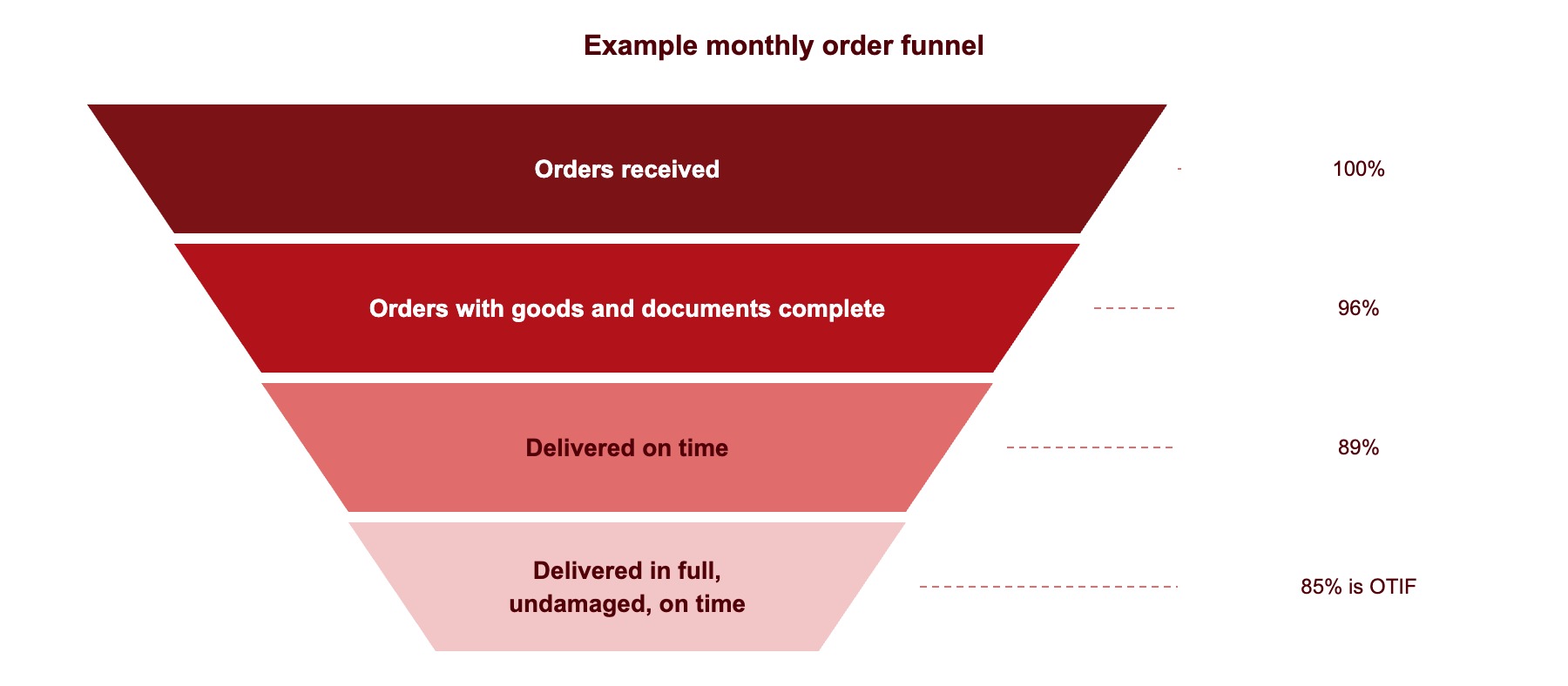
Each layer of loss in the funnel points to a management weakness to address.
Common management issues and solutions
| Area | Common issues | Solution | Deliverables |
|---|---|---|---|
| Orders, quotes | Quotes not covering full cost, loss-making orders | Route cost tables, price approval procedure | Costing model, quoting procedure |
| Fleet dispatch | Empty return trips, poor load consolidation | Consolidation rules, route planning | Dispatch procedure, vehicle KPI sheet |
| Fuel, trip costs | Unclear norms, leakage | Norms by vehicle type and route, GPS data reconciliation | Norm regulation, reconciliation reports |
| Warehousing | Inventory discrepancies, slow picking | Receiving and issuing procedures, cycle counts, storage locations | Warehouse procedures, count forms |
| Incidents, complaints | Unclear liability for damaged goods | Incident procedure, minutes, liability allocation | Incident procedure, minutes template |
| Data | Scattered information, slow reports | Connect order, trip, warehouse and accounting data | Daily and weekly management reports |
Businesses should prioritise the area with the greatest waste.
Among these, trip and fleet costs usually account for the largest share.
Operating KPIs and trip cost control
| Indicator | Formula | Frequency |
|---|---|---|
| OTIF rate | Orders delivered in full, on time, undamaged over total orders | Weekly |
| Load utilisation | Actual load divided by rated capacity | Daily |
| Empty running rate | Empty km divided by total km | Weekly |
| Fuel consumption | Litres per 100 km by vehicle type and route | Per trip |
| Inventory accuracy | SKUs matching counts over total SKUs counted | Monthly |
| Cost per order | Total operating cost divided by number of orders | Monthly |
Businesses should choose indicators suited to their service model rather than use all.
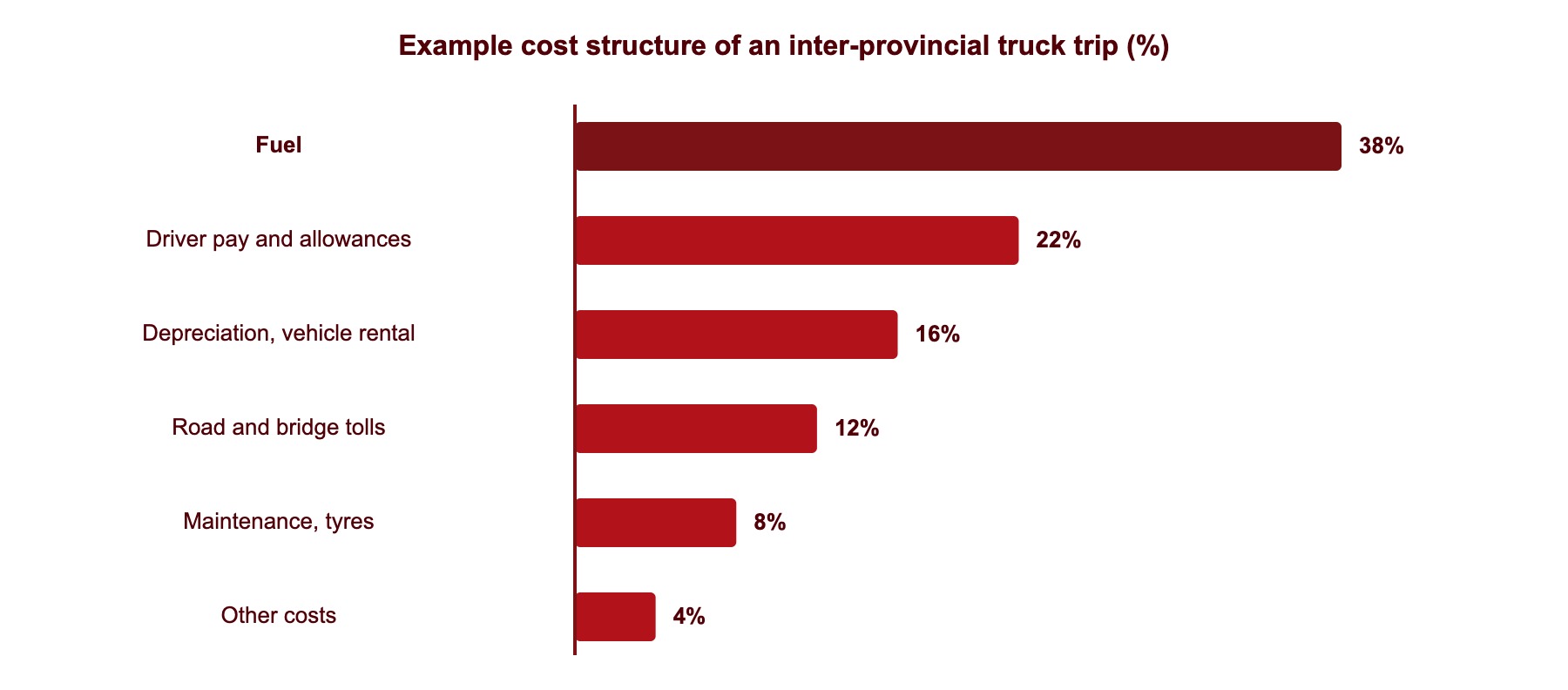
Fuel control
Fuel norms should be set by vehicle type, load and route, then reconciled with tracking device data. Under road traffic law, commercial transport vehicles must be fitted with journey monitoring devices; this data serves both compliance and control of distance, driving time and fuel.[2]
Indicators only work when linked to delegation and pay mechanisms.
Delegation, driver pay and related legal requirements
- Dispatch delegation. Dispatchers decide load consolidation within norms; trips incurring costs beyond norms require the department head's approval.
- Driver pay. Base pay plus lump sums per trip, km or revenue; fuel saving and safety bonuses; conditions and amounts must be stated in the regulation to be deductible under Decree 320/2025/ND-CP.[3]
- Working hours. Drivers' driving time is limited under road traffic order and safety law; dispatch schedules must comply to avoid violations and accidents.
- Liability for goods. Service contracts should set liability limits, complaint deadlines and cargo insurance.
These points often become clear through real cases.
Case analysis of logistics company management
Case one, revenue grows but profit falls
The company takes on many new routes at competitive prices without a route costing model. Analysis shows some routes lose money due to empty return trips. The solution is a cost-based price approval procedure and return-load planning.
Case two, damaged goods with unclear liability
Delivery minutes lack the condition of goods at pickup. Pickup minutes should be standardised with photos and signatures, plus a 24-hour incident procedure.
Case three, persistent fuel overconsumption
Tracking data shows vehicles deviating from routes. A norm regulation, reward and penalty mechanism and weekly reconciliation reports are needed.
Case four, prolonged customer receivables
Delivery documents reach the office late, delaying freight reconciliation. Delivery documents should be digitised upon delivery with a regular reconciliation schedule with customers.
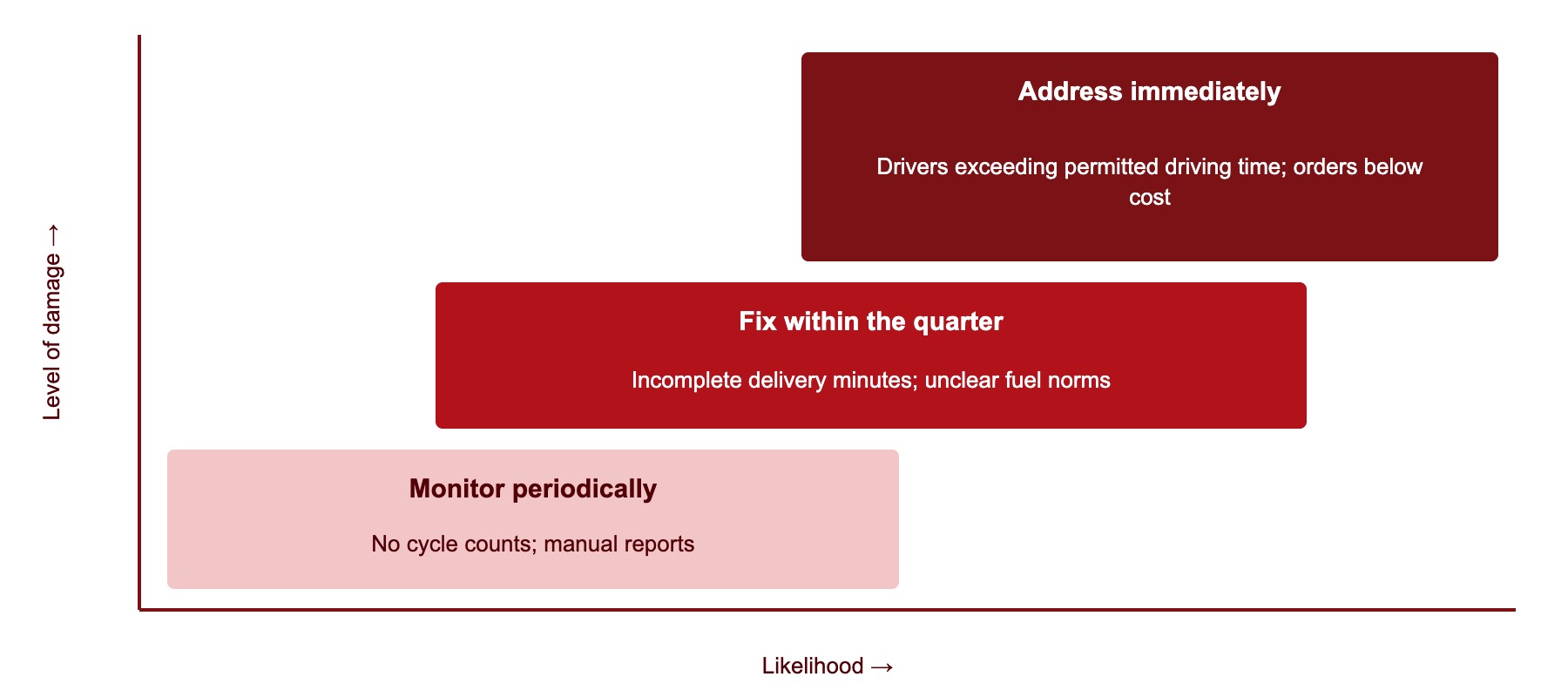
Risks of logistics management without a system
- Financial risk. Loss-making routes undetected, fuel leakage, prolonged receivables.
- Customer risk. Low OTIF leading to lost contracts and service-level penalties.
- Safety risk. Drivers working excessive hours and poorly maintained vehicles causing accidents.
- Legal risk. Compensation for goods beyond limits because contracts do not define liability clearly.
Suggested management consulting roadmap for logistics companies
| Phase | Content | Deliverables | Suggested timing |
|---|---|---|---|
| Diagnosis | Analyse profit by route and customer; measure current KPIs | Diagnostic report | Month 1 |
| Costing, quoting | Route costing model, price approval procedure | Model, procedure | Month 2 |
| Dispatch, fuel | Dispatch procedure, fuel norm regulation | Procedure, regulation | Months 2 to 3 |
| Warehouse, incidents | Warehouse and incident procedures, minutes | Procedures, forms | Month 3 |
| Measurement | Daily, weekly and monthly KPI reports | Management report set | From month 4 |
Suggested roadmap; adjust to fleet size and number of warehouses.
Related articles and templates
- Business consulting for logistics companies on service contracts, cargo liability, transport and labour
- Business management consulting, when it is needed, scope, process and how to measure results
- Template approval authority matrix for expenses, procurement and payments
- Management standardisation
How Justeps supports businesses
Justeps helps logistics companies analyse profit by route and customer, build costing models, quoting and dispatch procedures, fuel norm regulations, warehouse and incident procedures, driver pay mechanisms and operating KPI reports.
→ Learn about Justeps business management consulting services
Notes and references
- Association for Supply Chain Management (ASCM), Supply Chain Operations Reference model (SCOR).
- Law on Roads No. 35/2024/QH15 and Law on Road Traffic Order and Safety No. 36/2024/QH15, with guidance on road transport business.
- Article 9 and Clause 8, Article 10 of Decree No. 320/2025/ND-CP dated 15/12/2025.
This article is for research and reference only, reflects regulations in force at the time of publication (11/2026) and does not replace advice for specific cases.
For more information, please contact:
📩 Email: info@justeps.vn
🌐 Website: https://justepslegal.com · https://justeps.vn
🌐 Page: Justeps
☎️ Hotline (Zalo): 096 172 2607
📍 Thanh Xuan Office: 12th Floor, Licogi 13 Tower, 164 Khuat Duy Tien Street, Thanh Xuan Ward, Hanoi, Vietnam
📍 Ha Dong Office: LK06B, No.10, Dong Dua Area, Ha Dong Ward, Hanoi, Vietnam
📍 Ho Chi Minh City Branch: 528 Le Van Sy, Ho Chi Minh City, Vietnam
📍 Hai Phong Office: Truong Thinh Village, Ha Dong Commune, Hai Phong City, Vietnam
📍 Quang Ninh Office: Van Don Special Zone, Quang Ninh Province, Vietnam